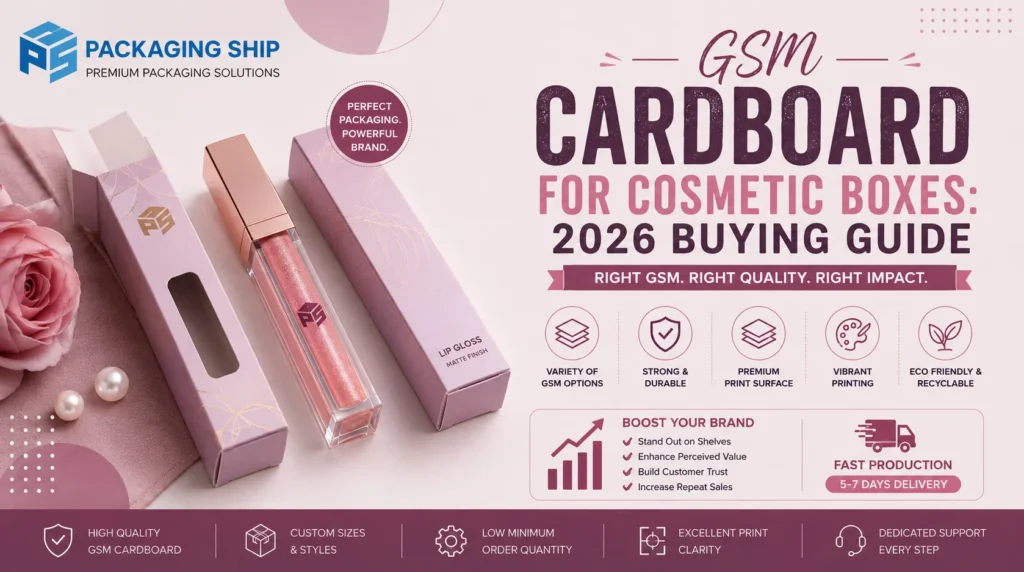
What GSM Cardboard Cosmetic Boxes Do You Need in 2026? TL;DR Cosmetic packaging tends to sit between 300 and 400 GSM, or 14pt to 18pt if you’re used to US terms. Light products need less, heavy glass and jars need more, and rigid boxes are a different category entirely, often starting near 1000 GSM. If your last order arrived feeling thin or bent too easily, there’s a good chance you ordered under the range your product actually called for. This guide walks through that decision by product type, so the next order is right the first time. Table of Contents Most cosmetic brands land somewhere between 300 and 400 GSM, which works out to roughly 14pt to 18pt. Lip balm and other light products can get away with 250 to 300 GSM. Glass perfume bottles need more, usually 350 GSM and up. The right number depends on what the product weighs, how it sits on a shelf, and how far it has to travel before it gets there. Why Your Boxes Might Feel Flimsy A box shows up. It feels cheap the second you pick it up. Corners already bent in the mailer, lid won’t sit flat, and now you’re wondering if the vendor cut corners somewhere. Most of the time they didn’t. Nobody asked what weight to specify, so the order defaulted to whatever was cheapest. This trips up more first time buyers than you’d think. Paperboard weight gets measured two ways: GSM, which is grams per square meter, or points, the thickness measurement US suppliers tend to use. Skip that number entirely and you’ve handed over control of how the box feels, prints, and survives shipping. Once the scale behind GSM cardboard cosmetic boxes actually makes sense, the guesswork disappears, and that’s really what this guide is for. Packaging Ship, a custom packaging manufacturer working with brands across the country, built this guide around the questions buyers actually ask before they order. GSM vs PT, What These Numbers Actually Mean GSM is a weight measurement, plain and simple. Weigh a square meter of board, and whatever that number comes out to in grams is your GSM. Higher number, heavier and denser sheet. PT works differently. It measures thickness, not weight, and one point is one thousandth of an inch. Here’s where things get messy. US suppliers usually quote in points. Paper mills overseas quote in GSM. Put those two together and you get brands comparing quotes that aren’t actually speaking the same language. Whether you’re looking at folding cartons or heavier cardboard boxes, this mismatch is where most quote confusion starts. GSM Cardboard Cosmetic Boxes Conversion Reference Roughly speaking, 300 GSM lines up with 14pt, and 400 GSM lines up with 18pt. These aren’t perfect conversions since density shifts by mill and coating, but they’re close enough to build a spec around. If a supplier only gives you one unit, just ask for the other. Takes ten seconds, and it clears up almost every bit of confusion before it costs you an order. 14pt vs 18pt Cardboard, Which One Fits Your Product This is the comparison that actually matters for most cosmetic brands. 14pt, sitting close to 300 GSM, handles lightweight items and secondary packaging well, anything that isn’t carrying much weight on its own. It folds clean, prints sharp, and keeps shipping costs reasonable. 18pt runs closer to 350 to 400 GSM, and it’s the better call once your product has real heft, you’re working with magnetic closures, or the box needs to survive a retail shelf without softening at the corners over time. Foil stamping and embossing also hold up noticeably better on the heavier stock, which matters if finishing is part of how your brand shows up. Not sure which side your product falls on? Order samples of both before committing to a full run. That small delay costs you almost nothing next to what a bad 5,000 unit order costs once it’s already printed. GSM Cardboard Cosmetic Boxes by Product Type Cardboard weight for beauty boxes isn’t one size fits all, and treating every SKU the same is usually where the ordering mistakes start. The table below is a fast reference before you get into the details on each category. Product Type Recommended GSM PT Equivalent Why Lip balm, small beauty items 250 to 300 GSM 12pt to 14pt Light product, box just needs to hold its fold Perfume, glass bottles 350 GSM and up 16pt to 18pt+ Glass is unforgiving if it shifts in transit Skincare jars, cream tubs, pumps 350 to 400 GSM 16pt to 18pt Needs to support weight and a premium feel Eyelash packaging Lighter to mid GSM 14pt to 16pt Priority is shelf presence, not load bearing GSM for Lip Balm & Small Beauty Items Custom lip balm boxes and other small items do fine at 250 to 300 GSM. Light product, so the box isn’t fighting gravity. It just needs to print cleanly and hold its fold. GSM for Perfume & Glass Bottle Packaging Perfume and glass bottles need more backup. Glass shifts during shipping and doesn’t forgive much when it does, so 350 GSM and up is the safer range here, especially paired with custom perfume boxes that include inserts to keep the bottle from moving around in transit. Skincare jars and heavier items, cream tubs, pumps, that sort of thing, generally sit in that same 350 to 400 GSM window too, sometimes stepping up into rigid stock when a brand wants that heavier unboxing feel. GSM for Eyelash Packaging Eyelash packaging has different weight needs than perfume or skincare boxes. The product is light, but the packaging still has to hold shape on a retail shelf and support a display window or magnetic closure. Most eyelash brands land in the lighter to mid GSM range rather than heavy rigid board, since the priority is shelf presence and print detail, not load bearing strength. If you want a full breakdown of weight, structure, and finishing options
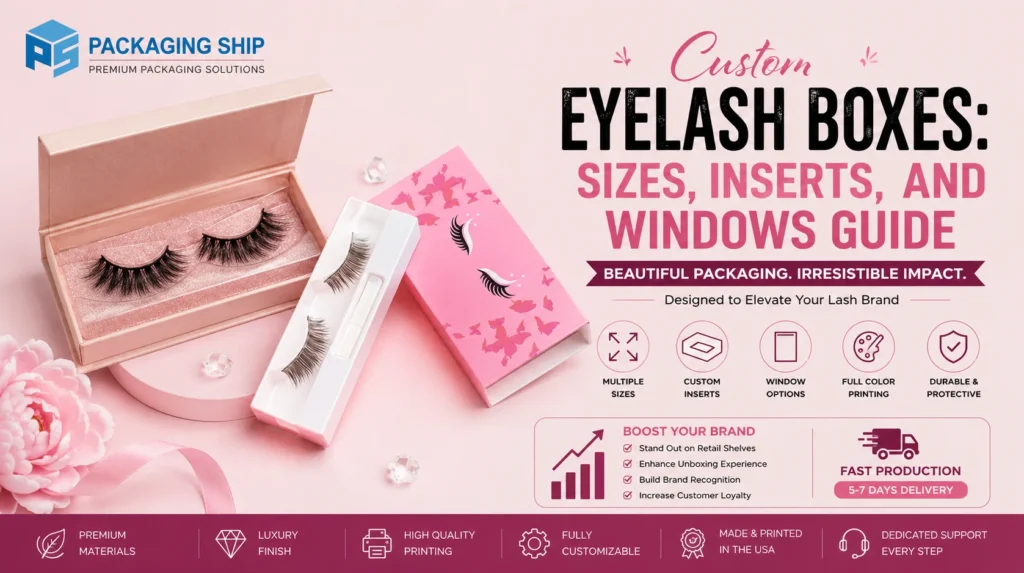
Custom Eyelash Boxes: Sizes, Inserts, and Window Options Explained TLDR Custom eyelash boxes come down to three decisions. Size has to match your actual lash tray or multi pack, not a generic template. Insert material, PVC, foam, or cardstock, decides whether lashes stay put during shipping or shift and crush. Window style, clear lid, die cut, or magnetic lash box, controls shelf appeal and how exposed the product is to handling. Get all three right and a lash box protects the product and sells it at once. Custom eyelash boxes wholesale no die charge USA orders typically start small, priced by size, material, and finish. Table of Contents A lash brand founder emailed the Packaging Ship team last spring with a photo of a crushed lash tray. The box looked fine outside. Inside, a flat insert had let the tray slide the whole way to Texas, and the curl on every strip in that shipment was flattened against the window. Nothing about the box itself was wrong, the insert just wasn’t specced for that tray. This guide walks through sizes, inserts, and window styles so that mistake doesn’t happen to your next order. What Is the Right Custom Eyelash Box Size and Insert in 2026? Here’s the short version. Custom eyelash boxes are built around three choices working together, not separately. Size has to match your lash tray exactly. Insert material decides whether lashes shift in transit. Window style decides how much of the product shows without exposing it to damage. Skip any one and the box looks fine in a photo but fails somewhere between your warehouse and the customer’s mailbox. What Goes Into a Custom Eyelash Box Strip away the branding and a lash box is really three parts working together, the outer box, the insert, and whatever window or closure sits on top. Most lash brands spend all their attention on the outside, color, logo, finish, and almost none on the insert underneath. That’s backwards, since the insert is what actually keeps the product intact. A lash box that looks great in a mockup can still fail if the insert doesn’t match the tray dimensions. Lashes are light but fragile at the curl, and a flat or too shallow insert lets the tray slide during shipping. That slide crushes the curl against the window or the box wall, the single most common complaint we hear from lash brands who switched suppliers. Curious what else falls under this category? Our cosmetic boxes page covers the full lineup, including boxes for mascara, eyeliner, and other eye makeup products that often ship alongside lashes. Eyelash Box Sizes: Matching the Box to Your Lash Style Size sounds simple until you’re packaging three lash formats under one brand. A single strip box, a multi pair box, and a full lash kit all need different dimensions, and using one template across all three is where sizing mistakes start. Box Type Typical Size Range Best For Single Strip Box 3.5 x 1 x 1 inch Individual lash pairs Multi Pack Box 4.5 x 3 x 1.25 inch 3 to 5 pair sets Lash Kit Box 6 x 4 x 1.5 inch Lashes plus applicator or glue Subscription Box 5 x 5 x 2 inch Monthly lash bundles Measure your actual tray, not the lash strip, since the tray dictates the insert cavity and the box interior. A box too large lets the tray shift even with a good insert. Too small, and the lid won’t close cleanly over the curl. Lash Box Inserts Explained: PVC, Foam, and Cardstock The insert is doing more work than any other part of the box, and it’s also the part brands spec incorrectly most often. Three materials cover almost every lash box with inserts on the market. PVC inserts are clear or tinted plastic trays, cut to the exact shape of the lash tray. They’re rigid, so once a tray is seated it doesn’t move, and they’re the standard choice for brands wanting a display quality presentation with real protection. Foam inserts cushion the tray rather than locking it into a fixed shape. They work well for kits with multiple items, glue, applicator, lashes, since foam can be cut with cavities for each piece. Foam adds more shipping protection against drops and impact than PVC, at the cost of a slightly bulkier build. Cardstock inserts are the budget option, folded rather than molded, holding a tray in place well enough for light, single strip products. They’re not the right call for anything heavier or for multi pair kits, since folded cardstock resists sliding far less than a molded insert under vibration during transit. Whichever material you choose, the fix for the most common insert failure is simple: send exact tray dimensions in writing before the die line is cut, not after a damaged batch shows up. Window Options: Clear Lid, Die Cut, and Magnetic Lash Boxes A window does one job well and one job poorly at once. It shows the product, and it also exposes that product to more handling risk than a fully enclosed box. A clear lid lash box uses a full transparent top, rigid plastic or PET film, so the entire lash tray is visible at once. This works best paired with a PVC insert, since the tray needs to stay perfectly still under a fully exposed lid. A die cut eyelash packaging window box cuts a smaller shaped opening, a logo, an eye outline, a simple oval, into the box itself, usually backed with a thin film for protection. This gives partial visibility with more structural coverage than a full clear lid, which matters if your product ships loose in mailers rather than protected cartons. A magnetic lash box replaces a tuck flap with a magnetic closure, a popular upgrade for brands positioned above entry level pricing. The false eyelash market keeps growing steadily through the early 2030s according to Grand View Research, and magnetic closures are one of the fastest growing
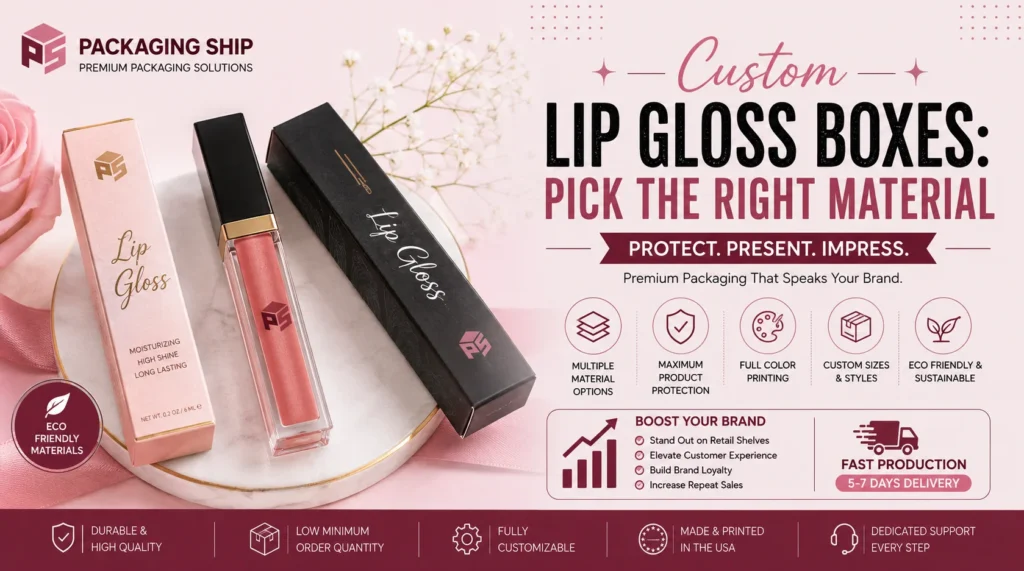
Custom Lip Gloss Boxes: How to Choose the Right Material for Your Formula TL;DR: Custom lip gloss boxes only work if the material matches your formula. Oily, shimmer heavy glosses need rigid or corrugated boards with a snug insert. Lighter, low viscosity formulas can ship safely in standard cardboard. Get the material wrong and you get melted gloss, warped boxes, and rejected retail orders. This guide breaks down each material, when to use it, and how to avoid the mistakes that cost small beauty brands their first wholesale run. Table of Contents What Is the Right Packaging Material for Lip Gloss in 2026? The right material depends on your formula, not your budget alone. Oil heavy or shimmer loaded lip gloss needs rigid board or corrugated stock, because thinner material transfers heat and lets tubes shift in transit. Lighter, low oil formulas can use standard folding cardboard safely. Most brands only learn this after their first bad batch arrives. Why Lip Gloss Packaging Fails Before It Reaches the Customer Picture this. A small beauty brand ships its first wholesale order of 300 units in July. The boxes look great in the mockup. Three days later, a retail buyer opens the case and finds gloss pooled in the corner of a thin kraft box. The tube cracked, the adhesive softened, and half the order had to be replaced out of pocket. This happens more often than most founders expect, and it is rarely a manufacturing defect. It is a material mismatch. Lip gloss is not lipstick. It has oil, wax, and often glitter or shimmer suspended in a semi liquid base, and that base reacts to heat, movement, and pressure in ways a solid bullet product never will. A box built for a lipstick tube will not automatically protect a lip gloss wand. Packaging Ship builds custom lip gloss boxes every week for brands at exactly this stage, and the pattern is consistent. The orders that come back for reprints are almost always tied to one root cause: the wrong board weight or structure for the formula inside. The Main Materials Used for Custom Lip Gloss Boxes There are four materials that cover nearly every lip gloss packaging need. Each one solves a different problem. 1- Rigid boxes. Thick, dense board, usually 2mm or heavier, wrapped in printed paper. Rigid boxes hold their shape under pressure and resist heat transfer far better than folding cartons. This makes them the top choice for oil heavy or shimmer loaded formulas, and for any brand shipping through summer heat. 2. Cardboard folding cartons. Lightweight, typically 14pt to 18pt stock, and the most common choice across the industry. Cardboard works well for standard, low viscosity gloss in a single wand tube, especially for high volume runs where cost per unit matters more than heat resistance. 3. Kraft paperboard. A natural, uncoated stock often chosen for clean beauty and eco positioning. Kraft looks great and photographs well, but it needs a grease resistant liner if the formula is oil heavy, or oil can bleed through the outer surface over time. 4. Corrugated board. Fluted, multi layer construction built for strength. Corrugated is the right call for shipping boxes and bulk wholesale cases, not usually for the retail facing display box itself. If you want to see the full range of styles built on these materials, Packaging Ship’s custom lip gloss boxes come in all four options, sized and printed to your formula. Matching Material to Your Formula This is the step most guides skip, and it is the one that actually prevents returns. A simple rule to remember: heavier formula, sturdier board. Lighter formula, standard board is fine. Skipping this step is the single biggest reason brands order the wrong material for their formula weight. Small Cosmetic Box Sizing and Fit A small cosmetic box that fits loosely is almost as risky as the wrong material. Extra space inside the box lets the tube move during transit, and repeated movement is what cracks caps and loosens seals. Measure your tube at its widest point, including the cap, and size the box with no more than a few millimeters of clearance on each side. A snug fit does more to prevent damage than upgrading to a thicker board. Should Your Box Have a Window? Yes, in most cases. A window lip gloss box lets retail buyers and online shoppers see the actual shade before they commit, which reduces returns from color mismatch and speeds up impulse purchases at checkout counters. The tradeoff is that a window creates a small opening for air and moisture, so pair it with a liner or insert on any formula that is sensitive to oxidation. Do You Need a Lip Gloss Insert? If you are shipping more than one unit per box, yes. A lip gloss insert holds each tube upright and stops it from sliding into the corners of the box, which is exactly where most transit damage happens. Inserts also protect against scuffing on printed surfaces, which matters if your packaging is part of an unboxing experience customers photograph and share. Display Boxes vs Shipping Boxes These are not the same product, even though brands often ask for one when they mean the other. A display lip gloss box is built for the retail counter or shelf, usually with a window and premium finish, meant to be seen by the end customer. A shipping box is the outer case that protects multiple units in transit and is rarely printed with retail grade finishes. Most wholesale orders need both, a display box for the customer and a corrugated shipping case around a set of them. What Custom Lip Gloss Boxes Cost Pricing depends on material, print complexity, and quantity, but the bigger issue for most small brands is minimum order size. Many manufacturers require 1,000 units or more before they will even quote a custom box. Packaging Ship offers lip gloss boxes wholesale USA no minimum, starting from 50 units,
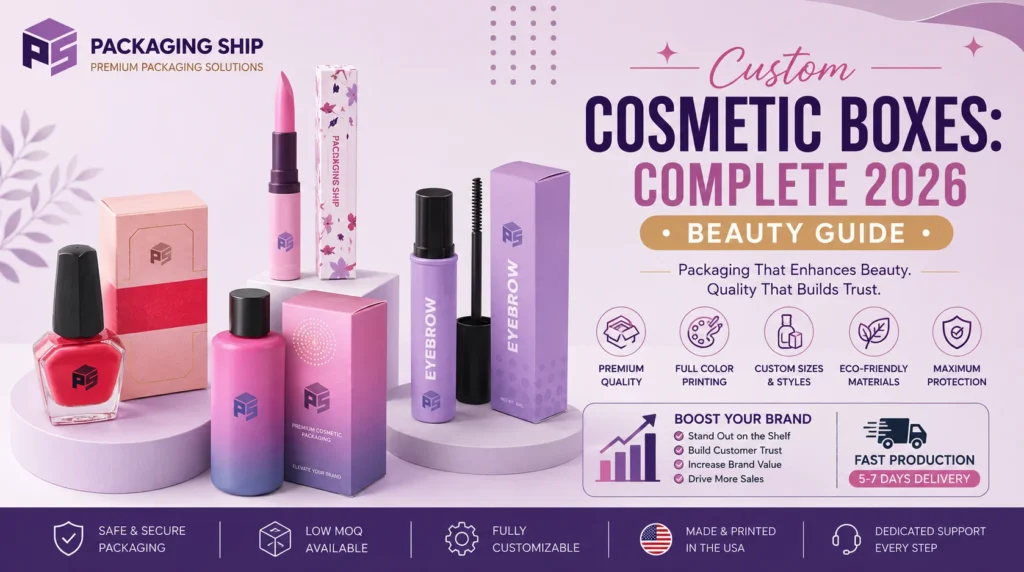
Custom Cosmetic Boxes: The Complete 2026 Guide for Beauty Brands TLDR Your box is doing more selling than you probably give it credit for. Customers form an opinion about quality before they’ve even opened the product, based on what’s holding it. This guide walks through materials, GSM, the soft touch versus gloss decision, real pricing, and how to order without getting stuck in a big minimum. If you’re short on time, skip straight to the finish comparison section. That’s usually where the real answer is hiding for most beauty founders wondering why their packaging feels a little off. Table of Contents What Counts as Custom Cosmetic Boxes Right Now Custom cosmetic boxes are packaging printed and sized to fit a specific beauty product, rather than pulled off a generic shelf template. Most brands in 2026 are ordering them in cardboard, kraft, or rigid board, printed with their own logo and colors, then finished with a coating like matte or gloss. Packaging Ship has built its whole production process around this kind of order, small brand, tight timeline, no design team in house. Beyond looking good, the box also has a job during shipping. It has to keep the product from shifting, cracking, or scuffing before it ever reaches a customer’s hands. Why Your Skincare Might Look Generic, Even If It Isn’t Picture this. You pull your product off the shelf next to a competitor’s. Your formula might genuinely be better. Your ingredients might cost more to source. But your box feels a little thin, the print looks slightly dull, and theirs has this soft matte texture with a foil logo that catches the light when you tilt it. Before either box is even opened, the customer has already made a call about which one is worth more. That’s not vanity talking. It’s closer to math. A national study by the Paper and Packaging Board, run with Ipsos, found that 72% of consumers say packaging design shapes their purchase decisions, and 67% say the same about the materials a product is packaged in. Separately, Dotcom Distribution’s consumer packaging research found that when shoppers receive premium packaging, a meaningful share of them get more excited about opening it and start seeing the brand as more upscale on the spot. Your formula never really gets a fair shot if the box already told the customer to expect less from it. Here’s the part that should be reassuring. Fixing this almost never means starting your brand over. Nine times out of ten it comes down to one or two things, usually the board thickness, the finish, or how sharp the print actually is. We’ll get into all three below. See what a properly specced box would cost for your product → Cosmetic Packaging Materials: 14pt vs 24pt Cardboard Board thickness gets measured in points, shortened to pt, and one point is one thousandth of an inch. It’s a small detail that a lot of first time founders skip past on a quote sheet, but it’s honestly one of the biggest factors in how sturdy your box feels once it’s actually in someone’s hand. Squeeze your own box gently. If it flexes and your product still feels premium in your hand, that gap between the two is usually the whole problem right there. Moving from 14pt up to 24pt on a serum or moisturizer line is one of the cheapest ways to close that gap, and it doesn’t require touching your formula, your label copy, or anything else. GSM Cardboard Cosmetic Boxes, and What Those Numbers Are Really Telling You GSM stands for grams per square meter. It’s measuring how dense the paper is, not how thick it is, which trips people up because pt and GSM get used interchangeably in casual supplier conversations more often than they should. In practice, anything under 300 GSM starts to feel flimsy once your retail price crosses roughly $15. If you’re aiming for a premium shelf presence, 350 to 400 GSM is a more realistic floor to work from, and this applies whether you’re boxing a jar of cream or something as small as a bottle of nail polish. Go higher than that and you’re really talking about rigid board territory, which gets measured by calipers instead of GSM, a whole separate spec again. The practical takeaway is simple. When you request a quote, ask for both numbers, pt and GSM. If a supplier just tells you it’s “premium cardboard” without giving you either figure, you have no real way to compare that quote against anyone else’s. Soft Touch vs Gloss Cosmetic Box: Which One Fits Your Brand Of everything covered in this guide, this is the decision that swings perceived value the most, and it’s also the one brands tend to get wrong most often. Soft touch lamination, sometimes called matte or velvet lamination, has a light texture to it and doesn’t reflect much light. That’s actually what makes it read as expensive under store lighting, since it absorbs light instead of throwing it back at the customer. It also holds up much better against fingerprints than gloss does. Most skincare, serum, and clean beauty brands lean on this finish when they want to come across as clinical and considered, and it’s a common pick for mascara boxes too, where a fingerprint smudge right on the box looks worse than almost anywhere else. Gloss lamination works the opposite way. It reflects light and makes printed colors look more saturated, more alive. For color cosmetics, think lip gloss, eyeshadow palettes, anything with a bold seasonal drop, gloss tends to be the stronger pick because the whole point is grabbing attention through color. Neither one wins outright. What actually goes wrong is brands picking the trendy option instead of the one that fits their product. Put a bright, playful lip gloss line in matte and it can end up looking flat and lifeless. Put a clean, minimalist skincare line in heavy gloss and it can start to look
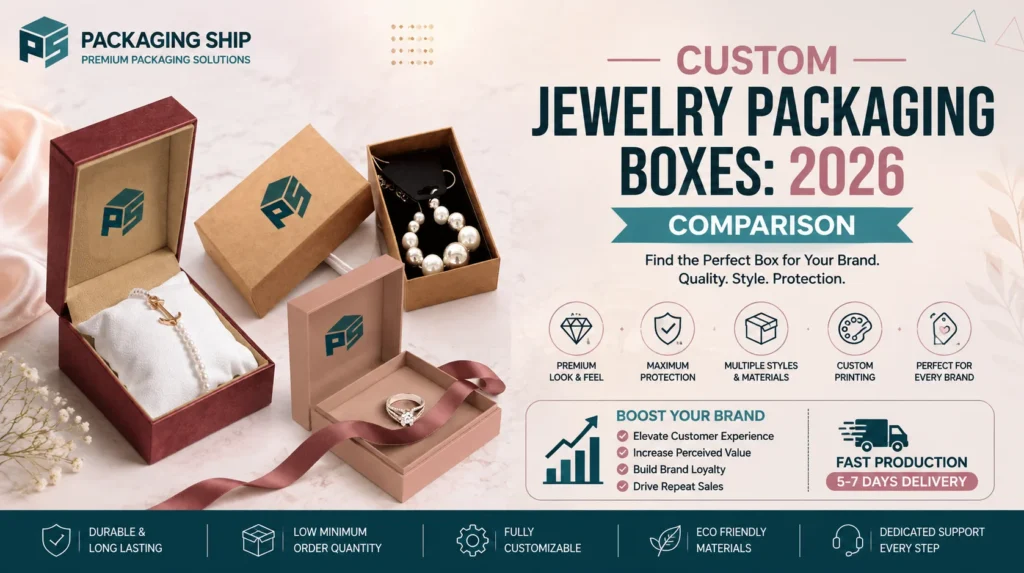
Custom Jewelry Packaging Boxes: Rigid Boxes, Pillow Boxes, and Display Cases Compared TL;DR There are three real options when you’re picking custom jewelry packaging boxes: rigid, pillow, or a display case. Rigid wins on protection and feels expensive the second someone picks it up. Pillow boxes cost less and suit light pieces like studs or thin chains. Display cases aren’t for shipping at all, they’re for counters and shows. Pick based on your average order value and what you’re actually shipping, not on which one looks nicest in a catalog photo. And you don’t need to order thousands of units just to find out, most suppliers will now do 50. Table of Contents What Are Custom Jewelry Packaging Boxes in 2026? A custom jewelry packaging box is a branded container built to hold and protect small pieces, rings, chains, earrings, whatever you sell, while they’re shipped, gifted, or sat on a shelf. Most are made from rigid chipboard, kraft paper, or corrugated stock, and nearly all of them include some kind of soft insert so the piece doesn’t slide around. That’s the functional part. The other part, the one people underestimate, is what the box tells the customer about the product before they’ve even touched it. The Real Reason Packaging Loses Repeat Customers Say you sell a $65 ring. It ships in a plain poly bag, no insert, nothing holding it in place. The ring itself is fine. But the person opening it feels a little cheated, even if they can’t quite say why. That gap between what they paid and what arrived is where a lot of jewelry brands quietly lose repeat business. It’s rarely one problem. Packaging that doesn’t match the price is the obvious one. But there’s also the damage angle, a chain with no insert tangles or scratches in transit more often than people expect, and that turns into returns and refunds nobody budgeted for. Then there’s the piece brands forget entirely: plain packaging gets thrown in the trash. Branded packaging gets photographed and shared, or at least kept in a drawer instead of the recycling bin. That’s free marketing you’re leaving on the table if the box isn’t worth keeping. Shoppers notice packaging more than most founders assume. An Ipsos survey on packaging’s influence on purchase decisions found that most Americans say a product’s packaging design shapes how they judge that product, often before they’ve used it at all. Small jewelry brands who upgrade their boxes tend to do it the moment they can afford to, and that’s usually not a coincidence. Rigid, Pillow, or Display Case: What Each One Is Actually For Jewelry brands are usually choosing between three formats. None of them is the “correct” one, they solve different problems. For a fuller breakdown of formats and finishes, our guide on what types of jewelry packaging exist covers more ground than we can here. A rigid box for jewelry is built from a thick board, around 2mm, dense enough that the box holds its shape no matter how it’s handled. Pick one up and it feels heavy in a way that a folding carton never does. That weight is doing work. It’s telling the customer, before the lid even lifts, that whatever’s inside cost something. Custom pillow boxes go the other direction. Lighter cardboard, curved shape, tuck closure, and a much lower price and shipping weight. For a pair of stud earrings or a delicate chain, a rigid box is honestly overkill, and a pillow box still looks intentional without the extra cost. Display cases are a different animal altogether. They’re built for a counter, a trade show table, a pop-up, somewhere the box gets opened and closed all day long and needs to keep looking good doing it. Most have a window or an open face so a shopper can see the piece without picking it up first. If you’re only shipping direct to customers, you probably don’t need one of these at all. Rigid Box vs Pillow Box for Jewelry Brand USA This is the decision most brands actually get stuck on, so here’s a straightforward way to look at it. Factor Choose Rigid Box Choose Pillow Box Average order value Above $40 to $50 Under $30 Product type Real metal, gemstones, fine jewelry Light pieces: studs, thin chains, charms Buying occasion Gifting, direct-to-customer premium unboxing Everyday purchase, no gifting expectation Order volume Lower to mid volume, quality over quantity Higher volume, shipping weight matters Cost per unit $0.50 to $1.20, depending on size and finish Lower cost, less material used Shipping weight Heavier, adds to freight cost Lighter, cuts shipping cost Perceived value Strongest, signals quality before the lid opens Still branded and deliberate, just lighter touch Does a Ring Box Need to Be Different From a Necklace Box? Yes, and brands trip over this more than you’d think. A ring box needs a slot that holds the band in a fixed spot, otherwise it shifts and scratches during shipping. A necklace needs room to lay flat, usually with a card backing or a hook so the chain doesn’t knot itself into a mess. Trying to use one generic box for both usually ends in complaints about tangled chains or rings rattling around in too much empty space. If rings are your main product, look at a dedicated slot insert. If it’s necklaces or pendants, a wider tray or card-backed setup works better. Matching the insert to the product, instead of forcing one box to handle everything, cuts down on damage complaints more than almost anything else you could do. Custom Jewelry Boxes Wholesale: What It Costs, and Ordering Small Custom jewelry boxes wholesale used to mean committing to 1,000 units or more before a manufacturer would even talk about custom printing. That’s not really true anymore. A growing number of suppliers, Packaging Ship included, now offer custom jewelry boxes wholesale USA no minimum, which means you can start at 50 units instead of guessing your way into a
Custom Packaging Boxes Wholesale USA 2026: Your Complete Buyer’s Guide TL;DR Custom packaging boxes wholesale USA 2026 buyers want one thing above all else, a supplier who won’t waste their time or money. This guide breaks down real pricing, US versus overseas risk, a seven point vetting checklist, and what “no minimum order” actually means in practice. You’ll walk away knowing exactly what to ask a supplier before you send a single dollar. Table of Contents What Is Custom Packaging Boxes Wholesale USA 2026? Custom packaging boxes wholesale USA 2026 refers to branded, made to order boxes produced by domestic manufacturers at bulk friendly pricing, usually without the high minimum order quantities that large factories once required. In plain terms, it means you can order 50 boxes or 5,000 boxes from the same US supplier, at the same transparent price per unit, without waiting six weeks for a container ship. That shift matters because the packaging industry has quietly changed shape. A few years ago, custom boxes belonged to brands that could commit to 1,000 or 2,000 units upfront. Now, a solo founder testing a new skincare line can order a short run, see how customers react, and reorder within days. That flexibility is the real story behind this keyword, not the boxes themselves. Why Your Supplier Choice Costs More Than You Think Picture this. A Texas bakery owner books a wholesale packaging order six weeks before a farmers market season opener. The supplier quotes a six week lead time. Then a customs hold adds three more weeks. The season opens with no boxes, no branding, and a scramble to buy plain kraft mailers from a local print shop at triple the price. This isn’t rare. It’s the most common complaint founders share about custom packaging boxes wholesale, right after price. Three mistakes cause most of the damage. A “6 week lead time” from an overseas factory often does not include ocean freight, customs clearance, or last mile delivery. Ask whether the quoted timeline covers production only or door to door delivery. If a supplier requires 1,000 units minimum and you have not sold a single unit yet, you are carrying inventory risk that has nothing to do with packaging. Sustainability claims are easy to print and hard to verify. Ask for the certification name, not just the label. US Based vs Overseas Manufacturers, What Actually Changes Here’s the honest comparison, without the marketing spin. A US packaging supplier comparison should look at more than sticker price, since hidden time and communication costs often decide the real winner. Factor US Based Manufacturer Overseas Manufacturer Standard production time 7 to 10 business days after proof approval 3 to 6 weeks, production only Shipping 2 to 5 days via FedEx or UPS ground Ocean or air freight, plus customs clearance Communication turnaround Same business day, same time zone 12 to 16 hour gap, 2 to 3 days per revision Minimum order flexibility Often as low as 50 units Frequently 1,000 units or more Quality control visibility Direct factory audits, reprint guarantees Harder to verify without a site visit Best fit for Fast launches, testing demand, reorders Very large, long lead time bulk orders None of this means overseas manufacturing is always the wrong call. Large, established brands ordering tens of thousands of units on a long planning horizon sometimes benefit from overseas per unit pricing. But for a small or growing brand that needs to move fast and fix mistakes quickly, a wholesale custom box supplier USA based operation removes a lot of that risk from day one. Quality control deserves more than a slogan too. A real domestic manufacturer should describe their process step by step. At Packaging Ship, quality checks run through paper stock verification, ink color calibration against your approved proof, die cut dimensional accuracy, and a final packing audit before anything ships. That’s what “US based quality control” should actually mean, not just a location on a map. How to Vet a Wholesale Packaging Supplier Use this checklist on any supplier you’re considering, including ones that are not Packaging Ship. A supplier who welcomes this kind of scrutiny is usually a good sign. This is also where wholesale packaging suppliers with no minimum claims deserve a second look. Ask directly, “what is your smallest possible order,” and get a number, not a marketing phrase. How to Choose the Best Custom Packaging Boxes Wholesale USA 2026 Supplier Pricing usually decides things once trust is established, so let’s talk real numbers. Custom boxes wholesale generally start around $0.20 to $0.60 per unit, depending on box size, material, print complexity, and quantity. Two production methods drive that range. Digital printing suits orders between 50 and 500 units, since it needs no printing plates and produces finished boxes faster, which makes it ideal for a first product launch. Offset printing becomes more cost effective above roughly 500 units, because the plates that make offset slower to set up also deliver sharper Pantone color matching and a lower per unit price at higher volume. Watch for two charges that inflate quotes without adding value. Die charges, often $200 to $800, and plate charges, often $150 to $500, are standard at many large manufacturers. A genuine custom boxes wholesale with free shipping and no minimum order model should fold these into the unit price instead of adding them after you’ve already committed. Real data backs up why this spending matters in the first place. A national study conducted by the Paper and Packaging Board and Ipsos found that 72 percent of consumers say packaging design influences their purchase decisions, and 67 percent say the same about the material a product is packaged in, according to Ipsos survey research. A more recent academic review published in Humanities and Social Sciences Communications confirmed this pattern across 221 peer reviewed studies, noting that packaging design remains one of the most consistently documented influences on purchase intent, according to research published in Nature’s Humanities and Social Sciences
Custom Subscription Box Packaging Design: How to Build Boxes That Get Opened on Camera in 2026 TLDRA plain box gets tossed in a closet. A well built one gets filmed, shared, and remembered. This guide walks through custom subscription box packaging design for 2026, covering structure, materials, pricing, and the small choices that make a subscriber press record. You will also find real research, verified sources, and a simple checklist for your next print run. Table of Contents I have spent a good part of my career sitting near print floors, talking to founders about their packaging, and reading the reviews their customers leave. One thing keeps repeating. Founders pour weeks into the product sitting inside the box and almost no time into the three seconds before the lid comes off. This piece exists to close that gap, using real data instead of guesswork, drawn from what we see building boxes every day at Packaging Ship. What Is Custom Subscription Box Packaging Design in 2026 Custom subscription box packaging design is the process of building a mailer box, insert, and print layout specifically for a recurring monthly shipment, not a single one time sale. It covers the box structure, the interior print, the unwrapping sequence, and the small branded touches a subscriber notices before they even reach the product. Good design protects the item and turns a routine delivery into a moment worth sharing. Subscription mailer box design sits at the intersection of two goals that often pull against each other. The box has to survive a monthly shipping cycle without denting or crushing. It also has to feel special enough that a subscriber wants to open it on camera instead of tossing it aside. Balancing those two goals, cost and drama, structure and surprise, is really the whole job. A Quick Custom Subscription Box Packaging Design Checklist Before ordering anything, run your box idea through five questions. Does it survive a shipping cycle without crushing corners? Does the exterior give someone a reason to pause before opening it. Does the interior have at least one printed surface? Does an insert give a viewer something to read. Does the price per unit still work at your subscriber count? Answer yes to most, and your design is camera ready. Why the First Box Decides If a Subscriber Stays Subscription commerce runs on a metric many founders do not watch closely enough, monthly churn. Industry benchmarking from subscription commerce researchers shows discovery style boxes, the beauty, snack, and lifestyle categories, tend to see monthly cancellation rates well above replenishment subscriptions like coffee or supplements, often landing in the ten to fifteen percent range. A large share of that churn happens inside the first ninety days, right after the very first box lands on a doorstep. That first box is not just a delivery. It works more like an audition. A national study conducted by the Paper and Packaging Board and Ipsos found that 72 percent of consumers say packaging design influences their purchasing decisions, and 67 percent say the packaging material matters just as much. Those numbers were not built around subscription boxes specifically, but the behavior applies directly. If a box feels flat or generic, a subscriber quietly starts drafting a cancellation. If it feels considered, they tell a friend, snap a photo, or simply renew. This is exactly why subscription box packaging design should never be treated as a decoration layer added at the end. It sits right next to your onboarding email and first product experience as genuine retention infrastructure. What Makes an Unboxing Worth Filming Unboxing content stopped being a niche hobby years ago. A peer reviewed study published in the Journal of Marketing Analytics found that viewers watch unboxing videos for information seeking, entertainment, and social connection, and that these motives meaningfully shape purchase intent and word of mouth sharing. People are not only watching for fun. They are quietly deciding whether to trust a brand based on how its box behaves on camera. A few details separate a filmable unboxing from a forgettable one. The exterior needs a reason to make someone pause before opening it. A branded mailer, a wax seal sticker, or a simple ribbon signals that something is about to happen. The interior needs layers rather than one flat glance. Tissue paper, then a printed insert, then the product itself, gives a viewer three small reveals instead of one moment. A plain brown interior reads as an afterthought, while a printed interior, even in one color, reads as intentional. None of this demands a huge budget. It mostly demands sequence, restraint, and a willingness to think about the box the way a viewer’s camera will. How to Design a Subscription Box That Gets Unboxed on YouTube Here is a simple four step method we walk new subscription clients through. This four step approach to custom subscription box packaging design works whether a brand ships fifty boxes a month from a spare room or ten thousand boxes from a full warehouse. Materials That Hold Up in a Monthly Ship Cycle Material choice affects both durability and how a box performs on video. Rigid boxes suit beauty, jewelry, and higher ticket subscriptions where the unboxing should feel like receiving a gift. Mailer boxes, usually built from sturdy corrugated or cardboard stock, suit most general subscription categories and survive repeated monthly shipping without dented corners or soft spots. Kraft paper bags work well for lightweight, low item count boxes and lean into a natural look that appeals to environmentally minded subscribers. Box Style Best For Relative Cost Camera Presence Rigid Box Beauty, jewelry, premium tiers Highest Excellent, feels like a gift Mailer Box General monthly subscriptions Moderate Strong with a printed interior Kraft Paper Bag Lightweight, low item count boxes Lowest Natural, eco leaning look Brands comparing custom mailer boxes wholesale against rigid box pricing usually land on the same conclusion. Mailer boxes give most new subscription brands the strongest balance of cost, durability, and
Why Etsy Sellers Are Rethinking Packaging in 2026 TLDR: You don’t need a big budget to brand your Etsy shop with custom packaging in 2026. Kraft boxes, mailer boxes, and small batch printing now come with low per unit prices and no minimum order requirement. Below: real pricing, low cost branding ideas, and a few ways to make your packaging feel as good as a big brand’s without their budget. Table of Contents I put this together after fielding the same question from a handful of Etsy sellers I know, all of them stuck at the same point. They loved their product, hated their packaging, and assumed fixing it meant spending money they didn’t have yet. That’s usually not true. Most of what follows came from actually calling small printers and asking what fifty boxes would cost, not from guessing. How to Brand Your Shop Without Spending a Fortune If you sell handmade goods online, you know the feeling. A package from a big brand shows up looking like a gift. Then you glance at your own poly mailer and wonder if the customer even notices the difference. Getting custom packaging in 2026 doesn’t mean trying to spend like a big brand. It means spending in the right places, for a shop that’s usually just you, a workbench, and a stack of orders waiting to go out tonight. What Does Custom Packaging Actually Mean Here? For most Etsy sellers, it’s boxes, mailers, or bags printed with your logo and colors, ordered in small batches instead of factory sized runs. You can now order fifty units instead of five thousand, pay per piece instead of covering a setup fee, and end up with something that looks professional without eating your margin. If you want a look at what real small batch pricing looks like, this breakdown of custom kraft boxes wholesale pricing in the USA is a good place to start. Why Packaging Carries More Weight for Etsy Shops People don’t shop Etsy the way they shop Amazon. They’re already expecting something personal, made by an actual person, not pulled off a warehouse shelf. A 2018 study from the Paper and Packaging Board, run with Ipsos, found that packaging design has a real influence on how shoppers feel about what they bought, and that the material itself changes their impression of the product. (You can look up the full Ipsos numbers if you want the details.) For a handmade shop, a plain poly mailer can undo weeks of work you put into your photos and your listing copy. Etsy had roughly 5.6 million active sellers as of early 2026, according to figures tracked by Marketplace Pulse, and most of those are one person operations running out of a spare room or garage. With that many shops chasing the same buyers, packaging is one of the few edges you get without spending on ads. That’s a big part of why it’s stopped being a “nice to have” and started feeling closer to standard, even for shops shipping a couple dozen orders a month. Why It Always Felt Too Expensive Most sellers don’t skip custom packaging because they don’t like it. They skip it because the first quote they got came from a large industrial printer asking for a run of one thousand or five thousand units before they’d even discuss price. That kind of minimum doesn’t make sense if you’re shipping forty candles a month. Smaller printers running digital presses instead of metal plates have changed that, with runs starting around fifty units in some cases. Look specifically for suppliers who advertise no minimum order. That’s the detail that actually matters, since it’s the difference between packaging you can use and inventory you’re stuck storing. Printers offering this usually skip the die and plate charges too, which was often where the real cost was hiding in the first place, not in the box itself. On price: a basic kraft mailer with one color of logo typically runs fifty to ninety cents a unit at low volume. On a thirty dollar item, that’s under three percent of the sale price, often less than what you’re already spending on bubble wrap and tape. Packaging Ship lists a starting price of twenty cents per unit on basic kraft styles, with cost going up from there depending on size, ink colors, and finish, so at least you know what you’re paying for up front. Matching Packaging to Product Jewelry and small accessories tend to do best in small kraft boxes with a foam or cardboard insert so pieces don’t shift around in shipping. Candles and soap usually call for a sturdier board, often with a windowed lid so the buyer can see what’s inside before opening it. Apparel sellers frequently skip boxes and go with printed paper bags instead, since fabric doesn’t need rigid protection. Paper goods and stationery sellers tend to prefer a slim mailer box that keeps prints flat and corners from getting crushed. The idea is to match the box to what you’re shipping instead of buying one generic size for everything. Kraft boxes are a reasonable default if you want something that photographs well and fits most handmade categories. For anything going straight to a customer’s door, custom mailer boxes handle protection and branding at once. The self locking design also cuts down on how much tape you need. If you’re not sure which style fits your shipping setup, this comparison of mailer boxes vs shipping boxes walks through the difference. Here’s a quick side by side of the most common options: Product Type Best Packaging Option Typical Cost per Unit Why It Works Jewelry, small accessories Small kraft box with insert $0.60 to $1.20 Keeps pieces from shifting in transit Candles, soap Sturdy box, windowed lid $0.90 to $1.80 Protects product, lets buyer see inside Apparel Printed mailer bag $0.30 to $0.70 Lightweight, no rigid protection needed Paper goods, stationery Slim mailer box $0.70 to $1.30 Keeps prints flat, corners
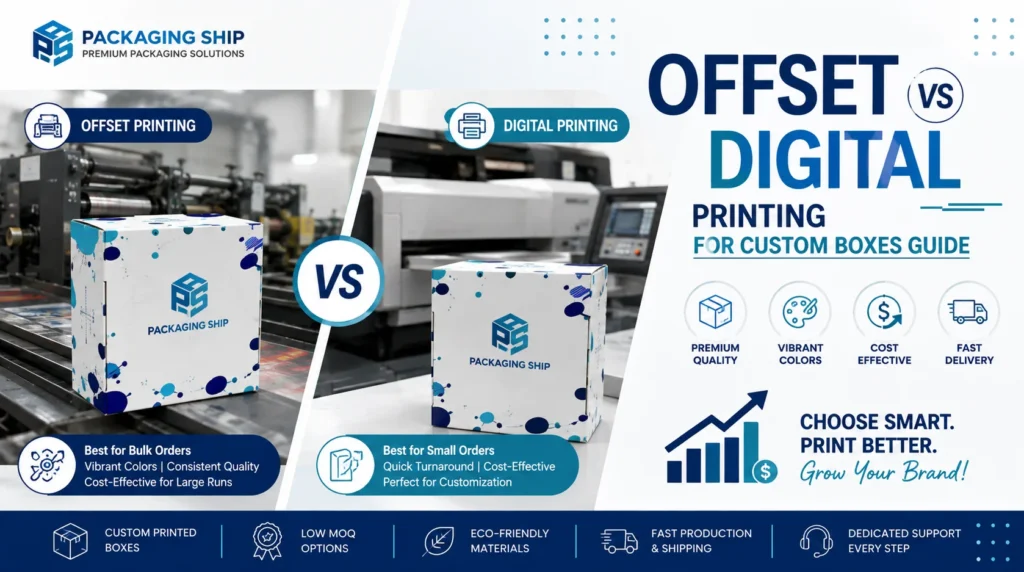
What Is Offset Printing vs Digital Printing for Custom Boxes in 2026? Which Should You Choose? TL;DR: Offset printing uses metal plates and works best for large orders, usually 500 units or more, where color needs to stay consistent across thousands of boxes. Digital printing skips the plates and prints straight from a file, which makes it the better choice for small runs, quick launches, and orders under 300 units. Your quantity decides your printer, not the other way around. Table of contents A quote that made no sense A soap brand owner in Ohio once sent us a screenshot of a quote from another supplier. It listed a plate charge, a die charge, a spot color fee, and a digital proof fee, all before a single box was printed. She had no idea what half of it meant. She just wanted 200 boxes for a farmers market launch in three weeks. This happens all the time. Small business owners search for offset printing vs digital printing custom boxes because they’re staring at a quote full of terms nobody explained, and they’re worried about spending money on the wrong process. This guide breaks it down in plain language, using real numbers from custom printed boxes USA production, so you can pick the right method the first time. What offset printing actually is Offset printing, also called offset lithography, uses metal plates to transfer ink onto paperboard. Each color in your design needs its own plate. A rubber roller picks up ink from the plate and rolls it onto your box material. It’s the same core process used to print magazines and newspapers for over a century. Because the plates are physical objects, someone has to make them before printing starts. That setup step is where the plate charge on your quote comes from. Once the plates are made, offset can run thousands of sheets quickly and hold color steady from the first box to the last. Offset tends to shine on rigid boxes and other premium packaging where a brand needs the same shade of blue on box one and box five thousand. If you look at our custom rigid boxes, most of the premium finishes on those products, like foil stamping and soft touch lamination, pair naturally with offset because the process holds fine detail so well. What digital printing actually is Digital printing skips the plates entirely. It prints directly from your artwork file onto the box material, somewhat like how an office printer works, just built for packaging stock at commercial scale. There’s no setup step waiting on plates, so digital printing can start production almost right after you approve your proof. That makes digital the natural fit for small batches, prototypes, and seasonal designs that might change next month. It’s also why Packaging Ship can accept orders starting at 50 units with no minimum order requirement. Without plate costs sitting on top of every order, small businesses get access to full color custom packaging printing options that used to require a 1,000 unit commitment at traditional manufacturers. CMYK vs spot color, and why your colors might look off This is where most of the fear around printing comes from. CMYK printing boxes wholesale uses four ink colors, cyan, magenta, yellow, and black, layered together to build every shade you see on screen. It works well for photos, gradients, and most everyday packaging. Spot color, often called Pantone or PMS matching, uses a premixed ink built to match one exact shade every time. If your brand color is a very specific navy or a precise shade of pink, spot color tends to hold that shade more reliably than CMYK, especially across large offset runs. Digital printing almost always uses CMYK. Offset can use either CMYK or spot color, which is one reason offset often wins when exact brand color matching matters most. Reputable print shops calibrate against ISO 12647, the international standard for offset color consistency, and follow G7 methodology to keep proof to print color variance tight. The PRINTING United Alliance explains that this kind of color management builds real consistency across print runs, which is exactly why your printed box should match your approved proof instead of surprising you. Offset printing minimum quantity, and when it actually pays off Here’s the honest answer. Offset printing minimum quantity custom boxes typically sits around 500 units at most manufacturers, and often higher. Below that number, the fixed plate charge gets spread across too few boxes, so your price per unit climbs instead of dropping. At Packaging Ship, we don’t charge plate or die fees, which shifts this math in your favor. Even so, digital printing usually still wins under 300 to 500 units simply because there’s no plate production time to wait through. Above that range, offset starts pulling ahead on both price per unit and color consistency, since the press is already running efficiently at higher volumes. Think of it like ordering coffee for an office. A single pot brews fast with no setup. A catering urn for three hundred people takes longer to prepare, but once it’s running, it serves everyone at a lower cost per cup. Offset is the urn. Digital is the pot. Which printing method for 100 custom boxes If you’re asking which printing method for 100 custom boxes, the answer is almost always digital. At that quantity, offset plate setup costs would dominate your total spend, and you’d still wait longer for production to start. Digital printing gets you full color CMYK printing at a fair per unit cost, with production starting right after your proof is approved. This applies whether you’re ordering mailer boxes for a product launch, sample packaging for a trade show, or a first test run before committing to a bigger inventory order. A small quantity doesn’t mean lower quality. It just means a different process gets you there. Best printing method by box material The material you choose also shapes which printing method makes sense.
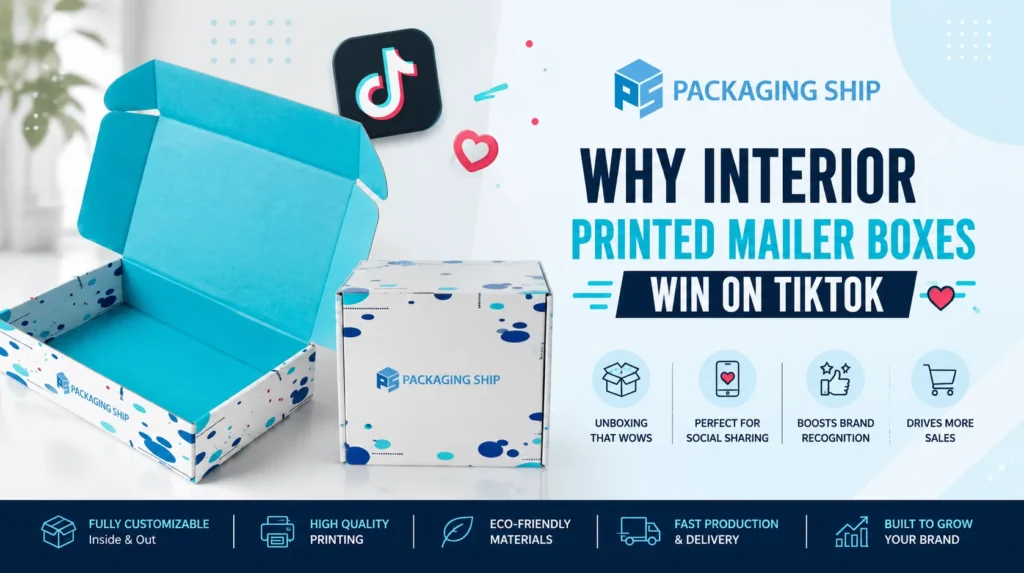
Inside Box Printing: The 2026 Packaging Trend That’s Winning Unboxing Videos on TikTok TLDR Inside box printing puts your design on the interior flaps of a mailer box instead of just the outside. It works because the moment a box opens is the exact moment a camera is pointed at it. Small brands can add it in batches as low as 50 units through digital printing, with no die charge and no plate fee. This guide covers the cost, the process, and how to get your first proof made this month. Table of Contents July 2026 update. Packaging suppliers across the US are reporting a real jump in requests for interior printed mailer boxes this year, and the reason is simple. Shoppers are not just opening packages anymore. They are filming the moment. Custom printed boxes USA sellers order used to mean a logo on the outside, maybe a brand color. That is changing fast. E-commerce packaging trends in 2026 point to one clear shift. The inside of the box now gets as much design attention as the outside, because the inside is what shows up on video. Packaging buyers and creators now have a name for this shift. They call it the inside box printing packaging trend, and it is reshaping how small brands think about their mailer boxes. This guide from Packaging Ship walks through what the trend actually is, why it works, what it costs, and how to get your first box made without a big minimum order. What Is the Inside Box Printing Packaging Trend in 2026? The inside box printing packaging trend means adding a full color design, a message, or a pattern to the interior flaps or walls of a box instead of only the exterior. Small and mid size brands use it on custom mailer boxes to create a surprise moment when the box opens, which drives more social shares and repeat orders than exterior branding alone. For years, printing stopped at the outside of the box. The inside stayed plain brown or white. That made sense when a box only had to survive a shelf or a delivery truck. It does not make sense anymore, because the box now has a second job. It has to perform on camera. An interior printed mailer box can carry a thank you note, a bold pattern, a brand story, or a small hidden design that only shows up once the flaps open. The exterior still matters for shipping and first impression. The interior is where the emotional reaction happens, and that reaction is what gets recorded and shared. Why Interior Printed Mailer Boxes Win on TikTok Interior printed mailer boxes win on TikTok because the moment a box opens gets far more camera time than the exterior ever does, and a hidden design creates a short burst of anticipation that makes the reveal feel more rewarding. Think about how a typical unboxing video plays out. A creator holds up the box, talks for a few seconds, then opens it. That opening moment is the part viewers actually watch closely. It is the payoff. An exterior design gets maybe half a second of real attention before the box starts opening. The interior gets several full seconds, often the longest single shot in the whole video. Most brands are still spending their entire design budget on the half second instead of the several seconds. A 2018 study by the Paper and Packaging Board, conducted with Ipsos, found that roughly seven in ten shoppers say packaging design shapes their purchase decisions, and a similar share say the packaging materials themselves influence how they feel about a brand. That data predates the TikTok unboxing trend fully maturing, which suggests the influence is likely even stronger now that packaging performs in front of an audience, not just the buyer. Packaging Dive, an industry trade publication, reported that digital printing has made interior printing far more accessible than it used to be, since digital presses can print inside surfaces without the plate costs older printing methods required. One packaging executive quoted in that report, Kerry Sanders, vice president of market development at digital printing company EFI, noted that packaging has become a genuine brand activation platform for retailers trying to stand out in a crowded market. The inside box printing packaging trend is not only a social media trend either. It plays into a psychological effect called delayed reveal. A hidden design creates a small sense of anticipation, and that brief anticipation makes the final reveal feel more rewarding, the same way a wrapped gift feels more exciting than an unwrapped one, even when the contents are identical. How to Add Inside Printing to Custom Mailer Boxes USA Adding inside printing to custom mailer boxes is the practical side of the inside box printing packaging trend, and it takes four steps. Pick a box style with flaps that face the camera, choose digital printing for small runs or offset for large ones, send your artwork, then approve a digital proof before production starts. Mailer boxes and tuck-top boxes both work well for interior printing, since their flaps naturally face the camera when opened. A tuck top box in particular tends to reveal the interior print all at once, which reads very well on video. The right method depends mostly on your order size and how detailed your design is. Factor Digital Printing Offset Printing Best order size 50 to 500 units 500+ units Plates needed No Yes Turnaround speed Faster, no plate setup Slower setup, faster once running Color matching Strong for gradients and photos Sharper Pantone (PMS) matching Cost per unit, low volume Lower Higher, due to plate cost Cost per unit, high volume Higher Lower, once volume covers the plate Best fit for this trend First time testers, small batch launches Established brands scaling a proven design You do not need a finished print file. Many suppliers, including Packaging Ship, offer free design support and build your artwork