
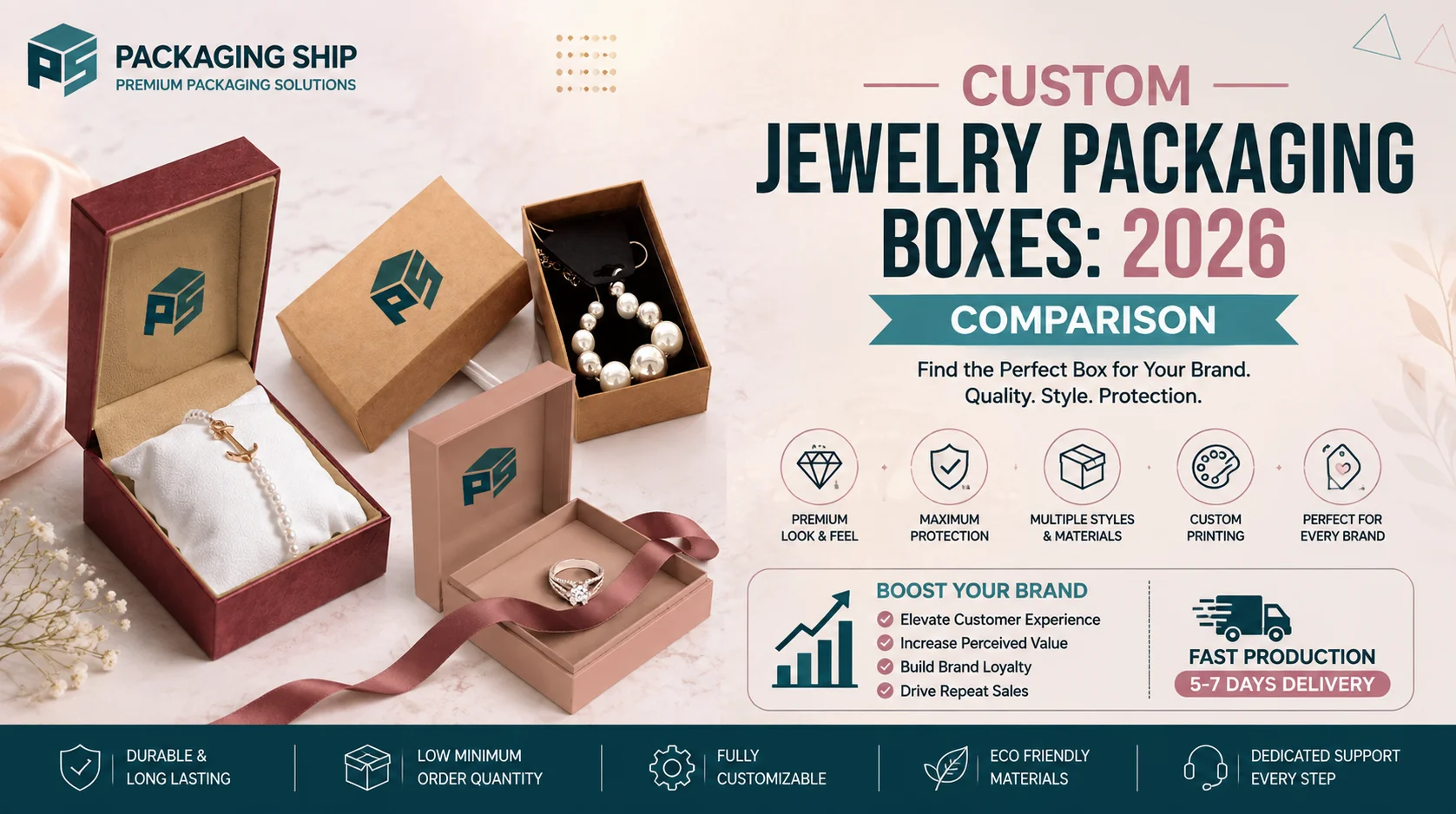
There are three real options when you’re picking custom jewelry packaging boxes: rigid, pillow, or a display case. Rigid wins on protection and feels expensive the second someone picks it up. Pillow boxes cost less and suit light pieces like studs or thin chains. Display cases aren’t for shipping at all, they’re for counters and shows. Pick based on your average order value and what you’re actually shipping, not on which one looks nicest in a catalog photo. And you don’t need to order thousands of units just to find out, most suppliers will now do 50.
A custom jewelry packaging box is a branded container built to hold and protect small pieces, rings, chains, earrings, whatever you sell, while they’re shipped, gifted, or sat on a shelf. Most are made from rigid chipboard, kraft paper, or corrugated stock, and nearly all of them include some kind of soft insert so the piece doesn’t slide around. That’s the functional part. The other part, the one people underestimate, is what the box tells the customer about the product before they’ve even touched it.
Say you sell a $65 ring. It ships in a plain poly bag, no insert, nothing holding it in place. The ring itself is fine. But the person opening it feels a little cheated, even if they can’t quite say why. That gap between what they paid and what arrived is where a lot of jewelry brands quietly lose repeat business.
It’s rarely one problem. Packaging that doesn’t match the price is the obvious one. But there’s also the damage angle, a chain with no insert tangles or scratches in transit more often than people expect, and that turns into returns and refunds nobody budgeted for. Then there’s the piece brands forget entirely: plain packaging gets thrown in the trash. Branded packaging gets photographed and shared, or at least kept in a drawer instead of the recycling bin. That’s free marketing you’re leaving on the table if the box isn’t worth keeping.
Shoppers notice packaging more than most founders assume. An Ipsos survey on packaging’s influence on purchase decisions found that most Americans say a product’s packaging design shapes how they judge that product, often before they’ve used it at all. Small jewelry brands who upgrade their boxes tend to do it the moment they can afford to, and that’s usually not a coincidence.
Jewelry brands are usually choosing between three formats. None of them is the “correct” one, they solve different problems. For a fuller breakdown of formats and finishes, our guide on what types of jewelry packaging exist covers more ground than we can here.
A rigid box for jewelry is built from a thick board, around 2mm, dense enough that the box holds its shape no matter how it’s handled. Pick one up and it feels heavy in a way that a folding carton never does. That weight is doing work. It’s telling the customer, before the lid even lifts, that whatever’s inside cost something.
Custom pillow boxes go the other direction. Lighter cardboard, curved shape, tuck closure, and a much lower price and shipping weight. For a pair of stud earrings or a delicate chain, a rigid box is honestly overkill, and a pillow box still looks intentional without the extra cost.
Display cases are a different animal altogether. They’re built for a counter, a trade show table, a pop-up, somewhere the box gets opened and closed all day long and needs to keep looking good doing it. Most have a window or an open face so a shopper can see the piece without picking it up first. If you’re only shipping direct to customers, you probably don’t need one of these at all.
This is the decision most brands actually get stuck on, so here’s a straightforward way to look at it.
| Factor | Choose Rigid Box | Choose Pillow Box |
| Average order value | Above $40 to $50 | Under $30 |
| Product type | Real metal, gemstones, fine jewelry | Light pieces: studs, thin chains, charms |
| Buying occasion | Gifting, direct-to-customer premium unboxing | Everyday purchase, no gifting expectation |
| Order volume | Lower to mid volume, quality over quantity | Higher volume, shipping weight matters |
| Cost per unit | $0.50 to $1.20, depending on size and finish | Lower cost, less material used |
| Shipping weight | Heavier, adds to freight cost | Lighter, cuts shipping cost |
| Perceived value | Strongest, signals quality before the lid opens | Still branded and deliberate, just lighter touch |
Yes, and brands trip over this more than you’d think. A ring box needs a slot that holds the band in a fixed spot, otherwise it shifts and scratches during shipping. A necklace needs room to lay flat, usually with a card backing or a hook so the chain doesn’t knot itself into a mess. Trying to use one generic box for both usually ends in complaints about tangled chains or rings rattling around in too much empty space.
If rings are your main product, look at a dedicated slot insert. If it’s necklaces or pendants, a wider tray or card-backed setup works better. Matching the insert to the product, instead of forcing one box to handle everything, cuts down on damage complaints more than almost anything else you could do.
Custom jewelry boxes wholesale used to mean committing to 1,000 units or more before a manufacturer would even talk about custom printing. That’s not really true anymore.
A growing number of suppliers, Packaging Ship included, now offer custom jewelry boxes wholesale USA no minimum, which means you can start at 50 units instead of guessing your way into a five figure inventory bet. That matters a lot if you’re testing a new box format for the first time. A custom packaging for jewelry brand 50 units small batch order lets you see how a box performs, how customers react, before you commit real money to it. If you want to see how different manufacturers stack up before you commit, our post on comparing suppliers for custom jewelry boxes walks through what to look for.
Rough numbers, for what they’re worth: digital printing tends to make sense under 500 units, and keeps setup costs low. Once you’re past that, offset printing usually brings the per-unit price down further. It’s worth asking your supplier to quote both your small test batch and whatever volume you expect in six months, so you’re not surprised later by where your unit cost actually lands.
Material changes how a box feels in someone’s hand, and it changes the price too.
A velvet box has that soft, almost plush texture that fine jewelry and engagement pieces are usually packaged in. It’s also the pricier option. Kraft, the material behind custom kraft jewelry boxes, costs less and reads as natural and a little more sustainable, which works well if that’s part of your brand story. Market research from Market.us’s jewelry box packaging report puts North America ahead of other regions in jewelry box packaging demand, and points to gifting culture and a growing pull toward sustainable materials as two of the bigger reasons why, which lines up with more brands leaning on kraft even at higher price points.
There’s no wrong answer here. Velvet says luxury. Kraft says value and sustainability. Pick whichever one actually matches what your brand is promising the customer, not just whichever one looks nicer in a mood board.
If you’re selling through a boutique or standing behind a table at a trade show, jewelry display packaging is solving a different problem than a shipping box. It has to survive being opened and closed constantly without looking beat up by the end of the day, and it has to show the piece clearly, usually through a window or a raised tray, before anyone even picks it up.
Don’t try to make your shipping box double as your display box. They’re built for different jobs, and forcing one to do both usually just means neither gets done well. If you’re choosing a supplier for a branded retail rollout, comparing suppliers for branded jewelry boxes is worth a read before you sign off on a large order.
| Question | Direct Answer |
| What is the best custom jewelry packaging box in 2026? | There isn’t one universal answer. Rigid boxes suit fine jewelry and gifting. Pillow boxes suit lighter, lower cost pieces. It comes down to your product and price point. |
| What is the difference between a rigid box and a pillow box for jewelry? | Rigid boxes use thick boards for stronger protection and a heavier, more premium feel. Pillow boxes use lighter cardboard, cost less, and work well for smaller pieces. |
| Is there a minimum order for custom jewelry packaging boxes? | Not with every supplier. Packaging Ship, for one, accepts orders starting at 50 units with no minimum required. |
| Is velvet or kraft better for jewelry packaging? | Velvet gives a softer, more luxurious feel and suits fine jewelry. Kraft costs less and fits brands leaning into a sustainable, natural look. |
| Can the same box work for shipping and retail display? | Usually not. Shipping boxes are built to protect during transit. Display boxes need to survive daily handling and show the product clearly on a counter. |
Want to see actual pricing for your jewelry line? Get a free packaging quote from Packaging Ship and get a proof back within 24 to 48 hours. No minimum order required.
There’s no fanciest option here, just the one that fits what you’re actually selling. Match the box to your product’s weight, your price point, and how it reaches the customer, whether that’s a shipping label or a handoff across a retail counter. If you’re not sure, start with a small batch. Fifty units will teach you more about how customers respond than any amount of guessing at a spreadsheet. Once you know what works, scaling it up is the easy part.