Custom Mailer Boxes: The 2026 Guide for DTC and Shopify Brands That Ship Weekly TL;DR: Custom mailer boxes are self locking, tape free boxes built for weekly shippers who need speed, consistent branding, and lower shipping costs. This guide covers sizing, materials, no glue assembly, and real pricing for brands already shipping every week, not just testing their first order. Table of Contents What Are Custom Mailer Boxes in 2026? A custom mailer box is a one piece corrugated box that folds and locks shut on its own, with no tape or glue needed. It ships as the only box a customer sees, printed inside and out with your branding. In 2026, most DTC and Shopify sellers use them because they cut packing time, protect light products, and turn every delivery into free marketing. Who Needs This Custom Mailer Box Guide? You are not testing whether custom packaging works. You already ship every week, and you are trying to pack faster, keep your branding consistent, and stop losing money on box size and shipping fees. This guide skips the basics and goes straight to what changes once you move from occasional orders to a weekly shipping routine in mailer box e-commerce. Why Doesn’t Your Mailer Box Get Shared Like Your Competitor’s? You have seen it happen. A competitor posts an unboxing video, the comments fill up, and the video gets shared. Your product ships in the same brown box every week and nobody films it. That is one problem, but it is not the only one. Tape guns slow down packing night. Reorders sometimes look slightly different from the first batch, and nobody tells you why until the boxes are already shipped. None of this is random. According to Ipsos research for the Paper and Packaging Board, most American shoppers say packaging design shapes their buying decisions, and roughly two thirds say the same about the material a box is made from. Your box is doing marketing work whether you plan for it or not. What’s the Difference Between a Mailer Box and a Shipping Box? A mailer box locks shut on its own and is built for the customer to see. A shipping box needs tape and is built to survive a rough ride through a warehouse. If your product is light and presentation matters, choose a mailer box. For the full decision framework, read our full mailer box vs shipping box breakdown. How Does a No Glue Mailer Box Work? A no glue mailer box uses a tuck top or tab lock closure. You fold the flaps, tuck them into place, and the box holds itself shut. No tape gun, no glue stick, no waiting for anything to dry. For a solo founder or a small fulfillment team packing dozens of orders on a Thursday night, this matters more than it sounds. Every second saved per box adds up across a full week of orders. It also means one less supply to buy, store, and run out of at the worst possible time. What Is an Inside Print Mailer and Why Does It Work? Printing the outside of your box is standard. Printing the inside is what actually creates a shareable moment. An inside print mailer can carry a hidden pattern, a thank you message, or your social handle on the flap, so the surprise lands the second the box opens, not before. A Dotcom Distribution study reported by Packaging World found that when shoppers received premium packaging, 41 percent said it made them more excited to open the package. That excitement is exactly what turns into a video someone actually posts. What Size Custom Mailer Box Do You Need? Order a box too big and you pay twice, once for the extra cardboard and again for dimensional weight shipping charges, since carriers price by size, not just weight. Measure your product, add a small allowance for padding, and round to the nearest standard size. If you ship more than one product type, it is usually cheaper to keep two or three sizes on hand than to force everything into one oversized box. You can browse full spec options for custom mailer boxes and match a size to your exact product before requesting pricing. Ready to see real numbers for your product? Get a free quote and compare sizes side by side before you commit to anything. What Material Is Best for a Corrugated Mailer Box? Most corrugated mailer boxes use one of two flute types. The E flute is thin, about 1.5mm, and gives you a smooth surface for sharp printing, ideal for light items under a few pounds. B flute is thicker, around 3mm, and adds cushioning for bulkier or heavier products. You do not need to memorize the engineering. Just know that lighter products want E flute, and anything with more weight or fragility wants B flute or a double wall option. How Do Subscription Mailer Boxes Stay Consistent Every Month? A subscription mailer box carries extra pressure, because the unboxing is part of what the customer is paying for every single month. Swapping in a seasonal design should not mean a new setup fee or a slower turnaround every time you want to refresh the look. Why Reordering Custom Mailer Boxes Doesn’t Have to Mean Starting Over Ask your supplier directly whether reprints or seasonal swaps carry a new die charge. If they do, that cost adds up fast across a year of monthly boxes. If you are not yet at full weekly volume and want to test a design first, start by ordering a small first batch before committing to a bigger run. When Should You Not Use a Mailer Box? Be honest about this one. Multi item orders, anything fragile, or bulk pallet shipments belong in proper shipping boxes with dividers, not a folded mailer hoping for the best. If you ship soft goods like apparel, a mylar bag alternative can also cut cost further and is worth comparing before you
Foam Inserts for Candle Boxes: How to Stop Glass Jars Breaking in Shipping TL;DR Glass candle jars break in shipping because nothing holds them still inside the box. A properly fitted foam insert cradles the jar, stops it from shifting, and absorbs shock from drops and vibration. This guide covers what foam inserts for candle boxes actually cost, how they compare to corrugated and molded pulp, whether they raise your shipping cost, and how to measure your jar for a perfect fit. Table of Contents Why Jars Break in Shipping Three customers wrote in this month about the same thing. They opened a box and found a cracked jar sitting in a puddle of wax. That is not bad luck. It is a packaging gap. A glass jar candle is heavy, top loaded, and wide at the base. Inside a loose box, it tips on its side the moment a truck brakes hard. From there, every bump on the road turns into a small hit against the cardboard wall. One hit rarely breaks glass. Fifty of them, over a two day shipping route, often do. This problem is only growing. The global candle market is projected to grow from 15.6 billion dollars in 2026 to 25.4 billion dollars by 2033, and online sales are one of the fastest growing parts of that market, according to Grand View Research . More candles shipped direct to doorsteps means more chances for a jar to break before it ever reaches a customer’s hands. This is the real reason foam inserts for candle boxes matter so much for candle brands shipping direct to customers. Why Bubble Wrap and Tissue Paper Are Not Enough Bubble wrap and tissue paper feel protective, but they do not stop movement. They compress under weight and slide inside the box, so the jar still travels loose. You also lose the clean, branded unboxing moment that custom candle boxes are built to deliver. A fitted insert solves both problems at once. What Is a Foam Insert for Candle Boxes in 2026? A foam insert is a die cut piece of foam shaped to hold your exact jar size. It sits inside the outer box, wraps around the base and sides of the jar, and keeps a fixed gap, usually one to two inches, between the glass and the box wall. That gap is what actually absorbs shock. Without it, glass meets cardboard directly on impact. Choosing the Right Foam Inserts for Candle Boxes Foam is not the only option, and it is not always the right one. Foam Insert Specifications at a Glance Here is what to expect when you spec out a foam insert order, so you know what to ask for on your quote request. Specification Typical Range Foam type EVA foam or polyethylene foam Density Medium to high density for glass jar support Thickness Half inch to one and a half inches Cavity style Single jar, multi jar, or gift set cavity Jar size range Two ounce votive up to sixteen ounce jar Cut method Die cut to your exact jar dieline Color Black, white, or gray standard, custom on request Compatible boxes Mailer boxes, rigid boxes, two piece boxes Minimum order Starts at 50 units Turnaround 7 to 10 business days after proof approval How Foam Inserts for Candle Boxes Are Cut to Fit Your Jar Your insert is only as good as its measurements. A packaging team takes your jar’s widest point, including the lid or any flared rim, and builds a die line around it. That die line is then used to cut foam sheets to an exact cavity shape, so the jar sits snug with no wiggle room. This same fitted approach applies whether your outer packaging is a simple mailer or two piece candle boxes with a separate lid and base. What Custom Foam Inserts Cost Cost depends on foam density, insert thickness, and cavity count. A single jar cavity in standard foam usually runs under a dollar per unit at moderate volume. Multi jar inserts cost more, since gift sets need extra cutting. Compare that against a replacement jar and a refund, and the insert usually pays for itself. Does an Insert Raise Your Shipping Cost? This is the objection most brands never ask about, and it is a fair one. Carriers charge by dimensional weight when a box takes up more space than its actual weight suggests. A closely fitted foam insert follows your jar’s shape closely rather than padding out a much bigger box, so in most cases it does not push your shipment into a higher rate tier. If you are unsure how your current box sizes up, get a free estimate and ask for a dimensional weight check alongside your quote. Are Foam Inserts Eco Friendly? Standard petroleum based foam is not biodegradable, and that matters to more candle buyers every year. If sustainability is core to your brand story, molded pulp or recycled corrugated inserts protect the jar just as well and break down naturally. Many candle brands now mix a kraft outer box with a pulp insert to keep the whole package plastic free. How to Measure Your Jar for a Custom Insert Measuring wrong is the most common reason an insert fails. Send these three numbers with your quote request and your insert will be built to match, not guessed at. Foam Inserts for Gift Sets, Tealights, and Wax Melts A single foam cavity works for one jar, but it is not enough once you pack more. Gift sets pairing a candle with matches or a second vessel need a multi cavity insert so nothing knocks together in transit. If you sell bundles, custom candle gift boxes use exactly this kind of multi slot insert. Smaller formats need a different approach. Votives ship differently than tealight candle packaging, which usually relies on flat tray inserts instead of foam, since tealights are lighter and less prone to breaking. Wax melt packaging follows the same
Custom Candle Gift Boxes: Rigid vs Folding for Holiday Orders, Which One Survives Shipping? TL;DR Table of Contents What Is the Right Box for Custom Candle Gift Boxes in 2026? Rigid board holds up better for glass jars over 10 ounces. It resists crushing when boxes stack in a delivery truck. Folding cartons work fine for lighter jars and tins, and they cost less to ship. The right pick depends on jar weight, not just budget. Why Do Glass Jar Candles Break During Holiday Shipping? Glass jar candles are heavy for their size. That weight sits right in the middle of the box, not spread out. During transit, boxes get stacked, tilted, and vibrated for hours. Packaging labs use ISTA transit testing, which simulates drop impact, vibration, and compression together, to prove whether a box survives real shipping conditions rather than just a shelf test. A box that looks strong sitting still can still buckle once other boxes stack on top of it. Most holiday failures do not come from one hard drop. They come from three things happening together: If your holiday order has failed QC before, this combination is very likely the real cause. What Makes a Rigid Candle Gift Box Hold Up? A rigid candle gift box uses dense greyboard, usually 1.5mm to 3mm thick, wrapped in printed paper. That thickness is the whole point. Rigid boards do not flex under weight the way folding cartons do. It holds its shape when boxes stack five or six high in a shipping pallet. Rigid construction also supports the finishes holiday buyers expect: If you want to see the full range, Packaging Ship’s custom candle gift boxes line covers all of these styles, built specifically for jar candles. The trade off is cost and space. Rigid boxes cost more per unit than folding cartons, and they usually ship pre assembled. That takes up more storage room before your holiday run goes out. For a heavy jar sold as a gift, that cost is usually worth it. When Does a Folding Candle Box Work for Holiday Orders? A folding candle box, sometimes called a two piece box or tuck top carton, uses lighter cardstock, typically 14pt to 24pt. It folds flat for storage. It locks together for shipping, which keeps freight costs down during your busiest weeks. Folding cartons are not automatically weak. A double wall corrugated folding box can protect a mid weight jar just as well as a thinner rigid board, especially with a snug insert. Packaging Ship’s two-piece candle boxes come with reinforced corners built for exactly this reason. Where folding cartons fall short is heavy jars, generally over 10 to 12 ounces combined weight. Past that point, the walls start to bow under stacking pressure. That bowing is usually what causes the collapse brands describe when a holiday order fails. How Do Rigid and Folding Candle Boxes Compare? Feature Rigid Candle Gift Box Folding Candle Box Board thickness 1.5mm to 3mm greyboard 14pt to 24pt cardstock Best for Jars over 10oz, premium gift sets Jars under 10oz, tins, votives Ships as Pre assembled, more storage space Flat, lower freight cost Closure options Magnetic, drawer, lid and base Tuck top, reverse tuck Typical cost per unit Higher Lower Stacking survival Strong Moderate, needs reinforcement Turnaround at Packaging Ship 7 to 10 business days standard 7 to 10 business days standard Why Do Holiday Candle Orders Fail Quality Control? Weight mismatch is the biggest cause, but not the only one. Four issues show up again and again during peak season: This matters beyond a single damaged jar. Ipsos research conducted for the Paper and Packaging Board found that a large majority of consumers say packaging design and materials influence their purchase decisions, which means a crushed or shabby looking box costs you more than one sale. Lighter products carry a different risk. Packaging Ship’s custom wax melt packaging uses lighter structural specs, since wax melts do not carry the same crushing risk as a glass jar. Do Tealights and Wax Melts Need Different Packaging? Tealights and wax melts face a different shipping risk than jar candles. They weigh less, so stacking collapse is rarely the problem. Instead, the risk is cracking or crushing from a box that fits too loosely, letting small items knock into each other during transit. That changes the rigid versus folding decision. A well built folding carton with tight internal dividers usually protects tealights just fine, without the added cost of rigid board. If you sell tealights as part of a holiday gift set candle line, Packaging Ship’s custom tealight candle packaging is built around that lighter, multi unit structure. If you want to go deeper on this format, read our full guide here. How Does Packaging Ship Help You Choose the Right Box? Choosing between rigid and folding is only half the job. Getting it produced correctly and on time before the holidays is the other half. Here is how Packaging Ship handles that process: This process exists specifically to stop the two most common holiday mistakes: guessing at material strength, and approving a proof too late to fix. How Do You Choose the Right Box for Your Gift Set Candle? Start with the actual filled weight of your jar, not the box size. Use this quick checklist during a busy production window: This decision comes down to jar weight, order timeline, and how the boxes get handled once they leave your facility. Ready to Order Your Holiday Candle Packaging? The global candle market reached roughly $15.6 billion in 2026, growing toward $25.4 billion by 2033 according to Grand View Research, and gifting is one of the fastest growing segments inside that number. Holiday buyers notice packaging first, before they ever open the box. Do not let a weight mismatch cost you replacements and returns during your busiest season. Get a Free Quote Bottom Line: Choosing between a rigid candle gift box and a folding candle box comes down to one number
Custom Cupcake Boxes: Insert Counts, Height Clearance, and What Bakeries Actually Order TL;DR: Custom cupcake boxes fail buyers for one reason more than any other, the box height is measured wrong. A box built for a flat iced cupcake will crush a buttercream swirl. This guide breaks down real insert cavity sizes, height clearance numbers for 4, 6, and 12 count boxes, and the ordering mistakes that cost bakeries the most money. You will also find a spec table, an FAQ section, and a direct path to a free quote with no die charge. Table of Contents What Are Custom Cupcake Boxes in 2026? Custom cupcake boxes are printed, sized packaging built to hold a set number of cupcakes, usually 1, 4, 6, or 12, using a die cut insert that locks each cupcake in its own cavity. A good box protects frosting and decoration during transport. A poorly sized box crushes both. The size, insert layout, and interior height all have to match the cupcake, not just the count. At Packaging Ship, that matching process starts with the spec, not the artwork, which is the part most first time buyers skip. The Mistake That Costs Bakeries the Most Orders Picture this. A bakery lands its first wholesale account, maybe a local coffee shop or a corporate catering order. They search for custom cupcake boxes, order the first option that shows up, and pack their best batch that night. The delivery arrives, the box gets opened, and half the swirls are smeared flat against the lid. This happens constantly, and it is rarely a bad box. It is usually a box height that was measured against the box itself, not against the tallest point of a decorated cupcake, topper included. That single gap between box height and cupcake height at its tallest point is where most first orders go wrong, and it sets the tone for everything else in this guide. Packaging is not a small detail here either. A 2018 study from the Paper and Packaging Board conducted with Ipsos found that 72 percent of consumers say packaging design influences their purchasing decisions. A crushed swirl inside a well printed box still reads as a packaging failure to the customer, even when the recipe was flawless. What a Cupcake Insert Box Actually Does A cupcake insert box is not just a box with a lid. It is a box built around a die cut insert tray that gives each cupcake its own cavity, so it cannot slide, tilt, or bump into the cupcake next to it. Without an insert, cupcakes shift every time the box moves, and frosting transfers between cupcakes or smears against the box wall. Standard insert layouts run in cavity counts of 1, 2, 4, 6, 9, 12, and 24, and each cavity is sized to a specific liner diameter. A standard bakery liner measures close to 2 inches across the bottom and finishes around 2.5 inches across the top once baked. The insert cavity needs to sit close to that footprint, with a small margin of slack so the cupcake sits snug without being wedged in. Here is the part most first time buyers miss. A 12 count insert built for a mini cupcake is a completely different physical product than a 12 count insert built for a standard or jumbo cupcake, even though both get sold under the same 12 count label. Always confirm liner size before you lock in an insert. Cupcake Box Height Spec, Explained in Real Numbers This is the section that actually saves you a reshipment. Cupcake box height spec depends entirely on decoration, not on the cupcake itself. 4, 6, and 12 Cupcake Packaging Dimension Chart Use this as a starting reference. Confirm exact tolerances with your supplier before locking artwork, since liner size and topper height shift the numbers slightly. Count Typical Box Size Interior Height Needed Best For 1 count 4 x 4 x 4 in 3.5 to 4 in Gift, sample, single item pickup 4 count 8 x 8 x 4 in 4 to 4.5 in Small retail box, family pack 6 count 10 x 7 x 4 in 4 to 4.5 in Most requested retail size in the US 12 count 14 x 10 x 4 in 4.5 to 5 in Wholesale, event, and catering orders This table covers the core 4, 6, 12 cupcake packaging range that most bakeries reorder month after month. Once you have your numbers confirmed, you can get a free quote with those exact dimensions instead of guessing on a standard size. Above 24 cupcakes, most bakeries split the order into two boxes instead of building one large tray, since a loaded tray past two dozen tends to flex in the middle and crack frosting on the cupcakes near the center. Cupcake Insert Box vs Loose Pack Some suppliers offer a loose pack option, meaning a plain box with no insert tray. It costs less to produce, but it only makes sense for short local deliveries where the box barely moves, like a table display at a bake sale. For anything that travels further than a few blocks, a cupcake insert box is worth the extra cost. Precise fit inserts, built to match one liner size exactly, cut down on returns and remakes caused by shifted or crushed frosting far more than a universal insert does. A universal insert fits a wider range of products, which helps a bakery running multiple cupcake sizes, but it protects each individual cupcake less. If your bakery runs one standard liner across most of its menu, the precise fit insert almost always pays for itself in fewer damaged deliveries. What Bakeries Actually Order Order patterns tend to fall into three groups, and knowing which one you fall into makes it easier to pick the right spec from the start. Farmers market and retail case orders usually run 4 or 6 count, ordered frequently in smaller batches, often with a window die cut so
TL;DR: A custom macaron box only works if three things match your product: an insert cavity sized to your shell diameter, a paperboard weight in the 250–400 GSM range, and a count (6, 12, or 24) that matches how you actually sell. Table of Contents Custom Macaron Boxes: Insert Counts, GSM, and Getting Your First Order Right What Is the Right Custom Macaron Box Setup in 2026? Custom macaron boxes need three things to work: a cavity insert sized to your shell diameter, a paperboard weight between 250 and 400 GSM, and a count, 6, 12, or 24, that matches how you actually sell. Get any one of those wrong and you find out three days before a market, not before. You know that feeling. You open the shipping box, and under the tissue paper, half your macarons have cracked lids or shells that slid loose and chipped against the wall. Nothing about the flavor changed. But the photo they were going to post now shows crumbs instead of a clean shell, and that’s the version of your product that travels. This happens for one of two reasons almost every time. Either the box shipped with no insert at all, so the macarons had room to rattle around during transit, or the insert was ordered by guess instead of by measurement, so the cavity was slightly too loose for the shell. We put this guide together at Packaging Ship after walking enough bakery owners through a first order to know exactly where it tends to go sideways. Why Most First Custom Macaron Box Orders Go Wrong New bakery owners tend to order packaging the way they’d order a t-shirt: pick a size, pick a color, done. Macaron packaging doesn’t work like that, because the product itself is fragile in a way most baked goods aren’t. A macaron shell has almost no structural give. If the box construction doesn’t account for that, the box becomes the reason for the break, not the shipping carrier. The first order tends to go wrong in one of a few predictable spots: an insert cavity that doesn’t match shell size, a paperboard weight chosen by price instead of by what the box needs to support, uncertainty about minimum order quantities that stalls a decision for weeks, or artwork that looks different on screen than it does printed. What Insert Count Really Means for Your Macaron Box An insert is the die-cut or molded tray that sits inside the box and holds each macaron in its own cavity. Insert count is simply how many cavities that tray has, and it should match how many macarons you’re packing per box, not how many you can technically fit. That’s the idea behind our custom macaron boxes with insert options: match the cavity to the shell, not the shell to whatever cavity happens to be in stock. A box with insert cavities that are even slightly oversized lets the shell move, and movement during transit causes cracking far more often than rough handling does. 6, 12, and 24 Count Custom Macaron Boxes: Which Fits Your Product? Most bakeries standardize around three counts, and each one serves a different part of the business. A 6 count box works well for single gift orders, sample boxes, and impulse buys at a farmers market table. A 12 count box is the workhorse size for most retail and online orders, since it holds a dozen without becoming too tall or too heavy to ship easily. A 24 count box suits corporate gifting, wholesale accounts, and holiday assortments where the buyer wants variety across flavors in one package. Count Typical Use Insert Style 6 Gifts, samples, market stalls Single row cavity tray 12 Standard retail and online orders Single or double row tray 24 Wholesale, corporate gifts, holiday sets Double row or two stacked trays Ordering a count you don’t actually sell wastes a first packaging budget fast. If your average online order is eight macarons, a 6 count box forces an awkward second box, and a 12 count box ships half empty unless you fill the gap with tissue, which adds cost and still leaves room for shells to shift. GSM Explained: Choosing the Right Paper Weight for Macaron Packaging GSM stands for grams per square meter, and it measures how heavy, and by extension how rigid, a sheet of paperboard is. Higher GSM means a thicker, stiffer board. For food packaging, GSM is one of the clearest numbers you can ask a supplier for, because unlike vague terms like “sturdy” or “premium,” it’s a fixed measurement you can compare across quotes. There’s no single published industry standard GSM specific to macarons, and any supplier who tells you there’s one exact number for every macaron box is oversimplifying. What holds up across confectionery packaging generally is a working range: 250 to 400 GSM for rigid or folding carton stock, depending on box style and count. A 6 count gift box can often use board on the lighter end of that range. A 24 count box, especially one stacked in a retail cooler or shipped with other items, performs better closer to the 350 to 400 GSM range, where the walls resist crushing under load. Heavier isn’t automatically better. A 450 GSM board on a small 6 count box adds cost and shipping weight without adding meaningful protection, since the insert tray does most of the protective work, not the outer wall thickness. If macarons are one of several items you package, GSM needs to shift by product, so it’s worth browsing our full food packaging range to see how weight recommendations change across your catalog before you lock in one spec for everything. A Macaron Box Sizing Guide That Actually Works Before you request a quote, measure your own shells. Standard macaron shells run between 1.5 and 2 inches in diameter, but recipes vary, and “standard” is doing a lot of work in that sentence. Measure five or six finished shells with
Custom Cookie Boxes With Window: What Bakeries Need to Know Before Ordering What is a custom cookie box with a window, and what should a bakery check before ordering in 2026? A custom cookie box with a window is a bakery box with a clear panel built into the lid or front so customers can see the product without opening it. Before ordering, a bakery should confirm the window film type, the box material, whether an insert tray is needed, and whether the packaging is food safe. Getting these four details wrong is the most common reason bakeries end up reordering. Table of Contents A bakery owner in Ohio once told me she unpacked five hundred window boxes three days before a Valentine’s Day pop-up and found half of them fogged, like someone had breathed on the plastic and it never cleared. The cookies looked fine. The box made them look like they had been sitting in a warehouse for months. She reordered on rush production, paid extra, and made the deadline by a single day. That mistake was not about design. It was about one line item on a spec sheet nobody asked about: the window film. What Is a Window Cookie Box A window cookie box is a folding carton, kraft box, or rigid box with a die cut opening covered by a clear film. The film lets a customer see the cookies before they buy or open the package. Bakeries use them for retail shelves, farmers markets, gift orders, and shipped subscription boxes because a visible product tends to sell faster than a sealed one. This is the idea behind every window box order, whether you’re looking at custom cookie boxes for a fifty-unit market stall run or five thousand units for a wholesale account. The Real Reason Window Boxes Go Wrong Most bakeries pick a box style, a color, and a size, then leave the window film as an afterthought. That is the mistake behind almost every scratched, foggy, or cheap looking window box. The film is not one product. It comes in different plastics with different behavior, and the wrong choice shows up weeks after the order ships, not on the day you approve the proof. PVC vs PET: Which One Actually Stays Clear PVC film is the most common and the cheapest option. It looks clear on day one and works fine for boxes that sell within a few days on a counter or table. It scratches more easily and can fog slightly in cold storage or during transit, which is exactly what happened in the Valentine’s Day order above. PET film costs a little more per unit but holds clarity longer. It resists scratching better and does not fog the way PVC can when a shipment moves through temperature changes, such as a truck in winter or a warm delivery van in summer. If your cookies are shipped, stored cold, or sitting in inventory for more than a week or two, PET is the safer spec. If the box sells same day off a counter, PVC is usually fine and keeps your cost down. PET has another point in its favor if any of your customers care about the packaging beyond the cookie: it’s also one of the few plastics that most curbside recycling programs actually accept, while PVC gets skipped by many municipal programs entirely. The EPA’s data on plastics in the waste stream backs that up if you want the numbers to show a customer or a retail buyer who asks. PVC Film PET Film Cost per unit Lower Slightly higher Clarity over time Fine short-term, can fog in cold or shifting temperatures Holds clarity through temperature changes Scratch resistance Lower Higher Best suited for Same-day counter or market sales Shipping, cold storage, or inventory held a week or more Curbside recycling Skipped by most programs Accepted by most programs Ask your supplier directly which film they default to and whether PET is available at the same lead time. Silence on this question is the first sign a supplier has not thought past the design proof. Kraft, White, or Rigid: Choosing the Right Material A kraft cookie box gives a bakery a warm, natural look that photographs well for farmers markets, artisan branding, and eco conscious customers. It costs less than white board or rigid stock, and the brown color hides light handling marks during transport. Its limitation is contrast. Bright ink and foil stand out less on kraft than on white stock, so if your logo relies on vivid color, ask to see a printed sample before committing to a full run. White folding carton stock, usually 14pt to 18pt board, gives sharper color reproduction and a cleaner retail look. It costs slightly more than kraft but suits brands selling through boutique retail or gift channels where shelf presentation carries more weight than cost per unit. Rigid board, often 2mm thick, is the premium option. It holds its shape without folding lines, feels substantial in hand, and is worth the extra cost for holiday gift sets, corporate gifting, or wholesale accounts where the packaging itself is part of the sale. For a daily production run of drop off cookies, rigid board is usually overkill. Window Shape and Placement Most cookie boxes use one of three window styles: a full lid window that shows the entire product, a die cut shape window such as a circle, heart, or custom silhouette that frames a specific cookie, or a corner window that gives a smaller peek without exposing the full contents. A full window sells the product best on a retail shelf. A shaped window works well for seasonal or gift lines because it doubles as a design element. A corner window is the lowest cost option and works fine for online orders where the customer already knows what they bought. The same three approaches carry over to other bakery formats, though the shape and placement shift with the product. Custom cupcake
Custom Cake Boxes: How to Choose the Right Size and Board for Every Cake What Are the Right Custom Cake Boxes in 2026? A Quick Answer Custom cake boxes should match your cake’s diameter plus one to two inches of clearance on every side, with a board that fits the box footprint within a quarter inch. Tiered cakes above three tiers usually ship in separate boxes and get stacked on site. Corrugated stock handles weight and distance better than plain cardboard. Table of Contents Why the Wrong Box Size Costs You More Than a Damaged Cake A ten inch round with a fondant topper measured nine and a half inches tall. The box was rated for eight. The topper flattened against the lid before the driver left the parking lot. That happens every week in bakeries that size boxes by guesswork instead of measurement. A box that is too small crushes the cake. A box that is too big lets it slide. Both problems leave your customer with a cake that looks nothing like the photo they ordered. Getting your custom cake boxes right the first time is what stops that from happening, and it starts with measurement, not the box itself. According to Ipsos research conducted on behalf of the Paper and Packaging Board, 72 percent of consumers say packaging design influences how they judge a product, and 67 percent say the same about the material it ships in. For a bakery, that means the box is not an afterthought. It is part of what you are actually selling. How to Measure a Cake Before You Order Custom Cake Boxes Get three numbers before you order anything. Measure across the widest point. For square or hexagon cakes, measure corner to corner as well, because that diagonal is often wider than the side length and it is what actually has to fit inside the box. Measure from the base board to the tallest point, including frosting, fondant, and any topper. This is the number bakeries skip most often, and it causes crushed decorations. A tiered cake is sized by its bottom tier, not an average of all the tiers. If your bottom tier is twelve inches, your box math starts at twelve inches, no matter how small the top tier is. Add one to two inches of clearance on every side of the diameter, and one inch of headroom above the finished height. That gap keeps frosting from touching a wall during a temperature swing, one of the most common causes of a smear that shows up hours after delivery. Custom Cake Boxes Sizing Guide by Cake Type A six inch round needs roughly an eight by eight by four inch box. An eight inch round needs about ten by ten by four. A ten inch round needs twelve by twelve by four, and a twelve inch round needs fourteen by fourteen by four. These four sizes cover most single tier birthday and celebration cake orders. Expect a box in the eleven to fourteen inch height range once you account for both tiers and a topper. This is where a lot of bakeries start running into standard stock that is either too short or oddly deep. These typically need seventeen to eighteen inches of height, and depending on the base tier, a footprint wider than most off the shelf boxes offer. Anything past four tiers, or a stack finishing taller than about sixteen inches, is usually safer shipped disassembled in separate boxes and stacked at the venue. Sheet cakes need a flat, wide footprint rather than height. Bento and mini cakes fit small four to six inch boxes and are one of the few categories where an off the shelf size genuinely works fine. If your cake does not fit neatly into any of these categories, that is exactly the situation custom sizing solves. A hexagon cake, a very tall buttercream build, or an odd eleven inch tier will always fight standard stock. You can see the full size range in our custom cake boxes collection, built to your exact dimensions instead of the nearest standard one. Cardboard vs Corrugated, Picking the Right Material A cardboard cake box is a single layer of paperboard. It works well for cakes under about eight inches and light single tier orders, and it keeps your cost per unit low on high volume days. A corrugated cake box has a wavy fluted layer sandwiched between two flat sheets. That structure is what stops the box from bowing under weight, which matters once you are carrying multiple tiers, a heavy fondant build, or a delivery going more than a few miles. At Packaging Ship, both run through the same printing lines, so switching to corrugated does not mean a drop in print quality. If your bakery ships two or more tiers, or anything traveling more than a short local trip, corrugated is the safer default, not an occasional upgrade. Window Box or Solid Lid, What Actually Protects Presentation A window cake box shows off the decoration before the customer opens it, which works well for retail cases and pickup orders where presentation sells the sale. The tradeoff is less climate control inside the box, so window boxes are a better fit for shorter transport times and sturdier frostings. The same tradeoff applies to custom sweet boxes, where a window sells the product but a solid lid protects anything delicate. A solid lid protects delicate buttercream and fresh floral toppers from light and temperature better, and it is the safer choice for longer deliveries or hot weather months. Neither option is universally correct. Match it to your delivery distance and your topper, not just your branding preference. Why Cakes Slide and Arrive Damaged, and How to Stop It Most delivery damage comes down to three separate failure points, and they need three separate fixes. Horizontal sliding happens when the board is noticeably smaller than the box interior. A gap wider than half an inch between
Custom Cosmetic Boxes With No Minimum Order: Is It Actually Possible? (2026 Guide) TL;DR Yes. Custom cosmetic boxes with no minimum order are genuinely available in 2026. Digital printing makes it possible to produce as few as 50 boxes without die charges or plate fees, and you still get the same materials, print quality, and design support you’d get with a bulk run, just at a smaller scale and a slightly higher cost per unit. Table of Contents Ask five packaging companies for a quote and most will throw out a number somewhere between 500 and 5,000 units. That’s the industry default, tied to how offset printing works, and it’s often way more than a new brand needs before it even knows if a product will sell. Suppliers who print digitally can turn out custom cosmetic boxes 50 units at a time with no setup fee attached. Below, we’ll get into why high minimums became the norm, how small batch orders actually get produced, what they cost, and what to watch for so you don’t get quoted “no minimum” and then hit with fees anyway. Why Most Cosmetic Packaging Has High Minimum Orders If you’ve shopped around for custom cosmetic boxes, you’ve probably run into the same number more than once. Five hundred units. A thousand. Sometimes five thousand. If you’re a founder about to launch your first serum, that figure can knock the wind out of you. Here’s the reason behind it. Most packaging still runs through offset printing, which relies on physical metal plates to press ink onto cardboard or rigid stock. Building those plates isn’t cheap, usually somewhere between 150 and 500 dollars per design, and cutting a custom die for the box shape can add another 200 to 800 dollars on top of that. A manufacturer needs enough units in the order to make that fixed cost worth it, and that’s really where the 500 unit minimum comes from. It’s not some industry law. It’s just how the cost math works out. That math doesn’t help a founder who only wants to test one product before spending real money. You don’t yet know if the formula is going to sell, whether the box size is right, or if customers will even like the design. Committing to a thousand boxes before any of that is settled is a genuine gamble, and honestly, it’s one of the more common reasons a launch gets pushed back. How Suppliers Make Small Batch Cosmetic Boxes Work What changed the equation was digital printing. There’s no plate involved. The design file prints straight onto the box material, kind of like a home printer scaled up for industrial use. Since there’s no plate to build and no die charge tied to a big production run, a manufacturer can actually turn a profit on a short run. That’s exactly why custom cosmetic boxes with no minimum order aren’t just a marketing line anymore. Suppliers with digital press equipment can take an order for 50 units, print it in full color, and ship it out without the setup fees that used to make short runs a losing bet. Packaging Ship runs it this way for its cosmetic packaging line too, printing digitally on smaller orders and moving to offset once quantities climb past roughly 500 units, where the per unit cost starts to drop on its own. And print quality doesn’t take a hit at low volume either. Digital presses now handle full CMYK color at 300 DPI, the same resolution standard used on larger offset jobs. The difference comes down to how it’s produced, not how good it looks when it arrives. If you want to read more, click here to read our complete guide on custom cosmetic boxes. What You Actually Get in a 50 Unit Order A lot of first time buyers assume a small order means you’re getting a watered down version of the real thing. That’s not really how it works with most suppliers today. A cosmetic packaging 50 units order usually still comes with: You can browse the full range of custom cosmetic packaging to see what materials and finishes are available even at low order volumes, including options built for skincare, lip products, and fragrance lines. Soft Touch vs Gloss Cosmetic Box: Which Finish Fits a Test Run This question comes up almost every time a founder decides to order a small batch. Soft touch lamination gives the box a velvety, matte feel, the kind that signals a slower, more premium unboxing moment. It tends to suit skincare and fragrance brands going for a minimalist, high end look, though fingerprints show up more easily on it and it usually runs a little more per unit. Gloss coating goes the other direction. Colors and bold artwork pop under light, smudges are less noticeable, and it’s often cheaper at low volume. Neither finish needs a big order to be available. Both can go on a 50 unit digital run without any issue. So the real decision isn’t about quantity, it’s about how you want the product to feel once someone’s actually holding it. If you want the full breakdown on finishes, materials, and box styles across the whole beauty category, click here to read about it. Who Actually Needs Small Order Beauty Boxes Low MOQ cosmetic packaging isn’t just something tiny startups reach for. It solves a real, recurring business problem, and a few different types of brands end up needing it. First time skincare founders launching a single product need to see how their formula actually performs before they scale up. Ordering test order beauty packaging in a small batch lets them check the box, the label placement, and how it looks on a shelf, without staking a five figure sum on it upfront. Established brands testing a new scent or a seasonal line run into the same math. Locking in a thousand units of a limited edition candle box, or a holiday lip gloss box, doesn’t make
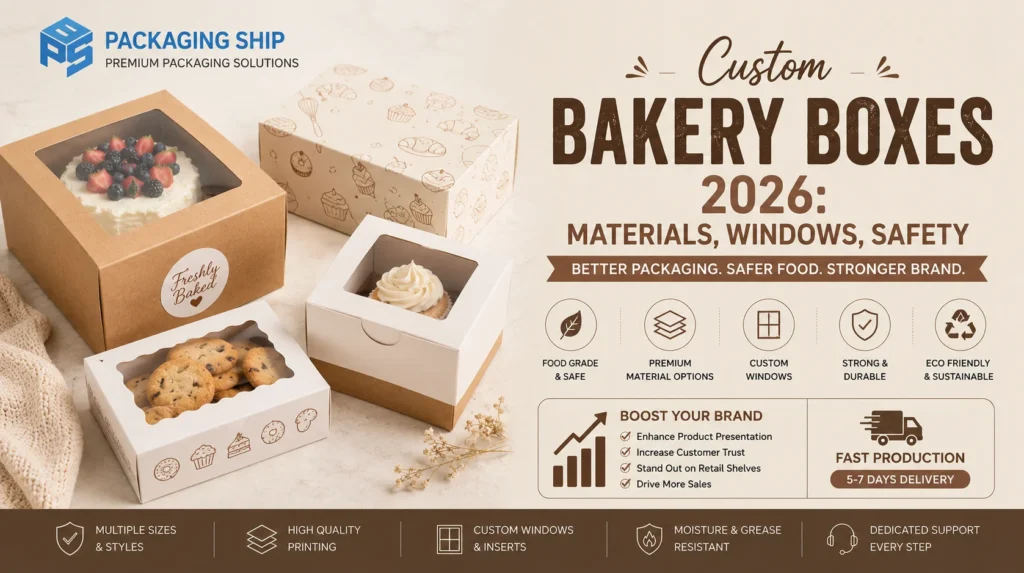
Custom Bakery Boxes in 2026: Materials, Windows, and Food-Safe Options for US Bakeries TL;DR: Custom bakery boxes affect how customers judge your price before they taste the product. This guide covers which materials hold up under grease and weight, when a window helps versus hurts, what food safe actually means under FDA rules, and how to order wholesale bakery boxes without a 1,000 unit minimum. Real numbers, real code sections, no fluff. Table of Contents What Are Custom Bakery Boxes in 2026? Custom bakery boxes are printed, branded packaging built for cakes, cookies, pastries, and baked goods, made from food safe materials like kraft, cardboard, or corrugated stock. In 2026, most US bakeries order them with a window, a custom insert, and no minimum quantity, so a small batch of 50 units costs the same per unit logic as a large wholesale run. Here’s the part nobody tells you when you start a bakery. Your recipe is not the first thing a customer judges. The box is. At Packaging Ship, we hear this from bakery owners every week, so this guide walks through exactly what to look for. Why Your Packaging Is Costing You Sales Picture this. A bakery owner in Ohio raises her sugar cookie price from five dollars to seven after switching from a plain kraft bag with tape to a printed box with a window. A regular customer picks one up, looks at the price tag, and asks if it went up. It didn’t. The cookie is the same cookie. The box changed how she read the price. That is not a coincidence. According to a national study by the Paper and Packaging Board, conducted with Ipsos, 72 percent of consumers say packaging design influences their purchasing decisions, and 67 percent say the same about the materials a product is packaged in. If your bakery still hands out treats in a plain white box or a generic bag, you are asking customers to trust your pricing on faith. A well built box does that convincing for you before anyone takes a bite. There is a second cost too, and it is less visible until it happens. A box that collapses in transit, or a window that fogs up and makes a cake look sweaty, does not just lose one sale. It makes a customer hesitate the next time they see your name on a box at all. What Food Safe Bakery Box Actually Means A food safe bakery box is packaging built from materials the FDA has cleared for direct or indirect contact with food, under the food contact substance rules in 21 CFR Parts 174 through 186. That includes the paperboard itself, any coatings, and any inks used in printing. Here is where most bakery owners get tripped up. Saying a box is “FDA approved” is not quite accurate. Compliance depends on the specific material, the coating, and how the food touches it. A supplier should be able to tell you whether their board meets food contact requirements for your specific product, not just hand you a generic claim. This matters most with high fat items. Butter croissants, shortbread, and anything with real cream will bleed grease through untreated cardboard within hours. A grease resistant coating, or a clay coated kraft liner, stops that. Skip it, and your customer opens a beautiful box with an oil stain spreading across the bottom. Ask your packaging supplier two direct questions before you order. Does the material meet food contact standards for the specific product I’m packing? And does it need a grease resistant coating for fat or moisture? If they cannot answer both without hesitation, that’s a warning sign. Choosing the Right Cardboard Bakery Box Material Not every cardboard bakery box is built the same way, and the material you pick should follow the product, not the other way around. Here’s how the three compare side by side. Material Best For Grease Resistance Print Quality Shipping Strength Cardboard (SBS) Retail cookies, cupcakes, display boxes Needs added coating Excellent, sharp CMYK Moderate Kraft Artisan cookies, brownies, gift assortments Good with clay coating Good, earthy tone Moderate Corrugated Wholesale delivery, cafe orders, shipped goods Needs liner for direct contact Fair to good Excellent Neither option is universally better. The right call depends on how your product travels and what your brand is trying to say on the shelf. To see every material laid out by box style and size, browse our full range of custom bakery boxes. Custom Sweet Boxes for Pastries and Delicate Bakes Cakes and cookies get most of the attention, but macarons, truffles, hand pies, and delicate pastries need their own approach. These items are small, often fragile, and usually sold as an assortment rather than one item per box. For this category, a rigid divider or a fitted paper tray matters more than a window. It keeps each piece separated so a macaron shell does not crack against its neighbor during delivery. If you sell an assortment box for gifting season, our custom sweet boxes for pastries and confections are built with divided compartments sized for exactly this kind of order. Window Bakery Box: When It Helps and When It Hurts A window sells the product before the customer opens the lid. For decorated cookies, colorful macarons, or a beautifully iced cake, that visibility does real selling work. But a window creates one problem competitors rarely mention. Warm baked goods release steam. If that steam has nowhere to go, it condenses on the inside of the window, and your gorgeous cake now looks like it’s sweating. Customers read fog as old, not fresh. The fix is simple once you know it. Let items cool fully before boxing, add small vent holes near the window, or use a window film designed to resist fogging. A good supplier will ask about your product’s moisture level before recommending a window style, not just sell you the standard option. For a deeper look at fog resistant film and vent
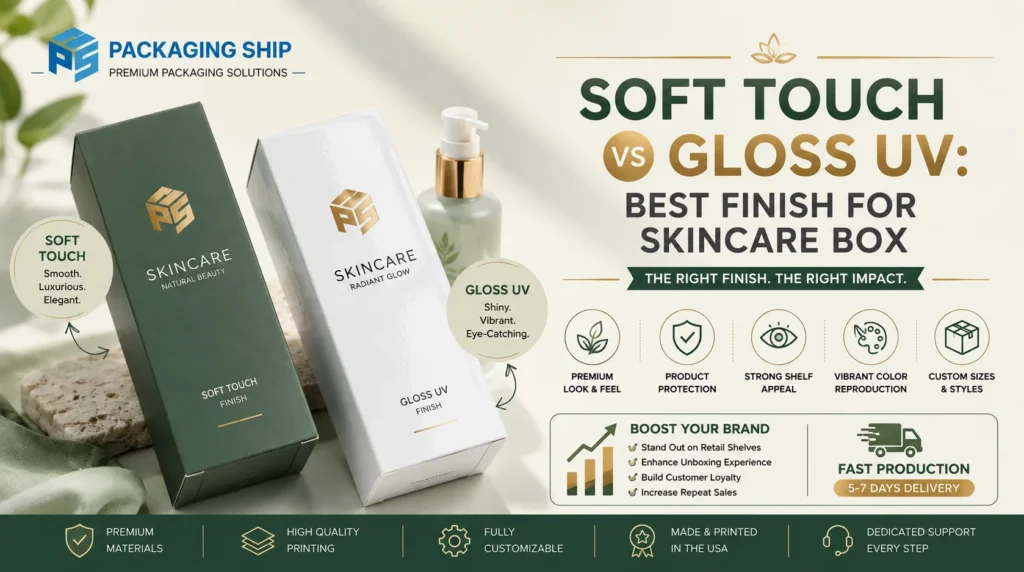
Soft Touch vs Gloss UV: Which Finish Works Best for Skincare Boxes? TL;DR: Soft touch feels expensive in your hand but doesn’t always photograph well under a camera flash, and it picks up fingerprints faster than gloss does. Gloss is cheaper, tougher under studio lighting, but can come off a little plain next to a soft touch competitor on the same shelf. Premium serums and clean beauty lines usually lean soft touch. Color cosmetics on a tighter budget usually lean gloss. Either way, check your GSM before you lock in a finish, and ask for a physical sample first. Photos on a screen lie more often than people expect. Table of Contents We hear some version of this almost every week. A founder approves a mockup, the box shows up two weeks later, and it doesn’t match what they had in their head. Nine times out of ten, it isn’t a printing mistake. It’s the finish. The soft touch vs gloss cosmetic box question is usually sitting right underneath the confusion, unanswered, because nobody explained the difference before the order got placed. Soft touch can feel genuinely luxurious in your hand, but under a ring light it sometimes looks a little dull. Gloss does the opposite. It photographs sharp but wears its fingerprints by the second week on a shelf. Neither finish is the “correct” one. They just do different jobs, and this guide is here to help you pick the right one. What Is the Difference Between Soft Touch and Gloss UV in 2026? Soft touch is a laminate film, usually a matte base with a bit of texture built in, so the surface feels almost like suede under your fingers. Gloss UV is a completely different animal. It’s a liquid coating cured under ultraviolet light in seconds, leaving behind a hard, shiny shell. One is meant to be touched. The other is meant to be seen from across a store aisle. That’s the whole distinction in a nutshell, and almost everything else in this article builds off it. Why Packaging Finish Shapes How Customers Judge Your Skincare Brand People decide what they think of your product long before they open it. Weight, print sharpness, and how the box feels when they pick it up, all of that gets processed in a second or two. According to research from Ipsos conducted for the Paper and Packaging Board, most American shoppers admit that packaging design shapes their buying decisions, and the materials a product ships matter almost as much as how it looks. That lines up with what we see at the quoting stage constantly, which is exactly why the soft touch lamination box question comes up on nearly every skincare call we take. Picture two products sitting next to each other on a shelf. One box feels a little slick. The other has this warm texture that makes you want to hold it a beat longer. Most people grab the second one without thinking twice about why, and that reaction is the entire point of choosing a finish. Skincare buyers are already primed to notice texture, since that’s how they judge the product itself once it’s on their skin. A box that echoes that feeling backs up whatever the formula promises. A box that feels cheap when the product claims to be gentle creates a small disconnect, and customers notice it fast. Soft Touch Finish: What It Feels Like, What It Costs, Where It Wins Soft touch lamination uses a BOPP film bonded onto the printed board. Instead of bouncing light back the way gloss does, it absorbs it, which mutes colors slightly but adds that tactile layer people notice the second they pick up the box. It’s a big reason serum brands, moisturizer lines, and clinical skincare companies gravitate toward it. No copy needed to sell the “premium” feeling. The box does that on its own. This isn’t a niche trend either. Future Market Insights projects steady growth for the global soft touch lamination film market over the next decade, with cosmetics and skincare brands a big part of what’s driving that demand. The Real Trade Offs in a Soft Touch vs Gloss Cosmetic Box Decision Nobody likes hearing the downsides after they’ve committed to a finish, so let’s cover them now. Fingerprints show up faster on soft touch than gloss, especially in darker colors like black or deep navy, and light scuffing along the edges happens too. Soft touch also costs more per unit, not a massive jump, but enough to notice on a big order, mostly because the film and bonding add a step to production. If your product gets handled a lot before reaching the customer, that’s worth thinking through early. In our own experience quoting skincare startups, the soft touch vs gloss cosmetic box decision usually comes down less to what looks best on screen and more to how the box gets handled in the real world. Gloss UV Finish: What It Feels Like, What It Costs, Where It Wins Gloss UV goes on as a liquid and cures almost instantly under UV light, leaving a hard, reflective shell on top of the print. Colors pop under it, which is why lip gloss, eyeshadow palettes, and anything bright and seasonal tends to use it. It’s tougher against moisture and light scratches than soft touch too, and it costs less, a real factor for a brand still figuring out if a product is going to sell. The catch is perception. Sit a gloss box next to a soft touch one and gloss can suddenly look a little ordinary, even mass produced. It picks up fingerprints too, just differently than soft touch does. Under bright store lighting, gloss can glare enough to wash out small text or fine details. Plenty of founders comparing matte vs glossy packaging for their first production run go with gloss anyway, simply because it’s the safer, cheaper bet while they’re still testing whether the product sells at all. Why Soft