
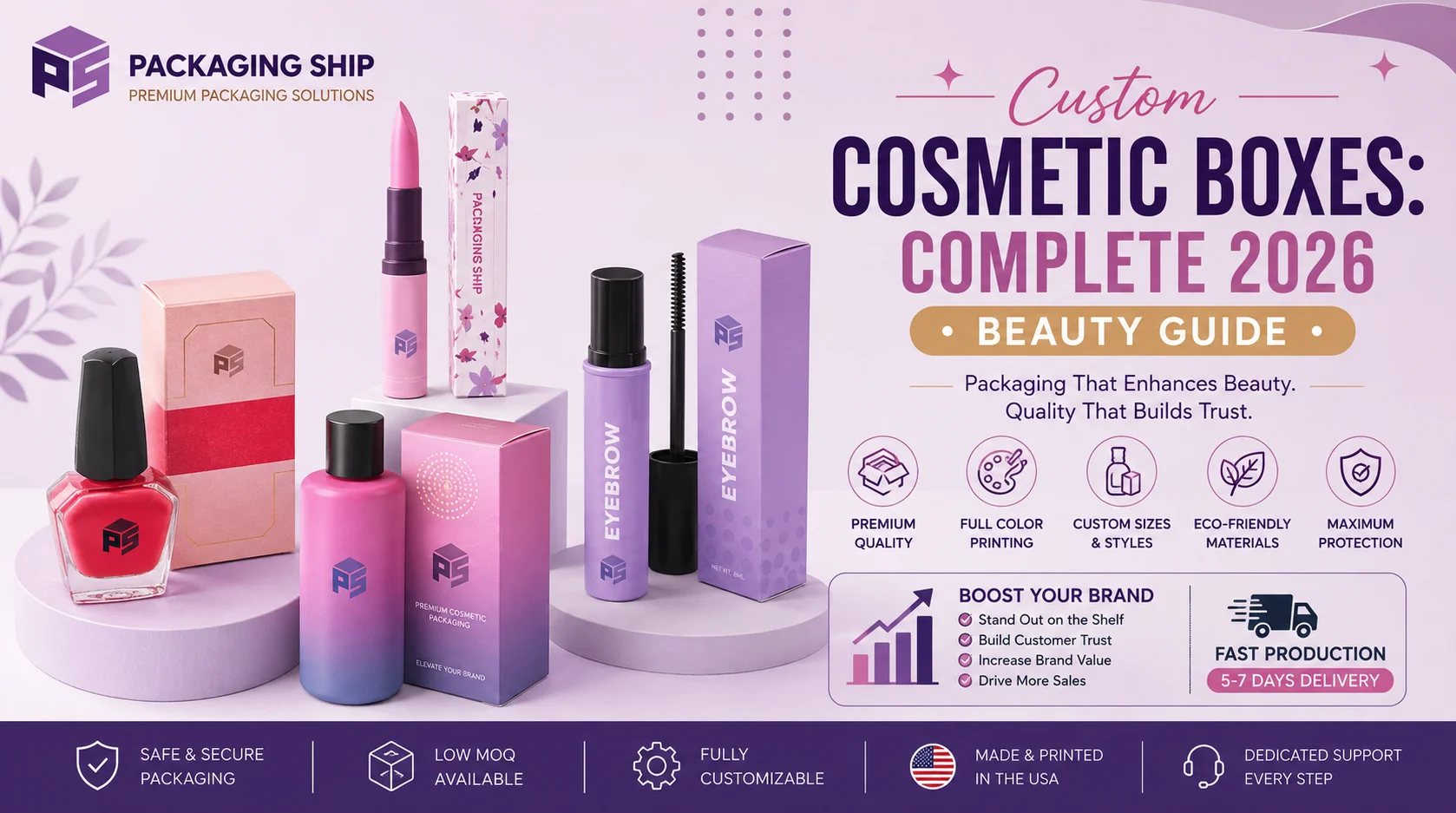
Your box is doing more selling than you probably give it credit for. Customers form an opinion about quality before they’ve even opened the product, based on what’s holding it. This guide walks through materials, GSM, the soft touch versus gloss decision, real pricing, and how to order without getting stuck in a big minimum. If you’re short on time, skip straight to the finish comparison section. That’s usually where the real answer is hiding for most beauty founders wondering why their packaging feels a little off.
Custom cosmetic boxes are packaging printed and sized to fit a specific beauty product, rather than pulled off a generic shelf template. Most brands in 2026 are ordering them in cardboard, kraft, or rigid board, printed with their own logo and colors, then finished with a coating like matte or gloss. Packaging Ship has built its whole production process around this kind of order, small brand, tight timeline, no design team in house. Beyond looking good, the box also has a job during shipping. It has to keep the product from shifting, cracking, or scuffing before it ever reaches a customer’s hands.
Picture this. You pull your product off the shelf next to a competitor’s. Your formula might genuinely be better. Your ingredients might cost more to source. But your box feels a little thin, the print looks slightly dull, and theirs has this soft matte texture with a foil logo that catches the light when you tilt it. Before either box is even opened, the customer has already made a call about which one is worth more.
That’s not vanity talking. It’s closer to math. A national study by the Paper and Packaging Board, run with Ipsos, found that 72% of consumers say packaging design shapes their purchase decisions, and 67% say the same about the materials a product is packaged in. Separately, Dotcom Distribution’s consumer packaging research found that when shoppers receive premium packaging, a meaningful share of them get more excited about opening it and start seeing the brand as more upscale on the spot. Your formula never really gets a fair shot if the box already told the customer to expect less from it.
Here’s the part that should be reassuring. Fixing this almost never means starting your brand over. Nine times out of ten it comes down to one or two things, usually the board thickness, the finish, or how sharp the print actually is. We’ll get into all three below.
See what a properly specced box would cost for your product →
Board thickness gets measured in points, shortened to pt, and one point is one thousandth of an inch. It’s a small detail that a lot of first time founders skip past on a quote sheet, but it’s honestly one of the biggest factors in how sturdy your box feels once it’s actually in someone’s hand.
Squeeze your own box gently. If it flexes and your product still feels premium in your hand, that gap between the two is usually the whole problem right there. Moving from 14pt up to 24pt on a serum or moisturizer line is one of the cheapest ways to close that gap, and it doesn’t require touching your formula, your label copy, or anything else.
GSM stands for grams per square meter. It’s measuring how dense the paper is, not how thick it is, which trips people up because pt and GSM get used interchangeably in casual supplier conversations more often than they should.
In practice, anything under 300 GSM starts to feel flimsy once your retail price crosses roughly $15. If you’re aiming for a premium shelf presence, 350 to 400 GSM is a more realistic floor to work from, and this applies whether you’re boxing a jar of cream or something as small as a bottle of nail polish. Go higher than that and you’re really talking about rigid board territory, which gets measured by calipers instead of GSM, a whole separate spec again.
The practical takeaway is simple. When you request a quote, ask for both numbers, pt and GSM. If a supplier just tells you it’s “premium cardboard” without giving you either figure, you have no real way to compare that quote against anyone else’s.
Of everything covered in this guide, this is the decision that swings perceived value the most, and it’s also the one brands tend to get wrong most often.
Soft touch lamination, sometimes called matte or velvet lamination, has a light texture to it and doesn’t reflect much light. That’s actually what makes it read as expensive under store lighting, since it absorbs light instead of throwing it back at the customer. It also holds up much better against fingerprints than gloss does. Most skincare, serum, and clean beauty brands lean on this finish when they want to come across as clinical and considered, and it’s a common pick for mascara boxes too, where a fingerprint smudge right on the box looks worse than almost anywhere else.
Gloss lamination works the opposite way. It reflects light and makes printed colors look more saturated, more alive. For color cosmetics, think lip gloss, eyeshadow palettes, anything with a bold seasonal drop, gloss tends to be the stronger pick because the whole point is grabbing attention through color.
Neither one wins outright. What actually goes wrong is brands picking the trendy option instead of the one that fits their product. Put a bright, playful lip gloss line in matte and it can end up looking flat and lifeless. Put a clean, minimalist skincare line in heavy gloss and it can start to look almost like a toy. The finish should match the feeling you’re trying to sell, not whatever’s popular on Instagram this particular month.
Hot foil cosmetic packaging adds a thin metallic layer, usually gold, silver, or rose gold, stamped straight onto the box surface. Used on a logo or a single accent detail, it genuinely reads as more expensive, mostly because foil catches light in a way printed ink just can’t. Cover the whole design in it, though, and that effect disappears fast. It starts to look cluttered instead of premium.
For a gift set, a limited run, or your flagship product, a rigid cosmetic box is usually worth the extra cost. These use a thick inner board wrapped in printed paper, and the result feels heavier and more substantial in the hand than any folding carton, cardboard included, can really match. Custom perfume boxes are probably the clearest example of this in the whole cosmetics category. A glass bottle needs the extra protection, and the format practically demands the weight and finish of rigid board to feel right at its price point. Rigid takes longer to produce and costs more per unit, so it makes the most sense reserved for your hero product rather than your whole lineup.
Different cosmetic products call for different specs. Here’s a quick reference table before we go product by product.
| Product | Best Material | Typical Finish | Starting Order |
| Custom cosmetic boxes (general) | 14pt to 24pt cardboard | Matte or soft touch | 50 units |
| Custom lip gloss boxes | 14pt to 18pt cardboard | Gloss or spot UV | 50 units |
| Custom eyelash boxes | 18pt to 24pt with window | Matte with spot UV logo | 50 units |
| GSM cardboard cosmetic boxes | 350 to 400 GSM | Depends on product | 50 units |
| Soft touch vs gloss cosmetic box | Rigid or 24pt cardboard | Buyer’s choice | 50 units |
| Custom cosmetic boxes, no minimum | Any | Any | 50 units, no true MOQ |
Take a look at the custom cosmetic boxes and cosmetic packaging collection if you want to compare styles side by side before requesting a quote. It’s where most orders on this list start.
Custom cosmetic boxes cover most of what a skincare or beauty brand actually orders day to day. A folding carton in 14pt to 24pt cardboard, sized around your bottle or jar and printed in your brand colors, is what moves through Packaging Ship’s production floor more than anything else. Custom lip gloss boxes fall into this same general category but at a smaller scale, since most tubes sit under four inches tall. Lightweight 14pt to 18pt cardboard holds its shape fine without bulking things up, and a gloss or spot UV finish helps the printed shade swatch actually pop, which matters a lot when color is basically the whole pitch.
Custom eyelash boxes almost always ship with a window die cut so a shopper can see the lash style before buying it. That window means you need the extra rigidity of 18pt to 24pt cardboard, because thinner stock tends to warp right around the cut edge. Matte exteriors with a spot UV logo have become the norm for lash brands selling through Amazon and Instagram right now. Brow and eye products built around a similar unboxing moment, like hair extension boxes, tend to follow the same window and rigidity logic.
Skincare packaging is where a skincare box with a logo really earns its keep, since it’s often the first branded touchpoint a customer has with a new formula. Lotion boxes and cream boxes both do best in that 18pt to 24pt range discussed earlier, since they’re carrying bottles or jars with real weight, and a soft touch finish tends to fit the clinical feel most skincare brands are going for.
Display and retail ready packaging is its own category worth separating out. Custom lip balm display boxes are built to hold multiple units upright on a countertop, so structural rigidity matters more here than almost anywhere else in the lineup. For a broader retail rollout, cosmetic display boxes handle the point of sale side of things, keeping products organized and visible on a shelf or checkout counter rather than tucked away in a stockroom.
A quick aside for anyone outside the traditional beauty aisle. Men’s grooming has quietly become one of the faster growing corners of this space, and beard oil boxes follow a lot of the same logic as skincare, mostly matte or soft touch, sized tight around a small glass bottle so it doesn’t rattle in transit.
A few more categories round out the lineup and don’t need much explanation beyond their name. Nail polish boxes and eyeliner boxes both work well on the lighter 14pt to 18pt end, since neither product weighs much, while eye shadow boxes usually need a bit more structure to protect a palette during shipping.
Pricing for cosmetic packaging wholesale in the USA generally falls between $0.20 and $0.55 per unit, and where you land depends on material, size, finish, and how many you’re ordering. Bigger orders push that per unit number down. Two line items worth watching for on any quote are die charges and plate charges, since some manufacturers tack these on separately without flagging it up front. Packaging Ship builds both into the quoted price, so what you see is what you actually pay at checkout.
Orders under 500 units generally go through digital printing, which skips the need for printing plates and moves faster for smaller batches. Once you’re past 500 units, offset printing usually takes over, bringing the per unit cost down and tightening up color consistency across the run.
Get your exact pricing based on your size and quantity →
If you’re a solo founder, or you’re working on a skincare box with a logo as your very first packaged product, ordering 50 units instead of 1,000 changes the whole risk picture. You get to test a new formula, a seasonal color, or your debut product without tying up money in inventory you’re not fully confident will sell yet.
It’s worth asking about free design support too, since you shouldn’t need a designer on payroll just to launch. Cosmetic packaging free design usually means a supplier takes your logo and brand colors and builds you a print ready proof, typically back in your inbox within 24 to 48 hours, with revisions included before you sign off on anything.
| Question | Direct Answer |
| What is the minimum order for custom cosmetic boxes? | Most orders start at 50 units, and there’s no strict minimum required past that. |
| What’s the difference between 14pt and 24pt cardboard? | 14pt is thinner and lighter, good for small items. 24pt is thicker and holds up better, which suits premium skincare. |
| Is soft touch or gloss better for cosmetic boxes? | Soft touch tends to suit skincare and clean beauty. Gloss works better for color cosmetics like lip gloss and eyeshadow. |
| How much do custom cosmetic boxes cost? | Usually somewhere between $0.20 and $0.55 per unit, depending on size, material, and finish. |
| How long does production take? | Standard production runs 7 to 10 business days once you’ve approved your design proof. |
| Do I need my own artwork to order? | Not necessarily. Free design support can build your artwork from your logo and brand colors. |
| Is rigid packaging worth the extra cost? | For gift sets, flagship products, or limited runs, generally yes. For your whole catalog, probably not. |
At this point you know the difference between 14pt and 24pt, you know soft touch from gloss, and you know GSM from calipers. The only thing left is turning all of that into an actual box.
Request Your Free Cosmetic Packaging Quote →
Send over your product dimensions and quantity, and Packaging Ship will get back to you with real pricing and a free design proof within 24 to 48 hours. No die charges, no plate charges, and no minimum order standing between you and launching.
Packaging isn’t something you tack on after the product is finished. It’s part of the product itself, in the customer’s mind at least, and they’re judging it in seconds, often before they’ve read a single ingredient on the label. Fixing that rarely calls for a full rebrand. Usually it’s one or two decisions, the right board thickness, the right finish, print that’s actually sharp.
If your skincare has felt a bit generic sitting on the shelf, start with the finish comparison above and match your GSM to your actual price point. Those two choices alone close most of the distance between packaging that blends in and packaging that looks like it belongs at a higher price point. And when you’re ready to move on, custom cosmetic boxes from a supplier with no minimum and free design support let you make that upgrade without the financial risk that larger manufacturers usually build in.