
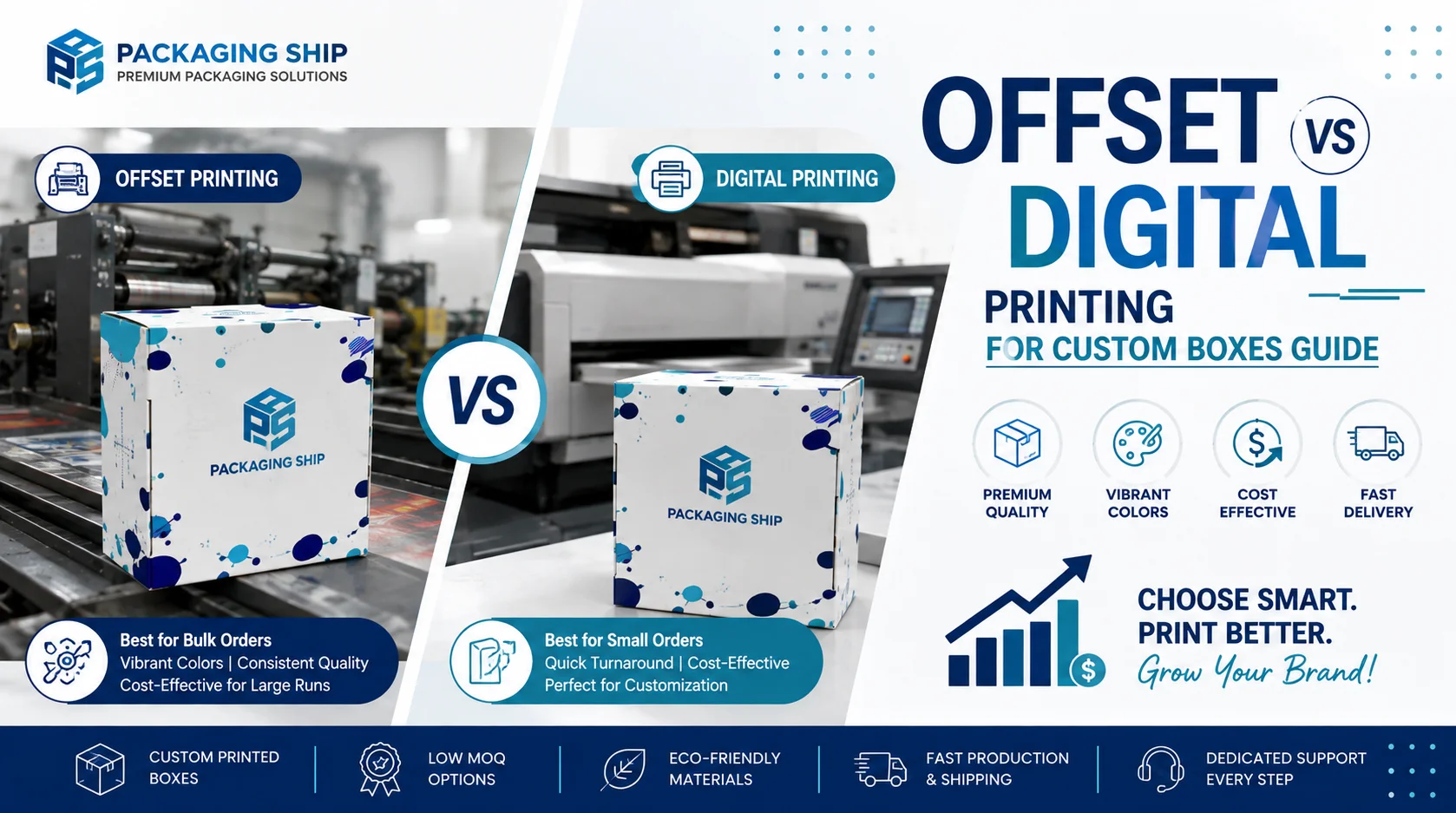
TL;DR: Offset printing uses metal plates and works best for large orders, usually 500 units or more, where color needs to stay consistent across thousands of boxes. Digital printing skips the plates and prints straight from a file, which makes it the better choice for small runs, quick launches, and orders under 300 units. Your quantity decides your printer, not the other way around.
A soap brand owner in Ohio once sent us a screenshot of a quote from another supplier. It listed a plate charge, a die charge, a spot color fee, and a digital proof fee, all before a single box was printed. She had no idea what half of it meant. She just wanted 200 boxes for a farmers market launch in three weeks.
This happens all the time. Small business owners search for offset printing vs digital printing custom boxes because they’re staring at a quote full of terms nobody explained, and they’re worried about spending money on the wrong process. This guide breaks it down in plain language, using real numbers from custom printed boxes USA production, so you can pick the right method the first time.
Offset printing, also called offset lithography, uses metal plates to transfer ink onto paperboard. Each color in your design needs its own plate. A rubber roller picks up ink from the plate and rolls it onto your box material. It’s the same core process used to print magazines and newspapers for over a century.
Because the plates are physical objects, someone has to make them before printing starts. That setup step is where the plate charge on your quote comes from. Once the plates are made, offset can run thousands of sheets quickly and hold color steady from the first box to the last.
Offset tends to shine on rigid boxes and other premium packaging where a brand needs the same shade of blue on box one and box five thousand. If you look at our custom rigid boxes, most of the premium finishes on those products, like foil stamping and soft touch lamination, pair naturally with offset because the process holds fine detail so well.
Digital printing skips the plates entirely. It prints directly from your artwork file onto the box material, somewhat like how an office printer works, just built for packaging stock at commercial scale. There’s no setup step waiting on plates, so digital printing can start production almost right after you approve your proof.
That makes digital the natural fit for small batches, prototypes, and seasonal designs that might change next month. It’s also why Packaging Ship can accept orders starting at 50 units with no minimum order requirement. Without plate costs sitting on top of every order, small businesses get access to full color custom packaging printing options that used to require a 1,000 unit commitment at traditional manufacturers.
This is where most of the fear around printing comes from. CMYK printing boxes wholesale uses four ink colors, cyan, magenta, yellow, and black, layered together to build every shade you see on screen. It works well for photos, gradients, and most everyday packaging.
Spot color, often called Pantone or PMS matching, uses a premixed ink built to match one exact shade every time. If your brand color is a very specific navy or a precise shade of pink, spot color tends to hold that shade more reliably than CMYK, especially across large offset runs.
Digital printing almost always uses CMYK. Offset can use either CMYK or spot color, which is one reason offset often wins when exact brand color matching matters most. Reputable print shops calibrate against ISO 12647, the international standard for offset color consistency, and follow G7 methodology to keep proof to print color variance tight. The PRINTING United Alliance explains that this kind of color management builds real consistency across print runs, which is exactly why your printed box should match your approved proof instead of surprising you.
Here’s the honest answer. Offset printing minimum quantity custom boxes typically sits around 500 units at most manufacturers, and often higher. Below that number, the fixed plate charge gets spread across too few boxes, so your price per unit climbs instead of dropping.
At Packaging Ship, we don’t charge plate or die fees, which shifts this math in your favor. Even so, digital printing usually still wins under 300 to 500 units simply because there’s no plate production time to wait through. Above that range, offset starts pulling ahead on both price per unit and color consistency, since the press is already running efficiently at higher volumes.
Think of it like ordering coffee for an office. A single pot brews fast with no setup. A catering urn for three hundred people takes longer to prepare, but once it’s running, it serves everyone at a lower cost per cup. Offset is the urn. Digital is the pot.
If you’re asking which printing method for 100 custom boxes, the answer is almost always digital. At that quantity, offset plate setup costs would dominate your total spend, and you’d still wait longer for production to start. Digital printing gets you full color CMYK printing at a fair per unit cost, with production starting right after your proof is approved.
This applies whether you’re ordering mailer boxes for a product launch, sample packaging for a trade show, or a first test run before committing to a bigger inventory order. A small quantity doesn’t mean lower quality. It just means a different process gets you there.
The material you choose also shapes which printing method makes sense.
A corrugated board has a textured surface, so it holds ink differently than a smooth paperboard. Digital printing works well here for shipping boxes and short run branding, while offset gets used for high volume retail shippers. Our corrugated cardboard boxes support both methods depending on your order size.
Lightweight cardboard cartons print cleanly with either method, so quantity becomes the deciding factor rather than the material itself.
Rigid boxes are the thicker, sturdier stock used for luxury cosmetics, jewelry, and presentation packaging. Offset tends to produce sharper detail and steadier solid color coverage on rigid stock, which matters when foil stamping or embossing gets layered on top.
Cost is rarely as simple as one method being cheaper across the board. It depends on where your order quantity lands.
| Factor | Digital printing | Offset printing |
| Best order size | 50 to 500 units | 500+ units |
| Setup cost | None | Plate cost, waived at Packaging Ship |
| Color matching | Strong CMYK accuracy | Best for exact Pantone matching |
| Turnaround | Faster start, no plate wait | Slightly longer setup |
| Cost per unit at low volume | Lower | Higher |
| Cost per unit at high volume | Higher | Lower |
| Best for | Launches, prototypes, small batches | Repeat orders, large retail runs |
Notice the crossover point. Somewhere between 300 and 600 units, the numbers on this table basically flip. That crossover, not a fixed rule, is the real answer to offset vs digital printing for custom packaging boxes USA buyers keep asking about.
Every quote uses a handful of terms that sound more complicated than they are. A plate charge is the cost of making the metal plates offset printing needs, and it only shows up on offset quotes. A die charge is the cost of the cutting tool that shapes your box, and it applies to both digital and offset orders since it covers the box structure, not the ink. A digital proof is just a preview of your design before production starts, so you can catch a color or layout problem before it becomes real. DPI stands for print resolution, and 300 DPI is the standard for packaging that needs to look sharp up close. A PMS or Pantone number identifies one exact color, which matters most when your brand color has to match perfectly every time.
If a quote lists these terms without explaining them, ask what each line means and why it applies to your order. A supplier that actually runs its own presses should be able to answer without hesitating.
| Question | Answer |
| Is offset printing better than digital printing? | Neither is universally better. Offset offers stronger color consistency at high volumes. Digital offers faster turnaround and lower cost at small volumes. The right choice depends on your order size. |
| What is the minimum order for offset printing? | Most manufacturers set it around 500 units because plate costs need enough volume to make sense. Some suppliers offer flexibility below that threshold. |
| Can I mix offset and digital in one order? | Rarely in a single production run, but many brands use digital for a small test batch, then move to offset once they confirm demand at scale. |
| Why didn’t my printed box match my proof? | Screens display color differently than ink on paperboard. Reputable printers calibrate to standards like ISO 12647 to keep this gap as small as possible. |
| Does Packaging Ship offer both printing methods? | Yes. Packaging Ship runs both digital and offset printing in house, so your order gets matched to whichever method fits your quantity and finish requirements. |
You don’t need to memorize any of this before placing an order. Tell us how many boxes you need, what style you’re after, and any colors that have to match exactly, and we’ll recommend the right printing method for your project, plate free and pressure free.
Request Your Free Custom Packaging Quote →
Offset printing vs digital printing custom boxes really comes down to one question. How many boxes are you ordering? Under roughly 300 to 500 units, digital printing usually saves you money and gets you moving faster. Above that range, offset printing tends to deliver steadier color and a lower cost per box.
Neither method is the wrong choice. They’re built for different stages of a business, and a first product launch often calls for a different answer than a fifth reorder does. What matters is understanding the trade off before you sign off on a quote, not after your boxes show up.
If your packaging needs to protect the product inside and still look like your brand actually made it, on a timeline you can plan around, the printing method isn’t a minor detail. It’s the decision that shapes everything else about how your box turns out. According to Ipsos research conducted for the Paper and Packaging Board, most Americans say packaging design influences their purchase decisions, which is exactly why the printing choice behind that design is worth getting right the first time.