
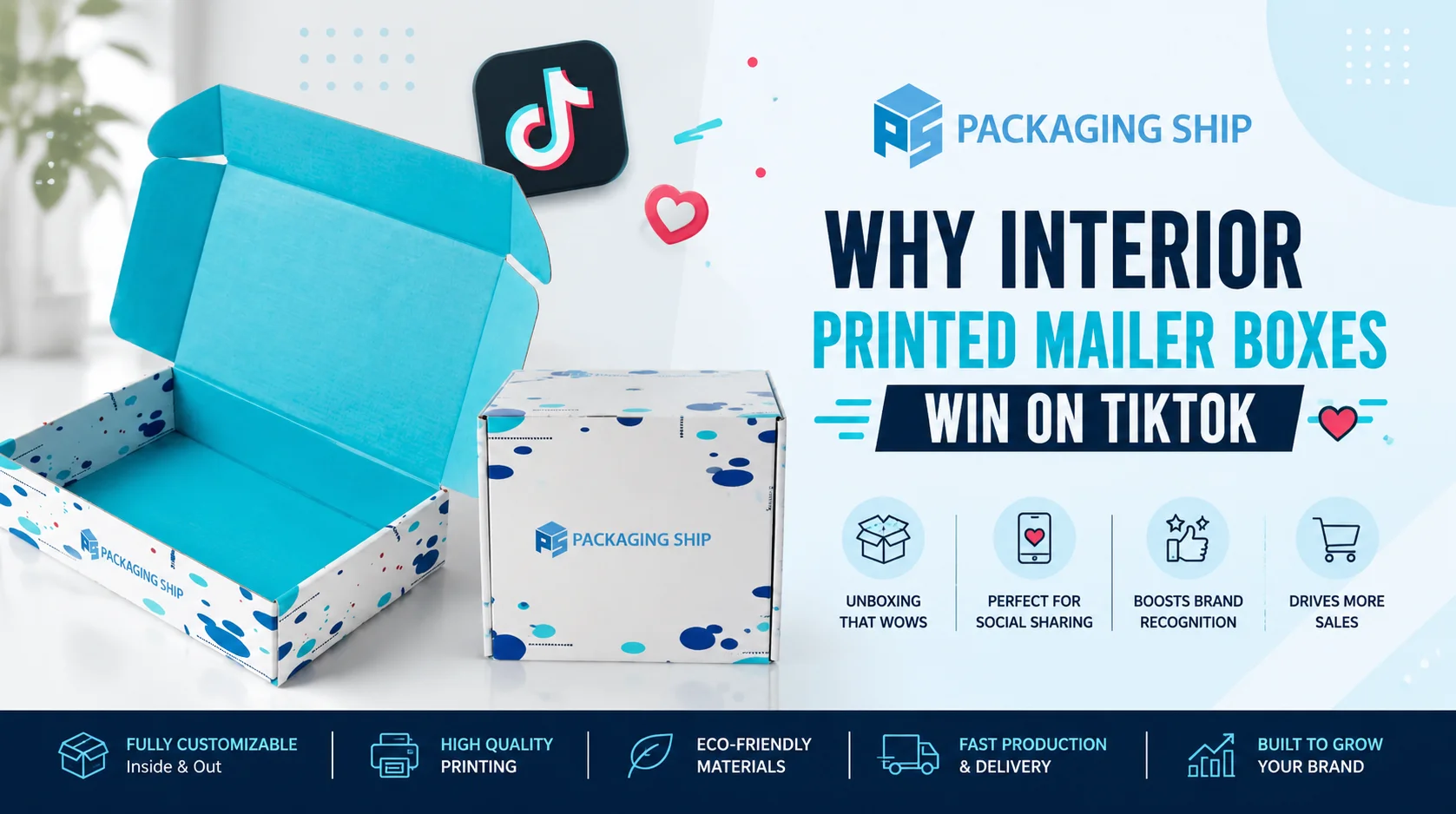
Inside box printing puts your design on the interior flaps of a mailer box instead of just the outside. It works because the moment a box opens is the exact moment a camera is pointed at it. Small brands can add it in batches as low as 50 units through digital printing, with no die charge and no plate fee. This guide covers the cost, the process, and how to get your first proof made this month.
July 2026 update. Packaging suppliers across the US are reporting a real jump in requests for interior printed mailer boxes this year, and the reason is simple. Shoppers are not just opening packages anymore. They are filming the moment.
Custom printed boxes USA sellers order used to mean a logo on the outside, maybe a brand color. That is changing fast. E-commerce packaging trends in 2026 point to one clear shift. The inside of the box now gets as much design attention as the outside, because the inside is what shows up on video. Packaging buyers and creators now have a name for this shift. They call it the inside box printing packaging trend, and it is reshaping how small brands think about their mailer boxes.
This guide from Packaging Ship walks through what the trend actually is, why it works, what it costs, and how to get your first box made without a big minimum order.
The inside box printing packaging trend means adding a full color design, a message, or a pattern to the interior flaps or walls of a box instead of only the exterior. Small and mid size brands use it on custom mailer boxes to create a surprise moment when the box opens, which drives more social shares and repeat orders than exterior branding alone.
For years, printing stopped at the outside of the box. The inside stayed plain brown or white. That made sense when a box only had to survive a shelf or a delivery truck. It does not make sense anymore, because the box now has a second job. It has to perform on camera.
An interior printed mailer box can carry a thank you note, a bold pattern, a brand story, or a small hidden design that only shows up once the flaps open. The exterior still matters for shipping and first impression. The interior is where the emotional reaction happens, and that reaction is what gets recorded and shared.
Interior printed mailer boxes win on TikTok because the moment a box opens gets far more camera time than the exterior ever does, and a hidden design creates a short burst of anticipation that makes the reveal feel more rewarding.
Think about how a typical unboxing video plays out. A creator holds up the box, talks for a few seconds, then opens it. That opening moment is the part viewers actually watch closely. It is the payoff.
An exterior design gets maybe half a second of real attention before the box starts opening. The interior gets several full seconds, often the longest single shot in the whole video. Most brands are still spending their entire design budget on the half second instead of the several seconds.
A 2018 study by the Paper and Packaging Board, conducted with Ipsos, found that roughly seven in ten shoppers say packaging design shapes their purchase decisions, and a similar share say the packaging materials themselves influence how they feel about a brand. That data predates the TikTok unboxing trend fully maturing, which suggests the influence is likely even stronger now that packaging performs in front of an audience, not just the buyer.
Packaging Dive, an industry trade publication, reported that digital printing has made interior printing far more accessible than it used to be, since digital presses can print inside surfaces without the plate costs older printing methods required. One packaging executive quoted in that report, Kerry Sanders, vice president of market development at digital printing company EFI, noted that packaging has become a genuine brand activation platform for retailers trying to stand out in a crowded market.
The inside box printing packaging trend is not only a social media trend either. It plays into a psychological effect called delayed reveal. A hidden design creates a small sense of anticipation, and that brief anticipation makes the final reveal feel more rewarding, the same way a wrapped gift feels more exciting than an unwrapped one, even when the contents are identical.
Adding inside printing to custom mailer boxes is the practical side of the inside box printing packaging trend, and it takes four steps. Pick a box style with flaps that face the camera, choose digital printing for small runs or offset for large ones, send your artwork, then approve a digital proof before production starts.
Mailer boxes and tuck-top boxes both work well for interior printing, since their flaps naturally face the camera when opened. A tuck top box in particular tends to reveal the interior print all at once, which reads very well on video.
The right method depends mostly on your order size and how detailed your design is.
| Factor | Digital Printing | Offset Printing |
| Best order size | 50 to 500 units | 500+ units |
| Plates needed | No | Yes |
| Turnaround speed | Faster, no plate setup | Slower setup, faster once running |
| Color matching | Strong for gradients and photos | Sharper Pantone (PMS) matching |
| Cost per unit, low volume | Lower | Higher, due to plate cost |
| Cost per unit, high volume | Higher | Lower, once volume covers the plate |
| Best fit for this trend | First time testers, small batch launches | Established brands scaling a proven design |
You do not need a finished print file. Many suppliers, including Packaging Ship, offer free design support and build your artwork from a logo and brand colors, then send a digital proof before anything goes to print.
Once you approve the digital proof, production typically takes 7 to 10 business days, with rush options available if you are working against a launch date.
This is the question most guides skip, and it decides whether a small brand actually moves forward. Interior printing has no flat universal price, since the added cost depends on three factors. Coverage matters first. A single color message on one flap costs far less than a full bleed, full color design across every interior panel. Method matters second. Digital printing avoids plate costs entirely, so the added expense mostly comes from extra ink and press time, not new tooling. Order size matters third, since the added cost per unit tends to shrink as quantity grows, the same way exterior printing costs shrink at higher volumes.
The practical takeaway is this. A small brand testing interior printing for the first time should expect a modest increase over a standard exterior only box, not a doubling of price, as long as the order stays in the digital printing range. The only way to know the real number for your exact box is to request a quote with both an exterior only version and an interior printed version listed side by side, so you can compare the actual dollar difference rather than guessing.
This is the core of interior custom printing small batch USA sellers can actually afford. There is no need to guess at a huge order size before you know if the design works. If you are ready to test this on your next product run, you can get a free quote in a couple of minutes and see real pricing for your exact box size before committing to anything.
The inside box printing packaging trend is not the only way to add a premium feel to a box, and it helps to know where it fits next to other finishing techniques.
| Technique | Where it’s applied | Tooling needed | Best order size |
| Interior printing | Inside flaps and walls | None, uses the digital press | Any size, including 50 units |
| Foil stamping | Usually exterior | Metal die required | Higher volume runs |
| Embossing / debossing | Pressed into the board | Metal die required | Higher volume runs |
| Spot UV | Over specific design elements | Fixed plate required | Higher volume runs |
Foil stamping presses a thin metallic or colored film onto the board, usually on the exterior, and it needs a metal die, which adds cost that only makes sense at higher volumes. Embossing and debossing press a design into the board itself for a tactile effect, but like foil, it needs a die and suits larger runs. Spot UV adds a glossy raised coating over specific elements, sharp under video lighting, but it also depends on a fixed plate cost.
Interior printing sits in a different category. It uses the same digital press as the rest of the design, needs no separate die or plate, and can change from one production run to the next without new tooling costs. That is why it fits a small batch budget in a way foil, embossing, and spot UV usually do not, even though all four techniques aim at the same goal, making a box feel considered rather than generic.
Yes, for most small brands, since digital printing removes the plate and die costs that used to make interior designs expensive, and orders can start from 50 units instead of the thousands older printing methods required.
Business owners want the premium look they see in viral videos, but assume it needs a premium budget and a huge minimum order. That assumption is outdated. Custom mailer boxes with interior print do not require a five thousand unit commitment, since there is no die charge or plate charge, and orders start from 50 units.
That changes the math. A brand testing a new product can order a small batch, film the unboxing, see how it performs, then scale once the design proves itself.
A Packaging Digest report on Dotcom Distribution’s ecommerce packaging survey found that 39% of online shoppers had shared a photo or video of a new purchase on social media, and 60% said they’d be more likely to share it if the packaging felt gift-like rather than a plain brown box. You do not need luxury materials to earn a share. You need a design moment worth filming, and interior printing creates that moment at a fraction of the cost of rigid boxes or heavy foil work
Not every category uses interior printing the same way, since the approach depends on what is inside the box.
Food and bakery brands often pair interior printing with a windowed lid or a printed thank you message on the flap, since customers frequently film the moment a bakery box opens. If you are shipping baked goods or snack products, food packaging built on FDA compliant, food contact safe stock keeps the interior print looking sharp without compromising safety.
Cosmetic and skincare brands tend to use interior printing alongside soft touch lamination or a subtle foil accent, since these categories lean toward a quieter, more premium feel rather than a bold pattern.
CBD and cannabis brands face an extra layer of complexity, since compliance rules affect label space and child resistant packaging requirements. For pouch style products, mylar bags offer a practical way to combine interior branding with the barrier protection these products need. If you are deciding between formats, this breakdown of how mylar bags compare to rigid boxes for CBD products covers the tradeoffs in more depth.
Sustainability and social media appeal are not opposites. More brands now pair interior printing with recycled or FSC certified stock, since customers increasingly notice packaging materials, not just the visual design.
Water based, low VOC inks now produce strong, vibrant interior prints without relying on solvent based inks, which matters for food adjacent products and for brands marketing themselves as environmentally conscious. If sustainable materials are part of your brand story, this guide to eco-friendly custom packaging boxes explains which certified materials are actually verifiable, rather than just labeled as green.
| Question | Answer |
| What is inside box printing? | It is printing a design, message, or pattern on the interior flaps or walls of a box instead of only the outside, timed to reveal itself when the box opens. |
| Is inside box printing more expensive than regular printing? | It adds some cost since it covers extra surface area, but digital printing keeps that added cost manageable for small orders, especially compared to older plate based methods. |
| What is the minimum order for a custom box with interior printing? | Orders can start from 50 units when using digital printing, with no die charge or plate charge added to the price. |
| Does interior printing work for small e-commerce brands? | Yes. Small batch digital printing was built for exactly this use case, letting a brand test a design before committing to a large order. |
| How long does production take? | Standard production runs 7 to 10 business days after you approve your digital proof, with rush options available. |
| What is the difference between interior printing and a printed insert? | Interior printing is applied directly to the box itself, while an insert is a separate piece of material placed inside the box. Interior printing tends to survive shipping better since it cannot shift or fall out. |
If you want a mailer box that actually performs when the camera turns on, the interior is where that happens. You do not need a big budget or a big order to test it.
Get a free quote today and see real pricing for a custom mailer box with interior printing built around your product, your budget, and your order size.
The inside box printing packaging trend is not going away in 2026, because it solves a real problem. Brands need a way to stand out in a video that lasts a few seconds, and the interior of the box is the part of that video customers actually watch closely. Small brands can test this trend without a large order, without a die charge, and without waiting weeks for production. Start with one product line, order a small batch, film the results, and let the data tell you whether to scale it up.