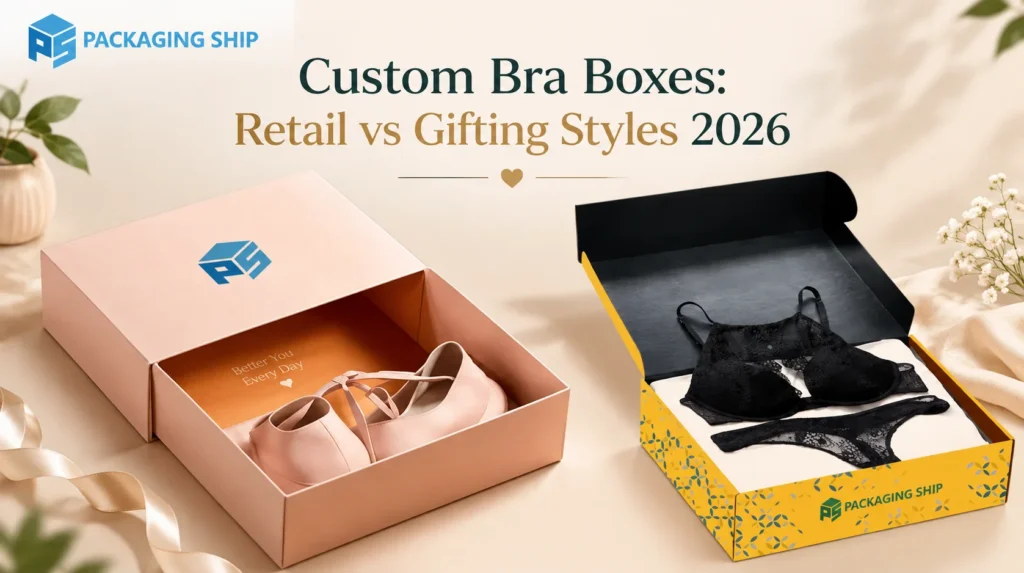
What Is the Right Custom Bra Box in 2026? Rigid drawer boxes built from 24pt or thicker board hold their shape on a retail shelf and under repeated handling. For e-commerce gifting, a lighter drawer style bra gift box with a tissue insert and ribbon pull creates a better unboxing moment, without the shipping weight or the collapse risk that comes from ordering the wrong board thickness. Table of Contents If you sell lingerie in a store and ship it to a customer’s door, you already know one packaging style rarely does both jobs well. Custom bra boxes built for a retail shelf and custom bra boxes built for a gift order are solving two different problems, and mixing them up is where most brands lose money on reprints and damaged returns. This guide comes from working directly with a US based custom packaging manufacturer, so the specs below reflect what actually ships well, not just what looks good in a mockup. Retail Shelf vs E-Commerce Gifting A retail bra box and a gifting bra box are built for different jobs. Retail shelf packaging needs to: Gifting packaging needs to: Why Shipping Damage Costs More for Bras Than Most Products Intimate apparel already carries one of the highest return rates in fashion e-commerce, mostly because fit is hard to judge without trying the product on. A case study on undergarment and lingerie sales found that online return rates in Europe jump to 25 to 40%, compared to roughly 8% for the same items bought in a physical store. Fit is largely out of a brand’s control once the order ships. Packaging is not. A crushed rigid box or a bra that arrives misshapen from a thin insert gives the customer a second reason to send it back, stacked on top of a sizing problem you may not be able to fix. Getting the box right is one of the few return drivers a lingerie brand can actually control. Rigid Bra Boxes for Boutique and Retail Display For boutiques and department shelves, rigid custom bra boxes made from 2mm board with a magnetic or window lid perform best. Why rigid stock works for retail: Best Finishes for Retail Shelf Presence Drawer Style Bra Gift Boxes for Online Orders For direct to consumer orders, a drawer style bra gift box strikes a better balance between protection and presentation. What makes a drawer box work for gifting: According to Retail Dive’s reporting on Dotcom Distribution’s e-commerce packaging research, 52% of shoppers are more likely to make a repeat purchase from a retailer that ships orders in premium, branded packaging. For subscription and gift set brands, this repeat purchase link is the entire business case for upgrading from a plain mailer to a drawer style box. Padded and Sports Bra Packaging Custom sports bra boxes usually skip the delicate finishes altogether. What sports bra packaging needs instead: This keeps custom bra packaging affordable for brands running frequent seasonal drops, since you’re not paying for a full rigid build every time. Bra Box Style Comparison Table Style Best For Board or Material Key Feature Rigid window box Retail shelf, boutique 2mm rigid board Shows product, resists dents Drawer style gift box E-commerce, gifting 24pt folding carton or rigid Slide reveal, unboxing moment Padded sports bra box Activewear, fitness lines Matte kraft or corrugated Foam insert, low cost per unit Bra gift set box Bundles, holidays 24pt to 2mm depending on size Fits two or three items The Number One Mistake: Wrong Board Weight Causing Boxes to Collapse This is the complaint we hear most from first time buyers of custom bra boxes wholesale. A brand orders a rigid style but specs a thin folding carton board, and the box arrives at the customer’s door crushed at the corners. The fix breaks down by box type: If you’re unsure which spec fits your box size and shipping method, ask your manufacturer to confirm board weight against your actual carrier and dimensions before production starts, not after. How to Choose the Right Custom Bra Boxes Wholesale Option Match the box to where it lives most of the time, not to what looks best in a mockup. Bundling for Higher Order Value Bra gift set boxes sell better when they’re part of a coordinated packaging line, not a one off item. Common bundle pairings brands request: Keeping the box style and print approach consistent across these product lines makes a multi item gift set look intentional instead of thrown together. FAQs Question Direct Answer What board weight stops a bra box from collapsing in shipping? Use 24pt board minimum for small drawer boxes, and 2mm rigid board for larger gift sets shipped without an outer mailer. Do bras need rigid packaging? Only if the box is sold on a shelf or shipped without an outer protective mailer. Padded corrugated or kraft works for most direct to consumer orders. What is a drawer style bra box used for? Drawer boxes are used for gifting and subscription orders because the sliding reveal creates an unboxing moment that plain mailers don’t. How long does custom bra box production take? Most manufacturers quote 7 to 10 business days for standard runs once artwork is approved. Can I order custom bra boxes without a minimum quantity? Yes. Several US manufacturers, including Packaging Ship, offer no minimum programs so new lingerie brands can test packaging before committing to bulk stock. Get Your Custom Bra Boxes Quote Once you know whether your line needs retail rigid, a drawer gift style, or padded sports packaging, the next step is pricing it against your real dimensions and order volume. Packaging Ship, which also builds related apparel packaging for scarves and socks, offers proofing before production so you can catch a board weight problem before it becomes a shipping problem. Get a Free Quote in Under 2 Minutes → Conclusion Retail and gifting are two different jobs, and custom bra boxes should be specced for the one
Custom Apparel Boxes: The 2026 Packaging Guide for US Fashion and Clothing Brands TL;DR: Custom apparel boxes protect clothing, cut down on return related damage, and let small fashion brands look a lot more established than their order size suggests. This guide walks through materials, sizing, pricing, sustainability, and what to check before ordering, along with real return and market data. There’s a quick FAQ near the end, plus a link to get a free quote from Packaging Ship. Table of Contents Fashion moves fast. A new clothing brand can go from idea to first sale in a matter of weeks, yet most founders don’t think about the box until an order is sitting there ready to ship. That’s usually a mistake, and an easy one to avoid. Custom apparel boxes are one of the few places where a small label can genuinely look like a bigger one, without needing a bigger budget to pull it off. This guide covers what custom apparel boxes actually are, roughly what they cost heading into 2026, which materials suit which products, and a few things worth checking before you place your first order. What Are Custom Apparel Boxes in 2026? Custom apparel boxes are branded, made to size packaging that clothing brands use to ship, store, or display garments. They’re typically made from kraft, rigid, or corrugated material, printed with a logo and brand colors, and shaped to fit specific items like shirts, dresses, scarves, or accessories, rather than being a generic shipping box that happens to have your logo slapped on it. Why Custom Apparel Boxes Matter for Fashion Brands Packaging isn’t just decoration, though a lot of brands treat it that way until they see the numbers. It’s the first physical thing a customer touches after buying from you, so it colors how they judge the product before they’ve even opened it. For clothing brands specifically, that first impression carries extra weight. Fashion buyers are already forming opinions about quality and finish the second they see the box, often before the garment comes out. Packaging Shapes the First Impression A study by the Paper and Packaging Board, conducted with Ipsos, found that 72% of consumers say packaging design influences their purchase decisions, and 67% say the same about the materials a product is packaged in. So the box isn’t just a formality tacked onto the end of an order. It plays a real part in whether a customer walks away thinking your brand feels premium, or just kind of forgettable. The Apparel Packaging Market Backing This Up This isn’t a niche concern either. The corrugated packaging sector, which includes the wardrobe and ship ready boxes commonly used for garment shipment, is projected to reach approximately $80.8 billion by the end of 2026, according to Markets. E-commerce growth and global trade expansion are both pushing that number up, and both of those trends run straight through apparel. That kind of growth says something. More brands are starting to treat the box as an actual line item worth planning for, instead of something you figure out the week before shipping. Returns Are Rising, and Apparel Leads the Pack The National Retail Federation’s 2025 Retail Returns Landscape report, produced with Happy Returns, found that online purchases come back at a rate well above in store shopping. Apparel is one of the categories consistently pushing that number higher, usually because of fit issues, shipping damage, or a product that just didn’t match what the buyer expected. A well built custom apparel box won’t fix a sizing problem. What it will do is protect the garment from crushing and moisture, and it leaves a cleaner first impression than a plain poly mailer ever could. Metric 2024 2025 Overall retail return rate 16.9% 15.8% Online return rate N/A 19.3% Total returned merchandise $890 billion $849.9 billion Source: National Retail Federation and Happy Returns, 2025 Retail Returns Landscape report. Where Custom Apparel Boxes Pay Off for Small Brands A founder shipping fifty units a month isn’t going to out price a big retailer, and honestly shouldn’t try to. What they can do is compete on presentation, and packaging happens to be one of the cheapest ways to do that. This is really where custom apparel boxes prove their worth for a small brand, letting a one person operation look as finished as a company ten times its size. What are the types of Custom Apparel Boxes for Every Product Not every garment needs the same box, and treating them all the same tends to either waste money or risk damaging something delicate. A scarf and a wedding dress just don’t pack the same way. Packaging Ship’s custom apparel boxes line covers folding cartons, rigid boxes, and mailer styles built specifically for clothing, so brands can match the box to the product instead of forcing one style to handle everything. Custom Apparel Boxes for Specialty Garments Specialty items usually get the worst packaging treatment, mostly because brands don’t realize a dedicated box already exists for them. For lightweight accessories, custom scarf boxes keep delicate fabric from creasing while still looking gift ready on a shelf or inside a mailer. For bridal and formal wear, a bridal dress storage box gives full length garments the structure and coverage they need. That matters a lot when a customer is paying a premium price and expecting the packaging to reflect it. For everyday basics, custom socks packaging boxes work well for multi pack bundles, subscription drops, or shelf display in a retail setting. And for layered pieces, custom vest packaging boxes offer enough depth so structured fabric doesn’t get crushed in transit. Materials and Printing Options Material choice affects both what you pay and how premium the box feels once it’s in someone’s hands. The right pick really comes down to your product, your price point, and how far the box has to travel. Material Best For Key Trait Kraft board Casual and streetwear brands Lightweight, natural texture Rigid board Premium
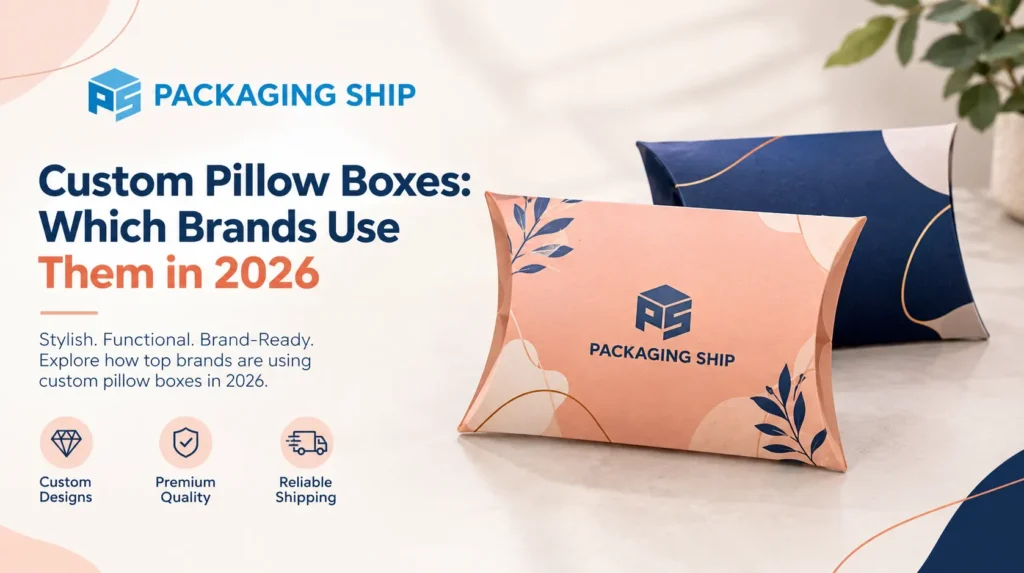
Custom Pillow Boxes: Which Brands Use Them and What Makes Them Convert? TL;DR: Custom pillow boxes work great for small, light products like jewelry, candy, soap, and gift favors, but only if the material and finish are right. A cheap looking curve undoes a nice logo fast. Packaging Ship ships custom pillow boxes wholesale with no minimum across the USA, backed by a free proof, so you can test a size before committing to a full run. In this article: What Are Custom Pillow Boxes? (2026 Guide) Picture a small box that curves in the middle instead of sitting flat and square. That’s a pillow box. Fold the side flaps in, and the paperboard puffs up into that soft, rounded shape people recognize instantly. Brands reach for this format when they’re packing something small, like jewelry, candy, or a bar of soap, because it closes on its own with no glue or tape, and ships flat until you’re ready to fill it. Which Brands Use Pillow Box Packaging Walk through any jewelry seller’s Etsy shop and you’ll spot pillow boxes everywhere. A pair of earrings or a delicate chain sits in that curved pouch and doesn’t move around in transit, which matters once a box has gone through a sorting facility. Chocolate and candy brands lean on the same shape for truffles and small treats, often choosing a kraft pillow box because the natural, unbleached look reads as handmade. Soap and bath brands use pillow boxes too, mostly because the curve wraps around a bar of soap without extra padding, which keeps shipping weight down. Wedding favor shops and gift brands like the format for a different reason. It already looks finished, no extra wrapping needed. There’s a pattern here. Every one of these brands ships something under a few ounces. Once a product gets heavier or bulkier, a pillow box loses its shape fast, and that’s when it’s time to look at something sturdier. What Makes a Pillow Box Convert Here’s where most brands get it wrong. A pillow box looks cheap for pretty ordinary reasons: thin stock that bends the moment it hits a delivery truck, a dull print job, or a size that doesn’t fit what’s inside. None of that is really about the format. It’s about execution. What makes one look premium comes down to a few things working together. The material has to match what’s inside, a heavier or rigid board for jewelry that costs more, a kraft pillow box for a brand leaning eco or handmade. The curve needs to feel snug, not loose, since a box that runs even slightly big loses that pillow like shape fast. A small finishing detail, a foil edge, a ribbon pull, or just a cleaner print run, tells a customer someone thought about the moment they’d open it. A study run by researchers at the University of Wisconsin, working with Pregis, found that packaging choices shift how people perceive a product’s value before they’ve even touched it, with premium packaging scoring far higher on attractiveness and prestige than plain packaging, even though the product inside was identical. Read the full Pregis unboxing study for the complete numbers. Same product, different box, completely different reaction. Pillow Boxes vs Tuck Boxes, Display Boxes, and Gable Boxes Pillow boxes aren’t the right call for everything, and that’s fine. Forcing one format to do every job is how brands end up with packaging that doesn’t fit the product. Here’s a faster way to compare the four formats we get asked about most: Format Best For Key Strength Pillow Box Jewelry, candy, soap, small gifts Soft curve holds small items snugly, no glue needed Tuck Top Box Apparel, multi item sets Holds shape under stacking and pressure Display Box Retail shelf products Stands upright and grabs shopper attention Gable Box Bakery goods, takeout gifts Built in carry handle Custom pillow boxes work best when the product is light, small, and meant to feel like a little reveal when it’s opened. Anything heavier, match the format to the product first, then worry about finishes. Custom Pillow Boxes for Jewelry Jewelry might be the clearest example of a pillow box doing something useful, not just looking nice. The curved sides press in just enough to hold a pair of earrings or a bracelet without foam inserts or dividers. For a single piece, a kraft pillow box or a simple printed one looks personal without trying too hard. That said, pillow boxes don’t work for every jewelry brand. Stackable rings or layered necklace sets, anything that reads more as a collection than a single gift, usually does better in a rigid custom jewelry box built for more structure and shelf presence. It comes down to whether you’re protecting one item or presenting several. How to Order Custom Pillow Boxes Wholesale, No Minimum, USA Most large packaging manufacturers won’t touch an order under 1,000 units, fine if you’re an established brand, pretty useless if you’re just testing whether a format works for your product. That’s why Packaging Ship starts custom pillow boxes wholesale with no minimum USA orders at 50 units. Test a size, see how it holds up, then decide if you want to scale. Every order comes with a free digital proof, usually back in your inbox within 24 to 48 hours, so you approve your actual design before anything gets printed. Standard production takes 7 to 10 business days, and pricing starts around $0.20 per unit depending on size and material. The custom pillow boxes page has the full range if you want to see sizes and finishes for yourself, and you can request exact pricing from there. FAQS: Question Direct Answer Are pillow boxes good for shipping? For light items under a few ounces, yes. Put them inside a sturdy mailer box for extra protection in transit. What size pillow box fits jewelry or soap? Around 3x3x1 inches works for earrings, rings, and bar soap. Go bigger for candles or gift
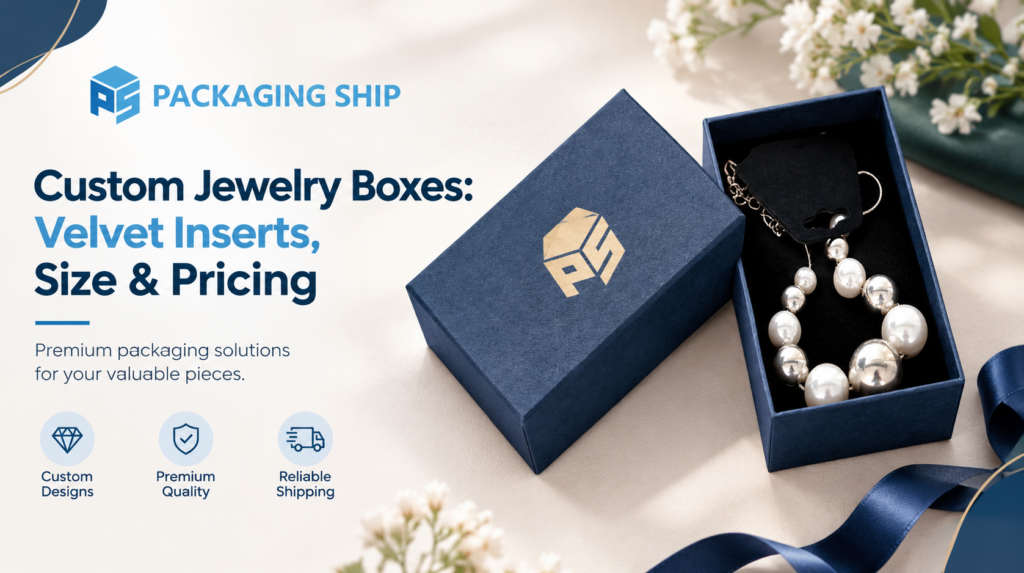
Table of Contents You spent weeks on the design. Then a customer opens the box, and the ring lies sideways. That moment costs you trust. Good custom jewelry boxes prevent it. This guide shows how inserts, sizes, and materials work together, so your first bulk order fits right. What Are Custom Jewelry Boxes in 2026? Custom jewelry boxes are made to the exact size, style, and print of your line. Each one has a fitted insert that holds the piece still. You choose the material, the closure, and the logo finish, then order a small or large run. Material sets price, feel, and strength. Rigid board, up to 2 mm thick, protects gold and diamond pieces. Cardboard, from 14 pt, suits fashion lines on retail shelves. For a natural look, many brands pick kraft jewelry boxes for simple studs and charms. Watch your green claims. The FTC Green Guides tell marketers to qualify partly recycled claims, such as “Made from 30% recycled material.” Print the real percentage, not just “eco friendly.” Why Does My Ring Shift? Velvet Inserts That Fit Fit matters because packaging sells. In an Adobe Express survey, 73% of consumers said premium packaging improves how they see a brand. Also, 57% of consumers with a memorable packaging experience bought from that brand again. A ring shifts when the slot is too wide, too shallow, or too soft. Most fit complaints about custom jewelry boxes trace back to the insert. Velvet is only the finish. The grip comes from the foam or board under it. Run three checks. First, measure the tallest point of the piece. That is usually the setting, not the band. Next, choose a slot deep enough to seat the band fully. Insert makers commonly cut ring slots about 20 to 25 mm deep. Finally, close the lid with the real ring inside. Try this quick math. Your box is 35 mm tall inside. The insert takes 20 mm. That leaves 15 mm of headroom. A ring standing 14 mm above the insert barely clears the lid. So pick a lower insert or a taller box. You can pair our ring box packaging with custom inserts and match the slot to the band. Then shake the closed box. Flip it and reopen it. If the ring moves, the fit is wrong. What Size Should Custom Jewelry Boxes Be? Size starts with the insert, not the outside. Measure the piece in three directions. Add the insert thickness. Then leave a small gap so the lid closes softly. Subtract insert depth from the inside height to find your true usable space. Our quote form asks for length, width, and depth in inches. Necklace Gift Box Tips for Pendants Chains tangle and kink. So a necklace gift box needs a spot for the clasp and a pad for the chain. For a single charm, pendant boxes with a shaped pad keep the pendant centered and the chain flat. Silver tarnishes in storage, so consider a tarnish resistant wrap. Earring Packaging Box and Anklet Options Loose earrings twist. Use a slit card or paired foam cavities, so both stay level. Anklets are long and light. Coil them on a pillow or wrap them around a card. Our anklet boxes can suit either layout. What Do Fine Jewelry Brands Order? Your buyers have plenty of choices. Grand View Research estimates the U.S. jewelry market at $78.4 billion in 2025, with 5% yearly growth projected through 2033. Fine brands treat custom jewelry boxes as part of the product. For a fine piece, we would spec a rigid box with a magnetic closure, a velvet wrapped foam insert, soft touch lamination, and hot foil stamping for the logo. Add a branded mailer and tissue from our range of custom packaging boxes. Print runs use CMYK, and offset orders can match Pantone colors. Planning a holiday drop? Think about custom christmas boxes early. Lock artwork and insert size for your custom jewelry boxes in October. Add a festive sleeve or ribbon to your standard box instead of starting a new build. Specs, Pricing, and Lead Time Custom Jewelry Boxes Wholesale USA No Minimum Packaging Ship pricing starts at $0.20 per unit. Jewelry quotes vary by size, material, print, and quantity. Here is what every order includes: Get Your Jewelry Boxes Quoted Today Send your sizes and quantities. We reply with a clear price and a free proof. Request a Free Quote Final Thoughts Strong custom jewelry boxes hold each piece still, close without pressure, and look like your brand. Measure first, test the insert, then scale up. Small fit details shape how buyers judge your brand. A snug insert shows you care before they touch the piece. Send us your sizes, and we will help you match each insert to each piece FAQS OF Jewelry Boxes Question Short answer What is the minimum order for jewelry boxes? We start at 50 units. There is no set minimum. How do I stop a ring from moving in its box? Use a snug foam insert with a slot cut to the band width. Test it with the lid closed. What is the best insert for jewelry boxes? Foam wrapped in velvet suits, rings and earrings. Cards and boards suit flat pieces. How long does production take? 7 to 10 business days after proof approval. Rush takes 4 to 5. Shipping adds 2 to 5.
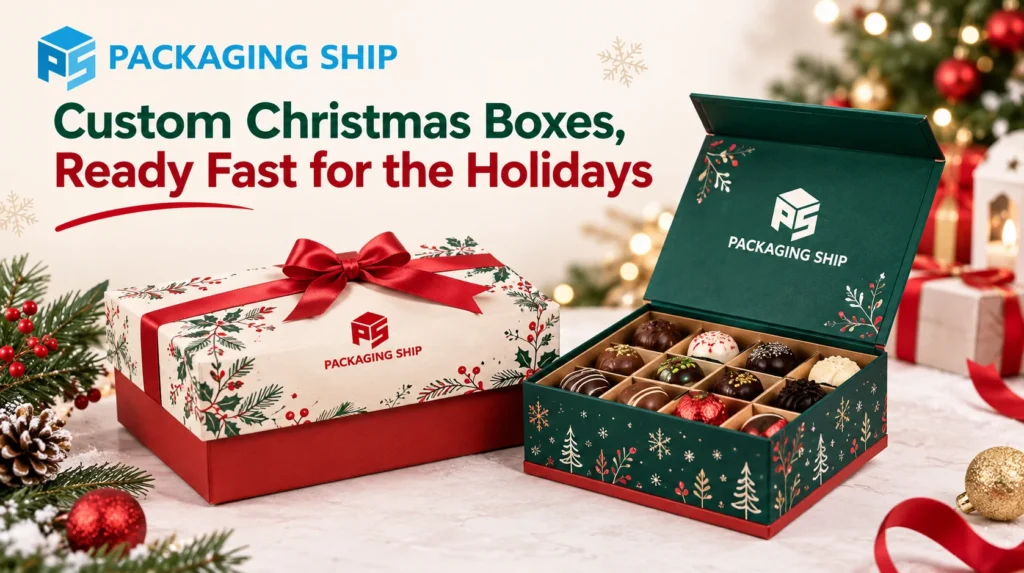
Custom Christmas Boxes: How to Order Holiday Packaging Without a 3-Month Lead Time TL;DR: Most holiday packaging suppliers need 6 to 10 weeks, and by the time a small brand finds that out, the calendar is already against them. This guide breaks down realistic production timelines, the hidden costs of ordering late, and how to lock in holiday boxes with weeks to spare instead of gambling on a rush order. In this guide: A brand we talked with last year placed their box order in early September. Their supplier quoted 10 weeks. By the time the boxes shipped, it was mid December, and by the time they cleared customs and freight, the product was still sitting in a warehouse two weeks after Christmas. That’s not a rare story. It’s the default outcome when a small brand treats packaging like an afterthought instead of a deadline. This guide walks through what actually drives holiday packaging timelines, what a realistic order calendar looks like, and where custom Christmas boxes fit into a launch that still has time to work. What Are Custom Christmas Boxes in 2026? Custom Christmas boxes are printed, brand specific packaging made for holiday products, gift sets, or seasonal SKUs, usually produced in cardboard, kraft, or rigid stock with festive colors and finishes. In 2026, most small brands order them in digital print runs under 500 units, since that keeps setup time low and lets a first time seller test a holiday product without committing to a big batch. Which Box Style Fits Your Product? Why Holiday Packaging Deadlines Catch Small Brands Off Guard Holiday demand keeps climbing, which is exactly why packaging capacity gets tight every year. The National Retail Federation’s official 2025 holiday forecast put November and December retail sales above $1 trillion for the first time ever, with shoppers planning to spend $890 per person on gifts, food, and decor. When demand hits records like that, suppliers get slammed too, and the brands who ordered early are the ones who don’t get stuck waiting. Here’s the part most suppliers don’t lead with. A 6 to 10 week production timeline sounds fine in July. It stops sounding fine once you add design revisions, a proof delay, and standard ground freight on top of it. Key 2026 Holiday Deadlines to Work Backward From Flexport, a major freight and logistics provider, publishes exact dates every year so merchants can plan backward. Here’s how those dates line up against a realistic packaging timeline: Milestone Date Why It Matters Black Friday & Cyber Monday inventory deadline November 6, 2026 Recommended date to have inventory stocked and ready Full holiday inventory deadline November 21, 2026 Recommended cutoff for December holiday demand Super Saturday, the last big rush day December 19, 2026 Final wave of last minute holiday orders Recommended order-by date for custom boxes Mid October Leaves buffer for proof revisions, production, and ground shipping Work backward from those dates once you factor in a multi week production run, and a September order is already cutting it close. One place in October is a gamble. The lead time problem also rarely shows up alone. It usually travels with: Any one of these can sink a seasonal launch. Together, they’re why so many small brands quietly give up on custom Christmas boxes and settle for plain shipping boxes with a sticker slapped on top. How Fast Can You Get Custom Christmas Boxes Wholesale in the USA? At Packaging Ship, a direct US packaging manufacturer, the numbers look like this: That means a brand ordering in mid to late October can still have finished, printed custom Christmas boxes in hand well before the Super Saturday rush, with room left over for a reprint if something needs fixing. Best Custom Christmas Boxes for Holiday Gifting Not every holiday product needs the same box. A few styles worth knowing before you request a quote: For smaller or lighter items, like a candle, a bar of soap, or a small accessory, custom gable boxes are worth a look too. The fold and lock construction skips glue assembly, they ship flat to keep freight costs down, and they still take full color printing plus a carrying handle that feels gift ready off the shelf. For a brand adding one seasonal item without redesigning its whole packaging line, gable boxes are often the fastest style from quote to shelf. Packaging quality also does real work at the register. A September 2026 VistaPrint survey of 1,000 US adults found that 89% say packaging quality shapes how they judge the product inside, and 46% said it affects whether they’ll buy from that brand again. For a holiday gift, where first impressions matter even more, that’s not a small detail to skip. FAQs Question Answer What’s the minimum order for custom Christmas boxes? There’s no minimum order requirement. Orders start from 50 units, so you can test a holiday SKU without committing to a bulk run. How fast can I get holiday packaging made and shipped? Standard production is 7 to 10 business days after proof approval, with rush options in 4 to 5 business days for most styles. Is this holiday packaging available in eco-friendly materials? Yes. FSC certified kraft and cardboard, recycled content stock, and water-based inks are available on request. Do I need a designer to place an order? No. Send your logo and brand colors, and the design team builds a print-ready proof for you within 24 to 48 hours. What’s the last safe date to order holiday packaging for Christmas? Aim to place your order by mid October. That leaves room for proof revisions, standard production, and free ground shipping before Super Saturday. Get Your Holiday Packaging Locked In Every week you wait shrinks the buffer between your order and the holidays. If your product is ready but your packaging isn’t, that’s the one thing standing between you and a season you already worked hard to earn. Get a Free Estimate → Final Thoughts A missed
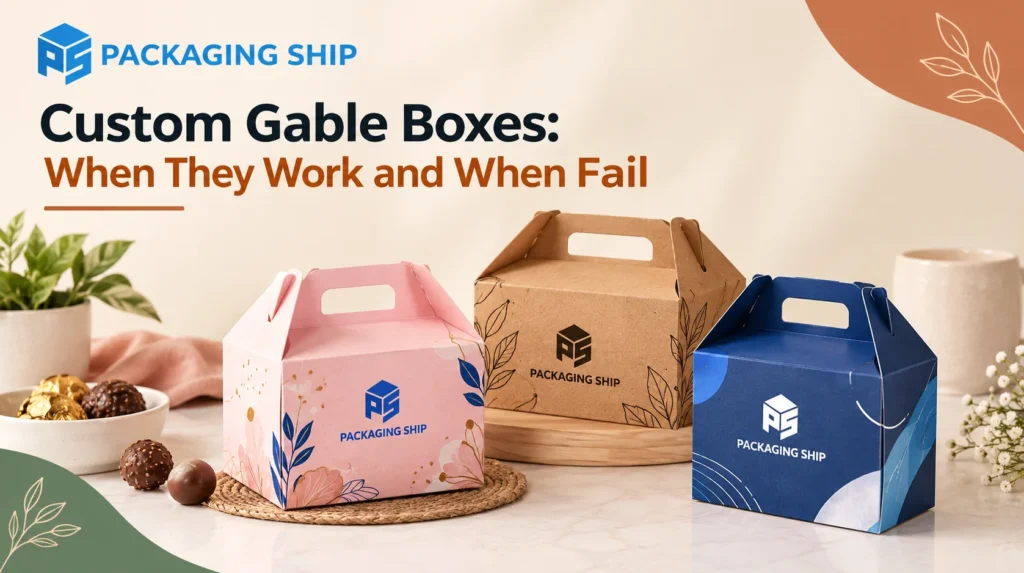
Custom Gable Boxes: When Are They Right and When Do They Fail? TL;DR Custom gable boxes are a strong packaging choice for lightweight retail, bakery, and gift products under about two pounds. They fail most often when brands pick a board weight that is too light for the product inside, which causes the handle to tear during carrying. The fix is simple. Match your board weight to your product weight before you print, not after. What Are Custom Gable Boxes in 2026? Table of Contents When Custom Gable Boxes Are the Right Choice Gable boxes earn their keep when three things line up. The product is light, the box needs to be carried by hand, and the brand wants shelf appeal without paying for a rigid box. Bakeries use them constantly for cookies, small cakes, and gift sets, because the handle turns a simple box into a takeaway item without extra packaging. Candle brands and small gift retailers use them for the same reason. A customer can pick one up off a shelf and walk out holding it, no bag needed. If you sell through a storefront, a farmers market, or a retail partner, a well built gable box also gives you shelf presence that a flat mailer cannot. Pair that with a display setup and the box becomes part of your merchandising, not just your packaging. This is where our team often points bakery and gift clients toward custom display boxes as a companion piece, since the two work well together at point of sale. When Gable Boxes Fail, and Why Here is where most packaging guides go quiet, and where most of the actual customer problems show up. What Board Weight Should You Actually Choose This is the part almost no competitor page explains with real numbers, and it is the part that prevents the handle tear problem above. Board Weight (GSM) Best For Handle Durability 300 GSM Light items, individual candies, small favors, light gifts Adequate for items under 1 lb, not recommended for handle carrying above that 350 GSM Standard retail and bakery gable boxes, most common everyday use Reliable for items up to roughly 1.5 to 2 lbs 400 GSM Heavier gift sets, bundled products, premium positioning Strong enough for items over 2 lbs, best resistance to handle tearing If your product sits close to or above two pounds, do not default to the cheapest board option. Ask for 350 or 400 GSM, or consider moving to a custom mailer box, which distributes weight across the whole structure instead of concentrating it at a handle. Kraft Versus Cardboard, Which One Fits Your Brand Kraft paper gives a warm, natural look that signals sustainability and craft, and it takes deep, saturated ink colors well, especially metallics. It is the common choice for bakeries, candle brands, and eco positioned gift companies. Cardboard, usually coated white board, gives sharper color reproduction and a cleaner, more polished look. It suits brands leaning toward a premium or modern retail feel rather than a rustic one. Neither one is objectively better. The choice comes down to what story your packaging needs to tell on a shelf. One related note worth mentioning here. Brands packaging assortments like custom chocolate boxes usually run into a different tradeoff than the tear problem above. Chocolate pieces need cushioning inserts and structural support far more than they need heavier boards, since the risk is breakage in transit, not handling failure. The lesson is the same though. Match the spec to the actual failure risk of your product, not to a generic template. Is a Gable Box Food Safe? Yes, when it is built for food contact. A food safe gable box uses FDA compliant food contact board, along with a grease resistant coating for items with oil content and water based, low VOC inks. If you are packaging anything that touches food directly, specify this at the quote stage so the right material and coating get selected from the start. Gable Box Versus Other Box Styles How to Order Wholesale With No Minimum in the USA One reason gable boxes work so well for small and growing brands is that you no longer need to commit to a huge print run to get them. Custom gable boxes with no minimum USA production are now standard at manufacturers built for small business volume, meaning you can order as few as fifty units, test the packaging with real customers, and scale up once you know it performs. Why This Actually Matters for Your Packaging Budget, Not Just Looks Gable boxes fall under the folding carton category, and that category is not a small or shrinking part of the packaging industry. According to a market analysis published by Future Market Insights, the USA folding carton market is valued at roughly 15.6 billion dollars in 2026 and is projected to grow at a 4.4 percent CAGR through 2036, driven largely by demand from healthcare, beauty, specialty food, and sustainable paperboard packaging applications, the exact categories most gable box buyers fall into. That growth is not happening because folding cartons are the cheapest option on the market. It is happening because brands in food, beauty, and gifting keep choosing paperboard formats that customers can hold, open, and recognize as intentional packaging rather than a plain shipping container. A gable box built to the right spec is part of that same demand curve, not a side product. Material sourcing matters just as much as format. If sustainability is part of your brand story, look for FSC certified board, verified through the Forest Stewardship Council’s chain of custody system, which confirms the paper came from responsibly managed forests rather than being a marketing claim with nothing behind it. Get a Custom Gable Box Quote Built Around Your Product, Not a Template Your product’s weight, shape, and use case should decide your box spec, not the other way around. Send us your product dimensions and approximate weight, and we will recommend the right
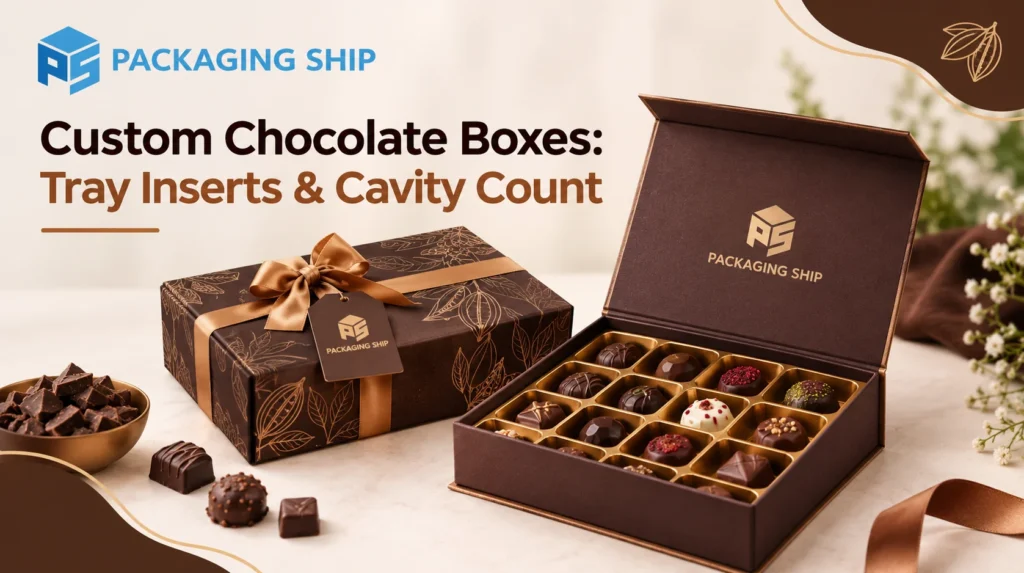
Custom Chocolate Boxes: Tray Inserts, Windows, and Getting the Count Right TL;DR: Custom chocolate boxes fail more often from wrong cavity depth than wrong cavity count. Match tray depth to the chocolate’s height, not the box height. Use PET film windows for anything that ships. Order from a US manufacturer with no die charge and a low minimum, so a small batch will not cost you a setup fee. What’s in this guide Open a shipping box of hand made chocolates and you expect neat rows, not a scene from a small accident. Two truffles have rolled into a corner. One praline is cracked down the middle. This happens more often than most chocolate brands think, and it almost never means the chocolate itself was bad. It means the tray inside the box did not match the product. Custom chocolate boxes only work when the cavity count, the tray depth, and the window are built around the exact chocolate going inside them, not around a generic size chart. What Are Custom Chocolate Boxes in 2026? A custom chocolate box is packaging built to a chocolatier’s exact specs, not picked off a shelf. It includes an outer box, a tray insert sized to the chocolate, and often a window. In 2026, most US chocolate brands order these from one manufacturer that also handles printing, so the box, the tray, and the branding come from a single factory. Packaging Ship builds these boxes in house at its own New York factory, so the tray and the outer box are made under one roof, not split between two suppliers. How Many Chocolates Fit in a Box? Cavity Counts by Size Cavity count is the first spec most people get wrong. Truffle packaging usually needs deeper cavities than flat pralines, and cavity counts commonly run at 4, 6, 8, 12, 16, 18, and 24 chocolates per tray. Bonbons and truffles usually need 8 to 12 cavities in a standard gift size box, while thin pralines fit better in 16 to 24 shallow cavities. You can look through custom chocolate boxes built around each of these counts before you choose one for your product. Cavity Sizes for Custom Chocolate Boxes Cavity Count Best For Typical Well Size 4 to 6 Large truffles, bars 1.5 to 2 inches 8 to 12 Standard truffles, bonbons 1.25 inches 16 to 18 Small pralines 1 inch 24 Thin chocolates, bark pieces 0.75 inches Getting Tray Depth Right So Chocolates Do Not Shift Depth causes more damage than count. A tray that is too deep lets chocolates roll and slide during transit. A tray that is too shallow crushes chocolates when the lid presses down. The fix is simple. Measure the tallest point of your chocolate, then choose a cavity depth about one eighth of an inch deeper than that measurement. That small gap keeps the piece snug without trapping it. If you are unsure, send your chocolate’s exact height and width when you request a quote, so the tray gets built around your product instead of a standard mold. Chocolate Box Windows, Film or Open Cutout A window sells the chocolate before the box is opened, but it can also be the weak point. An open die cut window with no film lets in air and moisture, which speeds up sugar bloom on chocolate near the surface. A PET film window seals the cut edge and still shows the product clearly. If your custom chocolate boxes will sit on a shelf for more than a few days, or ship any real distance, choose the film option over an open cutout every time. What Heat Does to Chocolate Inside the Box Cocoa butter starts to soften around 86 to 90 degrees Fahrenheit, well below a warm delivery truck in summer. Once it softens and re hardens, fat bloom appears as a dull, whitish streak on the surface. A study from Mendel University in Brno, published in the Potravinarstvo Slovak Journal of Food Sciences, stored chocolate at four temperatures for eighteen weeks and found that samples kept at 6 and 12 degrees Celsius held their color and texture far better than samples kept near 30 degrees Celsius, which showed heavy fat bloom within weeks. A well built tray will not stop heat on its own, but it can reduce how much a piece moves and rubs against the box during a temperature swing, which lowers visible damage even when some bloom still happens. Packaging made from FDA compliant food contact materials matters here too, since the box and the chocolate stay in direct contact for days at a time. Custom Chocolate Gift Boxes vs Praline Boxes A praline box is built purely around the chocolate, tight cavities, minimal branding space, made for wholesale and retail shelves. A chocolate gift box usually adds more, ribbon slots, printed lids, sometimes a second layer for cards or small extras. If you are shipping direct to a customer for a holiday or an event, a gift format usually converts better than a plain praline box, since the unboxing itself becomes part of the gift. That is the real difference between a plain praline box and one of the custom chocolate boxes built specifically for gifting. Many chocolate brands end up needing both formats over time, since a praline box works for wholesale orders to other retailers while custom chocolate gift boxes handle direct to consumer holiday and corporate orders. It is also common for a chocolate brand to expand into gift boxes more broadly once they start bundling chocolate with candles, cards, or other small items, since a chocolate specific tray will not fit a mixed product box. Seasonal Formats, Christmas and Chocolate Bomb Boxes Seasonal demand changes what a chocolate box needs to do. Christmas chocolate boxes usually need higher cavity counts for stocking stuffers and gift sets, along with sturdier board since they travel through cold trucks and warm homes in the same week. Chocolate bomb boxes are a different problem. A
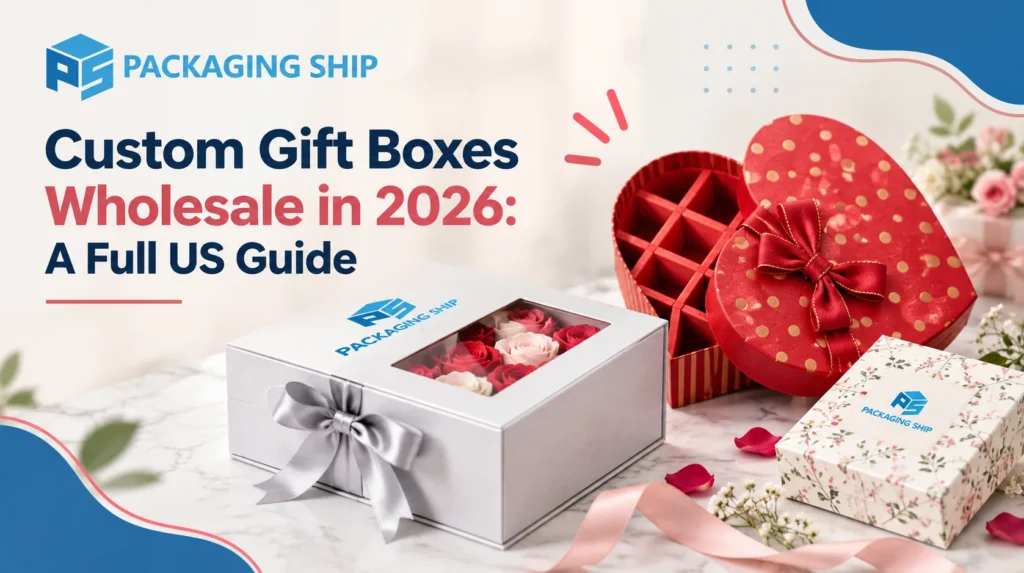
Custom Gift Boxes Wholesale in 2026: Rigid, Folding, and Magnetic Options for US Brands TL;DR: Short version, three box types, three totally different jobs. Rigid feels expensive. Folding is what you use once volume gets real. Magnetic sticks around on someone’s shelf long after the sale. And no, you don’t need a warehouse of inventory anymore, most US suppliers, Packaging Ship included, will start at 50 units, ship free, and turn it around in seven to ten days. In This Guide: A small skincare brand ships out its first holiday gift set. Three products, wrapped in tissue paper, dropped into a plain shipping box. The customer opens it. Shrugs. Moves on with her day. Now swap that plain box for a rigid one, ribbon pull, foil logo, the works. Same three products. Totally different reaction. Maybe she snaps a photo. Maybe the box sits on her dresser for a month before she tosses it. That’s the whole game with custom gift boxes, honestly. It’s why the category keeps growing every year, and why brands that used to ship in plain cardboard are suddenly ordering wholesale gift boxes just to get that one small reaction. What Are Custom Gift Boxes in 2026? A custom gift box, put simply, is packaging built to your size and your design instead of something pulled off a shelf. Pick your material, rigid board, folding cardboard, or magnetic closures, then add your own printing, ribbon, or foil. Most wholesale suppliers in 2026 won’t even ask for a minimum order. Why bring this up? Because the market backs it up. IMARC Group puts global gift packaging at close to 25 billion dollars in 2025, still climbing. VistaPrint ran a survey that found something similar, 89 percent of shoppers said packaging quality changes how they see the product inside, before they’ve even touched it. So brands stopped treating the box as an afterthought. It’s part of the product now, not wrapping paper around it. Worth a look at our gift box page before you settle on a style. Rigid, Folding, or Magnetic Custom Gift Boxes: Which One Fits? Not every gift box style works for every product. A candle needs different protection than a silk scarf. Here’s how the three main options stack up. Rigid Custom Gift Boxes for a Luxury Feel Manufacturers build rigid boxes from thick chipboard, usually somewhere between 800 and 1200 GSM, then wrap it in printed paper or matte film. It doesn’t fold flat. That’s kind of the point, the stiffness alone makes it feel expensive before you’ve even lifted the lid. Cosmetics brands use rigid. So do jewelry brands, and the chocolate companies charging thirty dollars for a small box of truffles. Weight and structure do a lot of the selling before anyone opens anything. Toss in a ribbon pull or a foil logo and you’ve got luxury gift packaging that competes with boxes priced three times higher. Folding Carton Gift Boxes for Bigger Orders Folding cartons ship flat, then pop into shape by hand in a few seconds, no glue gun required. Cheaper per unit once you’re ordering in real volume, which is exactly why nearly every subscription box on the market skips rigid entirely. Headed for a store shelf instead of someone’s doorstep? A folding carton with a printed window will usually outsell a closed rigid box. People want to see what they’re buying before they hand over money for it. Magnetic Gift Boxes for a Reusable Unboxing Small magnets sit inside the lid. Close it and you get a soft click instead of a flap that never quite sits right. Most magnetic boxes collapse flat before assembly too, so shipping costs stay down on your end. And because the box survives being opened and closed a hundred times, people actually keep it. That’s free advertising sitting on someone’s dresser for months. It’s usually the pick for gift set packaging in the USA once the holidays hit, when the box itself is basically half the present. Box Style Best For Cost Level Reusable Typical Lead Time Rigid Cosmetics, jewelry, premium chocolate Highest Sometimes 7 to 10 days Folding carton Subscription boxes, retail display Lowest No 7 to 10 days Magnetic closure Repeat gifting, corporate gifts Mid to high Yes 7 to 10 days The Real Problems Brands Hit When Ordering Gift Boxes Wholesale In three decades of pricing out packaging orders, the same mistakes come up again and again. Gift Box Styles for Every Season and Occasion Not every gift box has to be a plain rectangle. Packing holiday treats? Custom Christmas gift boxes with festive printing beat out plain kraft, and it’s not close, every December. Jewelry, bath bombs, anything small and light? Custom gift pillow boxes curve into shape without tape or glue, and shipping costs less too. Valentine’s Day and anniversary gifts call for something more playful sometimes. Heart shaped gift boxes are one of the rare styles where the shape does the marketing for you. December doesn’t own the seasonal packaging game either. Come October, brands selling candy or small novelty items switch over to custom Halloween gift boxes, catching shoppers standing in front of a seasonal display trying to decide. What Wholesale Gift Boxes Cost in the US Price comes down to size, material, and print colors, roughly in that order. Folding cartons start around 20 cents a unit once you’re at higher volumes. Rigid boxes with foil stamping climb closer to a dollar. No die charges tacked on at checkout, no plate fees either, the number in your quote is the number on your invoice, period. Want an exact price for your custom gift boxes instead of a range? Send your dimensions and quantity through our free estimate form. Most quotes land back in your inbox within a day, proof attached, ready for you to approve before anything hits the press. Ready to Order? Here’s Your Free Quote No finished design needed. No warehouse full of inventory either. Send us your box size
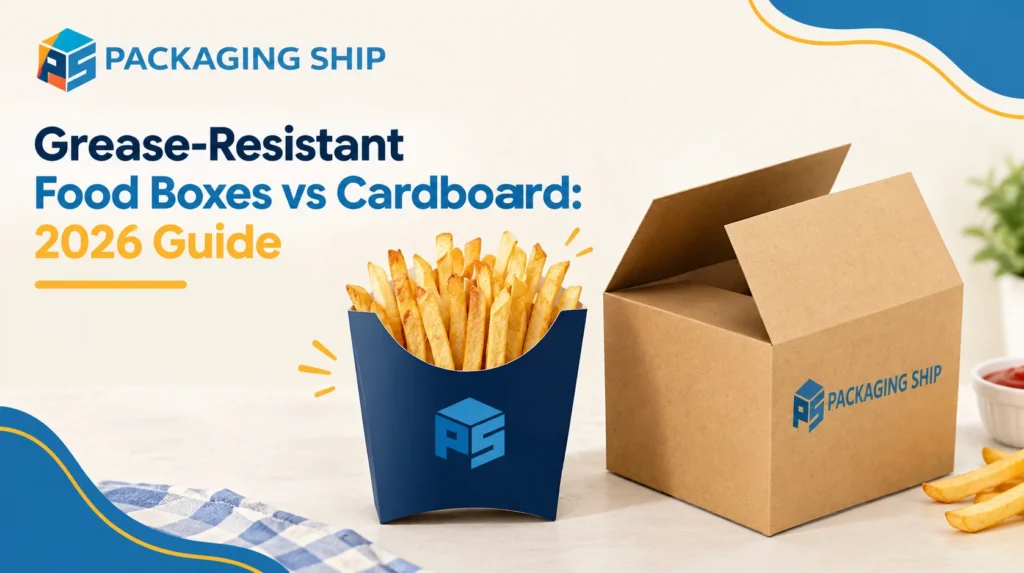
Grease-Resistant Food Boxes vs Standard Cardboard: What’s the Real Difference? What Are Grease-Resistant Food Boxes in 2026? Grease resistant food boxes are paperboard containers treated with a barrier coating, usually PE, wax, or a water based dispersion, that stops oil and moisture from soaking through the fiber. Standard cardboard has no such barrier. Under a hot, greasy food item, plain cardboard absorbs oil within minutes, weakens, and stains through to the outside. That single coating layer is the real difference. Table of Contents If you have ever pulled a box of fried chicken or a warm empanada out of a paper bag and watched a dark, translucent stain spread across the bottom, you already know why this topic matters. That stain is not just cosmetic. It is the packaging failing at its one job. At Packaging Ship, we get calls almost every week from restaurant owners and food brands who ordered plain cardboard, watched it fail on the first greasy order, and had no idea what to ask for instead. This guide breaks down exactly what separates grease-resistant food boxes from standard cardboard, so you can order the right one the first time. What Is a Grease-Resistant Food Box, Really? A grease resistant food box starts as the same base material as standard cardboard, either kraft paperboard or corrugated fiberboard. What changes is a thin functional layer added during production. This layer, known as a food box barrier coating, sits on the inside surface and physically blocks oil from migrating through the fiber. Here’s why uncoated cardboard can’t do this on its own: This is different from a box simply being thick or sturdy. Thickness affects strength. Coating affects grease resistance. Mixing the two up is one of the most common ordering mistakes we see. Why Standard Cardboard Stains and Fails With Greasy Food Standard cardboard was built for dry goods, shipping, and general retail, not hot, oily food. When grease hits uncoated fiber, three things happen in order: The real cost is bigger than the box itself. A stained, sagging box shows up in delivery photos and quietly damages a brand a business spent real money building. For fried food, sandwiches, or buttery baked goods, plain cardboard is close to a guaranteed failure point, not an occasional risk. PE Coated vs Wax vs Water-Based Coating: Full Comparison This is the question we hear most, and most suppliers answer it badly. Here’s the direct comparison. Coating Type Grease Resistance Best For Watch Out For PE coating Strongest, most consistent barrier Hot, oily food like burgers, fried chicken, takeout Harder to repulp than water-based options Wax coating Moderate, weakens under heat Light pastries, low-oil baked goods Breaks down faster with repeated handling Water-based dispersion Solid for short contact time Fast food, dry snacks, sustainability-focused brands Less durable for long delivery windows How to Match Coating to Your Food Type This one decision point solves the ordering confusion that sends most buyers back to their supplier for a second, more expensive order after the first one fails. Where Grease Resistance Matters Most, By Food Type Fried and Saucy Takeout Fried and saucy dishes make grease resistance non negotiable. Our custom Chinese takeout boxes are built with a PE barrier as standard for exactly this reason. Filled Handheld Food Warm fillings create oil and steam at the same time. A custom empanada boxes order needs a coating that handles both at once. Sandwiches and Deli Items Mayonnaise, dressings, and deli meats release oil steadily over time. Our custom sandwich boxes are built to hold that back through a full delivery window. Bakery Items Bakery items are a lighter case but still real. A glazed item in custom donut boxes can leave an oil ring on an uncoated board within an hour on a warm day. Loose Leaf and Infused Products Even custom tea boxes need consideration, since oil-infused blends can transfer natural oils onto uncoated interiors over a longer shelf life. Hot Dogs, A Special Case Hot dogs combine three stresses at once: grease from the meat, steam from the bun, and acidic staining from ketchup or mustard. A box built for hot dogs needs a coating that resists oil migration and moisture absorption together, a tougher combination than most single-category foods require. Is Grease-Resistant Packaging Food Safe and PFAS Free? This is where outdated information circulates, so the current facts matter. On February 28, 2024, the FDA confirmed that grease proofing substances containing PFAS chemicals are no longer sold by manufacturers for food contact use anywhere in the US, closing a voluntary phase out that began in 2020, according to the FDA’s official constituent update. PE coating and water-based dispersion coating are the compliant replacement technologies now standard across the industry. Major paperboard producers, including StoraEnso, publish detailed technical breakdowns of how modern PE and dispersion barrier coatings function as the industry standard replacement. In short: legitimate PE coated and water-based coated boxes sold in the US today are not using PFAS, because that supply chain no longer legally exists. How Much Do Grease-Resistant Food Boxes Cost? Grease resistant coating adds a modest cost over plain uncoated board, typically a few cents per unit depending on box size, coating type, and order volume. For a business ordering custom cake boxes or any grease-exposed product line, that small per-unit increase is almost always cheaper than reprinting a failed batch, or the reputational cost of a stained box reaching a customer. Get a Custom Quote on Grease-Resistant Food Boxes Ready to stop guessing which coating your food needs? Our design team will match the right barrier coating, board weight, and box style to your exact product, with no minimum order and a quote ready in under two minutes. Request Your Free Quote Now → Conclusion The real difference between grease resistant food boxes and standard cardboard comes down to one thin functional layer. That coating stops oil stains, prevents soggy bottoms, and keeps a box structurally sound long enough to reach a customer
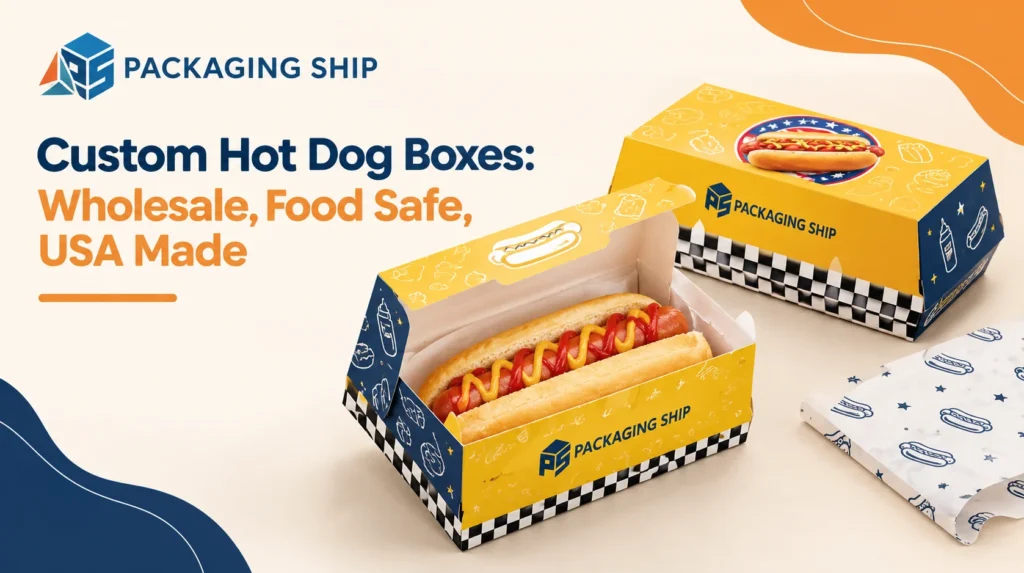
Custom Hot Dog Boxes: What Food Trucks and Stadiums Actually Need to Order TL;DR In This Article What Are Custom Hot Dog Boxes in 2026? A custom hot dog box is a food safe paperboard container built to hold a loaded hot dog without leaking or going soft from steam. In 2026, the better versions use grease resistant, PFAS free coatings and print in full color. Food trucks, stadiums, and concession stands across the USA use them daily. If you have ever watched a hot dog box give out mid rush, you already know packaging is not a small detail. It is the difference between a customer who comes back and one who walks away with sauce on their shoes. At Packaging Ship, we build custom hot dog boxes for food trucks, concession stands, and stadiums across the country, and this guide breaks down exactly what each of those buyers actually needs, not just what a catalog page claims. Why Custom Hot Dog Boxes Fail Before the Hot Dog Is Even Eaten Ask any vendor who has worked a rainy game day and you will hear the same story. The box looked fine on the counter. Ten minutes later, grease has soaked through the bottom, and the hot dog is sitting in a puddle of its own steam. This happens because too many boxes on the market are made from general purpose cardboard, not a board built for wet, hot, greasy food. Standard cardboard works fine for dry goods. It has no coating to stop oil or moisture, so it wicks liquid the same way a paper towel does. Add the steam from a fresh hot dog and a loaded bun, and a thin, uncoated box can go soft in twenty to thirty minutes. That is not a shipping problem. That is a material problem, and it shows up right in front of the customer. The fix is not complicated. A grease resistant coating on the right paperboard stops oil from bleeding through the surface, and a heavier board weight resists steam long enough to make it from the counter to the customer’s hand. That single choice, the board and the coating, decides whether a box holds up or falls apart in front of a paying customer. What Food Trucks Actually Need From a Hot Dog Box A food truck runs on speed and space. During a lunch rush, staff need to grab a box, load it, and hand it off in seconds, not fold it into shape while a line grows outside the window. Pre formed, fast assembly boxes save real time during a rush. Storage matters just as much. A truck kitchen has almost no spare room, so boxes need to stack flat and tight. And because a food truck’s whole brand often lives on that box, custom hot dog boxes printed in full color turn a five dollar hot dog into a small piece of marketing that customers photograph and share online. What Stadiums Actually Need From a Hot Dog Box Stadiums operate at a different scale entirely. The National Hot Dog and Sausage Council estimates that Americans eat around 70 hot dogs a year each, adding up to close to 20 billion hot dogs nationwide annually. A meaningful share of that gets sold at the ballpark. Reporting on Major League Baseball concessions found that ballparks moved roughly 19 million hot dogs in a single season, with one stadium alone selling more than 2.7 million. At that volume, custom hot dog boxes need to hold up across thousands of units without a single batch failing halfway through the game. Stadium concessions can bring in close to two million dollars in a single game, with fans spending an average of around thirty dollars each on food and drink, according to industry reports on stadium concession economics. A box that collapses, leaks, or slows down service at that scale is not a small inconvenience. It is lost revenue, repeated thousands of times in one afternoon. Because stadium food is almost always eaten standing up or walking, the box also needs to survive being held in one hand while a fan digs for their wallet with the other. That means a stronger fold, a secure closure, and a base that will not buckle under condiment weight. Choosing the Right Material for Hot Dog Packaging Not every paperboard behaves the same way once grease and steam get involved. Here is what actually holds up, broken down by material. Custom Hot Dog Boxes: Corrugated, Kraft, or Coated Board? Corrugated board brings strength and cushioning, which makes it a solid pick for bulk shipping or stacked storage before service. Kraft paperboard has a natural, rustic look that many food trucks like for branding, and it takes a grease resistant coating well. Coated cardboard, usually 14pt or heavier, gives the cleanest print results for full color branding and holds its shape under a loaded, sauced hot dog. For most food trucks and concession stands, coated cardboard or coated kraft with a grease resistant finish is the safer default. Save plain corrugated for outer shipping cases, not the box that touches the food directly. Packaging Ship builds its custom hot dog boxes with this logic, matching board weight and coating to how the box will actually be used, not a one size fits all spec. Custom Hot Dog Box Sizes: A Quick Reference Sizing is where a lot of buyers guess wrong. Here are the general ranges most vendors start from before customizing to their exact hot dog and topping combination. Box Type Typical Length Typical Width Typical Height Best For Standard single hot dog 6 to 7 inches 2.5 to 3 inches 1.5 to 2 inches A plain or lightly topped standard hot dog Foot long 8 to 10 inches 3 to 3.5 inches 2 inches Foot long franks that need extra length without extra topping room Loaded or stadium style 7 to 8 inches 3.5 to 4 inches 2.5 to 3 inches