
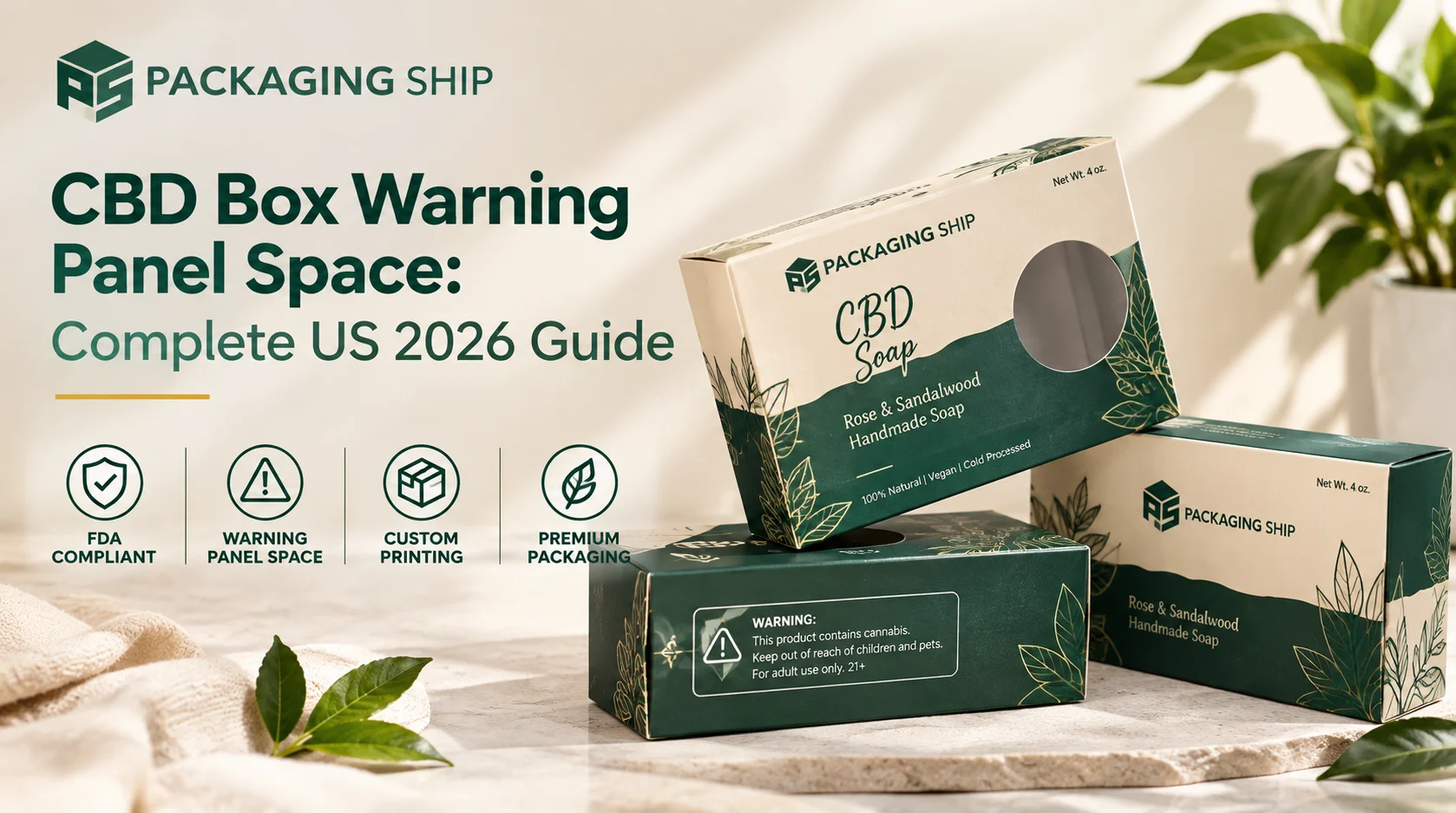
CBD box warning panel space is the room a package must set aside for required legal text, separate from your logo and brand art. There is no single federal rule that gives you an exact percentage or font size for hemp derived CBD packaging. What exists instead is a patchwork of FDA guidance, FTC enforcement action, and state specific rules for licensed cannabis products. This guide breaks down what actually has to appear on the panel, how much room to plan for, and how to solve the space problem at the dieline stage instead of after your art is already approved.
CBD box warning panel space is the printed area on a package reserved for legally required text such as usage warnings, product identity, and safety statements, separate from branding elements like the logo or color scheme. In 2026, no single federal standard sets an exact size for this space. The requirement instead comes from a mix of general FDA labeling rules and state level packaging law, which is exactly why so many designers get caught off guard.
Here’s the moment this usually happens. A designer finishes a premium tincture box, soft touch matte finish, gold foil logo, the client already signed off. Then the compliance checklist comes back and the warning statement won’t fit without shrinking the logo or resizing the box. This is why the team at Packaging Ship builds warning panel space into a dieline before a single proof goes out, not after, and it’s the same production first approach this guide follows.
Most CBD packaging content online is written for brand owners worried about fines. Designers and printers face a more specific problem: they’re the ones staring at a dieline, trying to make legally required text fit without wrecking a layout the client already loves. A large, bold, mandatory warning block can visually dominate a package designed to look premium, so the job isn’t just legal compliance, it’s making compliance look intentional rather than stapled on.
Printers face a related issue from the other direction. A file arrives with zero space budgeted for warning text, forcing a rushed fix or a return trip to the designer. Planning warning panel space early, at the dieline stage, avoids both problems at once.
Here’s a distinction a lot of published guidance gets wrong, and it matters for accuracy. Hemp derived CBD, meaning products with no more than 0.3 percent THC by dry weight, was removed from the federal controlled substances list by the 2018 Farm Bill, placing these products under FDA and FTC jurisdiction. State licensed marijuana and THC products are a separate category entirely, regulated by individual state cannabis control boards with their own specific font size, symbol size, and panel placement rules, and applying one category’s rule to the other is a common and costly mistake.
If your product is hemp derived CBD sold across multiple states, treat federal FDA and FTC guidance as your baseline, then check each state’s specific hemp and CBD labeling law on top of it. This is not legal advice, so confirm current requirements with legal counsel or your state’s regulatory agency before finalizing production.
At the federal level, FDA labeling standards call for text that is prominent, conspicuous, and easy to read, a general legibility standard that applies regardless of exact panel size. Beyond legibility, CBD packaging commonly needs to include:
The FTC has been especially active on one specific issue: unsupported health claims. Its own consumer guidance on CBD health claims makes clear that advertising CBD as a treatment or cure for serious diseases without solid scientific evidence is illegal, and it has sent warning letters over exactly this kind of claim, so designers should flag risky claim language early, not just measure font height.
There is no universal legal percentage that applies to every hemp CBD product nationwide. What experienced designers do instead is build in a planning allowance, roughly one fifth to one quarter of usable panel space for required text, before locking in logo size and decorative elements. This is a design habit, not a legal minimum, and it leaves room to adjust once your specific state requirements are confirmed.
Small format packaging makes this harder. Vape carts, tins, and small tubes often don’t have enough surface for both full branding and complete warning text without a structural change, not just a smaller font, which is where a quick conversation with your manufacturer tends to save time later.
A few patterns show up again and again in packaging that gets flagged, delayed, or sent back for rework:
The FDA keeps a public warning letter tracker for cannabis derived products, and its 2025 list alone already names seven separate companies cited for violations, a reminder that enforcement has not slowed down as the market has matured.
The box style you choose changes how much usable warning space you have, sometimes more than any layout trick can. Here’s how the most common CBD packaging formats compare:
| Box Type | Best For | Warning Panel Space Consideration | Explore |
| CBD Vape & Pen Boxes | Cartridges, pens, small batteries | Least surface area, usually needs a structural change rather than a smaller font | CBD vape and pen boxes |
| CBD Display Boxes | Retail shelf and counter presentation | Must repeat the same warnings as the primary package across visible display panels | CBD display boxes |
| Custom CBD Boxes | Tinctures, edibles, topicals, general product lines | Most flexible box size, easiest format to plan panel space into early | Custom CBD boxes |
| CBD Mylar Bags | Flower, edibles, concentrates | Back panel, gusset, and base all add usable space, more flexible than a rigid box of the same footprint | Not linked, flexible format only |
Flexible packaging is worth calling out on its own. Custom mylar bags don’t have one fixed rigid panel the way a folding carton does, which genuinely helps with space, but flexible material can shift slightly during filling and sealing, so warning text needs a small safety margin a rigid box doesn’t require.
Looping in your manufacturer earlier saves rework later. Before you lock a design, it helps to have on hand:
Sharing these details before art is finalized is a big part of why proof revisions rarely turn into structural surprises late in production.
| Question | Answer |
| How much warning label space does a CBD box need? | There’s no single federal percentage. Plan for roughly one fifth to one quarter of usable panel space as a starting allowance, then adjust for the specific states you sell into. |
| What warning statement is required on CBD packaging? | Requirements vary by product type and state, but common elements include a caution statement, product identity, net quantity, CBD content, and manufacturer contact information. |
| Can warning text use any font or size? | No. FDA labeling standards require text that is prominent, conspicuous, and easy to read, and many state cannabis programs set specific minimum font sizes for licensed products. |
| Do CBD display boxes need the same warnings as the primary package? | Generally yes, if the display box is the customer facing packaging at point of sale. Exact placement often differs due to the display’s shape. |
| Is hemp derived CBD packaging regulated the same as marijuana packaging? | No. Hemp derived CBD falls under federal FDA and FTC rules, while state licensed marijuana products follow separate, often more specific, state cannabis board regulations. |
Solving warning panel space at the design stage, instead of after art approval, is almost always faster and cheaper than reworking a finished file. If you’re comparing CBD boxes with warning panel space wholesale USA options, that’s exactly the gap a manufacturer who plans panel space into the dieline from day one is meant to fill.
CBD box warning panel space isn’t a footnote to handle at the end of a design project, it’s a structural decision that belongs at the start, right alongside box style and material choice. Get the federal and state distinction right, build in a realistic space allowance before finalizing branding, and choose a structural format that actually fits your warning text instead of fighting it. Designers and printers who plan for this upfront avoid the late stage scramble that sends approved art back to the drawing board.