
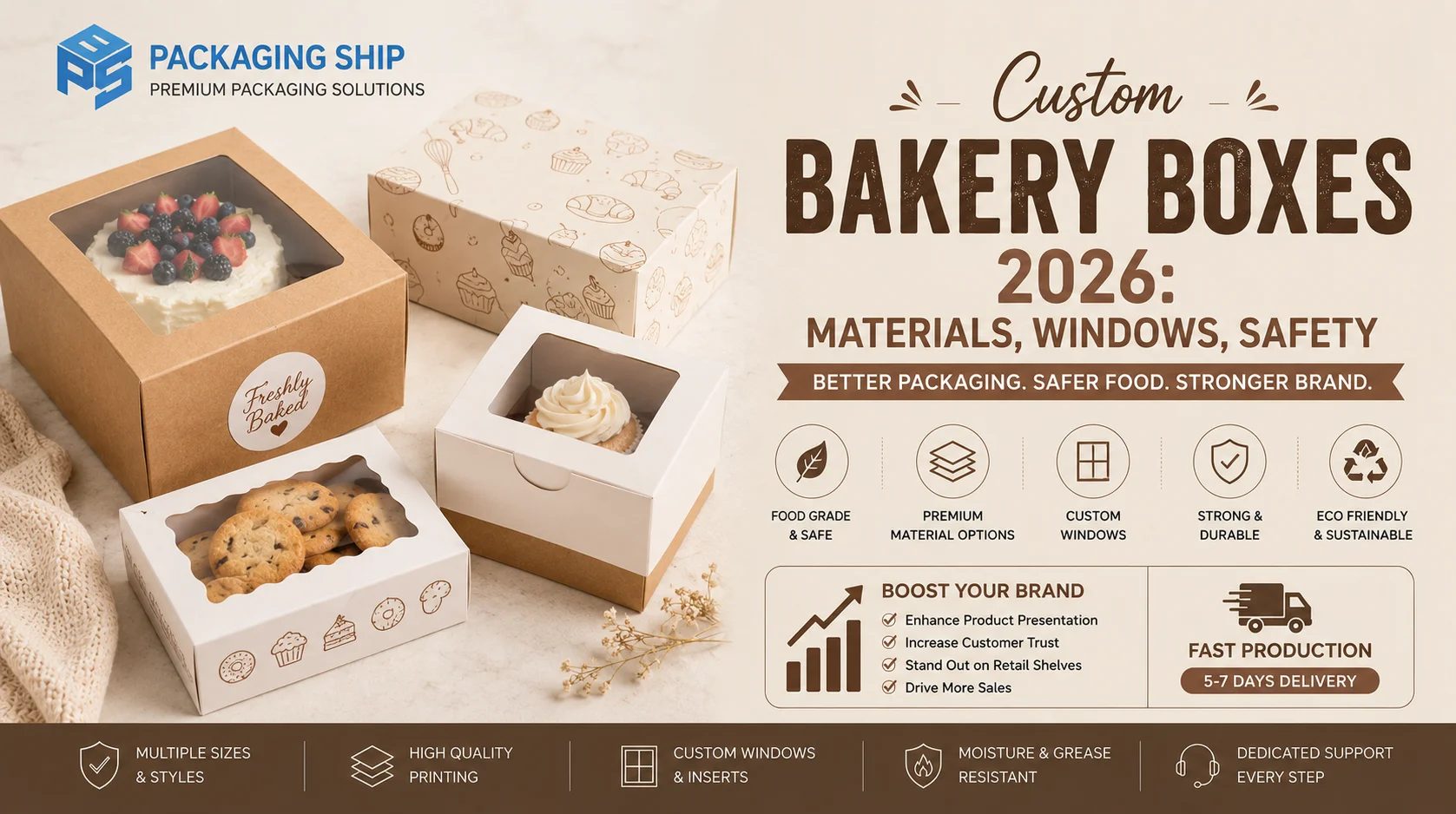
TL;DR: Custom bakery boxes affect how customers judge your price before they taste the product. This guide covers which materials hold up under grease and weight, when a window helps versus hurts, what food safe actually means under FDA rules, and how to order wholesale bakery boxes without a 1,000 unit minimum. Real numbers, real code sections, no fluff.
Custom bakery boxes are printed, branded packaging built for cakes, cookies, pastries, and baked goods, made from food safe materials like kraft, cardboard, or corrugated stock. In 2026, most US bakeries order them with a window, a custom insert, and no minimum quantity, so a small batch of 50 units costs the same per unit logic as a large wholesale run.
Here’s the part nobody tells you when you start a bakery. Your recipe is not the first thing a customer judges. The box is. At Packaging Ship, we hear this from bakery owners every week, so this guide walks through exactly what to look for.
Picture this. A bakery owner in Ohio raises her sugar cookie price from five dollars to seven after switching from a plain kraft bag with tape to a printed box with a window. A regular customer picks one up, looks at the price tag, and asks if it went up. It didn’t. The cookie is the same cookie. The box changed how she read the price.
That is not a coincidence. According to a national study by the Paper and Packaging Board, conducted with Ipsos, 72 percent of consumers say packaging design influences their purchasing decisions, and 67 percent say the same about the materials a product is packaged in.
If your bakery still hands out treats in a plain white box or a generic bag, you are asking customers to trust your pricing on faith. A well built box does that convincing for you before anyone takes a bite.
There is a second cost too, and it is less visible until it happens. A box that collapses in transit, or a window that fogs up and makes a cake look sweaty, does not just lose one sale. It makes a customer hesitate the next time they see your name on a box at all.
A food safe bakery box is packaging built from materials the FDA has cleared for direct or indirect contact with food, under the food contact substance rules in 21 CFR Parts 174 through 186. That includes the paperboard itself, any coatings, and any inks used in printing.
Here is where most bakery owners get tripped up. Saying a box is “FDA approved” is not quite accurate. Compliance depends on the specific material, the coating, and how the food touches it. A supplier should be able to tell you whether their board meets food contact requirements for your specific product, not just hand you a generic claim.
This matters most with high fat items. Butter croissants, shortbread, and anything with real cream will bleed grease through untreated cardboard within hours. A grease resistant coating, or a clay coated kraft liner, stops that. Skip it, and your customer opens a beautiful box with an oil stain spreading across the bottom.
Ask your packaging supplier two direct questions before you order. Does the material meet food contact standards for the specific product I’m packing? And does it need a grease resistant coating for fat or moisture? If they cannot answer both without hesitation, that’s a warning sign.
Not every cardboard bakery box is built the same way, and the material you pick should follow the product, not the other way around.
Here’s how the three compare side by side.
| Material | Best For | Grease Resistance | Print Quality | Shipping Strength |
| Cardboard (SBS) | Retail cookies, cupcakes, display boxes | Needs added coating | Excellent, sharp CMYK | Moderate |
| Kraft | Artisan cookies, brownies, gift assortments | Good with clay coating | Good, earthy tone | Moderate |
| Corrugated | Wholesale delivery, cafe orders, shipped goods | Needs liner for direct contact | Fair to good | Excellent |
Neither option is universally better. The right call depends on how your product travels and what your brand is trying to say on the shelf. To see every material laid out by box style and size, browse our full range of custom bakery boxes.
Cakes and cookies get most of the attention, but macarons, truffles, hand pies, and delicate pastries need their own approach. These items are small, often fragile, and usually sold as an assortment rather than one item per box.
For this category, a rigid divider or a fitted paper tray matters more than a window. It keeps each piece separated so a macaron shell does not crack against its neighbor during delivery. If you sell an assortment box for gifting season, our custom sweet boxes for pastries and confections are built with divided compartments sized for exactly this kind of order.
A window sells the product before the customer opens the lid. For decorated cookies, colorful macarons, or a beautifully iced cake, that visibility does real selling work.
But a window creates one problem competitors rarely mention. Warm baked goods release steam. If that steam has nowhere to go, it condenses on the inside of the window, and your gorgeous cake now looks like it’s sweating. Customers read fog as old, not fresh.
The fix is simple once you know it. Let items cool fully before boxing, add small vent holes near the window, or use a window film designed to resist fogging. A good supplier will ask about your product’s moisture level before recommending a window style, not just sell you the standard option. For a deeper look at fog resistant film and vent placement built for US shipping conditions, see our full guide to window bakery boxes in the USA.
A cake box with an insert is exactly what it sounds like. A structural piece inside the box, usually a cardboard platform or foam base, that locks the cake in place so it cannot slide, tip, or shift during delivery.
Wedding cakes and tiered cakes need this most. Without an insert, even a short car ride can shift a cake enough to crack the fondant or dent the frosting. One damaged wholesale delivery can end a retail relationship that took months to build.
Cupcake boxes work the same way on a smaller scale, with molded inserts holding each cupcake in its own slot so frosting never touches the lid or a neighboring cupcake. For tiered cakes specifically, our custom cake boxes with structural inserts are built with a locked base platform designed for exactly this kind of transport risk.
Cookie packaging is where the perceived value gap shows up most. A dozen cookies stacked loose in a plain bag looks like a bake sale item. The same dozen cookies in a printed box with a window and an insert tray looks like a seven dollar purchase, because it is styled like one.
Tuck top boxes work well for grab and go retail. Window boxes work better for gifting and for cookies with detailed icing work customers want to see. Insert trays keep individual cookies from sliding into each other and chipping the decoration, which matters most for royal icing or fondant work. Browse our custom cookie boxes with insert trays to see combinations sized for standard cookie dimensions.
Most large packaging manufacturers require a minimum order of 1,000 to 5,000 units. For a bakery testing a new item, or filling a single 60 box wedding order, that minimum is simply out of reach.
This is exactly why custom bakery boxes wholesale USA food safe no minimum ordering has become the standard small bakeries look for. It means you can order 50 units at the same transparent per unit pricing logic as a 5,000 unit order, without committing inventory you may never sell through.
There is a second hidden cost worth naming directly. Die charges and plate charges, often running 150 to 800 dollars, get added at checkout by many suppliers and are rarely mentioned upfront. Ask about this before you request a quote, not after you see the invoice. To see exactly how the pricing and order process works, read how no-minimum bakery box ordering works.
| Question | Answer |
| What makes a bakery box food safe? | It’s made from materials cleared under FDA food contact rules, 21 CFR Parts 174 to 186, with any needed grease resistant coating for fatty or moist products. |
| Do bakery boxes need a window? | Only if the product benefits from visibility, like decorated cookies or cakes. High moisture items need vent holes or anti fog film to avoid condensation. |
| What is the best material for cardboard bakery boxes? | SBS cardboard for sharp printed retail boxes, kraft for artisan branding, corrugated for shipped or stacked wholesale orders. |
| How much do custom bakery boxes cost? | Pricing varies by size, material, and print complexity, but no minimum order suppliers typically start well under a dollar per unit at low quantities. |
| Is there a minimum order for wholesale bakery boxes? | Not with every supplier. No minimum order programs exist specifically for bakeries testing new products or filling one time orders. |
| Why does my cake need a box insert? | An insert locks the cake in place during transport, preventing shifting, tipping, or frosting damage that a plain box cannot stop. |
Ready to stop underselling your bakes with the wrong box? Get a free bakery packaging quote today and see real pricing with no minimum order and no hidden die charges.
Custom bakery boxes are not a finishing touch you add once the product is done. They’re part of how a customer decides your price is fair before they taste anything. Get the material right for what you’re packing, get the window right for what actually needs to be seen, and get the insert right for anything fragile, and the box stops working against you. It starts doing some of the selling for you instead.