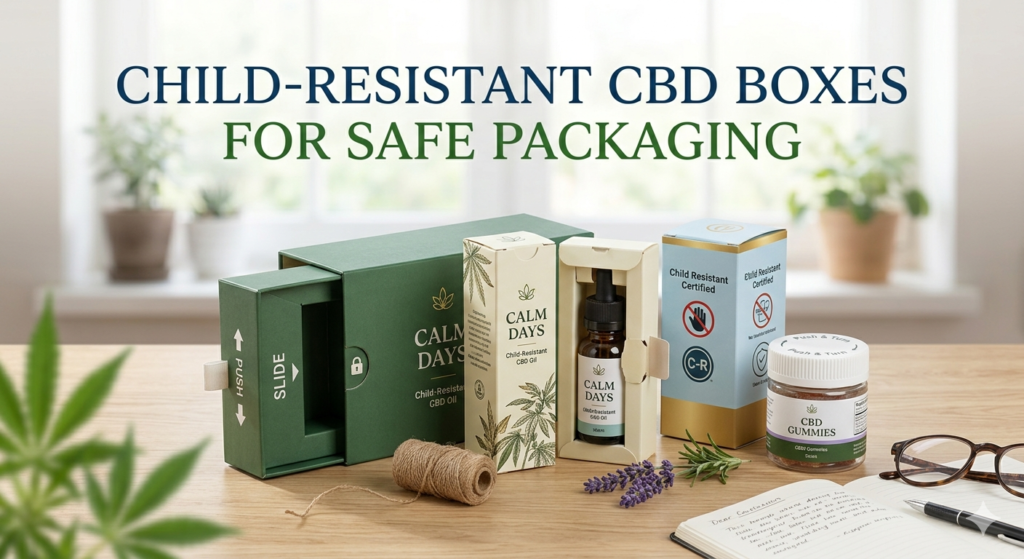
Picture this. You’ve spent eight months developing a CBD tincture line. The formula is solid. The brand looks great. You found a packaging supplier offering low MOQs and fast turnaround, so you placed the order. Three weeks after launch, a regional retail chain sends your product back. The reason? Your boxes were not child-resistant certified. This happens to CBD brands every single year. Not because they ignored compliance. Because nobody told them that “child-resistant looking” and “child-resistant certified” are two completely different things. Safe CBD packaging starts with understanding that difference. Everything else builds from there. What Child-Resistant Actually Means Under U.S. Law A lot of brands use the term loosely. Regulatory bodies do not. The U.S. Consumer Product Safety Commission sets the standard under the Poison Prevention Packaging Act. Any packaging claiming to be child-resistant must pass third-party testing under 16 CFR 1700.20. That testing uses panels of children aged 42 to 51 months. At least 85% of them must fail to open the package within the first five minutes. The 80% must still be unable to open it after a full ten minutes. At the same time, at least 90% of adults must open it successfully within five minutes. A box that snaps shut firmly does not pass this test by default. Only a packaging mechanism that has been physically tested by a CPSC-recognized third-party firm and documented with a certificate earns that designation. You can read the full standard directly on the CPSC website at cpsc.gov/FAQ/Special-Packaging-PPPA-FAQs. When you order CBD boxes, ask your supplier for that certificate. Ask them specifically which testing firm ran the protocol and under which CFR reference. If they cannot answer both questions, keep looking. Three Places CBD Brands Lose Their Retail Accounts Walk into any CBD brand’s first compliance failure and you will usually find one of three things. The first is uncertified stock packaging. Suppliers selling generic tuck-end boxes at scale will sometimes describe them as child-safe or child-friendly. Those words mean nothing without a 16 CFR 1700.20 test certificate attached to the specific SKU. One word swap in a supplier’s product description should not be enough to satisfy a state compliance review, but brands take that shortcut all the time. The second is mixing up child-resistant and tamper-evident requirements. These two are not the same job. Child-resistant packaging stops a child from getting in. Tamper-evident CBD packaging tells the buyer at the shelf that nobody else already did. Most serious retail partners require both. A shrink band, a breakable seal, or a perforated tab qualifies as tamper-evident. Neither replaces the other and both need to be on the same box if your retail target is any mid-to-large chain. The third is treating your CBD warning labels as secondary to design. In states with active cannabis or hemp regulations, label requirements are law. Font size, contrast, required symbols, batch numbers, potency per serving, manufacturer details, and in California, a Proposition 65 warning. If any of that is missing or undersized, your product fails before the buyer even opens the box. What Goes on a Compliant CBD Box in 2026 Your child-resistant CBD box needs five things working together. A certified CR closure mechanism that has been third-party tested and documented. A tamper-evident seal that is visible and unbroken at point of sale. Your product name, net quantity, and CBD milligram strength per serving printed clearly on the panel. A full ingredient list with allergen disclosures and whether the product is full-spectrum, broad-spectrum, or isolate. And a batch or lot number plus manufacturer contact details so the product is traceable. State-specific add-ons layer on top of all of that. Colorado uses a red triangle universal symbol. California adds Prop 65 language for products with detectable THC. New York has its own labeling format requirements. If you are selling nationally, your packaging needs to be built to the strictest state requirements in your distribution footprint, not just the easiest ones. A Note on CBD Oil Packaging Specifically CBD oil packaging has a compliance wrinkle that catches brands off guard. The tincture bottle’s dropper cap is often CR-certified at the primary packaging level. But in several states, the outer carton is also required to meet child-resistant standards separately. Brands that certify the bottle and ignore the box end up with a compliance gap at secondary packaging review. Your outer carton is also the thing a retail buyer holds in their hand when they are deciding whether to stock your product. Getting it structurally certified and visually branded at the same time is not a tradeoff. If you want to go deeper on this, click here to read our full CBD packaging breakdown. Compliant Packaging and Brand Quality Are Not Fighting Each Other Here is something worth pushing back on. A lot of CBD founders assume that child-resistant, compliant packaging means boring, clinical, stock-looking boxes. That assumption costs them shelf presence. The CR mechanism is part of the box’s structure. The exterior is still your brand. Full color printing, matte or gloss lamination, embossing, spot UV, foil stamping none of that affects the certification of the closure. The brands that are winning retail space right now are the ones who figured out that secure CBD packaging and beautiful branded packaging are the same box. Custom CBD Display Boxes at PackagingShip are built with certified closures and full customization from the first design brief. For brands running broader cannabis product lines, Custom Weed Pen Boxes and Custom Pre Roll Joints Boxes carry the same approach; compliance is baked into the structure, and your brand runs the exterior. Conclusion Safe CBD packaging is not complicated once you know what it actually requires. A certified child-resistant closure. A tamper-evident seal. Complete and accurate labeling for every state you sell into. Those three things together are what separates brands that grow their retail presence from brands that keep getting their products sent back. The brands doing well in 2026 are not spending more on packaging. They are spending
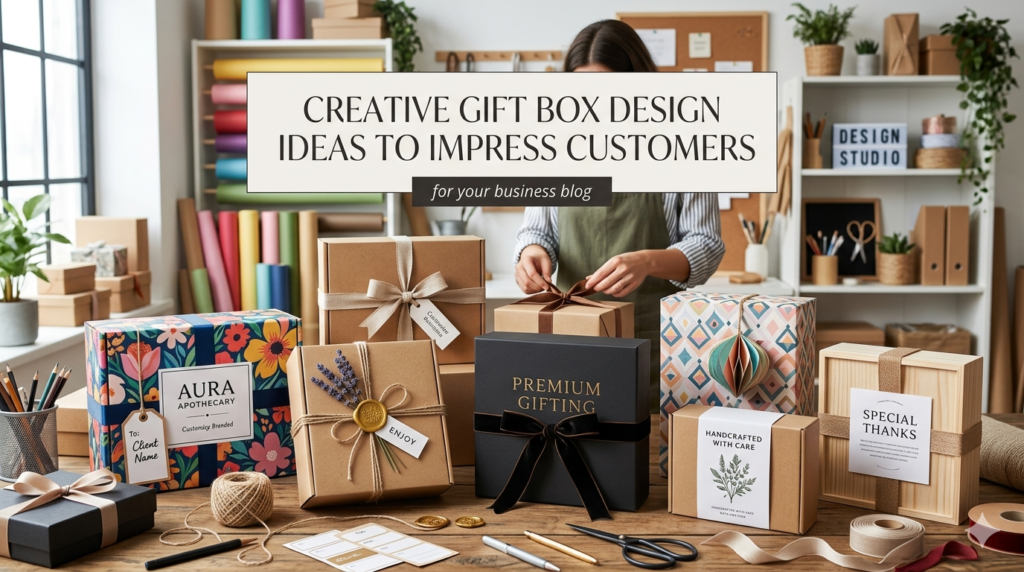
What Are the Best Gift Box Design Ideas for Brands in 2026? Your gift box touches the customer’s hands before your product does. That very first moment, the weight of the box, the texture of the finish, the way the lid opens, sets the tone for everything that comes after it. A 2024 Ipsos survey found that 72% of U.S. consumers say packaging design directly influences their purchasing decisions. That is not a small slice of your customer base. That is three out of every four people deciding whether to trust your brand based on what the box looks and feels like before the product is even visible. So no, the box is not an afterthought. It is part of the product itself. This guide walks you through creative gift box design ideas that real brands are using right now to win customers, earn repeat orders, and build the kind of packaging people photograph and share. What Makes Gift Box Design Ideas Actually Work? Here is something most growing brands get wrong. They spend weeks perfecting the product, then grab the cheapest box available and call it done. The customer opens a plain brown flap and the magic of what is inside never gets a fair chance. Good gift box design does not need to be expensive. It needs to be intentional. Three things drive whether packaging lands or falls flat in the customer’s hands. Structure sets expectations before the box even opens. A 1200 GSM rigid board box feels substantial. A thin tuck-end box flexes when you hold it. Customers read that difference in about half a second, and they make a judgment about your brand right then. Finish carries the emotional message. Soft-touch matte lamination feels premium and modern without saying a word. High-gloss UV feels energetic and bold. Gold foil on a dark background feels expensive, even when it costs very little per unit to add. Interior presentation turns a transaction into a memory. Brands that add tissue paper lining, crinkle paper fill, or a custom printed insert give the customer a reason to slow down and appreciate what they received. That slow-down moment is where brand loyalty gets built. 8 Creative Gift Box Design Ideas That Turn First-Time Buyers into Loyal Customers 1. Magnetic Closure Rigid Boxes Walk into any luxury retail store and look at how the gifting products are packaged. Magnetic closure rigid boxes show up everywhere for a reason. The pull of the magnet, the quiet snap of the lid, the clean reveal of the product inside, it communicates craftsmanship before the customer sees a single product detail. These boxes work especially well for jewelry, skincare serials, perfumes, and premium apparel sets. Our custom rigid boxes can be produced in any size or configuration, and pairing them with soft-touch matte lamination produces a finish that customers genuinely comment on. 2. Foil-Stamped Branded Gift Boxes A foil-stamped logo on a gift box might be the single highest-ROI finishing decision a product brand can make. Gold, silver, and rose gold foil catch light in a way that ink simply cannot replicate. On a dark matte surface, the contrast is striking. Beauty brands rely on it. Food brands use it for holiday lines. Corporate gifting companies build their entire visual identity around it. The investment per unit is small. The perceived value added is significant. 3. Drawer-Style Slide-Out Boxes There is something about a drawer-style box that naturally slows a customer down. They grip the ribbon pull or the base of the outer sleeve and slide it open. It creates a beat of anticipation. That pause is the moment your brand has the customer’s complete, undivided attention. These boxes photograph beautifully, which matters more than ever given how much gifting content ends up on Instagram and TikTok. They work best for gift sets, accessories, cosmetic bundles, and premium product reveals. 4. Window Cutout Gift Boxes Some products sell better when people can see them before opening. A window cutout in the box lid or face panel lets the product do its own marketing before the customer even makes the decision to unwrap it. This format performs exceptionally well for artisan chocolates, handmade candles, luxury soap bars, and cosmetic sets. Pair a die-cut window with a rich interior liner color and the visual effect is immediate. Customers notice that a brand thought carefully about how the product would look through that opening. 5. Kraft Gift Boxes with Custom Print Kraft is not what it used to be. Five years ago, a kraft box signaled low budget. Today, a well-designed kraft gift box signals environmental responsibility, artisan quality, and intentional brand choice. The shift in consumer perception has been dramatic. For wellness brands, food businesses, skincare companies, and any brand positioning itself around sustainability, a one or two-color custom print on natural kraft stock consistently outperforms generic gloss boxes in customer feedback. The tactile texture of the kraft surface itself communicates something that glossy board never can. Our custom kraft boxes are fully printable with no minimum order quantity required. 6. Two-Piece Set-Up Boxes with Interior Lining A base-and-lid construction with a custom printed interior is the defining format for premium gift packaging in jewelry retail. The lid lifts away cleanly. The product sits perfectly centered in a lined base. The interior print color contrasts against the product so that the first visual impression lands exactly as intended. This format translates well beyond jewelry. Premium cosmetic sets, watches, fountain pens, and high-value subscription gifting collections all benefit from this construction. Our custom jewelry boxes use exactly this format, with velvet, foam, and printed cardboard insert options available. 7. Full-Color Printed Gift Boxes Brands with strong visual identities, bold color palettes, distinctive illustrative patterns, or seasonal campaign artwork should let the print carry the full weight of the design. Full-color offset printing produces vivid, consistent results across large runs with zero color drift between units. These boxes need no additional embellishment. The artwork does the work. Holiday campaign
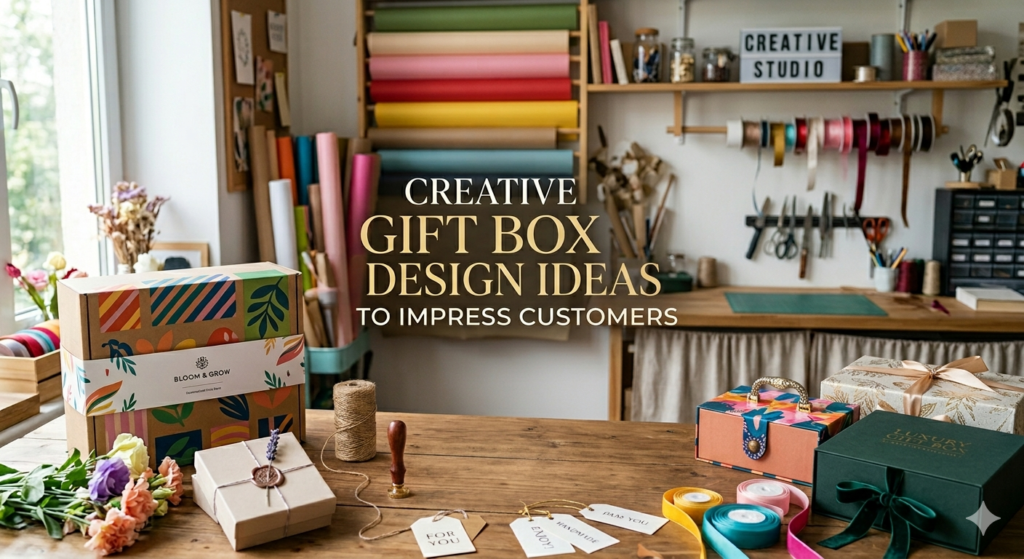
What Are the Best Gift Box Design Ideas for Brands in 2026? Your gift box touches the customer’s hands before your product does. That very first moment, the weight of the box, the texture of the finish, the way the lid opens, sets the tone for everything that comes after it. A 2024 Ipsos survey found that 72% of U.S. consumers say packaging design directly influences their purchasing decisions. That is not a small slice of your customer base. That is three out of every four people deciding whether to trust your brand based on what the box looks and feels like before the product is even visible. So no, the box is not an afterthought. It is part of the product itself. This guide walks you through creative gift box design ideas that real brands are using right now to win customers, earn repeat orders, and build the kind of packaging people photograph and share. What Makes Gift Box Design Ideas Actually Work? Here is something most growing brands get wrong. They spend weeks perfecting the product, then grab the cheapest box available and call it done. The customer opens a plain brown flap and the magic of what is inside never gets a fair chance. Good gift box design does not need to be expensive. It needs to be intentional. Three things drive whether packaging lands or falls flat in the customer’s hands. Structure sets expectations before the box even opens. A 1200 GSM rigid board box feels substantial. A thin tuck-end box flexes when you hold it. Customers read that difference in about half a second, and they make a judgment about your brand right then. Finish carries the emotional message. Soft-touch matte lamination feels premium and modern without saying a word. High-gloss UV feels energetic and bold. Gold foil on a dark background feels expensive, even when it costs very little per unit to add. Interior presentation turns a transaction into a memory. Brands that add tissue paper lining, crinkle paper fill, or a custom printed insert give the customer a reason to slow down and appreciate what they received. That slow-down moment is where brand loyalty gets built. 8 Creative Gift Box Design Ideas That Turn First-Time Buyers into Loyal Customers 1. Magnetic Closure Rigid Boxes Walk into any luxury retail store and look at how the gifting products are packaged. Magnetic closure rigid boxes show up everywhere for a reason. The pull of the magnet, the quiet snap of the lid, the clean reveal of the product inside, it communicates craftsmanship before the customer sees a single product detail. These boxes work especially well for jewelry, skincare serials, perfumes, and premium apparel sets. Our custom rigid boxes can be produced in any size or configuration, and pairing them with soft-touch matte lamination produces a finish that customers genuinely comment on. 2. Foil-Stamped Branded Gift Boxes A foil-stamped logo on a gift box might be the single highest-ROI finishing decision a product brand can make. Gold, silver, and rose gold foil catch light in a way that ink simply cannot replicate. On a dark matte surface, the contrast is striking. Beauty brands rely on it. Food brands use it for holiday lines. Corporate gifting companies build their entire visual identity around it. The investment per unit is small. The perceived value added is significant. 3. Drawer-Style Slide-Out Boxes There is something about a drawer-style box that naturally slows a customer down. They grip the ribbon pull or the base of the outer sleeve and slide it open. It creates a beat of anticipation. That pause is the moment your brand has the customer’s complete, undivided attention. These boxes photograph beautifully, which matters more than ever given how much gifting content ends up on Instagram and TikTok. They work best for gift sets, accessories, cosmetic bundles, and premium product reveals. 4. Window Cutout Gift Boxes Some products sell better when people can see them before opening. A window cutout in the box lid or face panel lets the product do its own marketing before the customer even makes the decision to unwrap it. This format performs exceptionally well for artisan chocolates, handmade candles, luxury soap bars, and cosmetic sets. Pair a die-cut window with a rich interior liner color and the visual effect is immediate. Customers notice that a brand thought carefully about how the product would look through that opening. 5. Kraft Gift Boxes with Custom Print Kraft is not what it used to be. Five years ago, a kraft box signaled low budget. Today, a well-designed kraft gift box signals environmental responsibility, artisan quality, and intentional brand choice. The shift in consumer perception has been dramatic. For wellness brands, food businesses, skincare companies, and any brand positioning itself around sustainability, a one or two-color custom print on natural kraft stock consistently outperforms generic gloss boxes in customer feedback. The tactile texture of the kraft surface itself communicates something that glossy board never can. Our custom kraft boxes are fully printable with no minimum order quantity required. 6. Two-Piece Set-Up Boxes with Interior Lining A base-and-lid construction with a custom printed interior is the defining format for premium gift packaging in jewelry retail. The lid lifts away cleanly. The product sits perfectly centered in a lined base. The interior print color contrasts against the product so that the first visual impression lands exactly as intended. This format translates well beyond jewelry. Premium cosmetic sets, watches, fountain pens, and high-value subscription gifting collections all benefit from this construction. Our custom jewelry boxes use exactly this format, with velvet, foam, and printed cardboard insert options available. 7. Full-Color Printed Gift Boxes Brands with strong visual identities, bold color palettes, distinctive illustrative patterns, or seasonal campaign artwork should let the print carry the full weight of the design. Full-color offset printing produces vivid, consistent results across large runs with zero color drift between units. These boxes need no additional embellishment. The artwork does the work. Holiday campaign
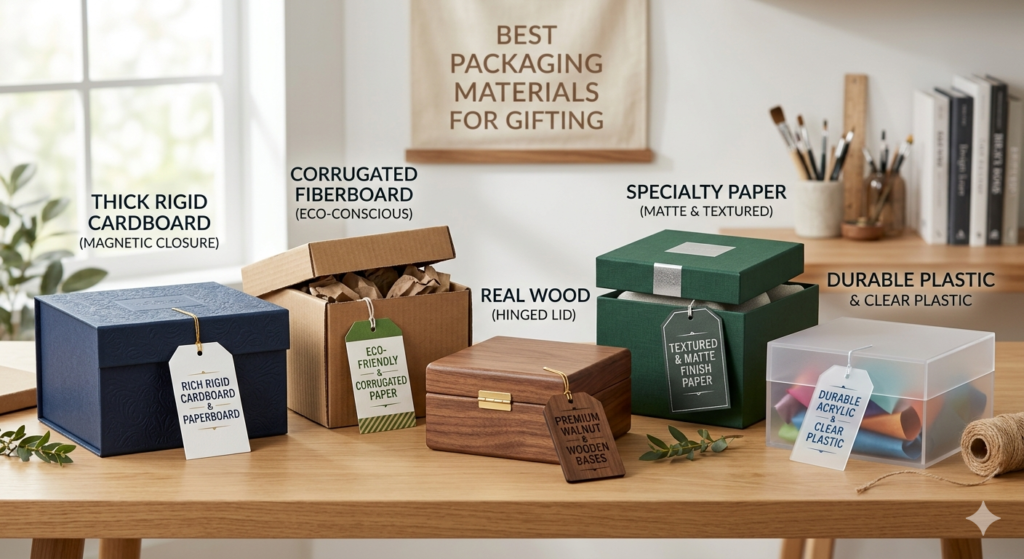
What are the best gift box materials in 2026? The best gift box materials include rigid greyboard, SBS cardboard, kraft paperboard and corrugated fiberboard. Each one serves a different product tier, shipping context and brand positioning goal. Choosing the wrong material costs you twice — once in damaged product, once in lost customer trust. Here is something most packaging guides skip: paper and paperboard already account for 43% of the global gift packaging market, which reached USD 27.5 billion in 2025, according to Future Market Insights. That is not a soft trend. It reflects a deliberate shift toward materials that are printable, recyclable and structurally suited to both retail presentation and e-commerce transit. This guide breaks down each core gift box material by structure, durability, print performance and cost so you can make the right decision before placing your first order. Why Gift Box Materials Determine More Than Just Durability Most brand owners think about gift box materials in terms of appearance. That is the wrong starting point. Material determines how your box survives a courier journey. It determines what print finishes will actually adhere cleanly. It determines whether your product shifts inside the box during transit or sits precisely where you placed it. And it determines what your customer feels when they hold the package — before they even open it. A rigid greyboard box feels substantial and considered. A kraft paperboard box feels honest and intentional. A corrugated box with litho-laminated print feels professional and transit-ready. None of those impressions happen by accident. They come from a deliberate material decision made early in the packaging process. “According to Zion Market Research, the global gift boxes market is projected to grow from USD 1.82 billion in 2024 to USD 3.50 billion by 2034 at a CAGR of 6.74%.” The brands driving that growth are not choosing materials randomly. They are matching substrate to product tier and shipping model with precision. The Most Common Gift Box Materials and What Each One Does Best 1. Rigid greyboard — the material behind luxury gift packaging Rigid greyboard, also called chipboard, is manufactured by compressing multiple layers of recycled paper fibers under high pressure. The result is a dense, solid board that does not flex, does not collapse under weight and holds its dimensional shape permanently. Standard thickness ranges from 1.5mm to 3mm depending on product weight and presentation requirement. This is the material inside every premium perfume box, every fine jewelry presentation case, every high-end chocolate gift set you have ever received and thought felt expensive. The greyboard core is then wrapped in printed paper, fabric, or specialty material to create the final exterior surface. That two-component construction is what separates rigid gift boxes structurally from every other format. Rigid boxes start at approximately USD 3.00 per unit, according to published cost benchmarks from Packings.co. That premium is justified when your product sells above USD 50 and the packaging is part of the perceived value the customer is paying for. Our custom kraft boxes pair naturally with rigid box sets where an inner kraft tray carries smaller items within a rigid outer presentation box. 2. SBS cardboard — the workhorse of retail and mid-tier gift packaging SBS stands for Solid Bleached Sulfate. It is a single-layer paperboard with a clay-coated smooth surface on one side that accepts full-color digital and offset printing cleanly. Standard GSM ranges for gift boxes run from 300 to 450 GSM. At 350 GSM, SBS cardboard holds a tuck-end closure under normal shelf and handling pressure without reinforcement. SBS is the most print-compatible of all gift box materials. Colors reproduce accurately. Fine details in artwork render crisply. Spot UV, matte lamination and foil stamping all adhere reliably to the coated surface. This makes SBS the default choice for custom printed gift boxes across retail, cosmetic and corporate gifting applications where visual brand impact on the exterior panel matters most. Cost per unit typically runs between USD 0.50 and USD 1.50. For brands in the USD 15 to USD 50 product range, SBS cardboard gives the strongest cost-to-presentation ratio of any gift box material available. Adding custom packaging sleeves over an SBS base box is one of the most cost-effective ways to create a premium branded exterior without upgrading to rigid board across the entire run. 3. Kraft paperboard — the sustainable material for eco-conscious gift brands Unbleached kraft paperboard goes through the kraft chemical pulping process, which retains more of the wood fiber’s natural lignin. That is what gives kraft its distinctive brown colour, its high tear resistance and its biodegradable profile. FSC-certified kraft stock degrades within two to three months under standard composting conditions, according to published material data from Custom Boxes Lane. For brands in the organic food, wellness, natural cosmetics and artisan gifting space, kraft is not simply a sustainable choice. It is a brand communication tool. The material itself signals authenticity and environmental responsibility before the customer reads a single word of copy. NielsenIQ and McKinsey’s joint analysis of USD 400 billion in US retail sales data found that products carrying sustainability claims on packaging averaged 28% cumulative sales growth compared to 20% for products without those claims. Kraft paperboard costs start at approximately USD 0.35 per unit. Dark inks and white ink on brown kraft produce strong results. Vibrant full-bleed color on kraft requires a white liner layer to prevent the brown surface from shifting hue. Pairing kraft boxes with custom roll labels is a practical solution for small-volume runs where full-panel print setup costs are prohibitive. 4. Corrugated fiberboard — built for e-commerce gift shipping Corrugated material consists of three layers: a flat outer liner, a wavy fluted middle layer and a flat inner liner. The fluted layer is structural. It absorbs impact, distributes pressure across the box surface and resists crushing under stacking weight. B-flute and E-flute are the most common configurations for gift packaging. E-flute, at approximately 1.6mm thickness, offers a flatter surface that accepts litho-laminated print panels cleanly
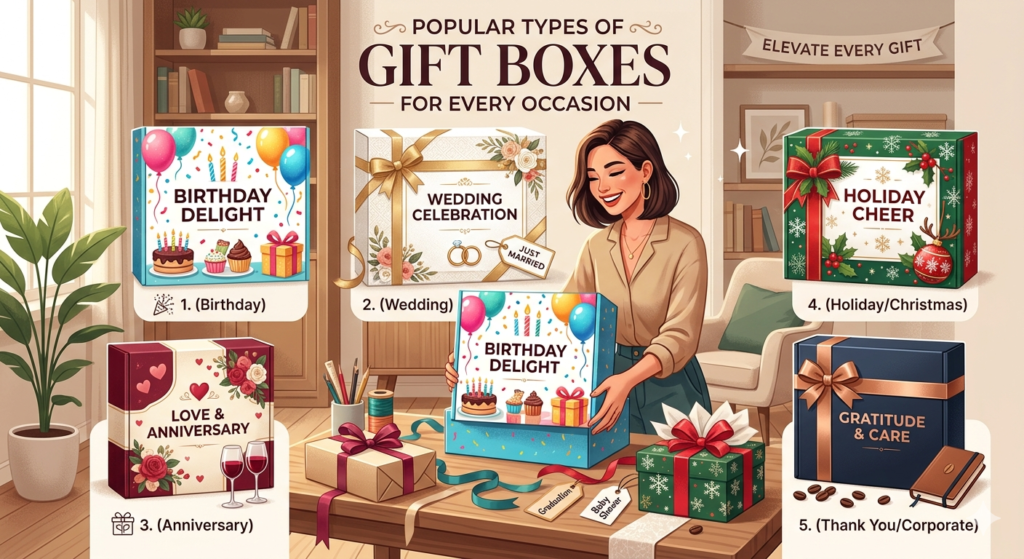
What are the different types of gift boxes in 2026? The most popular types of gift boxes include rigid boxes, kraft boxes, tuck-end boxes, magnetic closure boxes, window boxes, corrugated gift boxes and product-specific formats designed for jewelry, cosmetics and chocolate. Each style serves a different product tier, gifting occasion and brand experience goal. Most brands treat gift packaging as the last thing they think about. That is usually the first place their sales story falls apart.The global gift packaging market reached USD 27.5 billion in 2025 and is growing toward USD 44 billion by 2034, according to Precedence Research. Brands capturing that growth are not using whatever box happens to be cheapest. They are matching gift box style to product, occasion and customer expectation with precision. That is what this guide helps you do. Why the Type of Gift Box You Choose Changes What Your Customer Feels Before anyone reads your product name, they feel the box. They feel the weight of it, the texture of the surface, the resistance of the lid. All of that happens before a single word of your brand story lands. Rigid boxes feel substantial and expensive. Kraft boxes feel considered and natural. Magnetic closure boxes feel refined and deliberate. Tuck-end boxes feel organized and retail-ready. None of these impressions are accidental. They are the direct result of a material and structural decision made at the packaging stage. According to research from Radial and eDelivery, 52% of consumers say premium packaging encourages them to buy again. That figure measures repeat purchase behavior driven purely by how a box felt to receive. The types of gift boxes you choose are not aesthetic decisions. They are customer retention decisions. The Most Popular Types of Gift Boxes Used by Brands in May 2026 1. Rigid gift boxes the gold standard for premium gifting Rigid boxes are made from thick greyboard, typically between 1.5mm and 3mm, then wrapped in printed or laminated paper. They hold their form permanently. They do not flatten during transit, they do not lose shape on a retail shelf, and they do not arrive at a customer’s home looking tired. Jewelry brands use them. High-end cosmetic lines use them. Corporate gifting programs use them for exactly the reason you would expect: the physical weight of the box signals effort and quality before the lid comes off. Pair a rigid box with a magnetic closure and the experience becomes theatrical in the best possible way. Our custom rigid boxes are built to your exact specifications with spot UV, gold foil stamping and custom foam insert options, all available with no minimum order quantity. 2. Kraft gift boxes what sustainability actually looks like in packaging Kraft is not a compromise material. For a specific type of brand, kraft is exactly the right choice. If your product sits in the organic, artisan, wellness or natural food space, kraft packaging tells that story before your label has to. The natural brown stock reads as honest. It reads as considered. It accepts full-color digital printing cleanly and biodegrades responsibly. According to a 2024 study cited by PDI Technologies, 80% of US consumers say they are more likely to buy products in eco-friendly packaging. Kraft gift boxes tap directly into that purchasing behavior. Our custom kraft boxes serve bakeries, soap brands, wellness product lines and organic food companies across the US. They come from FSC-certified stock and are fully customizable with your logo, color palette and finish of choice. 3. Tuck-end gift boxes high volume, high impact, controlled cost Tuck-end boxes fold flat for storage, assemble in seconds and print across every panel. For brands running seasonal gifting campaigns, subscription programs or retail shelf packaging at scale, tuck boxes offer the strongest cost-to-impact ratio of any gift box format. They work for candles, cosmetic sets, food products and accessories. The straight tuck and reverse tuck configurations handle different product shapes and seal requirements. Our custom tuck boxes come with matte or gloss lamination options and ship within 6 to 7 business days of production approval. 4. Magnetic closure gift boxes the packaging that customers remember The magnetic closure box does something no print finish can replicate. When the lid closes, it snaps shut with a clean, satisfying click. That moment is tactile, memorable and directly connected to how customers feel about the product inside. This is why corporate gifting coordinators and luxury DTC brands consistently choose magnetic closure boxes for their flagship products and seasonal launches. 5. Window gift boxes when the product itself is the best sales argument A window cut-out in the front panel removes the uncertainty between a customer and a purchase decision. They see what they are buying. That visibility builds trust instantly, particularly in retail environments where buying decisions happen in under ten seconds. Bakeries, confectionery brands, candle companies and cosmetic lines all use window gift boxes for the same core reason. The product visible through the window does more selling than any headline printed on the box can do. 6. Corrugated gift boxes built for the full e-commerce journey Corrugated boxes are not just shipping materials with a logo printed on them. The best corrugated gift boxes are engineered to protect fragile contents in transit and create a strong unboxing experience on arrival. DTC food brands, subscription businesses and corporate gifting programs that ship nationally all need packaging that survives the fulfillment chain and still arrives looking considered. Corrugated gift boxes solve that problem without sacrificing the branded experience inside. 7. Specialty gift boxes jewelry, cosmetics and chocolate Some products need packaging built around their specific shape, fragility and presentation requirement rather than adapted from a general format. Jewelry needs a structured interior that protects delicate pieces and presents them with the kind of lift that a velvet-lined lid provides. Cosmetics need compartments, surface area for brand storytelling and a lid that opens with intention. Chocolate needs food-safe lining, structural protection and a window or display format that makes the product appetizing before
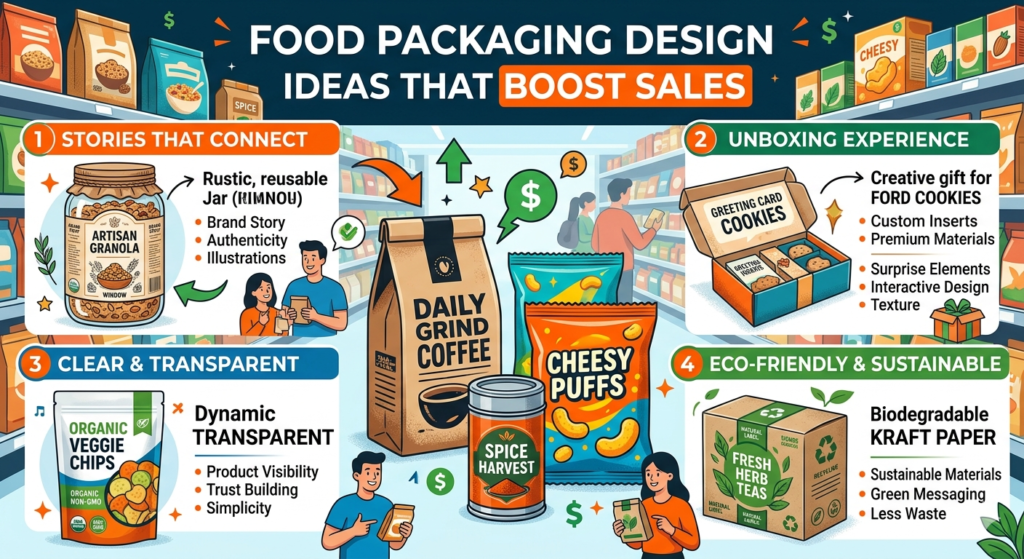
The best food packaging design ideas combine strong shelf appeal, brand-aligned materials and smart print finishes. They protect the product, communicate brand values instantly and move the purchase decision before the customer reads a single word. Your packaging speaks first. Before your ingredient list, before your price point, before your brand story, the box or bag your customer sees is already selling or losing the sale. Most food brands underestimate this. They invest heavily in product quality and almost nothing in packaging strategy. The result is great products sitting on shelves while competitors with smarter creative food packaging win the sale. This guide gives you eight actionable food packaging design ideas built for food brands that want real sales results, not just good-looking boxes. Why Food Packaging Design Directly Drives Purchase Decisions According to a national study by the Paper and Packaging Board and Ipsos,72% of American consumers agree that packaging design influences their purchase decision. Equally important, research cited by Klimchuk and Krasovec (2021) and published by PMC found that between 73% and 85% of consumer purchase decisions are made at the point of sale, with packaging design being the primary differentiator between competing products. That means your packaging is not decoration. It is a live sales tool operating at the exact moment your customer decides whether to buy. 8 Food Packaging Design Ideas to Increase Product Sales in 2026 1. Lead With One Dominant Brand Color Most food brands use too many colors and create visual noise. Strong packaging design commits to one dominant brand color covering 60 to 70% of the packaging face. Think of how consistently recognizable iconic food brands become through color alone. The color becomes the brand signal before the logo even registers. Choose your hero color based on the product category. Green signals freshness and organic. Brown Kraft signals artisan and natural. Deep navy signals premium. Keep it consistent across every SKU in your line. 2. Use Kraft Paper Packaging for Artisan and Organic Food Brands Kraft paper is no longer just a budget material. It is a brand statement. For bakeries, snack brands and organic food companies, Kraft packaging communicates authenticity, sustainability and craftsmanship. These are the values today’s food consumers pay a premium to support. Our Custom Bakery Boxes are built from premium Kraft stock with full-color print options. They are food-safe, structurally sound and available with no minimum order quantity. A window cut-out on the front face lets your product sell itself visually, which is especially effective for cookies, croissants and pastries where visual product appeal is the primary purchase trigger. 3. Add Spot UV or Matte Lamination to Elevate Perceived Value Finish choices matter as much as print quality. A matte lamination finish creates a soft, tactile experience that reads as premium, even on standard stock. Spot UV coating draws the eye to your logo or key brand element by creating a high-gloss contrast against a matte background. The Paper and Packaging Board and Ipsos survey found that 63% of consumers say paper and cardboard packaging makes a product seem more premium and high quality. Finish selection is one of the fastest ways to shift that quality perception without changing your product at all. 4. Design for the DTC Unboxing Moment with Custom Mailer Boxes If your food brand sells directly to consumers, the unboxing experience is your most powerful marketing channel. It is the one moment where the customer’s full attention is on your brand. Most DTC food brands waste it with a plain corrugated box and a packing slip. A well-designed custom mailer box, printed inside and out, generates social sharing, reduces return rates and turns a first-time buyer into a repeat customer. Our Mailer Boxes are engineered specifically for this moment, with structural options for inserts and dividers built in. 5. Use Transparent Window Packaging to Build Instant Trust Transparency in packaging works both literally and strategically. Window cut-outs in cardboard boxes or clear panels in food packaging bags allow customers to see the actual product before buying. This is especially effective for snack packaging design, where visual product appeal drives impulse purchase. The Paper and Packaging Board survey found that 81% of consumers have tried a new product simply because its packaging caught their eye. A visible product inside the pack removes buying friction at exactly the moment the customer is deciding. 6. Make Your Food Label Design Carry Compliance and Conversion Together Your food label design has two simultaneous jobs. First, it must meet FDA food labeling requirements covering nutrition facts, ingredient listing, allergen declarations and net weight. Second, it must convert a browser into a buyer by communicating brand positioning and quality signals within the first visual impression. Lead with flavor or benefit. Place your brand mark at eye level. Use a font size legible from three feet away. Keep the back of the label organized and clean. A cluttered nutrition panel does not just look bad. It actively erodes the consumer trust you need to close the sale. 7. Invest in Eco-Friendly Packaging to Capture the Sustainability Market Sustainability is no longer a nice-to-have for food brands. A 2024 NielsenIQ studyof approximately 4,000 American consumers found that 78% of US consumers say a sustainable lifestyle is important to them. A joint McKinsey and NielsenIQ analysis of 600,000 product SKUs across five years of US sales data further found that products carrying sustainability claims on their packaging averaged 28% cumulative sales growth, compared to 20% for products without those claims. Our Eco Friendly Packaging range includes biodegradable Kraft, FSC-certified cardboard and plant-based material options. All carry full-color print capability. Eco packaging does not require sacrificing visual impact. It requires choosing the right substrate and print method combination for your product. 8. Match Your Packaging Structure to Your Product’s Retail Context A gourmet chocolate brand selling at a specialty grocer needs rigid box packaging. A snack brand in a convenience store needs a corrugated display box. A subscription food brand needs a mailer
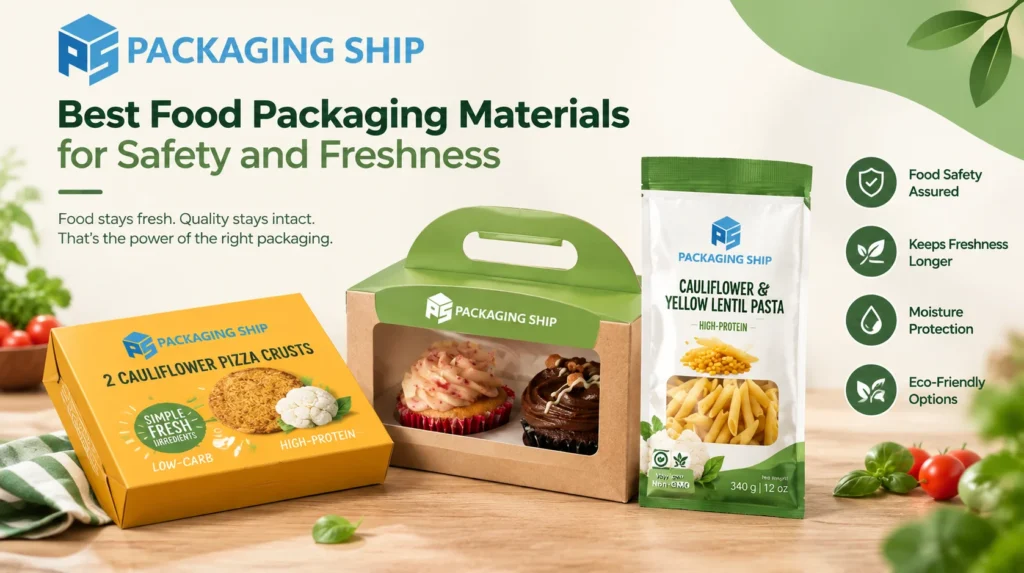
Here’s a situation I’ve seen play out more times than I can count. A food brand invests months developing a product — the recipe, the branding, the retail pitch. They order packaging based on price alone. The first retail shipment goes out. Within two weeks, a buyer calls to say the product arrived with moisture damage, a broken seal, or a panel that collapsed under stacking pressure. The product wasn’t the problem. The material was. Choosing the wrong food packaging materials doesn’t just cost a reorder. It costs retail relationships, compliance audits, and the brand credibility you spent a year building. The US food packaging market hit $78 billion in 2025 and is projected to reach $101.1 billion by 2033, according to Grand View Research. That growth is real but so is the pressure on brands to get material decisions right from day one. This guide cuts through the noise and gives you what you actually need, a straight material-by-material comparison built for food businesses making real purchasing decisions in 2026. What are the best food packaging materials? The best food packaging materials in 2026 include Kraft paper, food-grade cardboard, corrugated board, plastic films, aluminum, and biodegradable options. Each material serves a specific product, distribution channel, and compliance requirement. Choosing correctly protects freshness, passes FDA food contact standards, and keeps your brand credible on retail shelves. What Makes a Food Packaging Material Safe and Effective? Not all food packaging materials carry the same compliance weight. The FDA regulates direct food contact under the Food Contact Substances Notification Program (21 CFR), which sets migration limits — the measurable ceiling for how much of a packaging material can transfer into the food it touches. Three pillars determine whether a material is genuinely effective: Food safety compliance — does it meet FDA 21 CFR migration standards for your product category? Barrier performance — does it block oxygen, moisture, and light at the level your product needs? Structural integrity — does it hold up through your full distribution chain without panel collapse or seal failure? Miss any one of those three and the other two don’t save you. 6 Best Food Packaging Materials — Honest Comparison for 2026 Here’s a situation I’ve seen play out more times than I can count. A food brand invests months developing a product — the recipe, the branding, the retail pitch. They order packaging based on price alone. The first retail shipment goes out. Within two weeks, a buyer calls to say the product arrived with moisture damage, a broken seal, or a panel that collapsed under stacking pressure. The product wasn’t the problem. The material was. Choosing the wrong food packaging materials doesn’t just cost a reorder. It costs retail relationships, compliance audits, and the brand credibility you spent a year building. The US food packaging market hit $78 billion in 2025 and is projected to reach $101.1 billion by 2033, according to Grand View Research. That growth is real but so is the pressure on brands to get material decisions right from day one. This guide cuts through the noise and gives you what you actually need — a straight material-by-material comparison built for food businesses making real purchasing decisions in 2026. What are the best food packaging materials? The best food packaging materials in 2026 include Kraft paper, food-grade cardboard, corrugated board, plastic films, aluminum, and biodegradable options. Each material serves a specific product, distribution channel, and compliance requirement. Choosing correctly protects freshness, passes FDA food contact standards, and keeps your brand credible on retail shelves. What Makes a Food Packaging Material Safe and Effective? Not all food packaging materials carry the same compliance weight. The FDA regulates direct food contact under the Food Contact Substances Notification Program (21 CFR), which sets migration limits — the measurable ceiling for how much of a packaging material can transfer into the food it touches. Three pillars determine whether a material is genuinely effective: Food safety compliance — does it meet FDA 21 CFR migration standards for your product category? Barrier performance — does it block oxygen, moisture, and light at the level your product needs? Structural integrity — does it hold up through your full distribution chain without panel collapse or seal failure? Miss any one of those three and the other two don’t save you. 6 Best Food Packaging Materials — Honest Comparison for 2026 1. Kraft Paper — the Dry Food Standard and the Eco Credential Kraft paper punches well above its material cost for dry food brands. It’s FSC-certifiable, biodegradable, compatible with food-safe water-based inks, and reads as sustainable to retail buyers who increasingly require eco-credential documentation before shelf placement. At 80–120 GSM, virgin Kraft handles dry goods, cookies, bread, snacks, loose teas, without over-engineering the solution. The limitation is moisture barrier performance. Kraft on its own won’t protect liquid-adjacent or high-humidity products without a food-safe coating or laminate. Know that going in and you won’t be surprised by spoilage claims. For bakery brands or eco-conscious food lines, Eco Friendly Packaging from Packaging Ship uses certified Kraft with food-safe formats that don’t compromise structural or print performance. 2. Food-Grade Cardboard — the Retail Shelf Workhorse Food-grade cardboard at 300–400 GSM is the dominant material for retail-facing food boxes. It stacks cleanly under 4-layer planogram pressure, carries full-color print without bleed, and gives brands the largest surface area for branding of any rigid format. The grade matters. Solid Bleached Sulfate (SBS) board offers the cleanest print surface for premium food brands. Coated Unbleached Kraft (CUK) adds strength for heavier products like beverages. Both are food-contact compliant when paired with appropriate coatings. One gap most brands don’t anticipate: direct food contact requires virgin fiber, not recycled content. Recycled board is fine for outer layers, it cannot be used where the material touches the food directly without specific food-safe certification. Get that specification confirmed before ordering at volume. 3. Corrugated Board — Non-Negotiable for Shipping and DTC Corrugated board does the job that no flexible material
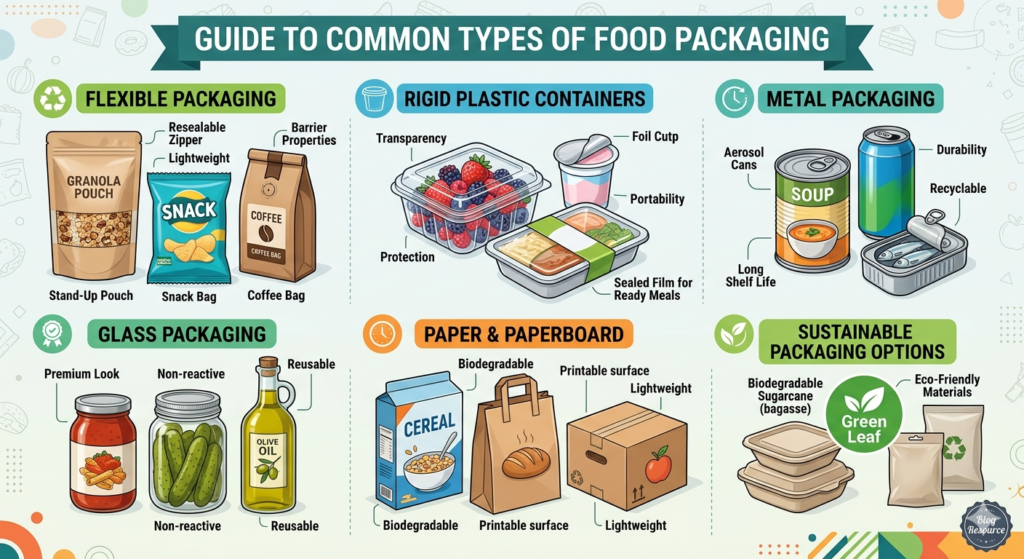
Ship. What are the types of food packaging? Types of food packaging include rigid boxes, flexible pouches, food packaging bags, corrugated mailers, and Kraft-based eco formats. Each one fits a different product from fresh bakery goods to frozen meals. Pick the wrong one and you’re looking at transit damage, spoilage, or a rejected retail order before you even start. Types of Food Packaging for Different Food Products Last spring, a bakery owner from Austin reached out to us frustrated. She’d finally landed a wholesale deal with a regional grocery chain something she’d worked toward for over a year. The first shipment went out. The buyer called two days later, not to confirm reorders, but to cancel. Her croissants had arrived crushed. She’d packed them in a standard white box with no insert, no window, no structural support. The buyer told her flat out: if the packaging looks careless, I assume the product is too. She wasn’t careless. She just didn’t know which packaging type her product actually needed. That gap — between knowing you need packaging and knowing which packaging — costs food businesses real money. The US food packaging market hit $78 billion in 2025 and is on track for $101.1 billion by 2033, according to Grand View Research. Growing market, yes. But the brands gaining shelf space are the ones getting packaging decisions right from the start. Here’s what you actually need to know. What Are the Main Types of Food Packaging in 2026? Strip away the jargon and types of food packaging come down to three structural families: rigid, flexible, and semi-rigid. Every food product you sell sits somewhere in that framework. The moment you know which family your product belongs to, the rest of the decision gets a lot cleaner. Rigid packaging holds its shape boxes, cartons, display trays. Flexible packaging conforms bags, pouches, wraps. Semi-rigid sits in the middle clamshells, molded containers. Each has a job. None is universally better. Context decides. Rigid Food Packaging — When Your Product Needs to Hold Its Shape Walk into any US grocery store and look at the shelf. Most of what you see is rigid packaging. There’s a reason for that. Rigid formats stack cleanly, display face-forward, and give your brand the most printable surface per cubic inch of product. Boxes and cartons dominate bakery, dry food, confectionery, and takeaway categories. Corrugated trays handle bulk retail and frozen food shipping. Rigid packaging also protects against compression damage — the kind that happens when three pallets of someone else’s product sit on top of yours during a cross-country freight run. Bakery Packaging — the Window Is Doing More Work Than You Think Here’s something most bakery brands figure out the hard way. The packaging window isn’t just decorative. It’s closing the sale before a customer even picks the box up. A windowed food-grade box in 300–350 GSM cardboard does three things at once: it protects the product from moisture and compression, it keeps the contents visible at retail, and it signals quality before anyone reads a single word of your label. Anti-fog film on that window matters more than most brands realize — without it, temperature shifts create condensation that makes your cookies look old even when they’re fresh. If you sell through retail accounts, foodservice, or farmers markets, Custom Bakery Boxes with food-safe lining aren’t optional anymore. Retail buyers in 2026 expect them as baseline. Not a premium. A baseline. Mailer Boxes — the DTC Food Brand’s Most Important Investment Shipping food direct to consumers is brutal on packaging. Courier sorting machines don’t care about your brand. Packages get dropped, stacked, compressed, and sometimes thrown. Flexible packaging buckles. Thin cardboard collapses. A corrugated mailer box — properly sized with internal inserts — handles all of it. Beyond protection, every mailer box a DTC food brand ships is a marketing moment. The customer opens it at home, usually alone, with no retail environment competing for their attention. A well-printed Mailer Box with clean branding lands differently than a generic brown box. One creates anticipation. The other creates doubt. Get the structure right first — E-flute corrugated for lighter food items, B-flute for heavier or fragile products. Then brand it. Flexible Food Packaging — the Format That Runs the Market Flexible packaging held a 47.95% revenue share in the US food packaging market in 2025, according to Grand View Research. That’s not a trend. That’s the market telling you something about what works. Bags, pouches, wraps, and films dominate because they’re light, cheap to ship, and versatile across product types. But not all flexible food packaging bags are built the same — and picking the wrong format costs brands more in spoilage and returns than the packaging itself ever saved on material cost. Dry Food Packaging — Bags That Protect and Sell Paper food bags have been the standard for dry goods — bread, cookies, snacks, coffee — for decades. Kraft paper bags earn extra attention right now because they hit both the eco-conscious branding note and the functional barrier requirement at the same time. They’re biodegradable, widely recyclable, and print beautifully with water-based inks. Stand-up pouches work harder on the shelf. For granola, trail mix, specialty coffee, or cookie packaging that needs to stand alone at retail, a resealable stand-up pouch with an oxygen barrier keeps product fresh longer and gives the brand a full panel of printable surface. Fewer returns for stale products. Better shelf presence. One format, two wins. Liquid Food Packaging — Where Airtight Isn’t a Feature, It’s the Requirement Sauces, broths, oils, dressings — liquid products have zero margin for error in packaging. One bad seal during transit and you’re not just dealing with a damaged product. You’re dealing with a contaminated shipment, a carrier dispute, and a customer who posts about it online. Spouted Mylar pouches with heat seals are the most reliable format for liquid food packaging at this scale. They’re lightweight, barrier-resistant to oxygen and light, and hold integrity under pressure
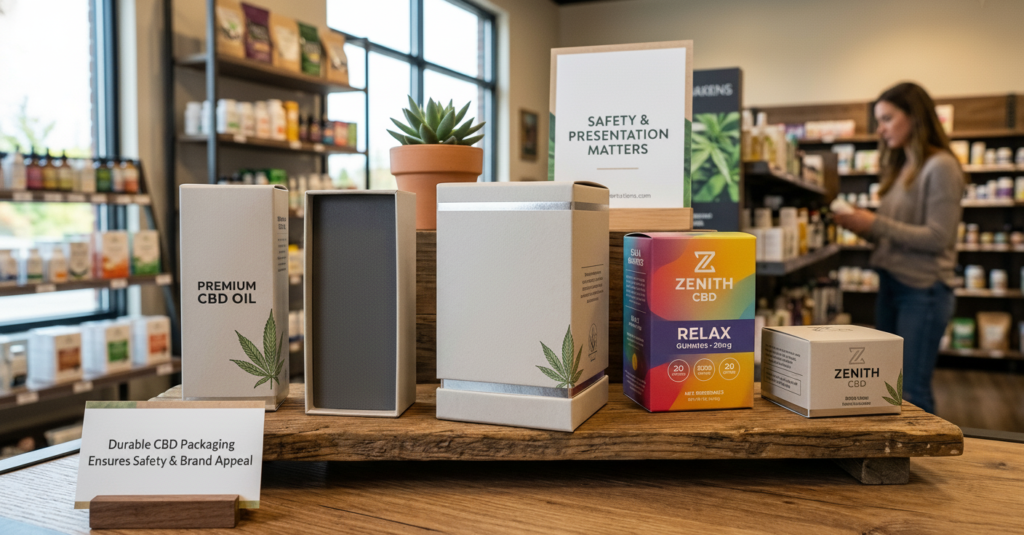
A CBD brand owner from Denver once told me something I never forgot. She had spent four months landing a retail account with a regional health chain. Her products arrived at the warehouse. The buyer called the next morning not to confirm the order, but to cancel it. Three boxes were dented. Two had broken seals. Her label was peeling. That was it. Four months of work, gone in one shipment. Her packaging wasn’t bad because she didn’t care. It was bad because no one told her that protective CBD packaging solutions do more than hold a product. They hold a reputation. What are protective CBD packaging solutions? Protective CBD packaging solutions are custom boxes, rigid containers, and child-resistant packaging designed to preserve product quality, meet US compliance standards, and strengthen brand presence on retail shelves helping CBD businesses reduce damage, pass inspections, and grow repeat sales. What “Protective” Really Means in CBD Packaging Most people think protection means padding. In reality, it means three things working together: structural durability, regulatory compliance, and shelf-level brand integrity. Miss one, and you pay for it in returns, rejections, or lost retail placements. According to the CPSC, child-resistant packaging must be designed so that at least 85% of children (ages 42–51 months) cannot open it within the first five minutes of testing, and at least 80% still cannot open it after a full ten minutes. This isn’t optional guidance. It’s enforceable law in states like California, Oregon, Minnesota, and Virginia. Structural protection is equally critical. CBD oils, tinctures, and glass-bottled products are fragile under courier pressure. A corrugated B-flute box with internal inserts absorbs impact that a standard cardboard mailer simply cannot handle during transit sorting. Brand integrity completes the picture. A dented, unbranded, or low-finish box signals low quality before the customer ever opens it. How Packaging Failure Costs CBD Brands Real Money Let’s be direct. Poor packaging creates three specific business losses. Child-Resistant Compliance: What CBD Brands Must Know in 2026 Which Products Require Child-Resistant CBD Packaging? Edible CBD products gummies, chocolates, beverages — carry the highest compliance risk. Edible cannabis and CBD products often come in forms that appeal to children, such as gummy shapes, which is why regulators treat them with pharmaceutical-level packaging scrutiny. The child-resistant reclosable edible bag market is projected to grow from USD 1.8 billion in 2025 to USD 3.1 billion by 2034, driven directly by tightening state safety mandates according to research cited in cannabis regulatory analysis published in 2026. Pre-roll products carry equal legal weight. Custom Pre Roll Joints Boxes with certified child-resistant closures (CRC) are now required in most regulated US states. Selling without them isn’t a risk it’s a liability. At Packaging Ship, every CBD packaging solution we produce can be spec’d with CRC closures, tamper-evident seals, and state-compliant labeling panels. And we do it with no minimum order quantity. Best Materials for Protective CBD Packaging Solutions: A Buyer’s Comparison Choosing the wrong material is where most wholesale buyers lose money silently. Material Best For Protective Strength Finish Options Cardboard (300–400 GSM) Tinctures, topicals, retail boxes Medium Gloss, matte, foil Corrugated (B/E flute) Shipping, bulk orders High Basic print Rigid Board Premium oils, gift sets Very High All premium finishes Kraft Eco-brand products, hemp lines Medium Natural, spot UV Corrugated boxes are non-negotiable for wholesale shipments and DTC deliveries. Rigid boxes serve CBD gift sets and high-end tincture lines. Cardboard at 350 GSM is the sweet spot for most retail-facing CBD packaging. CBD Packaging Styles for Different Products Not every CBD product ships in the same box. And it shouldn’t. CBD boxes comes in different packaging styles for different products CBD oil tinctures need tall, narrow tuck-top boxes with internal inserts to prevent glass movement. Gummies and edibles need resealable, airtight packaging with CRC closures and clear labeling panels. Topicals and creams do well in rigid or sleeve-style packaging that communicates premium quality at retail. For wax pens and vape cartridges, secure fit matters as much as aesthetics. Custom Weed Pen Boxes with foam or cardboard inserts prevent cartridge breakage and deliver a clean unboxing experience that premium cannabis consumers now expect. Mylar bags work well for flower and pre-measured edible portions, smell-proof, moisture-resistant, and fully printable for bold retail branding. Matching your packaging style to your product category is the starting point for building sturdy CBD boxes that protect products and earn shelf placement. 5 Signs Your Current CBD Packaging Is Hurting Your Business Check these quickly: If two or more of these hit your packaging is actively costing you revenue right now. Conclusion Your CBD product might be the best on the market. But if it arrives damaged, looks generic, or fails a compliance check none of that matters. Protective CBD packaging solutions protect more than your product. They protect your retail relationships, your brand reputation, and your revenue. Every shipment is a brand touchpoint. Every box on a dispensary shelf is a sales tool. At Packaging Ship, we build CBD packaging that does all three jobs protects, complies, and converts. No minimum orders. Free design support. Free US shipping. 6+ years. 10,000+ projects delivered. Ready to Build CBD Packaging That Protects Your Product and Grows Your Brand? Get Your Free Custom CBD Packaging Quote → No minimum order. Free design support. Free shipping across the USA. Frequently Asked Questions What are protective CBD packaging solutions? They are custom-designed boxes, rigid containers, and compliant closures built to preserve CBD product integrity through shipping, retail display, and consumer handling combining structural durability with regulatory and brand standards. Does CBD packaging need to be child-resistant? In most US states, yes especially for edible and ingestible CBD products. States like California, Oregon, Minnesota, and Virginia mandate CRC-compliant packaging for edible hemp-derived products under standards aligned with the federal PPPA. What material is best for CBD packaging boxes? Corrugated is best for shipping protection. Rigid board delivers the most premium retail presentation. Cardboard at 300–400 GSM is the most versatile for retail-ready CBD
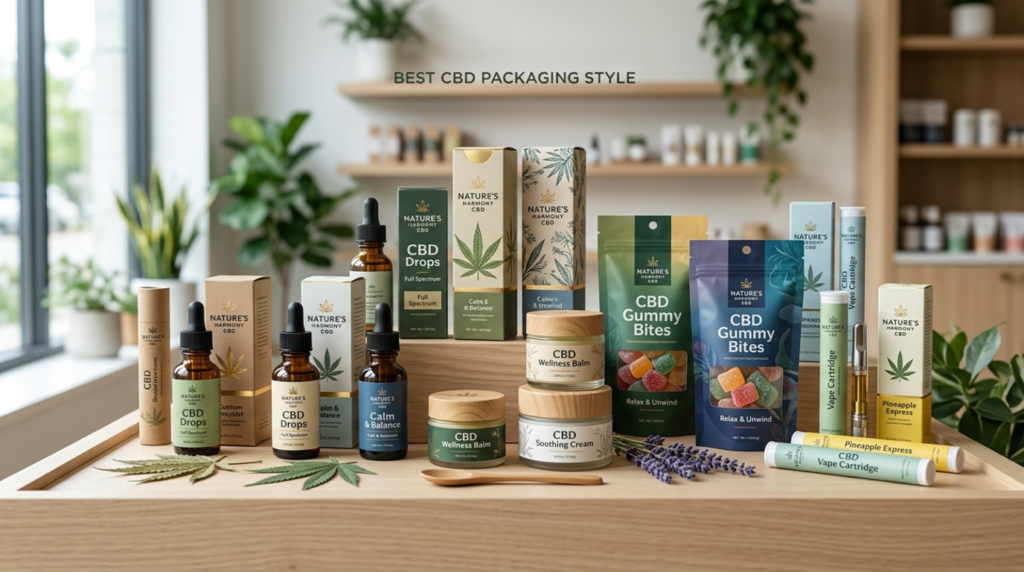
Pick up any two CBD products on a US retail shelf right now. Odds are, they look nearly identical. Same dropper bottle, with the same kraft box. Same vague wellness typography. For a buyer making a split-second decision, that sameness is fatal for any brand that isn’t the most recognized name on that shelf. Choosing the right CBD packaging styles for different products is not a design exercise. It is a sales decision. And getting it wrong using an oil box for a tincture, or a retail-facing design for an e-commerce mailer costs real money in returns, lost reorders, and compliance failures. This guide maps the right box style to each major CBD product format, with structural and commercial reasoning behind every recommendation. What are CBD packaging styles for different products in 2026? CBD packaging styles for different products refer to format-specific box structures, materials, closures, and finishes matched to each product type’s physical requirements, channel, price point, and target buyer. Tincture boxes are not oil boxes. Gummy packaging is not skincare packaging. Each format has its own brief. According to Mordor Intelligence (January 2026), oils and tinctures together hold 37.48% of the global CBD market in 2025, while CBD gummies are growing at a projected CAGR of 29.35% through 2031. That growth across multiple product categories means brands are managing different packaging briefs simultaneously and most are getting at least one of them wrong. The Real Cost of Mismatched CBD Box Styles Most brands discover packaging mismatches after the damage is done. A tincture bottle that rattles inside an oversized oil box during transit. A gummy box that fails a retail child-resistant inspection. A CBD cream box that looks like a hardware store product next to the beauty brands sharing that shelf. According to Refine Packaging Business Dasher reported in September 2024 that 81% of consumers purchased a new product because of its packaging design, and 72% agreed that packaging design can influence their purchase decisions. In the CBD category, where buyers cannot evaluate the product before they buy, your box carries the entire first impression. The structural and commercial requirements for CBD packaging styles for different products vary significantly by format. Here is what actually separates them. CBD Oil Boxes: Two Jobs, One Box CBD oil packaging has to do two things at once: protect a fragile glass bottle and present a premium brand identity. Brands that prioritize one over the other pay for it. For retail placement, rigid boxes with foam or cardboard inserts prevent bottle movement and signal premium pricing through structural weight. For e-commerce, corrugated board with custom inserts absorb shipping impact. Neither structure is interchangeable. On the design side, CBD oil buyers skew toward clinical precision or natural wellness aesthetics depending on the formula positioning. Full-spectrum oil packaging reads differently than an isolate. Matte lamination with clean typography communicates purity. Window patching lets the oil color validate quality claims without the buyer opening anything. The compliance surface matters too. Your oil box needs visible space for total CBD milligrams, ingredient list, distributor information, batch number, and a scannable QR code linking to your Certificate of Analysis. Cramming all of that onto a 30ml bottle label alone is a compliance failure waiting to happen. CBD Tincture Boxes: Not the Same as Oil Boxes This is the gap every competitor misses. Tincture boxes and oil boxes are structurally different briefs, and treating them as interchangeable loses you sales. Tinctures are typically sold in 15ml to 60ml dropper bottles a more precise, dosing-focused format. The buyer is measuring their intake carefully. Your packaging should reinforce that precision. Tight-fitting interior dimensions, no movement, clean label hierarchy with milligram dosing prominently featured, and a finish that reads clinical rather than lifestyle-adjacent. Our Custom CBD Tincture Boxes are built specifically for dropper bottle dimensions, with interior fitment options and a full compliance label surface on the rear panel. That precision in the box signals precision in the product which is exactly what a tincture buyer is paying for. CBD Gummy Boxes: Where Compliance Meets Color Gummies are the fastest-growing CBD product format in the US right now, and their packaging is the most technically demanding. According to Coherent Market Insights (March 2026),the pouches segment represents 38.6% of the CBD gummy packaging market in 2025, with North America leading global gummies market share at 62.2%. But here is what those pouch numbers obscure: for retail placement, custom printed boxes beat pouches on shelf presence every time. Pouches work for DTC e-commerce and travel-format products. For a dispensary shelf or a wellness retailer, a structured box with bold color and clear dosage typography commands more attention. Compliance is non-negotiable for gummy packaging. US requirements for ingestible CBD include child-resistant closures, clear CBD milligram content, full ingredient list, batch number, and a QR code for lab results. Missing child-resistant closure requirements specifically has caused significant regulatory action for CBD brands in multiple states. Get this right from the first production run. CBD Skincare Packaging: A Category With Its Own Rules CBD cream, lotion, and skincare buyers are not shopping in the CBD aisle. They are shopping in the beauty and wellness category. That changes everything about what your packaging needs to do. Shoppers evaluating a CBD lotion in 2026 are comparing your box to established skincare brands not to the tincture next to it. That comparison happens in under two seconds. Soft-touch lamination, embossed brand marks, and clean typographic hierarchy are not luxury add-ons in this category. They are the minimum entry point. Our Custom CBD Lotion Boxes are designed with this category standard in mind soft-touch finish options, wellness-forward layout, and print quality that holds its own next to premium skincare retail. CBD cream has an additional complexity: two distinct buyer audiences. Wellness-focused buyers respond to natural, clean, ingredient-led design. Pain management buyers respond to clinical labeling with precise ingredient transparency. Our Custom CBD Cream Boxes navigate that split with a clean base design and high-contrast compliance text that communicates to