
Ship.
What are the types of food packaging?
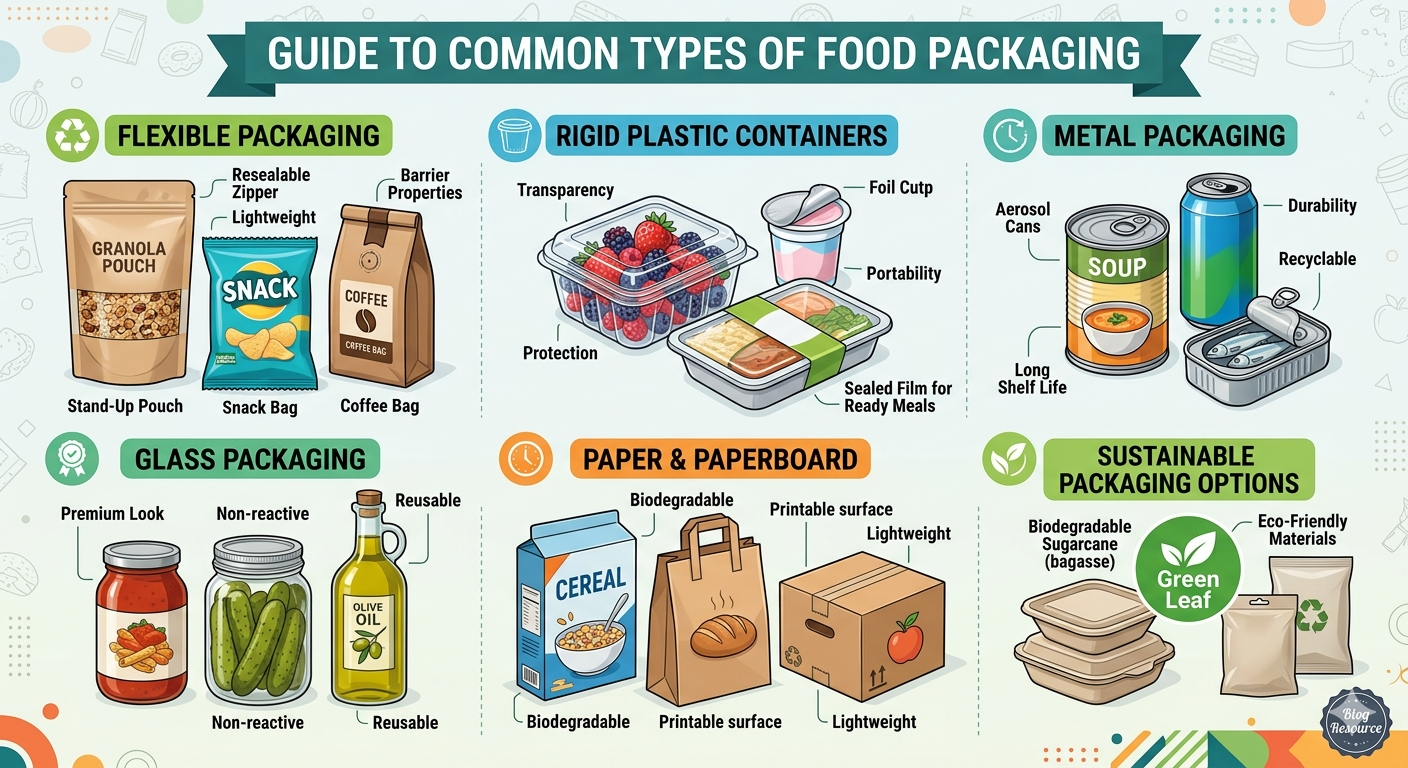
Types of food packaging include rigid boxes, flexible pouches, food packaging bags, corrugated mailers, and Kraft-based eco formats. Each one fits a different product from fresh bakery goods to frozen meals. Pick the wrong one and you’re looking at transit damage, spoilage, or a rejected retail order before you even start.
Last spring, a bakery owner from Austin reached out to us frustrated. She’d finally landed a wholesale deal with a regional grocery chain something she’d worked toward for over a year. The first shipment went out. The buyer called two days later, not to confirm reorders, but to cancel.
Her croissants had arrived crushed. She’d packed them in a standard white box with no insert, no window, no structural support. The buyer told her flat out: if the packaging looks careless, I assume the product is too.
She wasn’t careless. She just didn’t know which packaging type her product actually needed.
That gap — between knowing you need packaging and knowing which packaging — costs food businesses real money. The US food packaging market hit $78 billion in 2025 and is on track for $101.1 billion by 2033, according to Grand View Research. Growing market, yes. But the brands gaining shelf space are the ones getting packaging decisions right from the start.
Here’s what you actually need to know.
Strip away the jargon and types of food packaging come down to three structural families: rigid, flexible, and semi-rigid. Every food product you sell sits somewhere in that framework. The moment you know which family your product belongs to, the rest of the decision gets a lot cleaner.
Rigid packaging holds its shape boxes, cartons, display trays. Flexible packaging conforms bags, pouches, wraps. Semi-rigid sits in the middle clamshells, molded containers. Each has a job. None is universally better. Context decides.
Walk into any US grocery store and look at the shelf. Most of what you see is rigid packaging. There’s a reason for that. Rigid formats stack cleanly, display face-forward, and give your brand the most printable surface per cubic inch of product.
Boxes and cartons dominate bakery, dry food, confectionery, and takeaway categories. Corrugated trays handle bulk retail and frozen food shipping. Rigid packaging also protects against compression damage — the kind that happens when three pallets of someone else’s product sit on top of yours during a cross-country freight run.
Here’s something most bakery brands figure out the hard way. The packaging window isn’t just decorative. It’s closing the sale before a customer even picks the box up.
A windowed food-grade box in 300–350 GSM cardboard does three things at once: it protects the product from moisture and compression, it keeps the contents visible at retail, and it signals quality before anyone reads a single word of your label. Anti-fog film on that window matters more than most brands realize — without it, temperature shifts create condensation that makes your cookies look old even when they’re fresh.
If you sell through retail accounts, foodservice, or farmers markets, Custom Bakery Boxes with food-safe lining aren’t optional anymore. Retail buyers in 2026 expect them as baseline. Not a premium. A baseline.
Shipping food direct to consumers is brutal on packaging. Courier sorting machines don’t care about your brand. Packages get dropped, stacked, compressed, and sometimes thrown. Flexible packaging buckles. Thin cardboard collapses. A corrugated mailer box — properly sized with internal inserts — handles all of it.
Beyond protection, every mailer box a DTC food brand ships is a marketing moment. The customer opens it at home, usually alone, with no retail environment competing for their attention. A well-printed Mailer Box with clean branding lands differently than a generic brown box. One creates anticipation. The other creates doubt.
Get the structure right first — E-flute corrugated for lighter food items, B-flute for heavier or fragile products. Then brand it.
Flexible packaging held a 47.95% revenue share in the US food packaging market in 2025, according to Grand View Research. That’s not a trend. That’s the market telling you something about what works.
Bags, pouches, wraps, and films dominate because they’re light, cheap to ship, and versatile across product types. But not all flexible food packaging bags are built the same — and picking the wrong format costs brands more in spoilage and returns than the packaging itself ever saved on material cost.
Paper food bags have been the standard for dry goods — bread, cookies, snacks, coffee — for decades. Kraft paper bags earn extra attention right now because they hit both the eco-conscious branding note and the functional barrier requirement at the same time. They’re biodegradable, widely recyclable, and print beautifully with water-based inks.
Stand-up pouches work harder on the shelf. For granola, trail mix, specialty coffee, or cookie packaging that needs to stand alone at retail, a resealable stand-up pouch with an oxygen barrier keeps product fresh longer and gives the brand a full panel of printable surface. Fewer returns for stale products. Better shelf presence. One format, two wins.
Sauces, broths, oils, dressings — liquid products have zero margin for error in packaging. One bad seal during transit and you’re not just dealing with a damaged product. You’re dealing with a contaminated shipment, a carrier dispute, and a customer who posts about it online.
Spouted Mylar pouches with heat seals are the most reliable format for liquid food packaging at this scale. They’re lightweight, barrier-resistant to oxygen and light, and hold integrity under pressure changes during air freight. The critical thing most food brands miss: food-grade compliance has to cover the entire package. Not just the inner layer. The substrate, adhesives, and inks all fall under FDA 21 CFR food contact standards. A package that looks compliant and isn’t creates legal exposure you don’t want.
Food grade packaging isn’t a label you apply — it’s a material standard regulated by the FDA under 21 CFR Parts 170–189. The rules set hard migration limits on how much of any packaging material can transfer into food. Exemptions exist, but only for substances with no carcinogenic risk and migration levels below 0.5 parts per billion. The baseline standard is straightforward: manufacturers must prove materials are safe before they ever touch food.
In real terms, that means virgin Kraft paper or food-safe cardboard for direct contact applications. Recycled content is fine for outer layers and shipping cartons, but it doesn’t meet direct contact standards without additional certification. Food-safe coatings, non-toxic inks, and compliant adhesives complete the picture.
Here’s a quick material reference:
| Material | Best For | Food Grade | Eco-Friendly |
| Kraft paper (virgin) | Dry goods, bakery, wrapping | Yes | Yes |
| Food-grade cardboard (300–400 GSM) | Retail boxes, cartons | Yes | Recyclable |
| Corrugated board (B/E flute) | Shipping, mailers, bulk | Yes | Recyclable |
| BOPP film | Pouches, bags, wraps | Yes | Limited |
| Mylar / PET | Frozen, liquid, long shelf-life | Yes | Limited |
Sustainable food packaging became a procurement requirement faster than most brands anticipated. Retail buyers, particularly in natural and specialty food channels, now ask about material certifications before discussing pricing. The paper and paper-based materials segment is forecast to grow at a 5.2% CAGR from 2026 to 2033, per Grand View Research — which tracks directly with what retailers are demanding on their shelves.
Three materials hold up to genuine sustainability scrutiny: virgin Kraft paper, recycled corrugated board, and plant-based inks. Each has verifiable recyclability data. Each has FSC certification options. None requires the kind of compostability claims that are increasingly under regulatory review in California and the EU.
Greenwashing is a real legal exposure now, not just a reputational risk. If your packaging says eco-friendly, the material behind it has to prove it. Packaging Ship’s Eco Friendly Packaging range uses certified Kraft and recycled corrugated across food-grade formats — and the structural and print performance doesn’t take a hit to get there.
| Food Product | Packaging Type | Key Requirement |
| Cookies and bakery goods | Windowed bakery box / Kraft bag | Anti-fog window, food-grade lining |
| Frozen meals | Moisture-resistant corrugated tray | Barrier coating, thermal stability |
| Dry snacks and granola | Stand-up pouch / Kraft bag | Resealable, oxygen barrier |
| Sauces and liquid food | Spouted Mylar pouch | Airtight heat seal, FDA-compliant |
| Takeaway food | Gable box / paper bag | Grease-resistant, tamper-evident |
| DTC gift food | Custom mailer box | Corrugated, branded insert |
| Confectionery and chocolates | Rigid box / display box | Premium finish, moisture control |
What are the main types of food packaging? Rigid (boxes, cartons, trays), flexible (bags, pouches, wraps), and semi-rigid (clamshells, containers). Which one fits your product depends on what you’re protecting, how it’s distributed, and the shelf life it needs to maintain.
What is food grade packaging? It’s packaging certified safe for direct or indirect food contact under FDA 21 CFR. This covers the material substrate, coatings, adhesives, and inks — not just the inner layer. Non-compliant packaging creates both regulatory exposure and consumer safety risk.
What packaging works best for bakery products? Windowed cardboard boxes in 300–350 GSM food-grade board. The anti-fog window protects product visibility while the board weight handles stacking pressure at retail. Food-safe lining is non-negotiable for direct contact with fresh baked goods.
Can I order custom food packaging with no minimum quantity? Yes — Packaging Ship has no minimum order requirement, includes free design support, and ships free across the USA. That makes it workable for a bakery doing 200 units a week and a food brand scaling toward wholesale at the same time.
What’s the most genuinely eco-friendly food packaging material? Kraft paper and recycled corrugated board. Both are FSC-certifiable, widely recyclable in US waste streams, and compatible with food-safe printing. They’re also the two materials retail buyers most commonly ask for when they have sustainability sourcing requirements.
The right types of food packaging protect your product in transit, pass compliance checks at retail, and tell customers something true about your brand before they open the box. Get all three right and packaging becomes a growth tool. Miss any one of them and it becomes a liability you didn’t budget for.
Packaging Ship works with food brands across bakery, frozen, dry goods, and DTC delivery — with no minimum order, free design support, and free US shipping. If you’re not sure which format fits your product, that conversation starts with a free quote.
Get Your Free Food Packaging Quote →
No minimum order. Free design support. Free shipping across the USA.