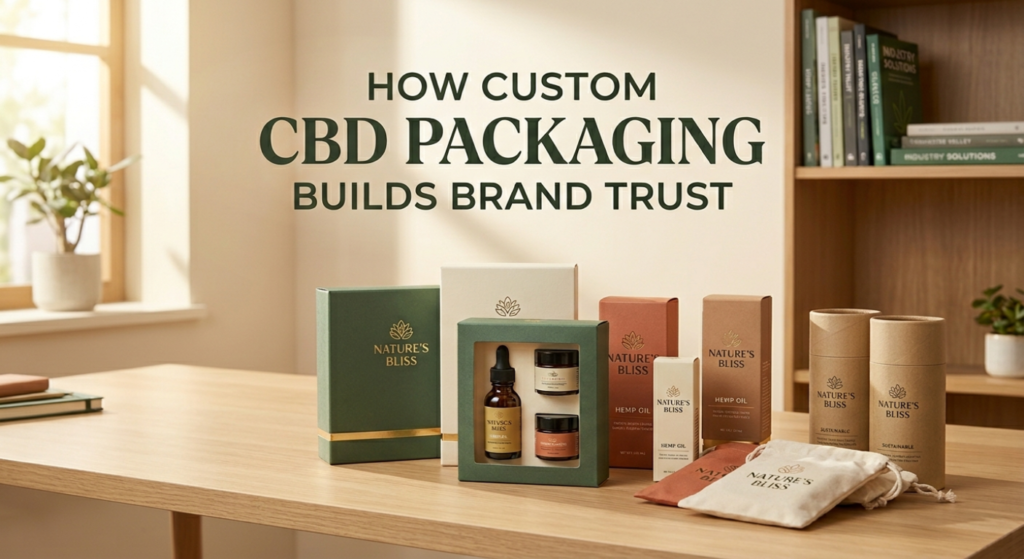
Last year, a custom CBD Packaging for brand owners told me something I haven’t stopped thinking about since. Her product had better lab results than anything on that shelf. Third-party tested. Organic hemp. Competitive price. She couldn’t figure out why sales were slow. Then she stood in the aisle and watched shoppers. Nobody picked her bottle up. They kept reaching for the brand next to hers. Same CBD content. Higher price. The box just looked more serious. She changed her packaging. Sales doubled in 90 days. That story isn’t unique in this industry. It’s actually the rule. What is custom CBD packaging for brands in 2026? Custom CBD packaging for brands means boxes, bags, or containers built specifically around your product type, your brand identity, and US compliance requirements. It goes beyond protection. It’s the physical argument your product makes to a stranger who has never heard of you. The global CBD product packaging market sat at $1.4 billion in 2025. Analysts at Wise Guy Research project it to reach $4.5 billion by 2035, growing at 12.3% CAGR. Brands aren’t spending that money on boxes for fun. They’re spending it because packaging closes sales that nothing else can. Why Custom CBD Packaging for Brands Is Now a Revenue Decision CBD is a credence product. A buyer cannot verify quality by looking at the liquid inside a tincture bottle. They cannot taste gummy before they buy it. So they look at your box and they make a decision based on what it tells them about you. That’s a lot riding on cardboard. A McKinsey study conducted with NielsenIQ found that products making sustainability-related claims grew 28% cumulatively over five years, versus 20% for products making no such claims. In the CBD category, where natural and wellness positioning is table stakes, the brands that communicate those values through their packaging capture real market share from those that don’t. Then there’s the repeat purchase reality. A 2024 Ryder Logistics study surveyed 1,300 US online shoppers. It found that 41% of them said a genuinely good unboxing experience made them want to order from that brand again. Among shoppers under 30, that number climbed to 60%. G+D Spotlight covered this research in detail. CBD is a monthly repurchase category for most users. The packaging that earns that first positive moment is directly responsible for what happens in months two, three, and twelve. Five Things That Separate Trusted CBD Packaging from Forgotten CBD Packaging 1. Material Choice Tells Buyers Who You Are Before They Read Anything Rigid boxes say premium. Kraft paper says it’s natural. Clean white cardboard says clinical precision. Corrugated says this product ships safely and arrives intact. None of those signals require a customer to read your copy. They land in under two seconds, at a gut level, before a hand even reaches for your product. Choose the wrong material for your brand position and price point, and you’ve lost the sale before the copy even gets a chance. 2. Print Quality Is a Proxy for Product Quality This one bothers most CBD brand owners at first because it feels unfair. But shoppers consistently judge the product inside by the quality of what’s outside. Blurry printing, inconsistent color across a product line, and flimsy stock all register as warning signals even subconsciously. Matte lamination adds a tactile weight that reads as expensive. Spot UV on your logo makes it catch light differently from the products next to it on the shelf. Offset printing keeps your brand colors exact across a run of 5,000 units so your product looks identical whether it’s in a Denver dispensary or a New York wellness boutique. 3. Compliance Labeling Isn’t Just Legal Protection, It’s a Trust Signal Every ingestible CBD product sold in the US needs to carry certain information on its box. Here’s what your CBD packaging must include: That QR code matters more than most brands realize. A customer standing in a store can pull out their phone, scan it, and read your lab results in thirty seconds. If those results are there and clear, trust goes up immediately. If nothing loads, or the link is broken, that customer puts your product back on the shelf and picks up the brand next to yours. Compliance packaging is trust packaging. Treat it that way. 4. Sustainable Materials Signal Brand Values to the Buyers Who Care Most NielsenIQ’s 2023 CPG Sustainability Report found that 92% of shoppers say sustainability matters when they’re choosing a brand. For a full breakdown of how sustainability claims translate into growth, McKinsey’s June 2025 packaging consumer research is worth reading. For CBD brands, this matters more than in almost any other category. Your product is a plant-based wellness item. Your buyer is often health-conscious, ingredient-aware, and skeptical of greenwashing. When your packaging uses recyclable cardboard, kraft paper, or soy-based inks, and you call that out on the box, you’re speaking directly to a buyer who was already leaning toward trusting you. You’re confirming what they hoped was true. That’s not marketing. That’s alignment. 5. The Unboxing Moment Is Where Loyalty Actually Gets Built A branded tissue paper costs almost nothing per unit. A small card thanking the customer and explaining how to get the most from the product costs a few cents. Neither of those things is expensive relative to your customer acquisition cost. But together, they create the kind of moment a customer tells someone about. They take a photo, and post it. They come back because they remember how the experience felt. According to NielsenIQ research, 92% of shoppers factor in sustainability when choosing brands. The brands that deliver on that promise at the unboxing level with materials that feel considered and intentional are the ones that convert first-time buyers into loyal monthly subscribers. Getting Packaging Right Across CBD Product Types Not every CBD product needs the same box. Getting this wrong is one of the most common and costly mistakes CBD brands make. Ordering CBD Packaging Without Taking
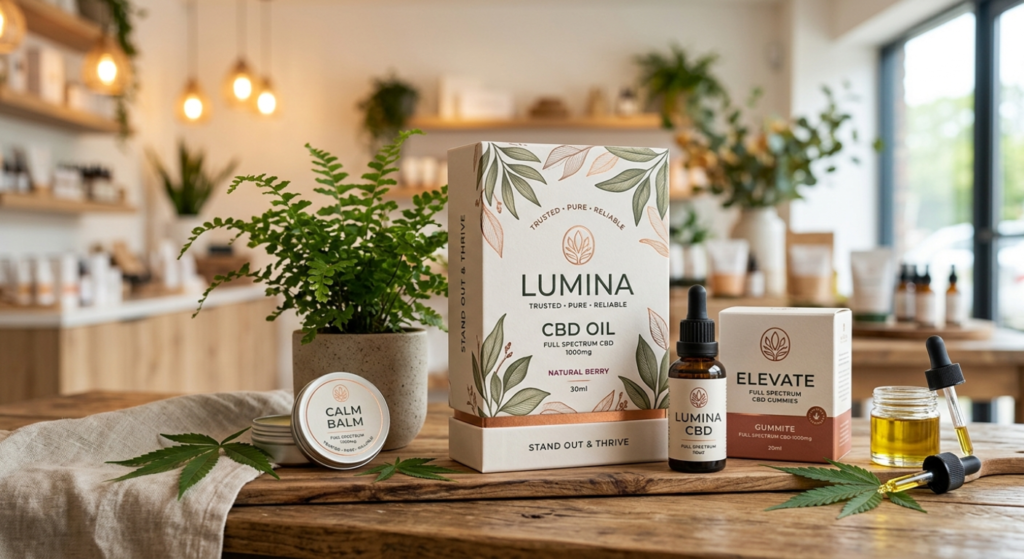
Last year, a custom CBD Packaging for brand owners told me something I haven’t stopped thinking about since. Her product had better lab results than anything on that shelf. Third-party tested. Organic hemp. Competitive price. She couldn’t figure out why sales were slow. Then she stood in the aisle and watched shoppers. Nobody picked her bottle up. They kept reaching for the brand next to hers. Same CBD content. Higher price. The box just looked more serious. She changed her packaging. Sales doubled in 90 days. That story isn’t unique in this industry. It’s actually the rule. What is custom CBD packaging for brands in 2026? Custom CBD packaging for brands means boxes, bags, or containers built specifically around your product type, your brand identity, and US compliance requirements. It goes beyond protection. It’s the physical argument your product makes to a stranger who has never heard of you. The global CBD product packaging market sat at $1.4 billion in 2025. Analysts at Wise Guy Research project it to reach $4.5 billion by 2035, growing at 12.3% CAGR. Brands aren’t spending that money on boxes for fun. They’re spending it because packaging closes sales that nothing else can. Why Custom CBD Packaging for Brands Is Now a Revenue Decision CBD is a credence product. A buyer cannot verify quality by looking at the liquid inside a tincture bottle. They cannot taste gummy before they buy it. So they look at your box and they make a decision based on what it tells them about you. That’s a lot riding on cardboard. A McKinsey study conducted with NielsenIQ found that products making sustainability-related claims grew 28% cumulatively over five years, versus 20% for products making no such claims. In the CBD category, where natural and wellness positioning is table stakes, the brands that communicate those values through their packaging capture real market share from those that don’t. Then there’s the repeat purchase reality. A 2024 Ryder Logistics study surveyed 1,300 US online shoppers. It found that 41% of them said a genuinely good unboxing experience made them want to order from that brand again. Among shoppers under 30, that number climbed to 60%. G+D Spotlight covered this research in detail. CBD is a monthly repurchase category for most users. The packaging that earns that first positive moment is directly responsible for what happens in months two, three, and twelve. Five Things That Separate Trusted CBD Packaging from Forgotten CBD Packaging 1. Material Choice Tells Buyers Who You Are Before They Read Anything Rigid boxes say premium. Kraft paper says it’s natural. Clean white cardboard says clinical precision. Corrugated says this product ships safely and arrives intact. None of those signals require a customer to read your copy. They land in under two seconds, at a gut level, before a hand even reaches for your product. Choose the wrong material for your brand position and price point, and you’ve lost the sale before the copy even gets a chance. 2. Print Quality Is a Proxy for Product Quality This one bothers most CBD brand owners at first because it feels unfair. But shoppers consistently judge the product inside by the quality of what’s outside. Blurry printing, inconsistent color across a product line, and flimsy stock all register as warning signals even subconsciously. Matte lamination adds a tactile weight that reads as expensive. Spot UV on your logo makes it catch light differently from the products next to it on the shelf. Offset printing keeps your brand colors exact across a run of 5,000 units so your product looks identical whether it’s in a Denver dispensary or a New York wellness boutique. 3. Compliance Labeling Isn’t Just Legal Protection, It’s a Trust Signal Every ingestible CBD product sold in the US needs to carry certain information on its box. Here’s what your CBD packaging must include: That QR code matters more than most brands realize. A customer standing in a store can pull out their phone, scan it, and read your lab results in thirty seconds. If those results are there and clear, trust goes up immediately. If nothing loads, or the link is broken, that customer puts your product back on the shelf and picks up the brand next to yours. Compliance packaging is trust packaging. Treat it that way. 4. Sustainable Materials Signal Brand Values to the Buyers Who Care Most NielsenIQ’s 2023 CPG Sustainability Report found that 92% of shoppers say sustainability matters when they’re choosing a brand. For a full breakdown of how sustainability claims translate into growth, McKinsey’s June 2025 packaging consumer research is worth reading. For CBD brands, this matters more than in almost any other category. Your product is a plant-based wellness item. Your buyer is often health-conscious, ingredient-aware, and skeptical of greenwashing. When your packaging uses recyclable cardboard, kraft paper, or soy-based inks, and you call that out on the box, you’re speaking directly to a buyer who was already leaning toward trusting you. You’re confirming what they hoped was true. That’s not marketing. That’s alignment. 5. The Unboxing Moment Is Where Loyalty Actually Gets Built A branded tissue paper costs almost nothing per unit. A small card thanking the customer and explaining how to get the most from the product costs a few cents. Neither of those things is expensive relative to your customer acquisition cost. But together, they create the kind of moment a customer tells someone about. They take a photo, and post it. They come back because they remember how the experience felt. According to NielsenIQ research, 92% of shoppers factor in sustainability when choosing brands. The brands that deliver on that promise at the unboxing level with materials that feel considered and intentional are the ones that convert first-time buyers into loyal monthly subscribers. Getting Packaging Right Across CBD Product Types Not every CBD product needs the same box. Getting this wrong is one of the most common and costly mistakes CBD brands make. Ordering CBD Packaging Without Taking
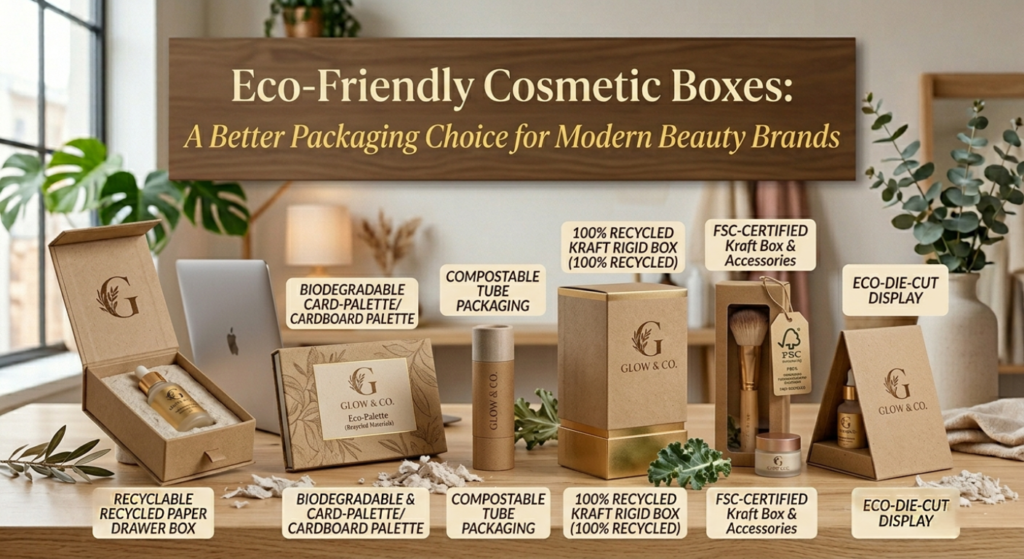
What Are Sustainable Cosmetic Packaging Solutions in 2026? Sustainable cosmetic packaging solutions are beauty product boxes built from eco-certified materials. Think FSC-certified kraft paper, post-consumer recycled paperboard, and corrugated recycled cardboard. They use soy-based inks and water-based coatings throughout production. They carry verifiable certifications. These certifications are accepted by US retail buyer compliance programs. They cover makeup, skincare, and hair care categories. The Relaunch That Stalled Over a Missing Document A Los Angeles hair care brand spent seven months rebuilding their product line in 2024. New formulas. New branding. A sustainability story front and center on every marketing channel they owned. Three months after relaunching, a major wellness retail chain sent a supplier qualification form. It asked for FSC chain-of-custody certification documentation, recycled content percentage by SKU, and coating chemistry confirmation for the full product range. The brand had none of it. Their hair packaging boxes were marketed as eco-friendly. They carried no FSC certification, no documented recycled content figure, and no coating specification confirming recyclability. The procurement team closed the inquiry the same week. The retail opportunity was gone. That founder learned the difference between claiming sustainable cosmetic packaging solutions and being able to prove them. In 2026, that difference is what separates beauty brands getting onto retail shelves from brands that stay in their DTC lane indefinitely. Why Sustainability Has Become a Supplier Qualification Requirement The global sustainable packaging market was valued at $303.80 billion in 2025 and is forecast to reach $463.41 billion by 2031, growing at 7.29% annually, according to Mordor Intelligence’s 2026 Sustainable Packaging Market Report. Extended Producer Responsibility regulations now span 63 countries, which means eco-packaging compliance is a cross-border business requirement, not a regional preference that brands can opt into when convenient. Within the beauty industry, the shift is accelerating at the brand level. Estée Lauder reports 71% of its packaging already meets verified sustainability criteria, per the same Mordor Intelligence data. When major prestige houses operate at that benchmark, boutique and indie beauty brands face real pressure from the same retail buyers who stock both tiers on the same shelves. A boutique wellness chain that stocks sustainable prestige brands will not grant shelf space to a supplier who cannot produce eco-documentation on request. Beauty and personal care brands also report that 61% of shoppers actively seek eco-aligned brands, per Mordor Intelligence’s 2026 sustainable e-commerce packaging data. That consumer demand is translating directly into retail buyer behavior, and into supplier qualification forms that beauty brands simply cannot pass without verified eco-packaging credentials in hand. “Sustainable packaging in the beauty industry is no longer a value statement. It is a commercial requirement that determines retail access. The brands that understand this are the ones getting shelf space in 2026.” — Senior Packaging Consultant, Packaging Ship 4 Materials That Hold Up Under a Compliance Audit FSC-certified kraft paper is the most widely accepted eco-material across US beauty retail supplier compliance programs. The Forest Stewardship Council certifies the full chain of custody from forest to finished box. That chain-of-custody documentation is what retail procurement teams actually request on compliance forms, not just an eco logo printed somewhere on the side panel. At 120 to 157 GSM, kraft handles most cosmetic product weights without structural compromise. Uncoated kraft biodegrades in 2 to 5 months and clears most US curbside recycling programs without issue. For green cosmetic packaging at the clean beauty and natural brand level, FSC-certified kraft delivers the aesthetic authenticity and verified credentials that both retail buyers and eco-conscious consumers actually trust when they read the packaging claim. Recycled paperboard built from post-consumer waste gives you the documented recycled content percentages that supplier qualification forms require. Vague language like “made with recycled materials” fails retail compliance audits. Documented figures, whether 30%, 50%, or 100% post-consumer recycled content confirmed in writing by the supplier, pass them. At 300 to 350 GSM for folding cartons, recycled paperboard delivers full-color printing for retail-ready lipstick packaging boxes, custom eyeshadow boxes, and makeup brush set packaging while keeping the material genuinely circular throughout the supply chain. For e-commerce shipping of fragile cosmetic products, corrugated recycled cardboard at B-flute structure provides the protective strength glass cosmetic containers need without petroleum-based foam or bubble wrap. Pair it with kraft honeycomb paper inserts, which are plastic-free and recyclable curbside, and you have a direct-to-consumer shipping solution for serum bottles, foundation jars, and lipstick gift boxes that arrives plastic-free at the customer’s doorstep. Natural skincare packaging in corrugated recycled configurations is increasingly the baseline expectation among wellness retailers evaluating skincare brand suppliers for the first time. This is precisely where most beauty brands and most of their current packaging suppliers quietly fail the sustainability test. A kraft box or recycled SBS carton with petroleum-based gloss lamination is not recyclable at most US curbside facilities, regardless of what the substrate material says on the spec sheet. Water-based matte coatings preserve recyclability. Soy-based inks replace petroleum pigments without compromising print resolution or Pantone color accuracy across the production run. The coating and ink specification determines whether an eco-packaging claim is true or whether it is greenwashing, and in 2026, retail buyers know the difference. Sustainable Packaging Matched to Each Beauty Product Category In FSC-certified SBS boards at 300 to 350 GSM communicates sustainable credentials without sacrificing the structural integrity that communicates premium positioning on a retail shelf. FSC-certified SBS takes full-color offset printing and foil stamping cleanly, which means a sustainable lipstick box does not have to look like a compromise on quality. It for a palette format needs to survive retail handling across a full sales cycle. Recycled paperboard at 350 GSM with water-based matte lamination handles repeated opening and closing on a retail shelf without showing structural wear. The recycled content percentage goes on the compliance form. The matte finish goes on the palette presentation at the point of sale. A Set packaging in eco materials needs to protect bristles during shipping and retail display at the same time. A recycled corrugated outer box
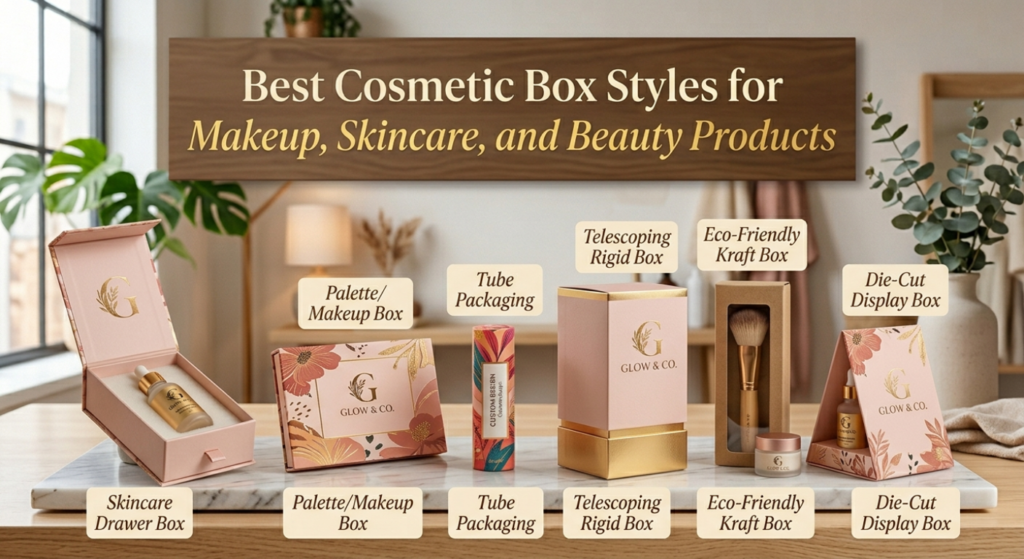
What Are Cosmetic Packaging Styles for Beauty Products in 2026? Cosmetic packaging styles for beauty products refer to the specific structural configurations of rigid boxes, folding cartons, sleeve boxes, window boxes, and display boxes matched to individual product types, retail price points, and sales channels to communicate brand positioning and protect product integrity simultaneously. Three Boxes, One Serum, One Retail Decision A Chicago skincare brand founder sat with three sample boxes on her desk in February 2025. Same serum formula inside each one. Same label with same price sticker. Three completely different box structures: a folding carton at 250 GSM, a sleeve box in kraft paper, and a rigid two-piece box at 2mm chipboard with soft-touch lamination. She sent all three to her retail buyer contact at a boutique wellness chain in the city. The buyer called back the same afternoon. She chose the rigid box. And she asked for 500 units. She never opened the other two. The founder had nearly ordered the folding carton because it cost $0.22 less per unit. That $0.22 saving would have cost her the account entirely. Cosmetic packaging styles for beauty products are not an aesthetic preference. They are a commercial decision with real consequences for retail access, perceived value, and brand credibility at every touchpoint from the shelf to the doorstep. Why Getting the Style Right Matters More Than Ever in 2026 The US beauty and personal care market was valued at $109.56 billion in 2025 and is projected to reach $196.33 billion by 2033, growing at 7.7% annually, according to Grand View Research’s US Beauty and Personal Care Market Report. Skincare alone accounts for 32.5% of that market, the largest single product segment driving packaging demand across retail and DTC channels simultaneously. Within that growth, premiumization is accelerating. Consumers are buying fewer products and choosing better ones. Premium beauty products are growing at a faster compound rate than mass-market alternatives, per Mordor Intelligence’s 2026 US Cosmetics Products Market Report. That shift directly impacts packaging decisions. A brand that packages a premium serum in a mass-market folding carton sends a signal that contradicts the product’s price point and that contradiction costs sales before the formula is ever tested. “The box a beauty product arrives in sets the customer’s expectation for everything inside it. Get the structure wrong and even an exceptional formula struggles to justify its price.” — Senior Packaging Consultant, Packaging Ship According to the Mordor Intelligence Global Cosmetic Packaging Market Report 2026, skincare retained 45.01% of global cosmetic packaging revenue in 2025, driven by multi-step routines that demand tailored packaging for each SKU in a product line. That figure underscores something every cosmetic brand owner needs to internalize packaging is not a one-size decision across a product range. 6 Cosmetic Packaging Styles Matched to Your Product and Channel Rigid two-piece boxes are the commercial standard for beauty products positioned above $25 at retail. A 2mm chipboard construction holds its shape under stacking pressure on a retail shelf. It communicates weight and quality at first touch in a way no folding carton can replicate. Serum boxes, face cream jars, and premium skincare sets belong here. Cosmetic display boxes in rigid construction also work for countertop retail environments where shelf presence drives impulse purchase decisions. For beauty brands moving into retail at wholesale volumes, folding cartons in SBS board at 300 to 350 GSM deliver the full-color printing surface needed for shelf visibility at a per-unit cost that scales cleanly. Foundation boxes, mascara boxes, lipstick boxes, and makeup brush set packaging all perform well in SBS folding cartons when consistent retail presence matters more than premium unboxing weight. At 2,000 units with offset printing, these deliver Pantone-accurate color and sharp detail across the full production run. Sleeve boxes use less material than a full rigid structure, which keeps unit costs lower at smaller volumes. They carry a restrained visual language that resonates with wellness, clean beauty, and natural skincare consumers. The reveal of a tray sliding from a sleeve creates an intentional unboxing moment without the production cost of a full two-piece rigid box. Cream boxes and skincare sets positioned in the $15 to $28 range tend to perform particularly well in sleeve configurations. Window boxes work when the product itself is the strongest visual selling tool. A lip gloss in a vibrant shade, a setting powder with a distinctive color payoff, or an essential oil in a textured glass bottle all of these benefit from a die-cut window that lets the customer connect with the product before opening the box. One important caveat: window boxes reduce perceived exclusivity for products priced above $30. For luxury skincare or premium fragrance, a closed box structure almost always outperforms a window configuration in retail environments. Cosmetic gift boxes and display configurations work for beauty brands selling through high-traffic retail points where countertop visibility is part of the sales strategy. Display boxes present multiple units at once, use shelf space efficiently, and keep the brand visible from multiple angles simultaneously. Votive candles, lip balms, travel-size skincare, and sample-sized fragrance all perform well in display box configurations at beauty counters and specialty retail environments. Drawer boxes signal premium positioning through the physical experience of opening them. The inner tray pulls out smoothly, the reveal is controlled, and that moment of opening is what gift buyers in the $40 and above price tier are purchasing. Seasonal collections, curated skincare sets, and fragrance gift boxes belong in drawer configurations when the unboxing experience is part of the product’s marketing strategy. Matching Box Style to Each Cosmetic Product Type It needs structural rigidity that communicates formula quality before the product is seen. At 300 GSM and above in SBS board, a lipstick packaging box communicates a price point that supports a $22 to $35 retail position. Below 250 GSM, the same formula reads as mass market regardless of what the label says. They have a specific structural requirement most brands overlook. The height-to-width ratio of a mascara box
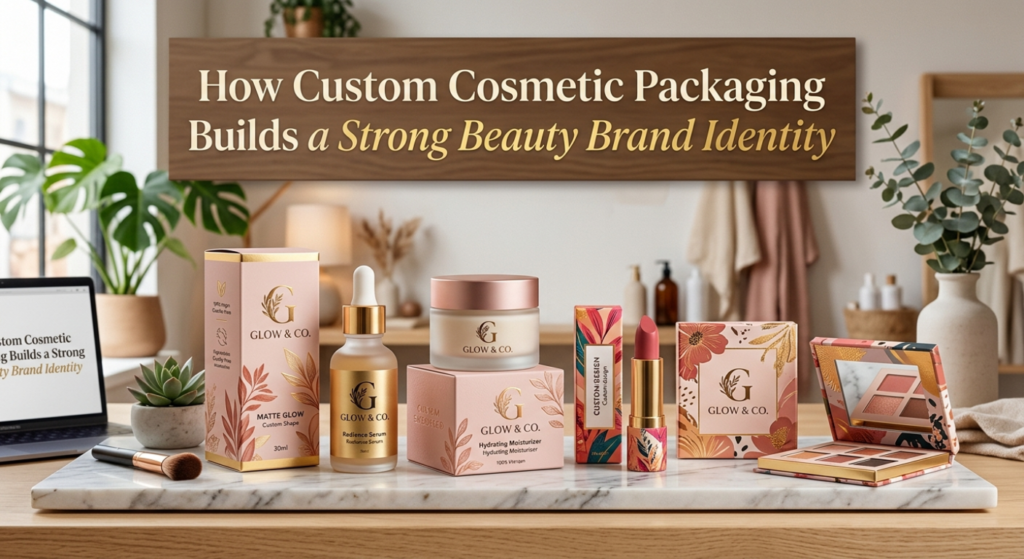
What Is Custom Cosmetic Packaging for Beauty Brands in 2026? Custom cosmetic packaging for beauty brands refers to boxes, cartons, and containers designed around a brand’s specific visual identity logo, color palette, finish, and structure applied consistently across lipstick, eyeshadow, skincare, and fragrance products to build recognizable brand presence across every sales channel. The Lipstick Box That Lost a New York Retail Contract A Houston indie lip brand had everything going for it in early 2024. The pigment quality was genuinely exceptional. A loyal following of 40,000 grew organically in under six months. Then came the moment every indie founder dreams about a wholesale inquiry from a boutique beauty retailer on the Lower East Side. The buyer flew in samples. She tested the formula in person. It was worth every dollar of the $28 retail price. The lipstick packaging box told a completely different story though. No texture with no weight. No finish that communicated anything beyond a drugstore price point. The buyer passed. Not on the formula. On what the box said about the brand. Nine months later, after switching to 2mm chipboard rigid boxes with soft-touch lamination and foil-stamped logo, that same brand landed three boutique placements in their first month of outreach. Custom cosmetic packaging for beauty brands is not a finishing detail you come back to once the formula is done. It is the first product your retail buyer and your customer evaluate. Getting it right changes every conversation that follows. Why the Market Rewards Brands That Invest in Packaging Early The US cosmetic packaging market was valued at $2.10 billion in 2025 and is on track to reach $3.44 billion by 2035, growing at a 5.05% compound annual rate, according to Towards Packaging’s 2026 US Cosmetic Packaging Market Report. That growth reflects a real shift in how beauty brands are treating packaging not as a protective container, but as a brand-building investment that influences purchase decisions before the product is ever tested. Color cosmetics, the segment covering lipstick, eyeshadow, blush, and contour, is growing at the fastest rate within that market. The brands capturing the largest share of that growth have one thing in common. They commit to packaging strategy at the same time they finalize their formula, not after. Globally, the cosmetic packaging market reached $30.19 billion in 2025 and is forecast to hit $40.33 billion by 2031, per Mordor Intelligence’s 2026 Cosmetic Packaging Market Report. The brands winning in that market are consistently the ones whose packaging communicates brand positioning before the product is touched, opened, or tested by anyone. “In the beauty industry, the box is the brand’s handshake. It sets every expectation the customer brings to the product inside.” — Senior Packaging Consultant, Packaging Ship What Your Box Communicates Before Anyone Reads the Label Most beauty founders think about cosmetic boxes packaging in terms of how it looks. Retail buyers think about it in terms of what it signals. A rigid box at 2mm chipboard signals a retail price point above $25. A standard folding carton at 250 GSM signals mass market. A matte lamination finish signals intentional, considered branding. Gloss lamination on a luxury lipstick packaging box signals cost-cutting at the manufacturing stage. Buyers read these signals in seconds, and those signals determine whether a product gets shelf space or a polite rejection email within the week. There are three things retail buyers evaluate in cosmetic boxes packaging before they look at anything else. Structural integrity under shelf stacking pressure comes first. Visual consistency between the packaging and the brand’s stated price point comes second. Finish quality as a proxy for overall manufacturing standards comes third. Getting all three right is not complicated once you understand which box structure and material combination communicates what. This is precisely where most indie beauty brands lose ground to larger competitors not on formula quality, but on packaging literacy. 5 Box Styles Matched to Your Brand Positioning Rigid boxes are the category standard for beauty products positioned above $25 at retail. The 2mm chipboard construction holds its shape under stacking pressure in a retail environment, signals weight and quality at first touch, and takes foil stamping and soft-touch lamination at a quality level that folding cartons simply cannot replicate. Packaging perfume design, high-end skincare gift sets, and seasonal collections belong in rigid boxes when the brand is positioned above the mass-market tier. There is no substitute at this price point. For beauty brands moving into retail at scale, folding cartons in SBS board at 300 to 350 GSM provide the full-color printing surface needed for shelf presence at a per-unit cost that works at wholesale volumes. Cardboard boxes in this category suit custom eyeshadow box lines, makeup brush set packaging, and skincare product ranges where consistent retail shelf presence matters more than premium unboxing weight. At 2,000 or more units with offset printing, these deliver Pantone-accurate color and sharp detail across the full production run. Magnetic closure boxes are purpose-built for the gifting channel. The opening moment carries emotional weight in gift retail: the magnet pulls cleanly, the interior reveals in a single controlled motion, and that experience is what gift buyers are actually purchasing. Holiday collections, brand collaborations, and limited-edition beauty sets belong in magnetic closure structures when unboxing sharability is part of the marketing strategy. Clean beauty brands and minimalist cosmetic lines tend to perform well in sleeve boxes. They use less material than a full rigid structure, which keeps unit costs manageable at smaller volumes. They also carry a restrained visual language that resonates with wellness and natural beauty consumers who associate minimal packaging with honest formulation. The reveal, a tray sliding from a sleeve creates an intentional unboxing moment without the cost of a full rigid two-piece structure. Kraft Boxes work particularly well for beauty brands where the sustainability story sits at the center of their brand identity. The natural brown surface communicates honesty and environmental commitment before a single word of copy is read. Pair it with soy-ink
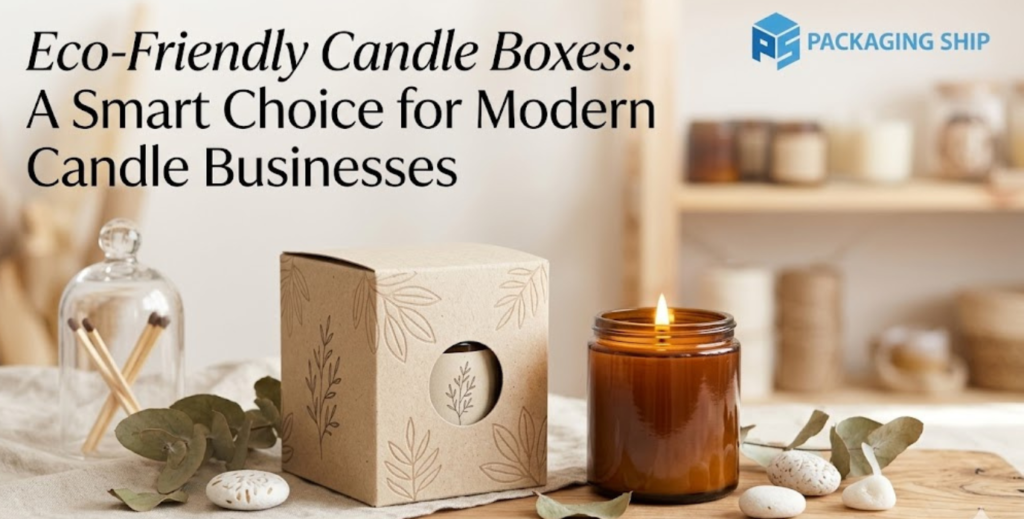
What Are Sustainable Candle Packaging Solutions in 2026? Sustainable candle packaging solutions are candle boxes made from recyclable, biodegradable, or post-consumer recycled materials verified through certifications like FSC that protect the product, satisfy retail supplier requirements, and reflect a brand’s environmental values across every sales channel. The Contract That Disappeared Because of the Box A Denver soy candle brand spent 14 months building something worth being proud of. Clean wax. Phthalate-free fragrance. A brand story that actually held up. In Q1 2025, their largest wholesale account, a 60-location health and wellness retail chain declined the reorder. Not the candles. The boxes. The US candle market generates approximately $3.14 billion in annual retail sales, according to the National Candle Association. Roughly 35% of those sales happen during the Christmas and holiday season alone, a concentrated window where packaging decisions directly impact revenue. Petroleum lamination. No recycled content. No FSC certification. The retailer’s supplier compliance form asked for documented eco-credentials, and the brand had nothing to hand over. That account was worth $84,000 a year. It walked out the door over a packaging upgrade that would have cost $0.14 more per unit. This is not a rare story. It plays out every quarter across US candle brands at exactly the moment they think they’ve made it into retail. Sustainable candle packaging solutions aren’t a marketing choice anymore. They’re the entry ticket to serious retail relationships in 2026. Why This Shift Is Permanent The global sustainable packaging market sat at $303.80 billion in 2025. By 2031, it’s projected to reach $463.41 billion, growing at 7.29% annually, according to Mordor Intelligence’s 2026 Sustainable Packaging Market Report. North America is carrying a significant share of that growth, driven by state-level Extended Producer Responsibility legislation and brand-level commitments to minimum recycled content thresholds. Paper recycling infrastructure in the US backs this up. In 2024, Americans recycled 46 million tons of paper, that’s 125,000 tons every single day turned into new packaging, boxes, and paper products. The recycling rate for paper hit 60 to 64 percent and cardboard reached 69 to 74 percent, according to AF&PA data published by American Recycler. Paper is one of the most successfully recycled materials in the country, which makes paper-based candle packaging the most credible and defensible sustainability claim a candle brand can make. Retail buyers know these numbers. Their compliance teams are getting sharper. A vague “eco-friendly” sticker on a box with petroleum lamination doesn’t pass anymore. “The right candle box isn’t just packaging, it’s the first physical signal your brand sends about what it actually stands for.” — Senior Packaging Consultant, Packaging Ship Sustainable Candle Packaging Across Every Dimension of Your Business Most candle brands think about sustainable packaging in one dimension, the material. The brands that get retail contracts think about it across four. 4 Materials That Hold Up Under Scrutiny FSC-certified kraft paper is the foundation that US retail compliance programs actually accept. The Forest Stewardship Council certifies the full chain of custody from forest to finished box which is what retail auditors ask for, not just a logo on the side panel. At 120 to 157 GSM, kraft handles most candle weights without the box losing structural integrity. Uncoated kraft biodegrades in 2 to 5 months and clears virtually all US curbside recycling programs. For sustainable packaging for candles at the artisan, wellness, and natural brand level, this is where most businesses should start. Recycled paperboard built from post-consumer waste gives you the documented recycled content percentages that supplier qualification forms actually require. “Made with recycled materials” without a percentage means nothing to a retail compliance auditor. At 200 to 350 GSM for folding cartons, recycled paperboard delivers a smooth printing surface for full-color retail packaging while keeping the material genuinely circular. This suits candle brands moving into major US retail chains with formal sustainability programs. For candle shipping, corrugated recycled cardboard at B-flute or C-flute structure gives glass jar candles real protection without petroleum foam. Pair it with kraft honeycomb paper inserts plastic-free, fully recyclable, and you have a direct-to-consumer shipping box that protects fragile glass and arrives at the customer’s door without a single piece of plastic inside it. Our green candle packaging range includes corrugated options designed specifically for candle e-commerce fulfillment at wholesale volumes. This is where most brands, and most of their suppliers, quietly fail. A kraft box with petroleum-based gloss lamination is not recyclable at most US curbside facilities, regardless of what the substrate says. Water-based matte coatings preserve recyclability. Soy-based inks replace petroleum pigments with plant-based alternatives without losing print resolution or color accuracy. The coating and ink choice isn’t a finishing detail, it determines whether your sustainability claim is true or not. Recyclable, Biodegradable, Compostable: They Are Not the Same Thing Using these three terms interchangeably is greenwashing, even when unintentional, and sophisticated retail buyers are catching it. Recyclable means the material processes through standard recycling infrastructure. Most FSC-certified paperboard without petroleum lamination qualifies. Biodegradable means natural biological breakdown over time. Uncoated kraft paper gets there in 2 to 5 months. Compostable means breakdown within a specific timeframe under composting conditions, typically 90 days in industrial composting environments, and requires BPI certification to claim it legitimately. When you order biodegradable candle boxes from Packaging Ship, every order comes with material documentation specifying exactly which claim applies. Your marketing team writes accurately. Your procurement team hands over a compliance document, not a vague promise. Four Questions to Ask Before Choosing a Supplier Ask for FSC chain-of-custody documentation that covers the full supply chain from forest to finished box. A logo without the documentation doesn’t clear a retail compliance audit. Ask for the specific recycled content percentage, 30, 50, or 100 percent post-consumer recycled content, stated in writing. Ask whether all coatings and inks are water-based, confirmed in the product specification. And ask what the MOQ is for certified eco materials specifically, not the general minimum, but the minimum for the certified version of the product you actually need.
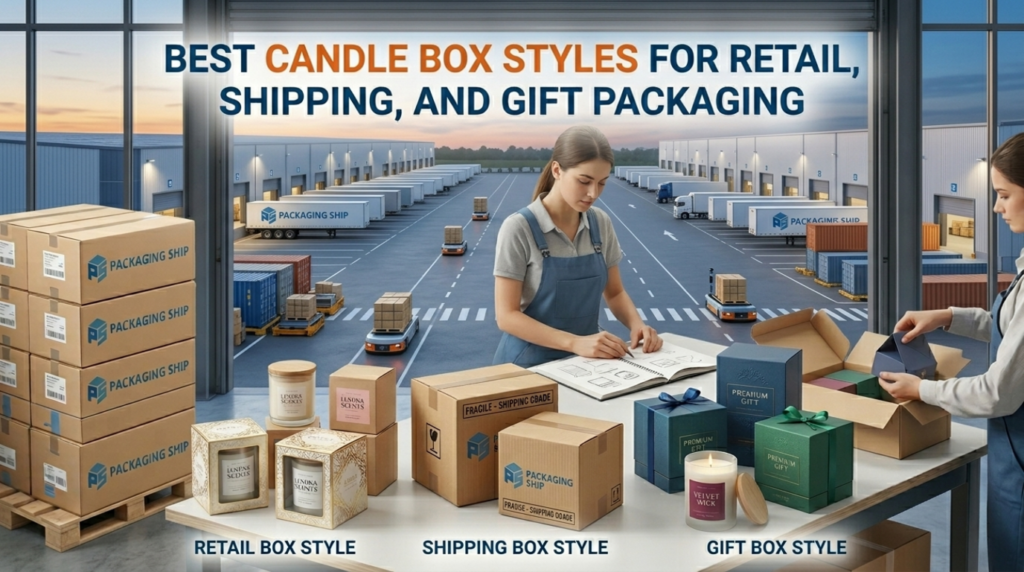
What Are Candle Box Styles for Different Candle Products in 2026? Candle box styles for different candle products refer to the specific box structures rigid, kraft, window, sleeve, magnetic closure matched to each candle type, sales channel, and brand positioning. Choosing the right style protects the candle, elevates brand perception, and directly impacts retail sell-through rates. The Packaging Decision That Cost a Brand Its First Retail Contract A soy candle brand from Nashville landed shelf space in a regional boutique chain in late 2024. Forty-eight stores. Their best moment yet. Three weeks after delivery, the buyer called. Twenty-two percent of units arrived with cracked glass jars. The culprit wasn’t the shipper. It was a folding carton with no insert chosen because it was $0.12 cheaper per unit than the corrugated alternative with die-cut cardboard inserts. That $0.12 saving cost them the contract. Choosing the wrong candle box style isn’t just a packaging mistake. It’s a business mistake. And it’s entirely avoidable once you understand which candle box styles for different candle products actually match your product, your channel, and your customer. This guide walks you through every major style with specific material recommendations, channel-by-channel guidance, and the practical specs your team needs before placing any order. 6 Best Candle Box Styles Matched to Your Product and Channel 1. Rigid Two-Piece Candle Boxes: For Luxury and Premium Gift Retail Rigid two-piece boxes are the gold standard for premium candle packaging. The lid and base are constructed from a 2mm chipboard, which holds its shape under stacking pressure and communicates quality before the candle is ever seen. These boxes suit high-end jar candles, gift sets, and luxury fragrance collections priced above $30. Retailers expect this level of presentation in boutiques, department stores, and specialty gift shops. Pair them with soft-touch lamination and foil-stamped logos for a finish that photographs well and drives unboxing content on social media. If your candle brand sits in the premium tier, luxury candle packaging is not optional, it is the product experience your customer pays for before they even light the wick. 2. Kraft Candle Boxes: For Eco-Conscious and Artisan Brands Kraft candle boxes are the most versatile wholesale option for small and mid-size candle brands. They cost 15–20% less per unit than rigid alternatives, they’re fully recyclable, and their natural brown surface reads as sustainable, which matters. According to the National Candle Association, fragrance is the top purchase driver for candle buyers. But increasingly, packaging sustainability is the second conversation happening at the register. Brands using FSC-certified kraft candle boxes tap directly into that conversation without saying a word. Kraft boxes work well for pillar candles, tin candles, and wax melt sets. Add a printed label or one-color logo for clean brand presence at a budget-friendly unit cost. 3. Window Candle Boxes: For Retail Display and Impulse Buying Window candle boxes solve a specific retail problem: customers want to see the candle before they buy. A die-cut window on the front panel lets the candle’s color, texture, and vessel do the selling work. These boxes perform especially well in high-traffic retail environments gift shops, home décor stores, and mass-market outlets. The window increases impulse purchase rates because it removes uncertainty. Shoppers connect with what they can see. Window boxes work best for jar candles, pillar candles, and specialty decorative candles where the vessel is part of the brand story. 4. Magnetic Closure Candle Boxes: For Premium Gift Packaging Magnetic closure boxes are the most gifting-specific structure on this list. They open with a satisfying pull. The magnet holds firm. The interior is clean. That moment the opening is what gift buyers pay for, and it’s what drives social sharing. These boxes suit candle gift sets, seasonal collections, and corporate gifting orders. At Packaging Ship, we see strong demand for magnetic closure candle boxes from beauty, wellness, and home fragrance brands preparing Q4 holiday inventory. Order early lead times for magnetic closure styles run 15–18 business days. 5. Candle Shipping Boxes with Inserts: For E-Commerce and Wholesale Glass jar candles crack in transit for one reason: movement. A corrugated mailer box with die-cut cardboard inserts eliminates that movement entirely. The insert holds the jar at the center of the box, absorbs lateral impact, and prevents the lid from shifting. Candle boxes with inserts are non-negotiable for any candle brand shipping direct-to-consumer or fulfilling wholesale orders through a 3PL. At 3mm insert thickness, die-cut cardboard absorbs impact forces that would otherwise crack standard glass jars in transit. 6. Sleeve Candle Boxes: For Minimalist and Boutique Brands Sleeve boxes slide over a plain base tray, revealing the candle in a clean, controlled presentation. They use less material than a full rigid box, which keeps unit costs lower while still delivering a premium unboxing moment. Boutique candle brands and minimalist aesthetics particularly suit this style. Sleeve boxes work well for candle tins, small jar candles, and subscription box inclusions where the packaging needs to feel intentional without overwhelming the product. Matching Candle Box Style to Your Candle Type Different candles need different structures. Here is a direct matching guide: Candle Type Recommended Box Style Key Reason Glass jar candles Rigid two-piece or corrugated with inserts Fragility needs structural support Pillar candles Kraft window box or sleeve box Shape display — customers want to see it Votive candles SBS paperboard display box Retail countertop visibility Taper candles Tapered-top paperboard box Secure vertical hold prevents breakage Tea light candles Kraft tuck-top box Cost-efficient for multi-unit packs Candle gift sets Magnetic closure or rigid two-piece Gifting experience unboxing matters Retail vs Shipping vs Gift: One Decision Framework Material Guide: What Works and What Fails Candle Box Wholesale: What to Confirm Before You Order According to the National Candle Association, approximately 35% of all US candle sales happen during the Christmas and holiday season. That means Q4 demand spikes are predictable, and brands that plan their wholesale candle box orders in August avoid the rush, the premium pricing, and the stockouts. Three things
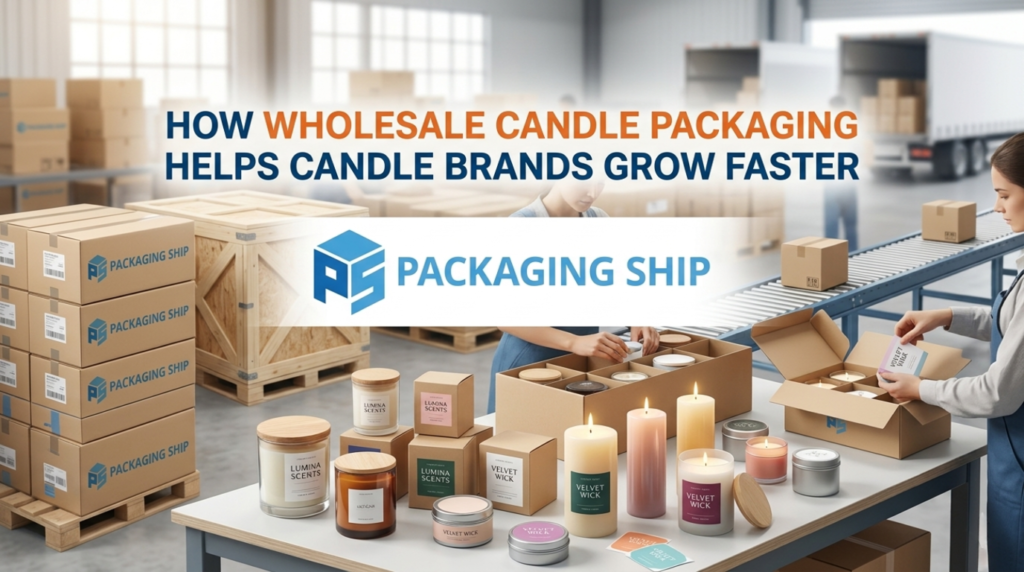
What Is Wholesale Candle Packaging for Brands in 2026? Wholesale candle packaging for brands means ordering custom-printed candle boxes in bulk at a reduced per-unit cost. Brands order wholesale to cut packaging spend, maintain quality consistency, and strengthen brand identity at scale. At 500+ units, per-unit costs typically drop 35–45% compared to small retail orders. The Packaging Decision That Turned a Small Candle Brand Into a Retail Contender A Nashville-based soy candle brand was hand-packing every order in generic kraft boxes through most of 2024. Their candles were exceptional. Their packaging said otherwise. In January 2025, they switched to wholesale candle packaging with full-color logo printing and soft-touch matte lamination. Their per-unit packaging cost dropped from $1.94 to $0.72 at a 1,500-unit run. That’s a 63% reduction, on the same box size, same kraft board material. Three months later, two regional boutique retailers reached out after seeing the brand’s packaging on a customer’s Instagram story. Neither retailer had heard of the brand before. This is the real value of branded candle boxes at wholesale. It’s not just a cost decision. It’s a brand infrastructure decision, and candle brands that make it early grow faster than those that don’t. If you’re evaluating wholesale candle packaging options right now, this guide gives you the full picture: pricing structures, material options, printing methods, and what to watch for before you place your first bulk order. See our full wholesale candle packaging range at Packaging Ship → What Is Wholesale Candle Packaging for Brands: And Why Does It Matter in 2026? Wholesale candle packaging for brands refers to bulk orders of custom-printed boxes, typically 500 units or more, produced at a reduced per-unit cost with logo printing applied during manufacturing. The result is professional, brand-consistent packaging at a fraction of retail pricing. The Fortune Business Insights report states that the candle market makes this decision urgent. The global candle market is projected to grow from $9.51 billion in 2026 to $16.42 billion by 2034, driven in part by increasing brand investment in sustainable packaging and premium presentation. In a market expanding at that pace, packaging is no longer a background cost. It’s a competitive weapon. The Real Cost Difference Between Retail and Wholesale Candle Boxes At retail, 100 custom candle boxes with logo printing typically cost $1.80–$2.40 per unit. At wholesale volumes, 1,000 units with offset printing, that same box lands between $0.55 and $0.90 per unit. The difference isn’t marginal. At 1,000 units, you’re saving between $900 and $1,500 on a single order. At What Order Volume Do Wholesale Savings Actually Kick In? Wholesale savings begin meaningfully at 500 units. They accelerate sharply at 1,000 units when offset printing becomes viable. At 2,000+ units, per-unit cost for a full-color printed kraft candle box typically falls below $0.75, making branded packaging genuinely affordable for growing brands at every scale. 5 Ways Wholesale Candle Packaging Helps Your Brand Grow Faster 1. Per-Unit Cost Drops: Your Margin Grows Every dollar you save on packaging is a dollar you can redirect toward product development, paid media, or fulfillment. Wholesale pricing makes that reinvestment possible without sacrificing quality. 2. Logo Printing at Scale Becomes Cost-Effective Digital printing on a 100-unit run costs more per impression than offset printing on a 2,000-unit run. At wholesale, logo printing stops being a premium add-on and becomes part of your standard production cost. 3. Consistent Brand Identity Across Every Touchpoint Inconsistent packaging erodes trust. Wholesale production runs maintain tighter color calibration than repeated small retail orders. Your box looks identical in March as it does in November — and that consistency signals professionalism to every retailer and customer who handles it. 4. Eco-Certified Options Meet Retail Supplier Requirements Major US retail buyers increasingly require FSC-certified packaging as a supplier qualification criterion. According to Future Market Insights report: Diptyque Paris unveiled a sustainable collection in May 2025 built entirely on 100% soy wax and FSC-certified packaging, a clear signal that certification is moving from optional to expected across the candle category. Wholesale suppliers who offer FSC-certified candle boxes give your brand a direct compliance pathway. 5. Reliable Lead Times Keep Seasonal Campaigns on Track Reactive reordering is expensive. Wholesale inventory planning, typically 60–90 days of stock on hand, eliminates emergency rush orders. Your Q4 holiday packaging is ready in September. Your Valentine’s Day runs on time. That operational reliability translates directly into revenue protection. Types of Candle Boxes Available at Wholesale Prices Kraft is the most popular wholesale choice for US candle brands in 2026. It’s durable, biodegradable, and takes logo printing cleanly on both coated and uncoated surfaces. Standard GSM for wholesale kraft candle boxes runs 120–157 GSM, sturdy enough for glass jar candles without adding unnecessary material weight. Rigid boxes signal luxury immediately. They work best for premium candle brands, gifting collections, and corporate orders where perceived value matters as much as product quality. At wholesale, rigid boxes cost approximately 25–35% more per unit than kraft, an investment that premium brands recover through higher retail price points. Tuck Boxes are the most versatile retail choice for candle brands. They assemble quickly, stack efficiently in retail displays, and print beautifully across the full exterior surface. For DTC candle brands scaling toward retail distribution, tuck top boxes hit the right balance of cost, structure, and brand presentation. A die-cut window lets the candle, its color, texture, and vessel, sell itself at retail. Window boxes work exceptionally well for pillar candles, colored jar candles, and artisan designs where the product’s visual appeal is part of the brand proposition. How Wholesale Pricing Works for Custom Candle Boxes Understanding MOQ: What Is the Minimum Order Quantity for Candle Boxes Wholesale? At Packaging Ship, there is no minimum order requirement. Digital printing works well from 100 units upward. For offset printing, where quality and per-unit cost performance are strongest, 1,000 units is the practical starting point for most candle brands. Wholesale Pricing Tiers for Candle Boxes Order Quantity Estimated Per-Unit Range Printing Method 100–499 units $1.40–$2.20
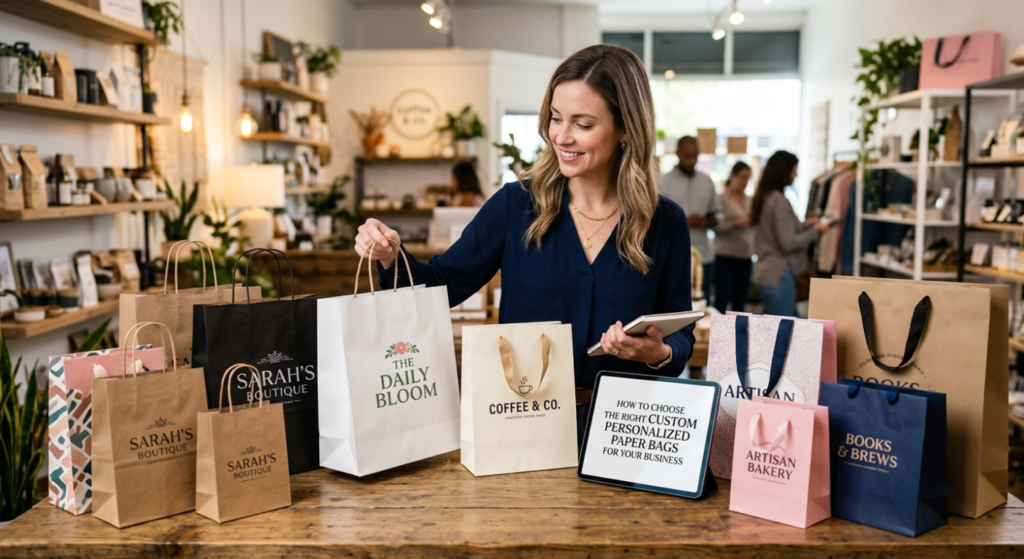
What Are Custom Personalized Paper Bags? Custom personalized paper bags are branded packaging solutions printed with your business logo, colors, and messaging. They work as both functional carriers and serious marketing tools. In 2026, over 74% of US consumers say packaging directly influences their repeat purchase decisions. The Bag That Killed a Brand’s Repeat Sales A boutique skincare brand in Austin, Texas dropped $18,000 on product development in 2024. The formulas were genuinely great. Their Instagram? Gorgeous. But six months after launch, repeat purchases tanked by 31%. It wasn’t the product people had a problem with. It was the plain, forgettable paper bag customers walked out with. No logo. No color. Nothing to remember. Once they switched to custom personalized paper bags, kraft finish, matte lamination, soft-touch handles, repeat purchases recovered within 90 days. That’s packaging doing real business work. If you’re a business owner, procurement manager, or brand director figuring out your packaging right now, keep reading. This guide is built for you. Why Custom Paper Bag Packaging Is a Strategic Business Decision Most businesses put packaging in the “cost” column. The ones growing fastest in 2026 put it in the “channel” column. Here’s what’s actually happening in the market. The global paper bags market industry was worth $6.02 billion in 2024. It’s heading toward $9.46 billion by 2033, growing at 5.15% annually as retailers, brands, and consumers steadily move away from single-use plastic. This isn’t a trend. It’s a structural shift. IKEA has already committed to phasing out all plastic consumer packaging in favor of paper by 2028, cutting 1,400 tons of virgin plastic from its supply chain every year. Your paper bag isn’t just carrying a product. It’s carrying your brand through grocery stores, offices, coffee shops, and social media feeds, every day, at zero additional cost. The businesses ahead of the curve in 2026 invest in printed paper bags that do three things at once: protect the product, promote the brand, and match their customers’ values around sustainability. 4 Types of Custom Paper Bags: Which One Fits Your Business? Before you place an order, get clear on what each material actually does, and where it falls short. 1. Kraft Paper Bags Kraft is the go-to for sustainable retail packaging. Made from wood pulp through the kraft process, these bags are naturally brown, genuinely tough, and fully recyclable. They hold up well for boutiques, food businesses, cosmetics, and eco-conscious brands. A standard kraft bag at 120–157 GSM handles up to 10 lbs without issue. 2. White Coated Paper Bags If your brand lives in the premium or luxury space, white coated bags give you that clean, high-end surface where full-color printing really lands. They’re the natural choice for jewelry, cosmetics, and fashion retail. The tradeoff is real though, coated bags cost roughly 15–20% more per unit than kraft. 3. Recycled Paper Bags These come from post-consumer waste, making them the strongest sustainability play on the list. B2B clients with corporate sustainability mandates are pulling toward these hard. FSC-certified recycled bags are becoming a requirement, not just a preference from major US retailers evaluating their suppliers. 4. Art Paper Bags Smooth, coated, available in matte or gloss. Art paper bags are built for gift packaging, cosmetics, and premium retail. They photograph exceptionally well, which matters a lot for brands with active social media presence. 7 Factors That Determine the Right Custom Shopping Bag for Your Business This is where most businesses go wrong, they narrow it down to price and miss everything else that actually drives ROI. 1. GSM (Grams Per Square Meter): GSM tells you how thick and durable your bag is. For lightweight retail products, 90–120 GSM works fine. For anything heavier bottles, electronics accessories, boxed items, you want 150–180 GSM. Cutting corners on GSM to save a few cents per unit is a false economy. A bag that tears in a customer’s hand is a brand problem, not a packaging problem. 2. Bag Size and Dimensions: Your bag needs to fit your product with 1–2 inches of clearance on each side. Too tight and you’re damaging the product. Too loose and it looks sloppy and drives up shipping costs. Measure properly before you spec. 3. Handle Type: Four options: twisted paper handles, flat paper handles, die-cut handles, and rope handles. Twisted handles are the standard for retail shopping bags. Rope handles signal premium, heavily used in fashion and cosmetics. Die-cut handles keep costs down and work well for food packaging. 4. Printing Method: Offset printing gives you the sharpest, most color-accurate output, best suited for large orders of 5,000+ units. Digital printing is flexible for small runs or multiple design versions. Flexographic printing fits high-volume orders where the design uses just one or two spot colors. 5. Finish, Matte, Gloss, or Soft-Touch Lamination: Matte lamination reads as premium and restrained. Gloss adds visual punch and costs less. Soft-touch lamination is in a different category, it feels expensive in someone’s hands, which is exactly why cosmetics and fashion brands use it as a differentiator. 6. Eco-Certifications: If your buyers include large retailers or enterprise clients, FSC certification isn’t optional anymore, it’s table stakes. The Forest Stewardship Council verifies that your paper materials come from responsibly managed forests. Fortune 500 retailers are increasingly making this a hard supplier requirement. 7. Minimum Order Quantity (MOQ) and Pricing: MOQ ranges from around 100 units for digital printing up to 5,000 for offset. At Packaging Ship, we’ve built our MOQs to work for both growing businesses and large enterprise accounts. Bulk orders typically cut per-unit cost by 30–40% compared to small runs, a meaningful number when you’re ordering at scale. How Printed Paper Bags Build Brand Recognition: The Numbers Consumer behavior backs this up clearly. 72% of American consumers say packaging design influences their purchase decisions, meaning your bag is already doing sales work before anyone even picks up the product. And then there’s this: 40% of consumers share photos of standout packaging on social media. That’s free reach,
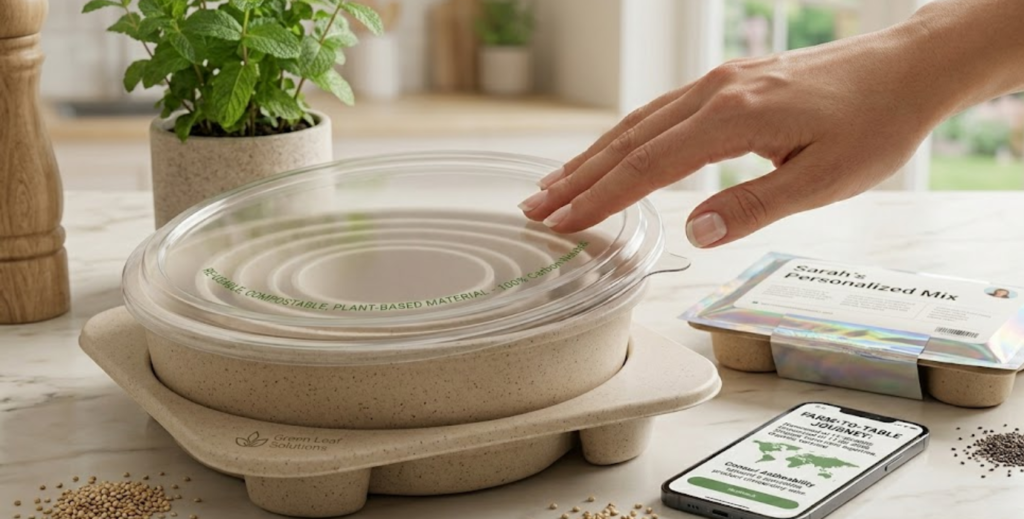
You have three supplier quotes open. Two material samples on your desk. A product launch six weeks away. And zero confidence that you are making the right packaging decision. This is the exact situation most food business owners face, not a shortage of options, but an overwhelming number of them with no clear framework for choosing. The wrong food packaging decision costs you more than money. It costs you retail buyers, repeat customers, and brand credibility you spent months building. This guide gives you a step-by-step decision framework, built specifically for US food brands in 2026, so you make one confident choice instead of 47 anxious ones. What Is Food Packaging and Why Does Your Choice Matter So Much? Food packaging is the stuff that holds and protects food. It has to keep the food safe, make it look nice and get it from the factory to the store without getting damaged. By 2026 food packaging will have to do four things at the same time: keep the food safe, help it last longer, tell people about the brand and be good for the environment. If you choose the food packaging that is not aligned with these areas, and you might not even notice until a store stops selling your product or a shipment of food arrives damaged. Step 1: Understand Your Product Before You Touch a Sample Most food businesses make the same first mistake. They browse packaging options before they fully understand what their product actually needs. Start here instead. Ask three questions. First: how heavy is your product? Products over 2 lbs need 18pt cardstock minimum or corrugated kraft to handle transit stress without deforming. Second: is your product moisture-sensitive? Oils, sauces, fresh baked goods, and anything with high water activity need moisture-resistant coatings, standard kraft absorbs moisture and collapses. Third: is your product fragile? Glass bottles, ceramic containers, and delicate baked items need die-cut inserts to prevent movement during shipping. These three factors, weight, moisture, and fragility, narrow your material shortlist from dozens to three or four options. That is where your packaging decision actually starts. Step 2: Choose the Right Food Packaging Material Material choice is the single most consequential packaging decision you make. Get it right and everything downstream, print quality, shelf performance, shipping cost, becomes easier. Get it wrong and no amount of great design fixes it. Here is a straight forward breakdown of the four materials US food brands use most in 2026: One critical compliance point across all materials: verify FDA 21 CFR food contact compliance before finalizing your order. Food-grade inks and food-safe coatings are not universal defaults , they must be explicitly specified. At Packaging Ship, every food packaging order uses FDA-compliant food-grade inks and coatings as standard, not as an add-on. Step 3: Match Your Packaging to Your Sales Channel The same product often needs completely different packaging depending on where it sells. A retail shelf and an e-commerce fulfillment center make entirely different demands on a box. Step 4: Build Your Brand Into the Packaging, Not Onto It Here is a distinction that separates growing food brands from stagnant ones. Brands that stick a printed label onto a plain box are adding branding onto their packaging. Brands that design the material, structure, finish, and print as an integrated system are building branding into it. The difference shows immediately on a shelf. A granola brand in Oregon switched from labeled kraft boxes to custom-printed matte cartons with a foil-stamped logo and a clean label panel. Their regional grocery buyer requested an expanded SKU listing within 60 days. The product did not change. The packaging made it retail-credible. Custom food packaging boxes with logo printing, Pantone color matching, and premium finishes matte lamination, soft-touch coating, spot UV, are not cosmetic extras. Dotcom Distribution’s 2022 research, which pulled responses from 1,150 U.S. online shoppers, showed that one in three consumers is more likely to return to a brand simply because of how their order was packaged. Explore Packaging Ship’s custom food packaging solutions to see branded box options across all materials and finishes, with free design support on every order. Step 5: Factor In Sustainability Without Breaking Your Budget In 2026, sustainability is a sourcing requirement for most major US retail buyers, not a branding choice. McDonald’s set a global goal to source 100% of its guest packaging from renewable, recycled, or certified sources by 2025, a commitment that cascades across their entire supplier network. For packaging vendors, this is no longer a preference; it is a contract requirement. The most common misconception is that eco-friendly food packaging costs significantly more. It does not, at the right order volumes. FSC-certified kraft, post-consumer recycled cardboard, and soy-based ink printing are all available at pricing parity with conventional materials on orders of 500 units or more. The cost gap that exists on very small runs disappears quickly as volume scales. For food brands with retail ambitions, How2Recycle label compliance and FSC certification documentation are no longer optional extras, they appear on vendor qualification checklists at natural grocery chains, specialty food retailers, and major DTC platforms. Source these upfront. Retrofitting compliance after a retail buyer asks for it costs significantly more than building it in at the start. Food Packaging Trends Shaping Buying Decisions in 2026 The food packaging world is changing fast by 2026. Most companies can’t keep up with these changes. Now we see single-material packaging that can be recycled. This is replacing the multi-layer packaging used in stores. Many food packages now have QR codes. These codes link to stories about where the food comes from and lab certifications. Buyers at health food stores expect to see this. Food companies are using FSC-certified kraft paper. They are also using coatings that can break down naturally. These used to be considered premium features. Now they are standard. When it comes to design, simple and clean labels are popular. They are outselling packages with a lot of graphics, on natural and