
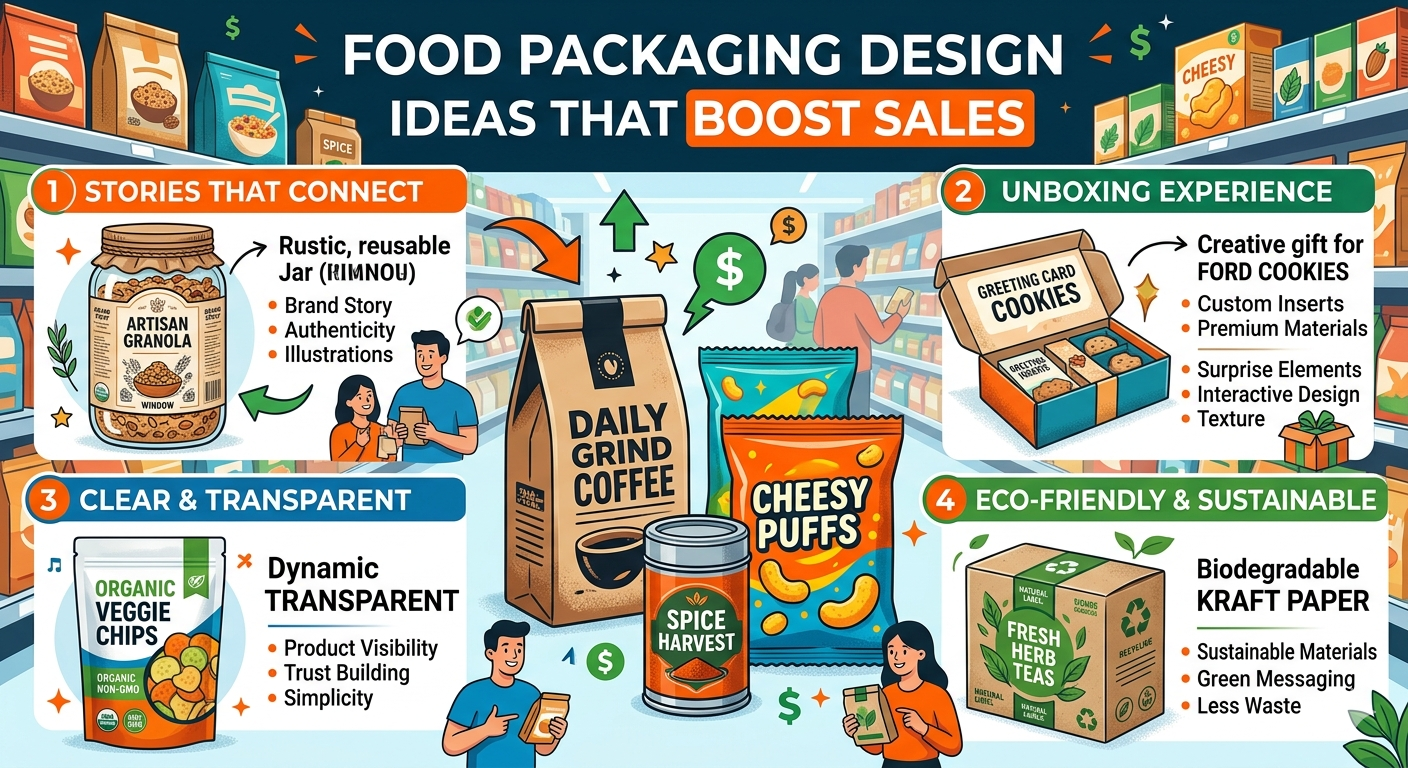
The best food packaging design ideas combine strong shelf appeal, brand-aligned materials and smart print finishes. They protect the product, communicate brand values instantly and move the purchase decision before the customer reads a single word.
Your packaging speaks first. Before your ingredient list, before your price point, before your brand story, the box or bag your customer sees is already selling or losing the sale. Most food brands underestimate this. They invest heavily in product quality and almost nothing in packaging strategy. The result is great products sitting on shelves while competitors with smarter creative food packaging win the sale.
This guide gives you eight actionable food packaging design ideas built for food brands that want real sales results, not just good-looking boxes.
According to a national study by the Paper and Packaging Board and Ipsos,72% of American consumers agree that packaging design influences their purchase decision. Equally important, research cited by Klimchuk and Krasovec (2021) and published by PMC found that between 73% and 85% of consumer purchase decisions are made at the point of sale, with packaging design being the primary differentiator between competing products.
That means your packaging is not decoration. It is a live sales tool operating at the exact moment your customer decides whether to buy.
Most food brands use too many colors and create visual noise. Strong packaging design commits to one dominant brand color covering 60 to 70% of the packaging face. Think of how consistently recognizable iconic food brands become through color alone. The color becomes the brand signal before the logo even registers.
Choose your hero color based on the product category. Green signals freshness and organic. Brown Kraft signals artisan and natural. Deep navy signals premium. Keep it consistent across every SKU in your line.
Kraft paper is no longer just a budget material. It is a brand statement. For bakeries, snack brands and organic food companies, Kraft packaging communicates authenticity, sustainability and craftsmanship. These are the values today’s food consumers pay a premium to support.
Our Custom Bakery Boxes are built from premium Kraft stock with full-color print options. They are food-safe, structurally sound and available with no minimum order quantity. A window cut-out on the front face lets your product sell itself visually, which is especially effective for cookies, croissants and pastries where visual product appeal is the primary purchase trigger.
Finish choices matter as much as print quality. A matte lamination finish creates a soft, tactile experience that reads as premium, even on standard stock. Spot UV coating draws the eye to your logo or key brand element by creating a high-gloss contrast against a matte background.
The Paper and Packaging Board and Ipsos survey found that 63% of consumers say paper and cardboard packaging makes a product seem more premium and high quality. Finish selection is one of the fastest ways to shift that quality perception without changing your product at all.
If your food brand sells directly to consumers, the unboxing experience is your most powerful marketing channel. It is the one moment where the customer’s full attention is on your brand. Most DTC food brands waste it with a plain corrugated box and a packing slip.
A well-designed custom mailer box, printed inside and out, generates social sharing, reduces return rates and turns a first-time buyer into a repeat customer. Our Mailer Boxes are engineered specifically for this moment, with structural options for inserts and dividers built in.
Transparency in packaging works both literally and strategically. Window cut-outs in cardboard boxes or clear panels in food packaging bags allow customers to see the actual product before buying. This is especially effective for snack packaging design, where visual product appeal drives impulse purchase.
The Paper and Packaging Board survey found that 81% of consumers have tried a new product simply because its packaging caught their eye. A visible product inside the pack removes buying friction at exactly the moment the customer is deciding.
Your food label design has two simultaneous jobs. First, it must meet FDA food labeling requirements covering nutrition facts, ingredient listing, allergen declarations and net weight. Second, it must convert a browser into a buyer by communicating brand positioning and quality signals within the first visual impression.
Lead with flavor or benefit. Place your brand mark at eye level. Use a font size legible from three feet away. Keep the back of the label organized and clean. A cluttered nutrition panel does not just look bad. It actively erodes the consumer trust you need to close the sale.
Sustainability is no longer a nice-to-have for food brands. A 2024 NielsenIQ studyof approximately 4,000 American consumers found that 78% of US consumers say a sustainable lifestyle is important to them. A joint McKinsey and NielsenIQ analysis of 600,000 product SKUs across five years of US sales data further found that products carrying sustainability claims on their packaging averaged 28% cumulative sales growth, compared to 20% for products without those claims.
Our Eco Friendly Packaging range includes biodegradable Kraft, FSC-certified cardboard and plant-based material options. All carry full-color print capability. Eco packaging does not require sacrificing visual impact. It requires choosing the right substrate and print method combination for your product.
A gourmet chocolate brand selling at a specialty grocer needs rigid box packaging. A snack brand in a convenience store needs a corrugated display box. A subscription food brand needs a mailer box. The structural format of your packaging must match the retail environment where it first meets your customer.
Getting this wrong is expensive. Brands that package premium products in flimsy cardboard lose the sale at the shelf. Brands that over-engineer packaging for a low-ticket snack kill their margins. Structure is a strategic business decision, not just a design one.
The foundation of every great food packaging design is material selection. Your choice of Kraft paper, corrugated cardboard, rigid board or Mylar film determines structural integrity, print quality, food safety compliance and shelf life performance. Kraft paper delivers an artisan appeal ideal for bakeries and organic brands. Corrugated board provides transit protection for e-commerce shipments. Rigid boxes communicate luxury for gift food products. Mylar bags offer superior moisture and oxygen barrier properties for snacks, coffee and dried goods. Getting material selection right before you finalize your design saves significant cost in the production run and prevents expensive reprints. If you want to read the full breakdown of food packaging materials including GSM specifications, print compatibility and food-safe certifications, click here.
Most content ranking for food packaging design ideas today produces either inspiration galleries or generic trend lists. They show beautiful designs but offer no vendor pathway. Sustainability talk, no real solutions. They cover trends but give no actionable material guidance.
Working with experienced Custom Packaging Providers who offer free design support, no minimum order quantities and a 6 to 7 day production turnaround changes the economics of custom food packaging for brands at every stage of growth.
At Packaging Ship, we have supported over 50,000 brands across the US food industry. Our in-house design team works with you from concept to final dieline at no additional cost.
Strong food packaging design ideas are not about aesthetics alone. They are about building a visual system that sells your product before a word is read, communicates your brand values before a customer picks it up and delivers an experience that drives repeat purchase. Every decision around material, color, finish and structure is a sales decision.
Packaging Ship gives food brands the infrastructure to execute these ideas without the complexity. Free design support. No minimum orders. Free US shipping. 6 to 7 day production. 30% off your first order.
Ready to Turn These Ideas Into Real Packaging? Stop losing sales to brands with better packaging. Your product deserves packaging that works as hard as you do. Get your free, no-obligation quote from Packaging Ship today and have your custom food packaging designed and delivered in under two weeks.
Get Your Free Quote Now: No Minimum Order Required
Shelf appeal is the most critical element. Research published by Klimchuk and Krasovec (2021) confirms that 73% to 85% of purchase decisions happen at the point of sale, making the first visual impression the primary driver of whether your product sells or stays on the shelf.
Kraft paper and food-safe cardboard are the most effective for bakery products. They provide structural support, allow full-color printing and communicate artisan quality. Window cut-outs increase impulse purchase rates by making the product visible before the buying decision.
Yes. Packaging Ship offers custom food packaging with no minimum order quantity, free design support and free shipping across the USA. You can start with a small production run and scale as your brand grows.
According to a five-year McKinsey and NielsenIQ analysis of $400 billion in US retail sales data, products with sustainability claims on-pack grew 28% cumulatively compared to 20% for products without those claims. Eco packaging is both a value signal and a direct revenue driver.
Digital printing suits smaller runs and detailed artwork. Offset printing delivers consistent color accuracy at larger production volumes. Packaging Ship offers both methods, with Spot UV and foil stamping finishing options available across all orders.