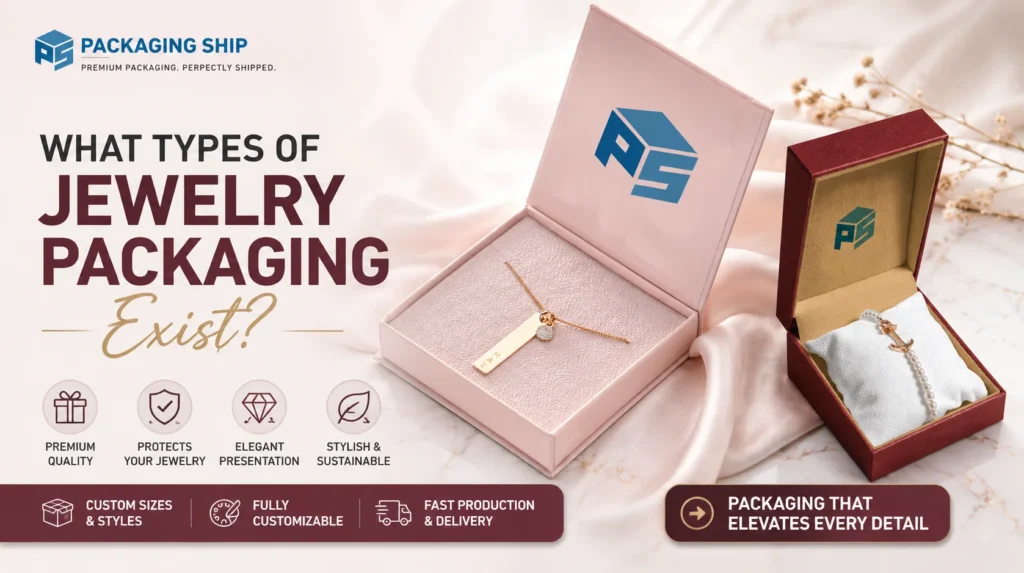
What Types of Jewelry Packaging Exist in 2026? Most jewelry brand owners spend months perfecting the product. Then they ship it in a box they found on Alibaba for $0.08 a unit. The customer opens it, feels nothing, and never reorders. Jewelry packaging is the moment your brand either lands or disappears. Eight main types exist: rigid boxes, kraft boxes, velvet pouches, pendant boxes, magnetic closure boxes, drawer-style boxes, cardboard boxes, and custom mailer boxes. Here’s what each one actually does and more importantly, when each one is wrong for your brand. Why This Decision Matters More Than You Think The US jewelry packaging market was worth $1.9 billion in 2025, growing toward $2.7 billion by 2033 at a 5.0% annual rate, per Verified Market Reports. That growth is tied almost entirely to e-commerce, where the box is the only physical thing a customer ever touches from your brand. There’s no store. No staff. No moment to recover from a bad first impression. Your packaging carries everything. The 8 Types of Jewelry Packaging, Honestly Explained 1. Rigid Boxes Made from dense chipboard that never collapses. Pick one up and the weight alone tells the customer something valuable is inside before they even open the lid. Right for: fine jewelry, engagement rings, anything above $80 where the brand story depends on perceived quality. One mid-tier jewelry brand switched from standard cardboard to custom magnetic rigid boxes and saw satisfaction scores climb 34% in six months. The jewelry didn’t change at all. Wrong for: fashion pieces under $25. The box costs more than the product warrants. 2. Kraft Jewelry Boxes Natural, uncoated board that reads sustainability and craft without needing a word of copy. Take soy-based ink well, so you can still print a sharp logo or full-color design without killing the organic feel. Artisan sellers and Etsy founders who’ve built their entire identity around “handmade from natural materials” this is your box. Pair it with branded tissue paper and a handwritten-style insert. That combination gets photographed and posted. Our Custom Kraft Jewelry Boxes carry FSC-certified board and ship with no minimum order, so your eco claims actually hold up if a customer asks. Wrong for: anything at a luxury price point. Kraft reads “craft market,” not fine jeweler. 3. Velvet Pouches They’ve been used for over a century because they genuinely work. Soft texture prevents scratches. The look signals value. They store flat and ship without adding meaningful dimensional weight. Best for fashion jewelry, mass-market pieces, trade show giveaways, or as secondary packaging nested inside a rigid box. The pouch holds the pendant while the box handles the brand experience. Don’t use them as your only e-commerce layer. Velvet has zero structural protection in transit. You need something around it. 4. Pendant Boxes Chains tangle. Pendants shift. A beautiful necklace can arrive looking bent or damaged even when it arrived physically fine, and the customer won’t know the difference. They’ll just return it. A purpose-built pendant box fixes this with a necklace card insert or foam slot holding everything in place. Standard sizing is 3.5 x 3.5 inches or 4 x 4 inches, which is enough space to display the piece cleanly. Our Custom Pendant Boxes handle the insert, custom sizing, and full print surface as standard. No minimum order required. Skip these for oversized layered sets, which need compartmentalized boxes instead. 5. Magnetic Closure Boxes There’s a click when the lid seats itself. It’s engineered, not accidental. Luxury brands understood this long before most, which is why magnetic close has become shorthand for premium jewelry gifting. Right for engagement rings, anniversary pieces, corporate gifting, anything where the moment of opening is emotionally loaded. The slow draw-and-close builds anticipation that translates directly to social sharing. The global jewellery box packaging market hit USD 4,347 million in 2024 and is heading to USD 6,134 million by 2032, according to Credence Research, with premium design and sustainability as the two named growth drivers. Magnetic closure on the FSC board sits exactly at that intersection. High-volume fashion pieces under $40? The unit cost math doesn’t work. 6. Drawer-Style Boxes A ribbon tab. A sliding inner tray. The slow reveal as it pulls out. It sounds simple, but that motion creates genuine anticipation — not theatrical, just quiet. The feeling that something good is coming. Lots of customers keep these long after the jewelry is out, which means your brand lives in their drawer or on their shelf for years. Good fit for earring sets, ring-and-earring pairs, curated gift collections. Also smart if you want customers to reuse the packaging as storage rather than throwing it away. Not justified for a single $18 everyday purchase. 7. Cardboard Jewelry Boxes The workhorse. Cotton-filled, lightweight, full-color printable, and significantly cheaper per unit than rigid. The cotton fill cushions rings, studs, and small pendants without costing what velvet or foam costs. Fashion jewelry retailers and silver brands reach for these because they give proper branded presentations at a margin-friendly price. Cardboard also takes finishing techniques well matte lamination, gloss, spot UV, foil stamping, so the final box can look far more premium than the raw material suggests. One thing: these are retail-grade, not transit-grade. Ship them inside a mailer. 8. Custom Mailer Boxes The corrugated outer layer with your brand on it. Every delivery becomes a marketing moment on someone’s doorstep before they’ve even seen the jewelry. Print on the inside lid too. The customer gets a second brand moment when they open it. Small detail, real impact. The practical approach is box-in-box: your presentation box inside a mailer sized tightly around it, eliminating void fill and reducing dimensional weight. Keeps shipping costs lower and reduces theft risk from a plain exterior. Browse the full range of custom jewelry packaging boxes to find the right combination for your product and shipping setup. What Your Material Choice Actually Tells the Customer Before they read a word of your copy, the material speaks. Rigid chipboard says permanent and confident.
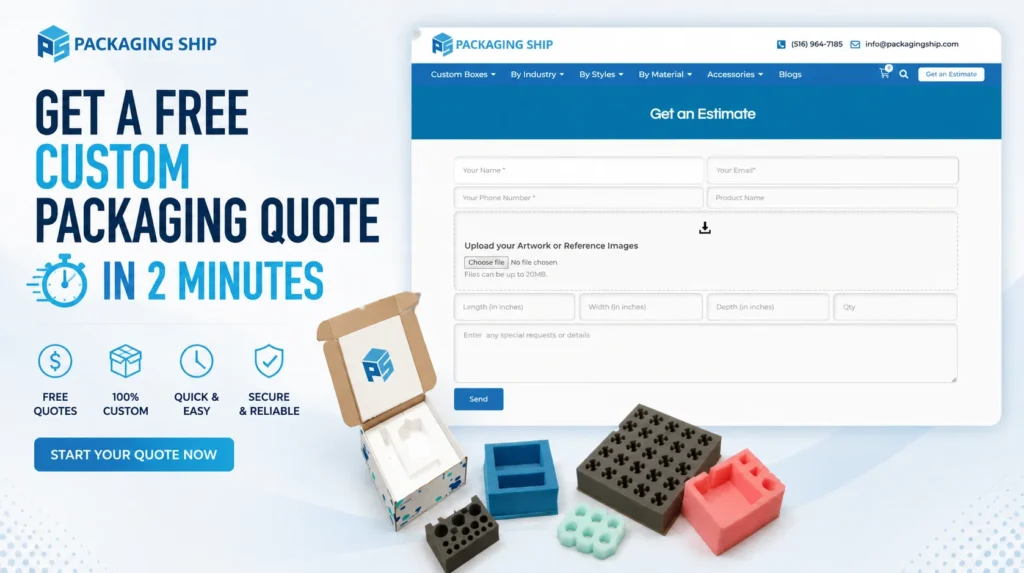
TLDR: Getting a free custom packaging quote online in the USA takes under 2 minutes when you know what to bring. You need your box dimensions, approximate quantity, preferred box style, material type, design status, and timeline. No minimum order. No artwork required. No sales call unless you want one. Table of Contents What Is a Custom Packaging Quote and Why Does It Matter in 2026? A custom packaging quote is a free, no-obligation price estimate you receive from a packaging manufacturer. It is based on your box specifications, quantity, and design needs. It tells you the per-unit cost, production timeline, and material options before you spend a single dollar. Here is the challenge most small brand owners face. They want custom branded packaging. They know their generic boxes are hurting them. But they delay requesting a quote because they feel unprepared. That delay is costing real money. According to a 2025 Swell research report on B2B marketplace behavior, 73% of B2B buyers are now millennials who prefer online self-service ordering over traditional sales interactions. These buyers want to request a packaging quote online, review pricing, and move forward without a phone call. If your packaging supplier cannot deliver that experience, your buyer moves on. On top of that, Gartner data confirms that 61% of B2B buyers now prefer completing a purchase without any sales representative involvement. The packaging quote process, how fast it is and how little it asks of the buyer, is already doing the selling for you. This guide removes every barrier between you and your first quote. What You Actually Need to Get a Custom Packaging Quote Online USA Most business owners overthink this step. A free packaging quote request requires exactly six pieces of information. That is all. Here is each one in plain language. 1. Your Box Dimensions (Approximate Is Fine) You need the internal dimensions of your box in inches, measured as Length x Width x Height. Measure your product at its widest points and add about 0.25 inches on each side for a snug, protective fit. If you do not have exact measurements yet, a rough estimate works for the initial quote. The Packaging Ship team refines dimensions with you during the proof stage at zero cost. 2. Your Quantity Range You do not need an exact number. A range such as “around 200 units” or “between 500 and 1,000” is enough to generate accurate pricing. Packaging Ship accepts orders starting from 50 units with no minimum order quantity requirement, so even a test run for a new product launch qualifies for a full free packaging estimate. Per-unit pricing decreases as quantity grows. At 50 units, digital printing handles your run efficiently. At 500 units and above, offset printing can reduce the per-unit cost significantly. More on that below. 3. Your Box Style or Product Description You do not need to know the technical name of the box you want. Describing what you are packaging works just as well. A narrow skincare serum, a set of four candles, a subscription kit with multiple small items inside. The production team matches your product description to the right structure automatically. If you already know the style you want, you can explore custom tuck-top boxes for retail products, display boxes for shelf presentation, and mylar bags for food, coffee, or supplement products. Each box type has a slightly different spec checklist, covered later in this guide. 4. Material Preference (Or Let the Team Advise) If you know your preferred material, mention it. Cardboard is the standard choice for retail folding cartons. Corrugated boards add structural strength for shipping heavy or fragile items. Kraft delivers an eco-friendly, natural look. Rigid board creates a premium, luxury-feel box for cosmetics or gifting. According to a 2025 ProCarton consumer survey, 87.1% of consumers say they would choose cardboard over plastic packaging. That shift matters when you are deciding your material at the quote stage. The Packaging Ship team recommends the right substrate based on your product type and brand positioning, completely free. 5. Your Design Status You do not need a print-ready file to submit a packaging quote request. A JPEG or PNG of your logo is enough to begin. The in-house design team builds your full packaging artwork at no additional cost. They accept PDF, AI, EPS, and PSD files for brands that already have production-ready assets. The custom box design free support at Packaging Ship covers layout, color matching, and dieline preparation. You review and approve a full-color digital proof within 24 to 48 business hours before anything goes to print. 6. Your Timeline or Launch Date A rough launch date helps Packaging Ship prioritize your production slot. Standard production runs 7 to 10 business days from artwork approval. Rush production in 4 to 5 business days is available for most box types. Free FedEx or UPS delivery adds 2 to 5 business days to any US address after production. What You Do NOT Need Before Submitting a Quote This clears up the four most common misconceptions that delay first-time buyers. You do not need print-ready artwork. A logo file and a brand color preference are enough. The design team handles the rest. You do not need exact dimensions. Approximate measurements get the quote started. Final dimensions are confirmed before production begins. You do not need a large order. The minimum order at Packaging Ship starts at 50 units. There is no pressure to commit to bulk quantities on your first box quote. You will not be pushed into a sales call. The quote is fully no-commitment. You receive a digital proof and pricing. You approve or revise. Nothing moves forward without your sign-off. How Packaging Ship’s Quote Process Works Step by Step The free packaging estimate process at Packaging Ship is built to take under 2 minutes. Here is exactly what happens from form to delivery. Step 1. Visit the Packaging Ship quote form and fill in your box dimensions, quantity, style preference, and timeline.
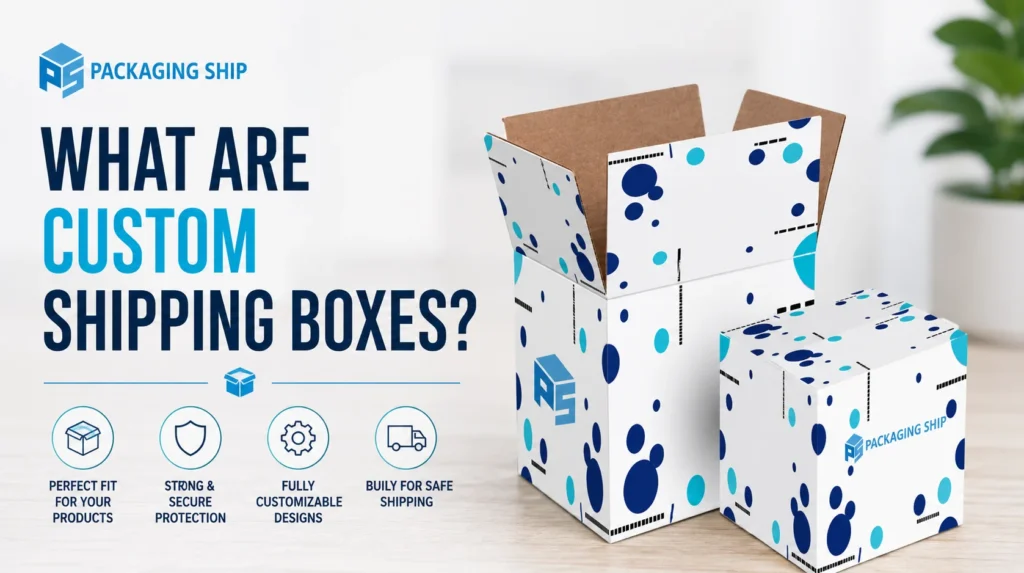
What Are Custom Shipping Boxes? (2026 Guide for Online Brands) Here is something most online sellers never think about until it is too late. Your customer places an order. They wait three days. The package arrives. They pick it up, look at it, and immediately feel something about your brand. Not from the product inside. From the box itself. That first impression happens before they even open it. And if you are shipping in a plain brown box with no branding, no custom sizing, nothing that says “we thought about you,” that impression is quietly neutral at best. Forgettable at worst. So, what are custom shipping boxes exactly? They are boxes built specifically around your product and your brand. Made-to-measure dimensions, your logo and colors printed on the outside, your choice of material and finish. Not the generic stock boxes that come off a warehouse shelf and get used by a thousand different sellers. Yours. Built for your products, carrying your identity, doing marketing work on your behalf the moment they land on a customer’s doorstep. That is the short version. The longer version is what this guide covers. What Are Custom Shipping Boxes and How Do They Actually Work in 2026? Think about the difference between a suit off the rack and one tailored specifically to you. Both cover the body. Only one actually fits. Custom shipping boxes work the same way. Standard stock boxes come in fixed dimensions, designed to roughly fit a wide range of products. You stuff in bubble wrap just to stop things from shifting around. You are literally paying to ship empty air. The box tells your customer nothing about who you are. Custom shipping boxes start from your product measurements. Length, width, depth, weight, fragile or not, ships alone or with other items. A box gets built around those details. Walls sized correctly. Product sitting without rattling. Your logo on the outside, exactly where the customer looks first. Getting them made is not complicated. Share your specs, work with a design team on the look, approve a proof, and production begins. At Packaging Ship, the whole thing takes around six to seven business days for production, with free US shipping on top of that. No minimum order. With no die charges. No fees that appear at checkout and ruin your day. Types of Custom Shipping Boxes Explained Honestly, the number of box styles out there confuses a lot of first-time buyers. So let me break down what actually matters. They are what most people picture when they think about ecommerce packaging. Three layers, two flat outer sheets with a wavy fluted middle pressed between them. That middle layer is doing most of the work. It catches impact, absorbs pressure from stacking, and keeps whatever is inside from getting knocked around during a rough delivery run. Heavy products, fragile items, anything going cross-country, corrugated is almost always the right call. They are a different experience entirely. Mailer boxes fold shut on their own without tape, which already saves you time on the fulfillment floor. But the reason beauty brands and subscription companies love them is the opening. When a customer lifts that lid, they see the inside of the box too. Printed inside, printed outside, sometimes with a tissue layer on top. It turns receiving a package into something that feels more like opening a present. That matters more than people give it credit for. These boxes are folded together at both ends. Tuck boxes contain lighter products, mostly. Candle makers use them. Soap brands, cosmetic lines, small food products. They are genuinely cost-effective, take up less storage space before assembly, and print well on every panel. If your product does not need heavy transit protection, a tuck box gets the branding job done without overengineering the packaging. 4- Display boxes: They are the ones that serve two purposes at once. Display boxes protect the product during shipping and then become a retail display unit at the point of sale. Gift brands and food companies use these a lot because once the box arrives at a store, it just opens up and sits on the shelf already presenting the product. 5- Rigid boxes: They are in their own category. Thick greyboard, no flex, wrapped in printed paper. Pick one up and it feels heavy and solid before you even see what is inside. Jewelry companies use them. Premium skincare brands use them. The packaging itself signals that whatever is inside was worth spending money on. Most brands we work with end up using more than one type depending on the product. Mailer Box vs Shipping Box: What Is the Real Difference? People ask us this one constantly, so it is worth spending a minute on it properly. A mailer box closes by itself. No tape, no extra tools, just fold and lock. It is built to look intentional on the outside and create a genuine unboxing experience on the inside. The whole point is that the customer notices it. They feel something when they open it. DTC brands selling beauty, wellness, or apparel use mailer boxes specifically because that emotional response drives repeat purchases. A regular shipping box, what the industry calls an RSC or regular slotted container, has four flaps at the top that you tape shut. It is not trying to be pretty. It holds more volume than a mailer, handles heavier contents, stacks better in a warehouse, and moves faster through a fulfillment operation. For brands shipping bulk products or operating at high daily order volumes, it is the practical choice. Neither one is objectively the right answer. It comes down to what you sell and what you want the customer to feel when the box shows up. Benefits of Custom Packaging for Shipping That Actually Show Up in Your Numbers I want to push back on something here. Custom packaging is often framed as a luxury, something nice to have once you are big enough. That framing is wrong,
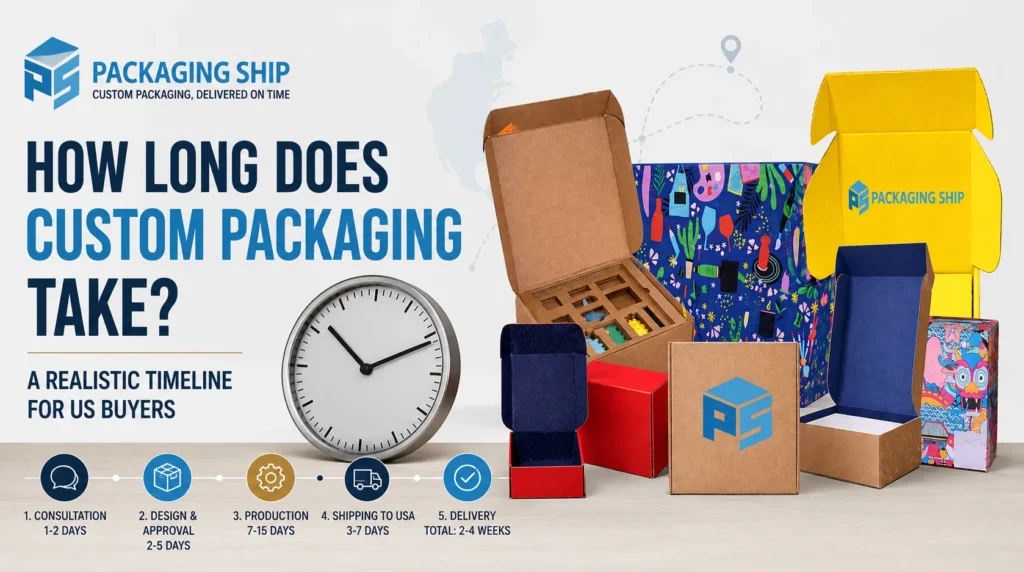
How Long Does Custom Packaging Take? A Realistic Timeline for US Buyers [2026] TL;DR: Custom packaging takes 7 to 10 business days to produce at Packaging Ship, plus 2 to 5 business days for US delivery. Total time from quote to door is as fast as 9 business days. Rush production cuts this to 4 to 5 days. The biggest delay is never production. It is always proof of approval. Table of Contents 1. What Is the Direct Answer to How Long Does Custom Packaging Take? At Packaging Ship, standard custom box production takes 7 to 10 business days from proof approval. Add 2 to 5 business days for US shipping via FedEx or UPS, and your total custom box lead time is roughly 9 to 15 business days. Choose rush production and that window drops to 8 business days total, door to door. Most competitors quote 2 to 6 weeks. You do not need that long. 2. The Real Custom Box Production Timeline, Stage by Stage Every custom packaging order moves through five stages. Knowing what happens inside each one lets you plan with precision, not guesswork. Stage 1: Quote to Digital Proof (24 to 48 Business Hours) You submit your box type, size, quantity, and logo. Within 24 to 48 business hours, Packaging Ship sends a print-ready digital proof showing your exact CMYK color layout and dimensions. No design experience needed and no design fee charged. This stage is fast. What slows things down is what comes next. Stage 2: Proof Approval (This Is Where 80% of Delays Happen) This stage is entirely in your hands. Every day you take to review the proof is one day added to your delivery date. Approve the same day and production starts tomorrow. Take five days to review, you have lost five business days that cannot be recovered on the production floor. A 2022 Loftware white paper on packaging artwork management found that delays in delivering accurate and approved packaging artwork have a direct and growing impact on time to market for food and beverage manufacturers, identifying artwork approval bottlenecks as a primary driver of missed production deadlines. Review your proof within 24 hours. Consolidate all feedback into one message. Assign one person internally who owns the approval decision. Stage 3: Production (7 to 10 Business Days Standard, 4 to 5 Days Rush) Once you approve, the order enters the production queue. Cutting dies are set, inks are calibrated to your CMYK or Pantone specification, sheets are printed, scored, and assembled. Standard orders are complete in 7 to 10 business days. Rush production is available in 4 to 5 business days for most box types. Specialty finishes like foil stamping or soft-touch lamination add 2 to 3 extra days regardless of which production track you choose. Stage 4: Quality Control (1 Business Day) Every order goes through a visual inspection and structural test before it ships. This is not optional and it is not skipped. It adds one business day and it is the reason your boxes arrive matching the proof you approved. Stage 5: US Shipping (2 to 5 Business Days) All orders ship free via FedEx or UPS with full tracking. East Coast deliveries from our Valley Stream, NY facility typically arrive in 1 to 3 business days. West Coast deliveries run 3 to 5 business days. International orders follow carrier-specific timelines, and these are confirmed at quote stage. 3. Standard vs. Rush Production: Which One Do You Need? Factor Standard Production Rush Production Production time 7 to 10 business days 4 to 5 business days Total to US door 9 to 15 business days 6 to 10 business days Cost premium Base price Rush fee applies Best for Planned launches, reorders Last-minute launches, Q4 scrambles Box types available All 50+ types Most standard types Choose standard production whenever you have 3 weeks or more before your in-hands date. Choose rush when your launch deadline is under 2 weeks out or when a reorder ran lower than expected. If your timeline is genuinely tight, get a free estimate here and our team will confirm the fastest available slot before you commit to anything. 4. How Long Does Each Box Type Take to Produce? Box type affects production time because structural complexity and finish requirements vary. Here is the packaging turnaround time breakdown by box category for US buyers: Digital vs. Offset Printing and Lead Time Digital printing skips plate setup. That saves 1 to 2 business days on your custom box production timeline, which makes it the right choice for orders under 500 units or when you need quick custom box production for a fast launch. Offset printing costs less per unit above 500 pieces and delivers richer color depth for CMYK and Pantone-matched orders. The trade-off is a slightly longer setup phase. 5. How Far in Advance Should You Order? (The Backwards Calendar) This is the section most packaging blogs skip entirely. Here is the practical calculation every first-time and repeat buyer needs before they place an order. Work backwards from your launch or in-hands date: Your launch date: Day 0 So if your product launches October 15, 2026, you need to request your quote no later than September 18, 2026. Give yourself an earlier start if your order includes foil stamping, embossing, or any premium finish that adds production days. Planning for the Q4 holiday season? Order by early October at the latest. Production capacity at every US packaging supplier fills fast between October and December. Custom packaging boxes and fast turnaround options still exist in Q4, but rush slots go first. Book early. 6. Five Things That Quietly Delay Your Packaging Order These are the most common avoidable reasons first-time buyers and even experienced procurement managers miss their packaging delivery timeline, pulled directly from real production data. 1. Slow proof approval. Each day you hold the proof is one day of production time lost. There is no way to recoup it. Set a 24-hour internal
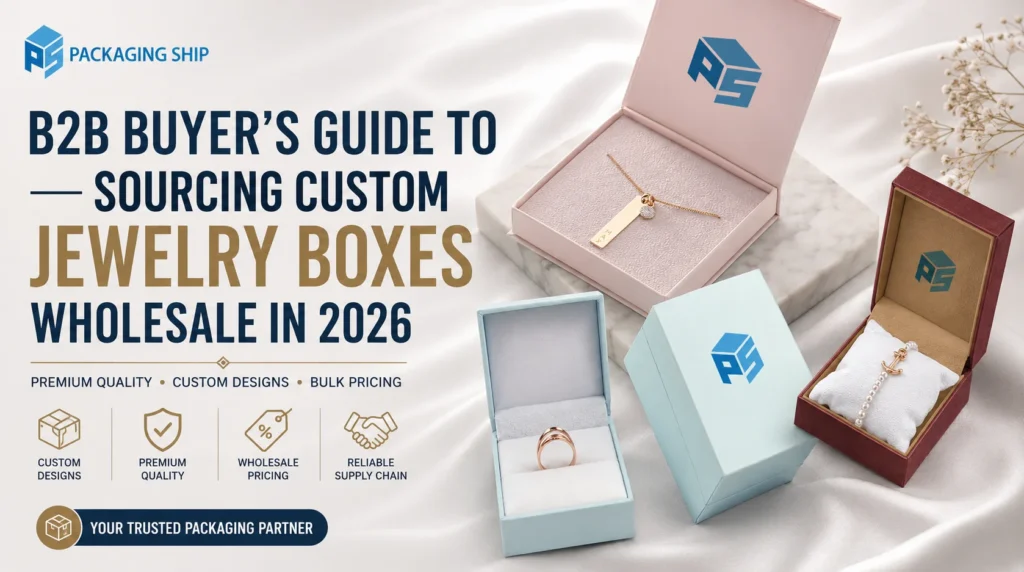
Comparing Suppliers for Branded Jewelry Boxes: What US Jewelry Brands Need to Know Before Placing a Wholesale Order A jewelry brand in Denver ordered 1,500 custom ring boxes from an overseas supplier in January. The quoted lead time was 10 days. The boxes arrived in 34 days, two weeks after their Valentine’s launch window had closed. The Pantone color was off by two shades. The logo on 400 units was misaligned. They ate the cost, reordered from a US-based supplier, and had replacement boxes in 11 days. That story is not unusual. In 6 years and over 10,000 packaging projects at Packaging Ship, we have seen that exact situation more times than we can count. Choosing the right supplier for custom jewelry boxes wholesale is not a minor procurement decision. It is a brand decision with financial consequences. Here is the framework you need before you sign off on anything. What Makes a Reliable Custom Jewelry Boxes Wholesale Supplier? A 7-Point Framework The global jewellery box packaging market was valued at USD 4,347 million in 2024 and is heading toward USD 6,134 million by 2032, growing at a 4.4% CAGR, according to Credence Research. That growth means more suppliers entering the market every year, which makes evaluation more important, not less. Here are the seven criteria that separate reliable wholesale jewelry packaging suppliers from vendors who will cost you more than they save. 1. MOQ: No Minimum Order Changes Everything Most overseas factories require 500 to 1,000 units as a minimum order quantity. For a growing jewelry brand, that means tying up significant cash in packaging inventory before you have confirmed demand for the design. Packaging Ship operates with no minimum order quantity. Order 50 units to test a new design. Order 5,000 units when your reorder cadence is established. The unit pricing scales accordingly, but you are never forced to overcommit. 2. Lead Time: Total Days, Not Production Days The most common supplier deception in this category is quoting production time without shipping time. “7 to 10 business days” from an overseas packaging company typically means 7 to 10 days in production, then another 4 to 6 weeks on a container ship. At Packaging Ship, total lead time is 6 to 7 business days in production, then 4 to 5 business days for US delivery. That is 10 to 15 business days from proof approval to your door. Ask every supplier you evaluate: “What is your total lead time from final proof approval to delivery at my address?” If they cannot give you a specific number, that is your answer. 3. Print Quality and Color Consistency at Scale A color that matches on 100 units does not always match on 1,000 units. Offset printing on large runs requires proper Pantone color management, not digital printing scaled up. Before placing any bulk jewelry boxes order, request a production sample that reflects actual bulk run conditions, not a hand-crafted sample made specifically to impress you. Ask whether they use offset or digital printing at your volume, and what their Pantone matching tolerance is. Cheap earring boxes in bulk often look great in the sample and inconsistent across the run. 4. Free Design Support: Not a Luxury, a Requirement A jewelry packaging company that expects print-ready artwork from every client is pricing out the majority of brands who actually need their services. Small and mid-size jewelry brands typically do not have an in-house designer on payroll. At Packaging Ship, free design support comes standard with every single order. From initial concept to print-ready file, the design work is included. No additional fee, no minimum spend threshold to unlock it. 5. US-Based Fast Shipping: The Total Cost Calculation Overseas suppliers often win on unit price. They rarely win on total cost of ownership when you factor in shipping fees, customs clearance, damaged freight risk, and the financial impact of late delivery. Packaging Ship ships across the USA with fast shipping jewelry packaging USA timelines, free of charge. No freight quotes, no customs paperwork, no container delays. For brands with product launch timelines, seasonal inventory cycles, or just-in-time restocking needs, domestic fast shipping jewelry packaging USA is not a preference. It is a business requirement. 6. Transparent Pricing: No Die Charges, No Hidden Fees Many jewelry box suppliers in the USA charge separate die and plate fees every time you reorder with even a minor sizing change. Those charges add $80 to $200 per order and compound quickly across multiple SKUs. Packaging Ship charges no die and plate fees. Pricing starts from $0.20 per unit. What you see in the quote is what you pay. 7. Product Range: One Supplier for Every SKU You Sell If you sell rings, pendants, anklets, and earrings, managing three or four different packaging suppliers creates serious operational risk. Lead time inconsistencies, different print standards, and mismatched brand aesthetics across your product line all trace back to fragmented sourcing. Packaging Ship covers your full jewelry product range. Our Custom Pendant Boxes include purpose-built necklace card inserts to prevent chain tangling in transit. Our Custom Ring Boxes use velvet and foam inserts sized for solitaires, bands, and stackable sets. For eco-conscious and artisan brands building a sustainability story, our Custom Kraft Jewelry Boxes use FSC-certified board with a fully printable surface, available in any quantity. And for jewelry categories that get overlooked by generic wholesale suppliers, our Custom Anklet Boxes are purpose-sized and fully customizable with your brand artwork. One supplier, four product lines, consistent brand presentation across every piece you sell. 5 Red Flags That Tell You to Walk Away When you are evaluating wholesale jewelry boxes suppliers, watch for these specific warning signs. Custom Jewelry Boxes: Understanding Your Full Range of Options If you are ordering wholesale jewelry packaging for the first time, or moving from generic off-the-shelf boxes to branded packaging, it is worth understanding the full range of jewelry box types before you commit to a bulk order. Rigid boxes, kraft boxes, velvet pouches, pendant
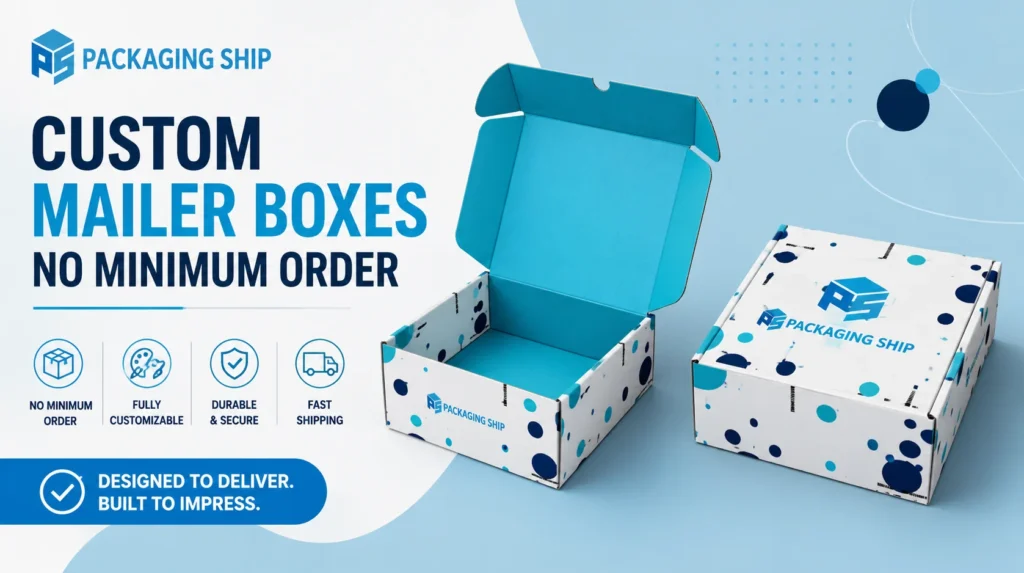
Custom Mailer Boxes No Minimum Order: How to Order 50 to 100 Units for Your Brand TL;DR: You do not need to order 1,000 boxes to get custom packaging. As of June 2026, digital printing lets small brands order custom mailer boxes with no minimum order, starting at 50 to 100 units, with free design support and free US shipping. This guide breaks down real costs, real production steps, and why a small first order is often the smarter business move. Table of Contents What Is a No Minimum Custom Mailer Box Order in 2026? A no minimum custom mailer box order means a supplier will print your logo and design on as few as 50 to 100 boxes, instead of forcing you to buy 1,000 or more. This became possible because digital printing does not require the metal plates that large offset presses need. You pay for the boxes you print, not for the setup. That is the whole shift, and it is why small brands can finally compete on packaging. This is not a niche workaround anymore. Small batch mailer boxes have become a mainstream option because the number of small sellers entering e-commerce keeps climbing every year, and suppliers like Packaging Ship have built their production model around serving that demand rather than turning it away. Why Most Suppliers Still Demand 500 to 5,000 Units Why Do Traditional Printers Require High Minimums? Large packaging manufacturers built their businesses around offset printing. Offset presses use physical plates, and those plates cost money to create, usually $150 to $500 per plate, sometimes more. A factory has to spread that setup cost across enough boxes to stay profitable. That is why traditional suppliers set high minimum order quantities. It has nothing to do with your brand. It is math on their end. Is Demand For Small Batch Packaging Actually Growing? This math is starting to shift because demand has shifted first. Grand View Research values the global e-commerce packaging market at $106.46 billion in 2025, with growth projected to reach $392.85 billion by 2033. Inside that market, the mailer segment specifically is forecast to grow faster than almost any other packaging format, at a 15.2% compound annual rate through the forecast period. That growth is not coming from a handful of giant retailers. It is coming from the flood of small DTC brands and Shopify sellers entering the market every year, which is exactly why more suppliers are finally building low quantity mailer boxes USA production into their model instead of ignoring it. Can You Really Get Custom Mailer Boxes for 50 to 100 Units? Yes. Custom mailer boxes no minimum order is not a marketing slogan anymore, it is a real production option for small brands. Digital printing produces the same CMYK color accuracy at 50 units that offset printing produces at 5,000. The difference is speed and cost per unit, not print quality. What Actually Changes Between 50, 100, and 500 Units? Here is the honest breakdown. Orders under roughly 500 units typically run on digital presses. Orders above that usually shift to offset, where the per unit price drops because the plate cost gets spread across more boxes. If you are ordering 50 to 100 custom mailer boxes for a small business launch, you are squarely in digital printing territory, and that is a good thing. No plates, no setup fees, no waiting on a die to be cut. What Hidden Fees Should You Watch For? Some suppliers advertise no minimum and then quietly add a design fee, a proofing fee, or a rush charge at checkout. Always ask directly whether the quoted price includes every fee. A transparent quote should have one number, not five line items added later. You can browse custom mailer boxes and see sizes and materials before you request pricing, so you know exactly what you are asking for. What a Small Batch Mailer Box Order Actually Costs How Much Do 50 to 100 Unit Mailer Boxes Cost? Custom mailer boxes’ wholesale pricing usually starts around $0.20 to $0.60 per unit, depending on box size, material thickness, and how many colors are in your design. A 50 unit order with a simple one color logo will land near the low end. A 100 unit order with full color printing and a coating like matte lamination will land higher, but still far below what most people expect. Do the math against a bulk order. If a supplier quotes you $0.35 per unit at 1,000 units, that is $350, plus you now own 1,000 boxes before you know if your design, your sizing, or even your product fit is right. Compare that to a 100 unit test order at maybe $0.55 per unit, roughly $55. You spend less up front, you find out fast if anything needs to change, and you have not tied up cash flow in cardboard sitting in a closet. Does Packaging Design Actually Affect Sales? Packaging design also does real work once it reaches the customer’s door. According to Ipsos research on packaging and purchase decisions, most American consumers say the design of a product’s packaging often influences what they buy, and products packaged in paper or cardboard are seen as more attractive and higher quality by roughly two thirds of shoppers. That means even a small first run of custom printed mailer boxes is not just protection for your product. It is doing marketing work the moment it lands on a doorstep. Free shipping matters here too. Many suppliers offering custom mailer boxes free shipping USA build that cost into the unit price rather than charging separately, so always ask if shipping is already included before you compare quotes side by side. Why a Test Run Beats a Big First Order What Happens When You Skip the Test Run? If you have looked for a supplier and hit a wall because nobody will touch an order under 500 units, you are not alone. That is the single most
7 Packaging Mistakes Small Businesses Make (And How to Avoid Every One) TL;DR Seven packaging mistakes drain small business profits every day. Wrong box dimensions push up your FedEx bill. Plain brown boxes kill repeat buyers. Flimsy materials trigger returns. This guide names each mistake, shows the real dollar damage, and gives you a fix that starts at $0.20 per unit, no minimum order, anywhere in the USA. Table of Contents What Are Custom Packaging Boxes in 2026? Custom packaging boxes are made-to-spec, printed containers built around your product’s exact dimensions, your brand colors, and your chosen material. They are not stock brown boxes from a supply warehouse. Custom printed boxes in the USA carry your logo, your message, and your identity, printed in full color, cut to size, and finished with coatings like matte lamination or spot UV. Here is what most small business owners do not realize: your box is a salesperson. It works before the product is opened. A 2018 Ipsos study commissioned by the Paper and Packaging Board found that 72% of American consumers say packaging design directly influences what they decide to buy. Now let’s get into the 7 specific packaging mistakes small businesses make, and what each one is actually costing you. Mistake #1: Is Your Box Size Making You Overpay FedEx Every Week? Sarah runs a candle brand out of Nashville. She ships about 40 orders a week. For eight months, she used a box that was three inches too tall for her product. She never thought about it. Then her accountant flagged that her shipping costs were $3.80 higher per order than her competitor’s. Over 35 weeks, that was $5,320 in unnecessary spend. The reason? Dimensional weight pricing. Both FedEx and UPS in the USA calculate your shipping cost based on whichever is greater: the actual weight of your package, or its dimensional weight. The formula for UPS Ground is: Length x Width x Height, divided by 139. So a box that measures 12 x 12 x 12 inches carries a dimensional weight of 12.5 lbs. If your product weighs 2 lbs, you pay 12.5 lbs. Every. Single. Shipment. This wrong box size costs compounds fast on Shopify or Amazon. It is one of the most quietly expensive common packaging errors among DTC brands in the USA, and most founders only catch it after months of overspending. The fix: Measure your product with its protective fill in place. Find the snuggest corrugated box that leaves no more than 1.5 to 2 inches of empty space on any side. Use custom sizing, not stock sizing. A right-sized box costs a little more upfront. However, it pays back on every single shipment going forward. Mistake #2: Are Generic Boxes the Reason Your Customers Never Come Back? Marcus built a men’s grooming brand over two years. His formula was dialed in. His price was right. But he shipped in plain kraft boxes from a wholesaler because “the product is what matters.” In month four, he ran a customer survey. When he asked why repeat purchases were low, the top answer he got back was: “The packaging felt cheap. I thought the product might be too.” That is how wrong packaging hurts brand reputation, not with one big complaint, but with dozens of quiet decisions by customers who simply felt let down before they even opened the box. The Dotcom Distribution 2022 e-commerce packaging consumer survey found that 40% of buyers would share a photo of packaging on social media if it looked distinctive or gift-like. A plain brown box earns zero of that organic reach. When a customer receives a custom mailer box carrying your brand colors, your logo, and a clean interior finish, the unboxing moment becomes a brand experience. Shopify’s internal merchant data shows DTC brands using branded packaging see repeat order rates roughly 23% higher than those shipping in plain stock boxes. Branded packaging solutions are not a luxury line item for small businesses anymore. They are standard practice in 2026. And with custom printed boxes USA manufacturers like Packaging Ship offering runs from 50 units at $0.20 per unit, there is genuinely no financial argument left for the plain brown box. Mistake #3: Is Your Packaging the Reason Products Arrive Broken? A Texas cookie brand launched in October. By November, they had 31 one-star reviews. Every single one said the same thing: “Arrived crushed.” Product damage during shipping is the third most common reason for e-commerce returns in the United States, according to Invesp research on online return behavior. Returns are not just refunds. Each one carries outbound shipping cost, return shipping cost, processing labor, and a customer who will likely never trust the brand again. Research shows between 30 and 50% of customers who receive a damaged product do not repurchase, even after a full refund. The bad packaging impact here is not just financial. It hits your review score, your repeat rate, and your brand’s credibility at the exact moment a new customer was forming their first impression. The structural fix depends on your product category. For anything fragile or high-value, corrugated boxes rated ECT-32 or ECT-44 resist stacking pressure and side-impact force that regular cardboard does not. For cosmetics, skincare, or multi-item food orders, custom display boxes with formed interior inserts hold each product in place so nothing shifts in transit. Nothing shifts, nothing breaks, and your review score reflects the actual quality of what you make. Mistake #4: Why Do So Many Small Brands Over-Order Boxes Before Testing? A Portland candle brand ordered 3,000 custom boxes before their Etsy launch. Six weeks in, they changed their product dimensions. Three thousand boxes went to the landfill. That was a $5,400 sunk cost, not counting the new run they had to order. Most large-format packaging manufacturers in the USA require minimum orders of 1,000 to 5,000 units. For a startup testing a new product, that commitment is dangerous. The packaging mistakes that cost small businesses money in the
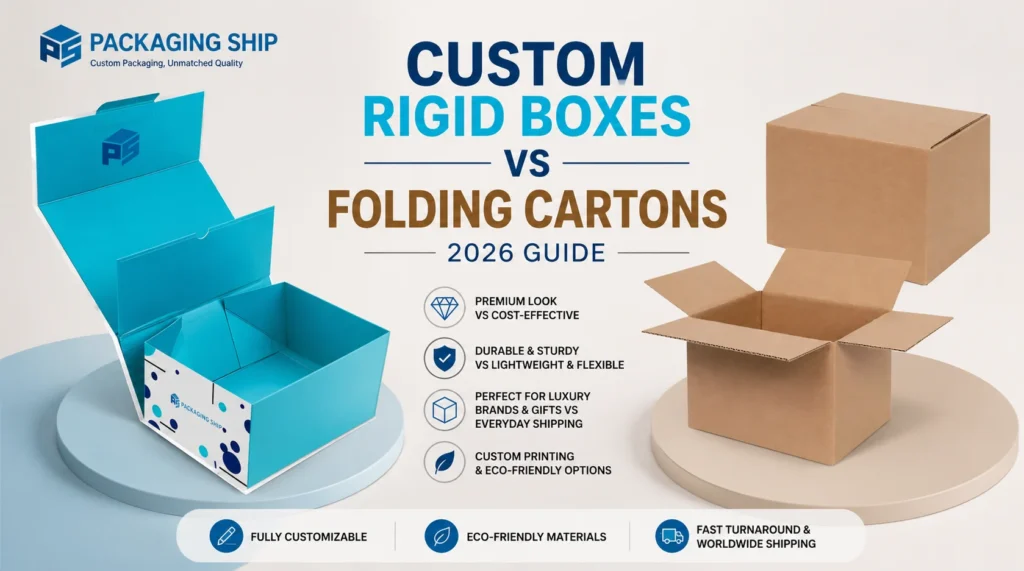
TLDR: Short version: rigid boxes cost more per unit, but they make your product feel worth more. Folding cartons are efficient. Rigid boxes are memorable. For anything you sell above $30, the math almost always favors going rigid. Table of Contents What Is a Custom Rigid Box? (2026) Picture the last time you received something that felt genuinely special in the mail. Chances are, the box itself was doing a lot of work before you even saw the product. Custom rigid boxes, sometimes called set-up boxes in the trade, are built from thick greyboard or chipboard ranging from 1.5 to 3 millimeters. A decorative paper wrap, printed and finished with whatever your brand calls for, gets pasted directly onto that board. The structure never folds flat. It holds its exact shape from the production floor all the way to your customer’s hands. That permanence is the whole point. What separates a rigid box from everything else on the market is really that single quality: structural confidence. Customers feel it the moment they pick up the package. That weight and solidity communicates something about your brand before they lift the lid. It tells them what is inside matters. Folding cartons cannot do that. They are not designed to. Folding Cartons: Where They Genuinely Shine Folding cartons are single-layer paperboards, usually SBS or CCNB boards, running between 250 and 600 GSM. They ship flat, assemble fast, and cost somewhere between $0.20 and $1.50 per unit depending on volume and finish choices. For food brands, pharmaceutical companies, and mass-market retail lines moving tens of thousands of units monthly, they make complete sense. They take foil stamping, spot UV, and embossing reasonably well, so calling them plain is unfair. The issue is not with folding cartons themselves. The issue is using them for products that have outgrown them. When a customer pays $60 for something and the box collapses slightly under their fingers, that price tag suddenly feels dishonest. The packaging did not lie exactly, but it did not tell the truth either. Premium goods need packaging that matches what is inside, and a folding carton, however well printed, cannot carry that weight. Rigid vs Folding Carton: Side-by-Side Breakdown Feature Custom Rigid Boxes Folding Cartons Core material Greyboard, 1.5 to 3mm SBS or CCNB paperboard Ships Pre-assembled Flat-packed Unit cost range $2.00 to $10.00 $0.20 to $1.50 Structural strength Resists up to 100 lbs compression Moderate, depends on GSM Unboxing feel Friction-fit lid, deliberate slow reveal Quick fold open Finish options Foil stamp, deboss, magnetic closure, ribbon, soft-touch matte Gloss, matte, spot UV, emboss Best product fit Jewelry, cosmetics, spirits, tech, gifting Food, pharma, mass retail Perceived value lift 15 to 30% price premium Functional, neutral Which Product Categories Actually Need Rigid Packaging? Anything priced above $35 benefits from rigid structure. The premium pricing signal works in both directions: customers who pay more expect more from the packaging, and packaging that matches that expectation reinforces the price point. It is a closed loop. A two-piece rigid box with a velvet or foam insert communicates craftsmanship. The lid fits with resistance. The product is revealed slowly. A folding carton tuck-end opening just cannot replicate that experience, no matter how well it is printed. These categories compete on sensory experience and “keep-worthiness.” Customers who keep a rigid box on their dresser or shelf are keeping your brand logo in their living space for months. That is passive brand exposure with zero ongoing cost. Apple’s unboxing sequence is studied in branding courses. The controlled friction of that lid rising slowly is not accidental. It is a retention mechanism built into the packaging itself. For retail and display boxes that complement your rigid packaging on a retail floor, Packaging Ship offers fully customizable options sized to your product and shelf configuration. According to Ryder’s 2024 E-Commerce Consumer Study of 1,306 US shoppers, 42% said visually appealing packaging was the top factor that would encourage them to post photos or videos of an unboxing online. That kind of organic social reach costs your brand nothing beyond the packaging itself. The Cost Conversation Most Brands Get Wrong Here is where founders consistently miscalculate. Say a rigid box costs $3.50 and a folding carton costs $0.85 for the same product. That looks like a $2.65 per-unit penalty. But if your product retails at $55, and premium packaging lifts perceived value by even 15%, you just unlocked an additional $8.25 per sale. The math reverses immediately. There is a well-documented psychological phenomenon in consumer research called the packaging halo effect. When the box feels premium, the product inside gets rated as more valuable, even when nothing about the formula or quality has changed. A 2025 industry analysis by Packestic found that brands moving to rigid packaging regularly command 15 to 40% higher price points than identical products sitting in standard carton packaging. That is not a small margin difference. That is a pricing strategy built into the box itself. And customers are paying attention to packaging more than most brand owners realize. A 2024 Ipsos survey of US consumers found that 74% say packaging design directly influences their purchase decisions. Not “sometimes influences.” Directly. Rigid packaging also cuts damage claims. The greyboard core resists compression and impact in ways that folding cartons simply cannot. Fewer damaged products means fewer refunds, fewer replacement shipments, and fewer frustrated customers writing negative reviews. For products that need both structural integrity in transit and a premium surface finish, pairing a rigid presentation box with a separate protective shipping box is the approach most luxury brands use, and Packaging Ship supplies both. Best Packaging for Etsy Sellers and Small Brands A lot of independent sellers and Etsy shop owners assume custom rigid boxes sit behind a wall of minimum order requirements. That used to be true. At Packaging Ship, there is no minimum order quantity. A jewelry maker selling 40 pieces a month gets the same greyboard quality and finishing options as a national cosmetics brand
Best Packaging for Etsy Sellers in 2026: What Actually Works TL;DR: Best packaging for Etsy sellers right now: a branded custom mailer or kraft tuck box, tissue paper, a real thank-you card. Starts at $0.20 per unit, zero minimum order. Nail the unboxing and you will see more five-star reviews, more repeat orders, more photos of your products circulating online without spending a cent on ads. Table of Contents What Is the Best Packaging for Etsy Sellers in 2026? Honestly, a shorter answer than most people expect. A branded mailer box or kraft tuck box with your logo, tissue paper inside, and some kind of personal card. That is it. Works for the vast majority of Etsy categories, from jewelry to candles to handmade soap to baked goods. What makes the best packaging for Etsy sellers is not complexity or cost. It is my intention. Does your box communicate that a real person made this thing and cared about how it arrived? If yes, you are already ahead of most sellers on the platform. Worth knowing: as of late 2025, Etsy held 86.6 million active buyers (Printful Etsy Statistics 2026) blog stated. Just over 48% of them qualified as repeat purchasers. Nearly half your potential audience already has a track record of coming back to shops they liked. Packaging is a big part of what makes them like a shop. Why Your Box Decides Whether Buyers Return A seller I know spent eight months refining her soap formula. Cold-process lavender, genuinely excellent. She shipped it in a plain white padded mailer she bought from Amazon, 100 for $19. The reviews mentioned the soap. Nobody mentioned the packaging. Nobody photographed it. Reorders trickled in slowly. Six months later she switched to a small kraft box with a printed label, a piece of cream tissue, and a card that said “Thank you for choosing handmade.” Nothing expensive. Her repeat purchase rate changed noticeably within two months. Same soap. Different box. That is the thing people underestimate about Etsy specifically. Buyers there made a deliberate choice to shop small, shop handmade, shop from a real person. Your packaging either validates that choice or it does not. A plain poly bag quietly suggests your shop is just another order to process. A thoughtful box says something different. The data backs this up too. Woola’s Ecommerce Packaging Statistics report found that 52% of online shoppers are more likely to order from a brand again when the packaging was premium or branded. Another 41% said branded packaging specifically nudged them toward a future purchase. Those are not niche findings. That is more than half your customer base making a next-purchase decision at the moment they open the box, before they have even used the product. Social sharing is part of this too. Dotcom Distribution’s research, covered by Packaging Digest , showed 40% of consumers share product photos on social media when the packaging is branded or gift-like. On Etsy, where discovery still happens through word of mouth and Instagram saves, that kind of organic sharing has actual monetary value. Best Packaging Types for Etsy Sellers Compared No single box style wins for every seller. Etsy shops make hand-thrown ceramics, screen-printed shirts, and macaron towers. Below is a practical breakdown of what works for what. Packaging Type Best Product Match Protection Brand Potential Typical Cost/Unit Custom mailer box Jewelry, candles, cosmetics, gifts High Very High $0.60 to $1.20 Kraft tuck box Soaps, small accessories, food Medium to High High $0.35 to $0.80 Corrugated shipping box Ceramics, glass, fragile goods Very High Medium $0.80 to $1.80 Rigid gift box Luxury or high-end products High Premium $1.20 to $3.00 Paper mailer with backing board Art prints, flat stationery, cards Medium Medium $0.30 to $0.70 Poly mailer Clothing, textiles, soft goods Low Low $0.20 to $0.50 Custom mailer boxes and kraft tuck boxes cover most of what Etsy sellers actually ship. They perform in transit, they hold print well, and they give customers something that feels considered rather than thrown together. Poly mailers do their job but they do not do anything for your brand. If you sell clothing and margins are genuinely tight, a poly mailer plus a nice tissue wrap and a sticker seal is a reasonable middle ground. Matching Packaging to Your Etsy Product Category Wrong order to approach this: pick a box you like, then figure out if your product fits. Right order: know exactly what your product needs to survive transit and feel right when opened, then choose the box format that delivers both. It should not be shipped in padded envelopes unless the piece is a simple sticker or flat charm. A small kraft tuck box or a custom pillow box with a cotton or velvet insert does something a padded mailer cannot, it creates a moment. Pillow boxes fold without tools, close cleanly, and look immediately gift-ready. Rings and earrings in a branded pillow box often get photographed and shared. The same items in a brown padded envelope get reviewed, maybe, if the customer remembers. They have it fairly easy in terms of format choices because custom kraft mailer boxes suit them almost perfectly. The natural texture of the kraft board pairs well with handmade branding aesthetically, not accidentally. It all reads as intentional and craft-focused, which is exactly the perception you are building. A soft-touch matte lamination finish on the outside takes the feel up another notch without dramatically changing cost. They need to think about food-grade materials before they think about branding. FSC-certified kraft board is both. Custom cake boxes in food-safe kraft not only keep your product protected during courier handling, they reinforce the artisan positioning your whole shop is built on. Someone ordering a handmade birthday cake from you is extending a lot of trust. Your packaging should feel equal to that. They get the worst deal here. Poly mailers are the standard because fabric does not need rigid protection and the costs add up fast at volume.
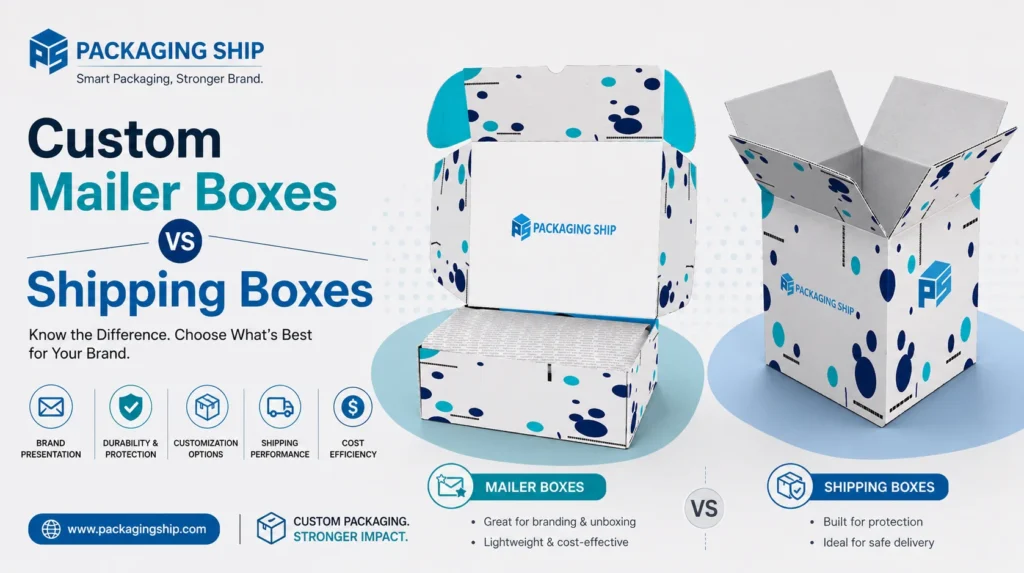
TLDR: Mailer boxes are light, self-locking, and built to look good when a customer opens them. Shipping boxes are sturdier and built to survive a rough ride. Which one you need comes down to what you’re shipping, not which one you like the look of more. Table of Contents What’s Actually Different Between a Mailer Box and a Shipping Box? A mailer box is a lightweight corrugated box that folds and locks shut on its own, no tape required, built mostly for light items and for making a good first impression. A shipping box is heavier, needs tape to close, and is built to take a beating in a truck. If your product is light and you care about presentation, go mailer. If it’s heavy or breakable, go to the shipping box. That’s the textbook answer anyway. In practice, most founders aren’t picking between two abstract categories. You’re standing in front of a spreadsheet trying to figure out why your damage claims went up last quarter, or you’re three weeks from launch and just need someone to tell you straight which box to order. So let’s actually get into it. Mailer Box vs Shipping Box, Side by Side Factor Mailer Box Shipping Box Good for Apparel, cosmetics, small accessories, books Bulk orders, fragile or heavy goods, multi item bundles How it closes Folds and locks, no tape Needs tape or adhesive Branding Plenty of room, built for the unboxing moment Functional, less about flash Cost per unit Usually cheaper for light, flat products Cheaper per cubic inch once you’re shipping heavier stuff Putting it together Fast, fold it and you’re done Takes longer, has to be sealed Protection Fine for light, durable items Better for anything fragile or heavy Both are made from the same stuff at the core, corrugated cardboard with a wavy fluted layer pressed between two flat liners. What changes is the engineering. A mailer box is die cut so it folds into a locked shape around your product. A shipping box gets built with thicker walls and more stacking strength, which is the whole reason it can sit at the bottom of a pallet without caving in. Four Questions That Settle the Decision Skip the guessing. Ask yourself these, in order, and you’ll know your answer by the third one. How much does it weigh? Anything under about two pounds and reasonably flat, a mailer box will hold up fine. Heavier than that and you should already be leaning toward a shipping box. Would it survive a drop? Folded apparel, a candle in a tin, most cosmetics, sure. Glass, ceramics, anything with moving parts inside, no. That’s a shipping box, full stop. How is it actually getting there? Straight to a customer’s front door, a mailer box is usually enough. Going through a 3PL or freight, or landing on a retail partner’s shelf, it’s going to get handled more roughly than you’d expect, and a shipping box gives you margin for that. Does the unboxing matter to your brand? For a subscription box or a gift set, yes, a lot. That’s often the one case where a mailer box wins even though a shipping box would technically protect the product just as well. Still torn after running through those four? Order the sturdier option. A few extra cents per box is cheaper than a refund and an angry email. Corrugated Grades, Without the Jargon This is the part most packaging blogs skip entirely, and it’s exactly where small brands get stuck calling suppliers asking “wait, what’s a flute again?” You don’t need to know the engineering behind it. Just three things. A thinner flute, usually called E flute, suits lighter products and gives you a cleaner surface to print on. Standard B or C flute is what most general purpose shipping boxes use, more cushioning, more stacking strength. Double wall board, which is two flutes combined, is for heavy or expensive items that genuinely can’t afford to get crushed. If a supplier quotes you a price without ever mentioning flute or wall strength, ask. It’s a completely fair question and any manufacturer who actually knows what they’re doing can answer it in a sentence. You can look through the corrugated boxes lineup by flute and wall type before settling on a quantity, so you’re not just trusting a quote on faith. What Happens When You Pick Wrong Here’s where this stops being a packaging question and starts being a money question. The National Retail Federation’s 2025 Retail Returns Landscape report puts the expected online return rate at 19.3% for 2025, and packaging failures are a recurring piece of why those returns happen. A return isn’t just a refund either. It’s the product cost, the return shipping, and very often a customer who quietly stops ordering from you. Packaging shapes that decision more than most founders give it credit for. A study run by Ipsos for the Paper and Packaging Board found that 72% of consumers say packaging design affects their purchase decisions, and 67% say the same about the materials it’s made from. That doesn’t stop at the first sale either. A box that shows up crushed or flimsy makes people hesitate before ordering again. None of this means “always buy the strongest box.” Overbuilding a mailer box for a t-shirt just wastes money and adds shipping weight you didn’t need to pay for. Underbuilding a shipping box for a set of glass jars basically guarantees you’ll see that order again, except this time as a return. The actual goal is matching the box to the product, not maxing out protection because it feels safer. Shopify Stores and Subscription Brands, This One’s for You Running a Shopify store and shipping anything under two pounds, custom mailer boxes are usually the right call. They arrive flat, take up almost no storage space, and you can fold and lock one shut in seconds, which matters a lot when you or one other person is the entire fulfillment