
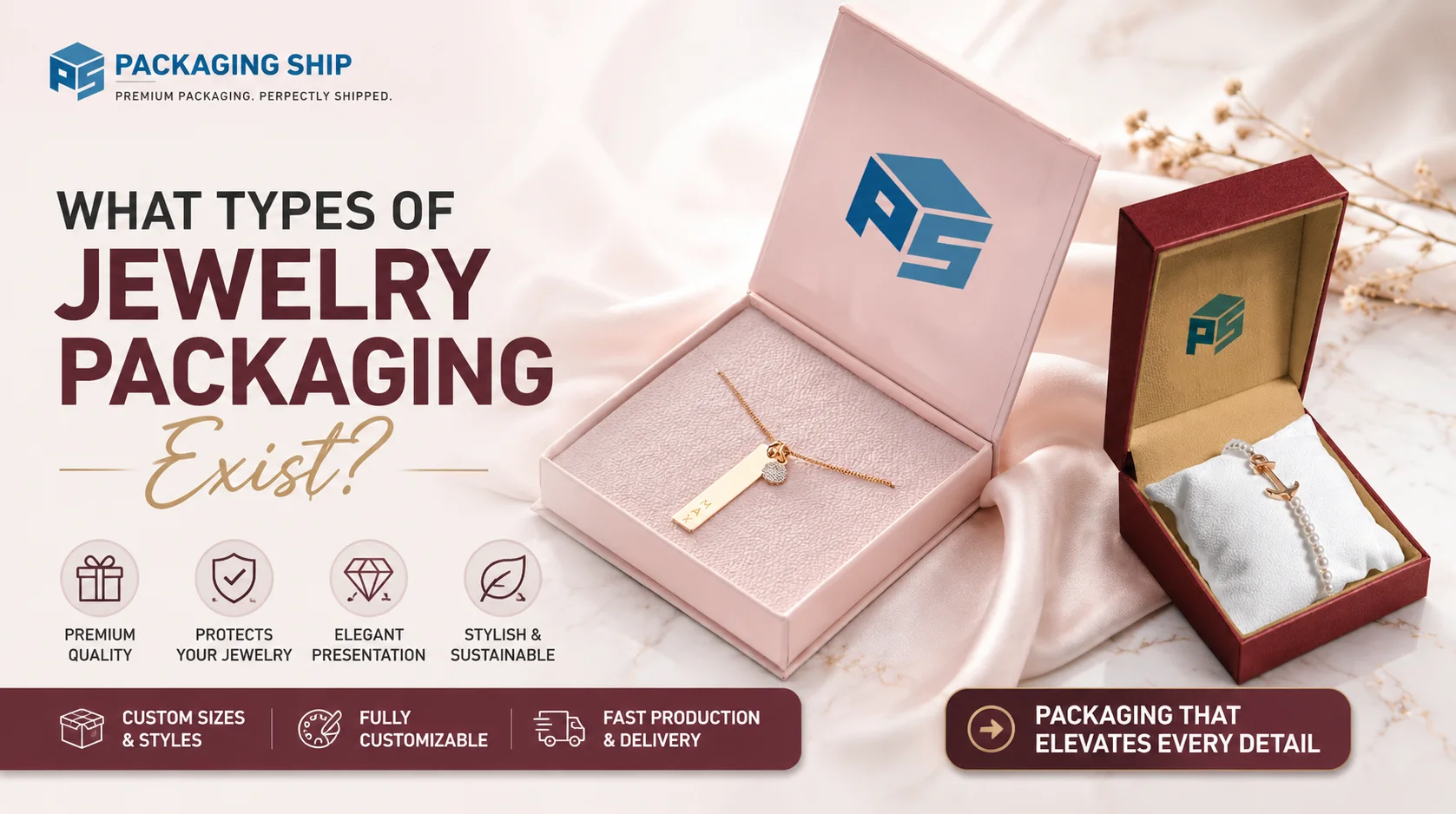
Most jewelry brand owners spend months perfecting the product. Then they ship it in a box they found on Alibaba for $0.08 a unit. The customer opens it, feels nothing, and never reorders.
Jewelry packaging is the moment your brand either lands or disappears. Eight main types exist: rigid boxes, kraft boxes, velvet pouches, pendant boxes, magnetic closure boxes, drawer-style boxes, cardboard boxes, and custom mailer boxes.
Here’s what each one actually does and more importantly, when each one is wrong for your brand.
The US jewelry packaging market was worth $1.9 billion in 2025, growing toward $2.7 billion by 2033 at a 5.0% annual rate, per Verified Market Reports. That growth is tied almost entirely to e-commerce, where the box is the only physical thing a customer ever touches from your brand.
There’s no store. No staff. No moment to recover from a bad first impression. Your packaging carries everything.
Made from dense chipboard that never collapses. Pick one up and the weight alone tells the customer something valuable is inside before they even open the lid.
Right for: fine jewelry, engagement rings, anything above $80 where the brand story depends on perceived quality. One mid-tier jewelry brand switched from standard cardboard to custom magnetic rigid boxes and saw satisfaction scores climb 34% in six months. The jewelry didn’t change at all.
Wrong for: fashion pieces under $25. The box costs more than the product warrants.
Natural, uncoated board that reads sustainability and craft without needing a word of copy. Take soy-based ink well, so you can still print a sharp logo or full-color design without killing the organic feel.
Artisan sellers and Etsy founders who’ve built their entire identity around “handmade from natural materials” this is your box. Pair it with branded tissue paper and a handwritten-style insert. That combination gets photographed and posted.
Our Custom Kraft Jewelry Boxes carry FSC-certified board and ship with no minimum order, so your eco claims actually hold up if a customer asks.
Wrong for: anything at a luxury price point. Kraft reads “craft market,” not fine jeweler.
They’ve been used for over a century because they genuinely work. Soft texture prevents scratches. The look signals value. They store flat and ship without adding meaningful dimensional weight.
Best for fashion jewelry, mass-market pieces, trade show giveaways, or as secondary packaging nested inside a rigid box. The pouch holds the pendant while the box handles the brand experience.
Don’t use them as your only e-commerce layer. Velvet has zero structural protection in transit. You need something around it.
Chains tangle. Pendants shift. A beautiful necklace can arrive looking bent or damaged even when it arrived physically fine, and the customer won’t know the difference. They’ll just return it.
A purpose-built pendant box fixes this with a necklace card insert or foam slot holding everything in place. Standard sizing is 3.5 x 3.5 inches or 4 x 4 inches, which is enough space to display the piece cleanly.
Our Custom Pendant Boxes handle the insert, custom sizing, and full print surface as standard. No minimum order required.
Skip these for oversized layered sets, which need compartmentalized boxes instead.
There’s a click when the lid seats itself. It’s engineered, not accidental. Luxury brands understood this long before most, which is why magnetic close has become shorthand for premium jewelry gifting.
Right for engagement rings, anniversary pieces, corporate gifting, anything where the moment of opening is emotionally loaded. The slow draw-and-close builds anticipation that translates directly to social sharing.
The global jewellery box packaging market hit USD 4,347 million in 2024 and is heading to USD 6,134 million by 2032, according to Credence Research, with premium design and sustainability as the two named growth drivers. Magnetic closure on the FSC board sits exactly at that intersection.
High-volume fashion pieces under $40? The unit cost math doesn’t work.
A ribbon tab. A sliding inner tray. The slow reveal as it pulls out.
It sounds simple, but that motion creates genuine anticipation — not theatrical, just quiet. The feeling that something good is coming. Lots of customers keep these long after the jewelry is out, which means your brand lives in their drawer or on their shelf for years.
Good fit for earring sets, ring-and-earring pairs, curated gift collections. Also smart if you want customers to reuse the packaging as storage rather than throwing it away.
Not justified for a single $18 everyday purchase.
The workhorse. Cotton-filled, lightweight, full-color printable, and significantly cheaper per unit than rigid. The cotton fill cushions rings, studs, and small pendants without costing what velvet or foam costs.
Fashion jewelry retailers and silver brands reach for these because they give proper branded presentations at a margin-friendly price. Cardboard also takes finishing techniques well matte lamination, gloss, spot UV, foil stamping, so the final box can look far more premium than the raw material suggests.
One thing: these are retail-grade, not transit-grade. Ship them inside a mailer.
The corrugated outer layer with your brand on it. Every delivery becomes a marketing moment on someone’s doorstep before they’ve even seen the jewelry.
Print on the inside lid too. The customer gets a second brand moment when they open it. Small detail, real impact.
The practical approach is box-in-box: your presentation box inside a mailer sized tightly around it, eliminating void fill and reducing dimensional weight. Keeps shipping costs lower and reduces theft risk from a plain exterior.
Browse the full range of custom jewelry packaging boxes to find the right combination for your product and shipping setup.
Before they read a word of your copy, the material speaks.
Rigid chipboard says permanent and confident. Kraft is honest and craft-made. The recycled board says you thought about where it ends up. Velvet says tradition. FSC-certified paperboard says verified, not just claimed.
Rigid boxes currently hold 38.4% of the global jewellery packaging market by product type, and over 60% of brands now name sustainability as a mandatory criterion when evaluating packaging suppliers. Both of those numbers point in the same direction: buyers want packaging that earns its place on both counts.
Premium packaging doesn’t require a big order. That misunderstanding costs a lot of small brands before they even get started.
The combinations we see performing best from handmade and small business jewelry sellers are simple: a kraft or cardboard box, a foil-stamped logo, tissue paper, and a short card insert. Total cost is usually modest. Perceived value from the customer side is often surprisingly high — people routinely assume they spent more than they did when the unboxing feels considered.
Wax seals on kraft boxes, ribbon-pull rigid boxes in unexpected colors, drawer boxes with a short message printed inside the base none of these need bulk orders and all of them create moments people share.
At Packaging Ship, every order comes with free design support, free US shipping, and no minimum order quantity. We’ve handled over 10,000 packaging projects for jewelry brands across the US from solo artisan sellers to wholesale accounts.
No commitments. No design fees. Packaging that makes your brand worth remembering.
The type of jewelry packaging you choose is a brand decision, not an afterthought. Rigid boxes signal luxury. Kraft signals craft. Velvet signals tradition. Magnetic closure signals ceremony. Each communicates something before your customer reads a single word.
The jewellery box packaging market reached USD 4,347 million in 2024 and is heading to USD 6,134 million by 2032, per Credence Research. Brands are finally treating the box as seriously as what’s inside it.
Match your packaging to your price point, your customer’s expectation, and your brand’s honest story. Then work with a supplier who doesn’t force you to choose between quality and what you can actually afford.
Rigid boxes, kraft boxes, cardboard boxes, velvet pouches, pendant boxes, magnetic closure boxes, drawer-style boxes, and custom mailer boxes. Each serves a different price point, brand position, and shipping need.
Kraft or cardboard with custom print. Low cost per unit, no minimum order, full brand customization practical for brands still building volume.
FSC-certified materials typically run 5 to 10% higher than standard. For most brands that premium pays for itself quickly with buyers who care about sustainability.
Box-in-box. Jewelry in a presentation box, that box inside a corrugated mailer sized tight around it. Cuts void fill, reduces DIM weight, reduces transit damage.
3.5 x 3.5 or 4 x 4 inches square covers most pendant and necklace styles cleanly.