
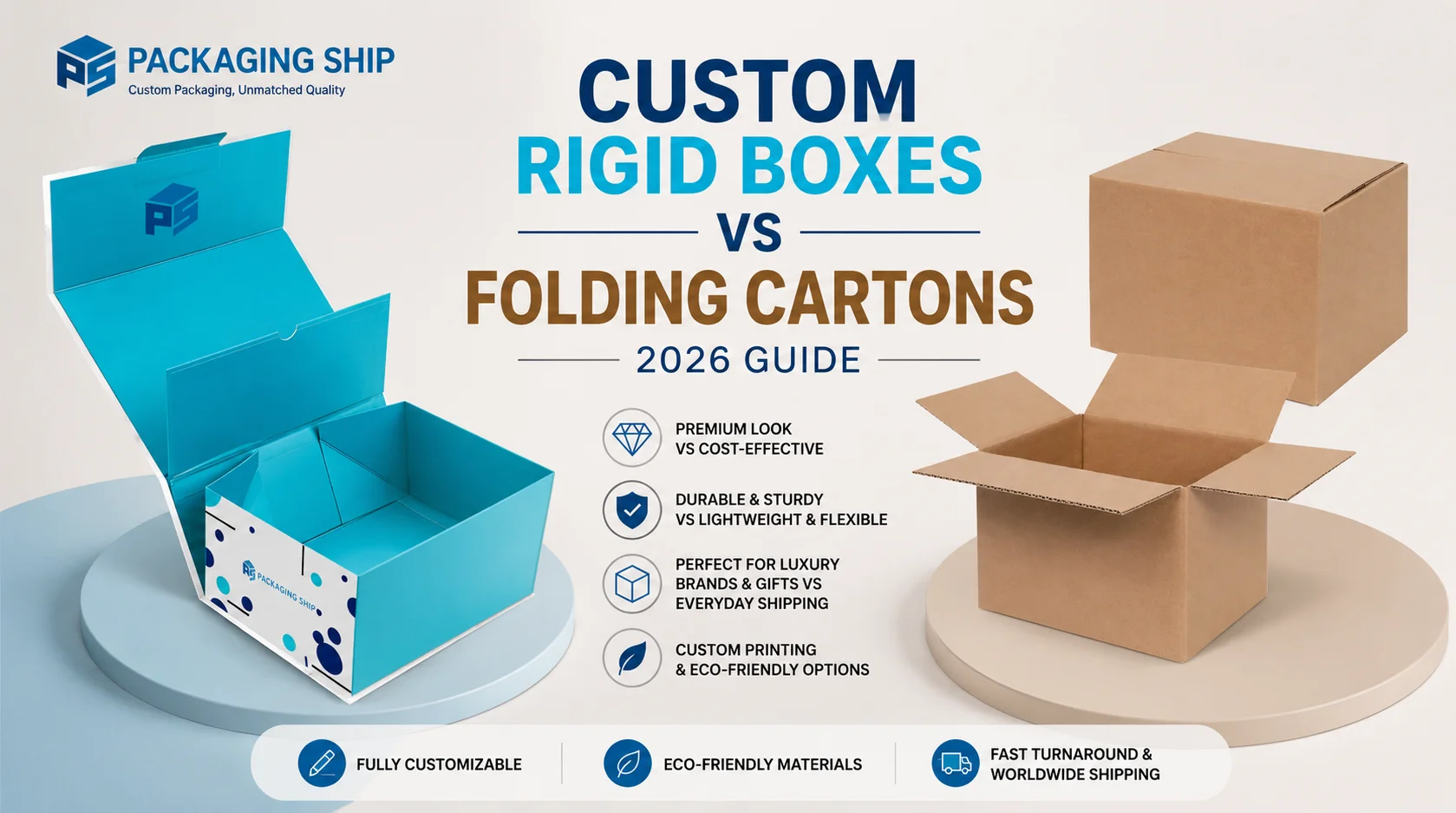
TLDR: Short version: rigid boxes cost more per unit, but they make your product feel worth more. Folding cartons are efficient. Rigid boxes are memorable. For anything you sell above $30, the math almost always favors going rigid.
Picture the last time you received something that felt genuinely special in the mail. Chances are, the box itself was doing a lot of work before you even saw the product.
Custom rigid boxes, sometimes called set-up boxes in the trade, are built from thick greyboard or chipboard ranging from 1.5 to 3 millimeters. A decorative paper wrap, printed and finished with whatever your brand calls for, gets pasted directly onto that board. The structure never folds flat. It holds its exact shape from the production floor all the way to your customer’s hands. That permanence is the whole point.
What separates a rigid box from everything else on the market is really that single quality: structural confidence. Customers feel it the moment they pick up the package. That weight and solidity communicates something about your brand before they lift the lid. It tells them what is inside matters.
Folding cartons cannot do that. They are not designed to.
Folding cartons are single-layer paperboards, usually SBS or CCNB boards, running between 250 and 600 GSM. They ship flat, assemble fast, and cost somewhere between $0.20 and $1.50 per unit depending on volume and finish choices. For food brands, pharmaceutical companies, and mass-market retail lines moving tens of thousands of units monthly, they make complete sense. They take foil stamping, spot UV, and embossing reasonably well, so calling them plain is unfair.
The issue is not with folding cartons themselves. The issue is using them for products that have outgrown them. When a customer pays $60 for something and the box collapses slightly under their fingers, that price tag suddenly feels dishonest. The packaging did not lie exactly, but it did not tell the truth either. Premium goods need packaging that matches what is inside, and a folding carton, however well printed, cannot carry that weight.
| Feature | Custom Rigid Boxes | Folding Cartons |
| Core material | Greyboard, 1.5 to 3mm | SBS or CCNB paperboard |
| Ships | Pre-assembled | Flat-packed |
| Unit cost range | $2.00 to $10.00 | $0.20 to $1.50 |
| Structural strength | Resists up to 100 lbs compression | Moderate, depends on GSM |
| Unboxing feel | Friction-fit lid, deliberate slow reveal | Quick fold open |
| Finish options | Foil stamp, deboss, magnetic closure, ribbon, soft-touch matte | Gloss, matte, spot UV, emboss |
| Best product fit | Jewelry, cosmetics, spirits, tech, gifting | Food, pharma, mass retail |
| Perceived value lift | 15 to 30% price premium | Functional, neutral |
Anything priced above $35 benefits from rigid structure. The premium pricing signal works in both directions: customers who pay more expect more from the packaging, and packaging that matches that expectation reinforces the price point. It is a closed loop.
A two-piece rigid box with a velvet or foam insert communicates craftsmanship. The lid fits with resistance. The product is revealed slowly. A folding carton tuck-end opening just cannot replicate that experience, no matter how well it is printed.
These categories compete on sensory experience and “keep-worthiness.” Customers who keep a rigid box on their dresser or shelf are keeping your brand logo in their living space for months. That is passive brand exposure with zero ongoing cost.
Apple’s unboxing sequence is studied in branding courses. The controlled friction of that lid rising slowly is not accidental. It is a retention mechanism built into the packaging itself. For retail and display boxes that complement your rigid packaging on a retail floor, Packaging Ship offers fully customizable options sized to your product and shelf configuration.
According to Ryder’s 2024 E-Commerce Consumer Study of 1,306 US shoppers, 42% said visually appealing packaging was the top factor that would encourage them to post photos or videos of an unboxing online. That kind of organic social reach costs your brand nothing beyond the packaging itself.
Here is where founders consistently miscalculate.
Say a rigid box costs $3.50 and a folding carton costs $0.85 for the same product. That looks like a $2.65 per-unit penalty. But if your product retails at $55, and premium packaging lifts perceived value by even 15%, you just unlocked an additional $8.25 per sale. The math reverses immediately.
There is a well-documented psychological phenomenon in consumer research called the packaging halo effect. When the box feels premium, the product inside gets rated as more valuable, even when nothing about the formula or quality has changed. A 2025 industry analysis by Packestic found that brands moving to rigid packaging regularly command 15 to 40% higher price points than identical products sitting in standard carton packaging. That is not a small margin difference. That is a pricing strategy built into the box itself.
And customers are paying attention to packaging more than most brand owners realize. A 2024 Ipsos survey of US consumers found that 74% say packaging design directly influences their purchase decisions. Not “sometimes influences.” Directly.
Rigid packaging also cuts damage claims. The greyboard core resists compression and impact in ways that folding cartons simply cannot. Fewer damaged products means fewer refunds, fewer replacement shipments, and fewer frustrated customers writing negative reviews. For products that need both structural integrity in transit and a premium surface finish, pairing a rigid presentation box with a separate protective shipping box is the approach most luxury brands use, and Packaging Ship supplies both.
A lot of independent sellers and Etsy shop owners assume custom rigid boxes sit behind a wall of minimum order requirements. That used to be true. At Packaging Ship, there is no minimum order quantity. A jewelry maker selling 40 pieces a month gets the same greyboard quality and finishing options as a national cosmetics brand ordering 5,000 units. Same chipboard, with the same foil. Same free design support. If you want to read more about packaging options built for small brands and independent sellers, click here.
There is also something worth knowing about rigid packaging’s second life. Customers reuse these boxes. They become jewelry storage, keepsake holders, desk organizers. Your logo stays in someone’s home for years after the purchase. That kind of brand visibility has no equivalent in a folding carton that gets recycled the same afternoon.
For smaller, lighter items in your product range, something like pillow boxes can sit alongside your rigid boxes and give your full product line a cohesive premium feel without spending a rigid-box budget on every SKU.
Packaging Ship has been working with US brands from Valley Stream, NY for over six years. The offer is straightforward: premium custom rigid boxes with no die or plate charges, no minimums, free design support from their in-house team, free US shipping, and production in 7 to 10 business days. Pricing starts from $0.20 per unit depending on format and volume.
Most brands stall at one of three points: they do not know the cost upfront, they do not have production-ready artwork, or they are worried about being locked into a large order before testing a design. Packaging Ship removes all three of those barriers with a free no-obligation quote and complimentary design assistance on every order.
Get your free custom rigid box quote today, no commitment, no minimum, no hidden fees.
Request Your Free Quote → packagingship.com/get-an-estimate
Rigid boxes are built on a thick, permanent chipboard structure between 1.5 and 3mm. They arrive pre-assembled and never fold flat. Folding cartons are single-layer paperboard that ships flat and need assembly. Rigid packaging suits premium and luxury products. Folding cartons work for high-volume, lower-price categories.
Yes, particularly now that suppliers like Packaging Ship have removed minimum order requirements. A small brand gets the same structural quality and premium finishes as an enterprise order. The repeat purchase and perceived value gains from better packaging usually cover the unit cost difference within a few months.
Seven to ten business days, with free US shipping included. For comparison, Packlane quotes up to 12 business days for rigid box orders, with shipping costs added separately.
Yes. The chipboard is manufactured from recycled paper fibres. Many suppliers, including Packaging Ship, use FSC-certified materials and water-based inks. And because customers tend to keep rigid boxes rather than throw them away, the lifecycle environmental footprint per use is often lower than single-use folding cartons.
Soft-touch matte lamination, gloss UV coating, gold and silver foil stamping, embossing, debossing, magnetic closures, ribbon pulls, and specialty textured paper wraps are all standard options at Packaging Ship. Free design support helps you choose the combination that fits your brand.
Nobody remembers a plain brown box. And nobody posts a photo of a flimsy tuck-end carton. Nobody keeps a folding carton on their shelf three months after they opened it.
Custom rigid boxes do something different. They hold their shape, create a moment at the point of opening, and tell the customer they made a good decision before the product is even visible. For brands selling above $30, operating in any category where visual and tactile quality matter, rigid packaging is not an upgrade you add later. It is the standard your brand should start from.
Packaging Ship makes that standard accessible regardless of your order size. No minimums. Free design support. Free US shipping. Production in under two weeks.
The box your customer opens is the first physical impression your brand makes. Make it count.