
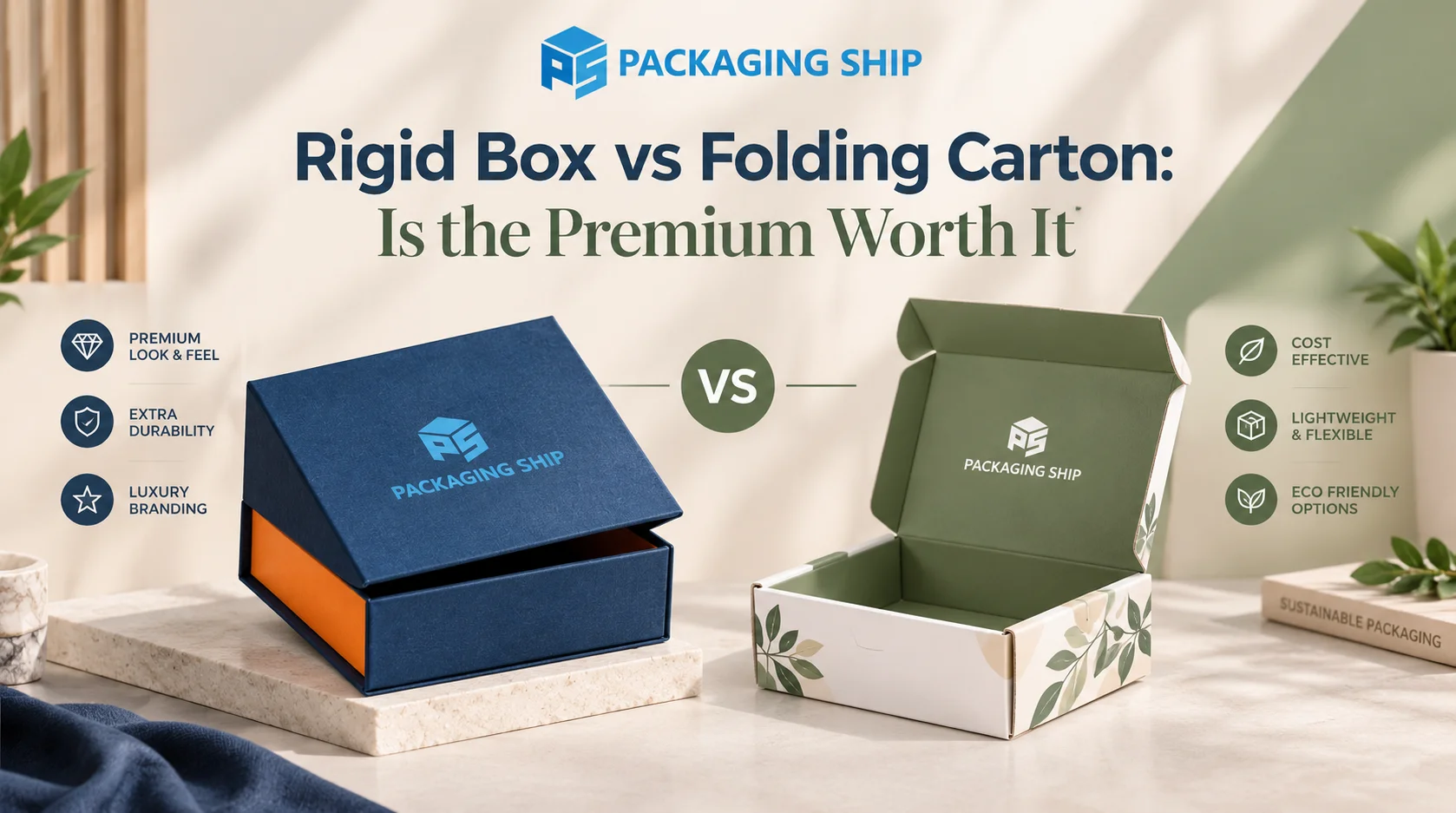
A rigid box usually runs two to four times what you’d pay for a folding carton at the same order size. Is that worth it? Usually, yes, once your product sells above roughly 50 dollars, or when the unboxing moment is part of what you’re selling, or the product just needs more crush protection. Under that price point, a folding carton is almost always the better call for your margin. At Packaging Ship, we help brands run this math before they commit to either format.
You are staring at two quotes for the same product. One says 45 cents a unit. The other says 2 dollars and 10 cents, for what’s basically the same box, same artwork, just a very different price tag. If you sell a 20 dollar candle, that gap feels impossible to justify. If you sell a 90 dollar skincare set, it might be the smartest money you spend all year. The rigid box vs folding carton decision isn’t really about which box looks nicer. It’s about whether your price point can carry the extra cost. At Packaging Ship, we quote both formats every week for small and mid size brands, so we see exactly where that line sits.
Think of a rigid box as furniture and a folding carton as a paper airplane. A rigid box is built from thick chipboard, usually 1.5 to 3 millimeters, wrapped by hand in printed paper and glued into a shape that never changes again. A folding carton is a thinner paperboard that ships flat and gets folded into shape right when it’s packed. Because of that extra material and hand assembly, a rigid box typically runs 2 dollars to 8 dollars per unit, while a folding carton runs 20 cents to 2 dollars at comparable order sizes.
Here is the breakdown that actually drives the price gap between a rigid box and a folding carton, and it is not just the board itself.
| Factor | Rigid Box | Folding Carton |
| Material | Chipboard, 1.5mm to 3mm, hand wrapped | Paperboard, 250 to 400 GSM |
| Assembly | Manual or semi automated | High speed automated folding |
| Cost per unit | 2 dollars to 8 dollars | 20 cents to 2 dollars |
| MOQ | Often flexible, low volume friendly | Usually higher volume runs |
| Shipping | Pre assembled, heavier | Ships flat, lighter |
| Best for | Retail price above 50 dollars | Retail price under 30 dollars |
Cardboard packaging, meaning folding cartons, wins on cost every single time because it is produced on automated lines and ships flat. That’s not some small niche corner of the industry, either. According to Mordor Intelligence’s folding carton packaging market analysis, the global folding carton market was worth 70.39 billion dollars in 2026 and is expected to hit 99.51 billion dollars by 2031, so plenty of brands still lean on this format even with all the premium packaging buzz right now. Rigid packaging is growing too, just from a smaller base. If you want to see the material range for yourself, our custom rigid boxes come in every board weight and finish mentioned above, with a full price breakdown before you commit to a quantity.
There is a simple rule that most packaging guides skip. Look at your retail price, not your production budget.
Under 25 to 30 dollars retail, a folding carton almost always protects your margin. Nobody’s expecting a luxury unboxing moment at that price, and honestly, a 2 dollar box on an 18 dollar product just eats too much of your profit.
Between 50 and 100 dollars, it really depends on your category. Skincare, jewelry, gift sets, these tend to do better in rigid packaging because the weight and solidity of the box tells the customer it’s worth something before the lid even opens.
Above 100 dollars, a rigid box usually earns its keep. Customers at that price point already expect a heavier, more deliberate unboxing experience, and a flimsy folding carton can actually work against you there, it can quietly undercut trust in the product.
Premium box ROI really comes down to one question, does the packaging change how often the customer comes back to buy again? A lot of founders already sense this intuitively, and the industry numbers back it up. Market Intelo’s research found that cosmetics and personal care already make up 21.4 percent of rigid box demand, and brands in that category are willing to pay more for packaging precisely because unboxing has become part of the product itself. If a heavier, rigid format nudges even a small percentage of buyers toward repeat orders, that 2 dollar premium can pay for itself pretty fast, especially on a product with decent margin.
Run the numbers before you decide. Take your rigid box cost, subtract your folding carton cost, and divide that gap by your product margin. That tells you how many extra repeat purchases you need per hundred customers to break even. For most brands selling above 50 dollars, that number is smaller than they expect.
If you like the weight and feel of rigid packaging but the shipping cost is scaring you off, there is a middle option. Collapsible rigid boxes fold flat for shipping and storage, then pop into a solid, permanent shape at the point of packing. You get most of the premium feel without paying full freight on pre assembled volume. This format works especially well for brands testing a new product line before committing to a full rigid box production run.
For gifting, influencer mailers, and anything built around the unboxing moment, magnetic closure rigid boxes are usually the format that gets the reaction you are hoping for. These typically add a rigid chipboard base, a decorative wrap, soft touch or matte lamination, and an embedded magnet at the lid, which gives a satisfying close and reopen and reads as a finished, considered product rather than a shipping container. Magnetic closures are also the single most popular closure type in the rigid box category overall, according to Market Intelo’s report, ahead of lift off lids and ribbon ties, which tells you this is not just a niche preference. If you want the full breakdown of what that magnet and extra board upgrade actually cost per unit, we covered it in detail in our guide on how much magnetic closure rigid boxes cost.
PR boxes serve a similar purpose for press kits and influencer sends, where the box itself is part of the pitch. Both formats lean into the same psychology as the ROI data above, that the weight and finish of a box shapes how a customer feels about what is inside it before they even open it.
| Question | Answer |
| Is a rigid box worth the extra cost? | Usually, if you’re selling above 50 dollars retail or unboxing is part of your brand story. Below that, a folding carton tends to protect your margin better. |
| What is the real cost difference between rigid boxes and folding cartons? | Rigid boxes typically run 2 dollars to 8 dollars per unit. Folding cartons run 20 cents to 2 dollars at similar order sizes. The gap comes from material thickness and manual assembly. |
| Can I order rigid boxes without a large minimum order? | Yes, quite a few manufacturers, Packaging Ship included, will take low volume rigid box orders, so you can test the format before committing to a full production run. |
| When should I use a folding carton instead? | Go with a folding carton if you’re under 30 dollars retail, shipping high volume, or you just care more about flat, cheap shipping than a heavy unboxing moment. |
You don’t have to guess which format is right for your product. Tell us your price point, order size, and category, and we’ll tell you straight whether a rigid box is worth the premium or a folding carton is the smarter move. Request a free quote and get real numbers back in a couple of days, no strings attached.
The rigid box vs folding carton decision isn’t really about which box looks better on a shelf. It comes down to whether your price point, and your customer’s expectations, can absorb that extra cost. Run the math on your own margin, be honest with yourself about your category, and pick the format that protects your bottom line, not just the one that looks impressive in a sample pack.