
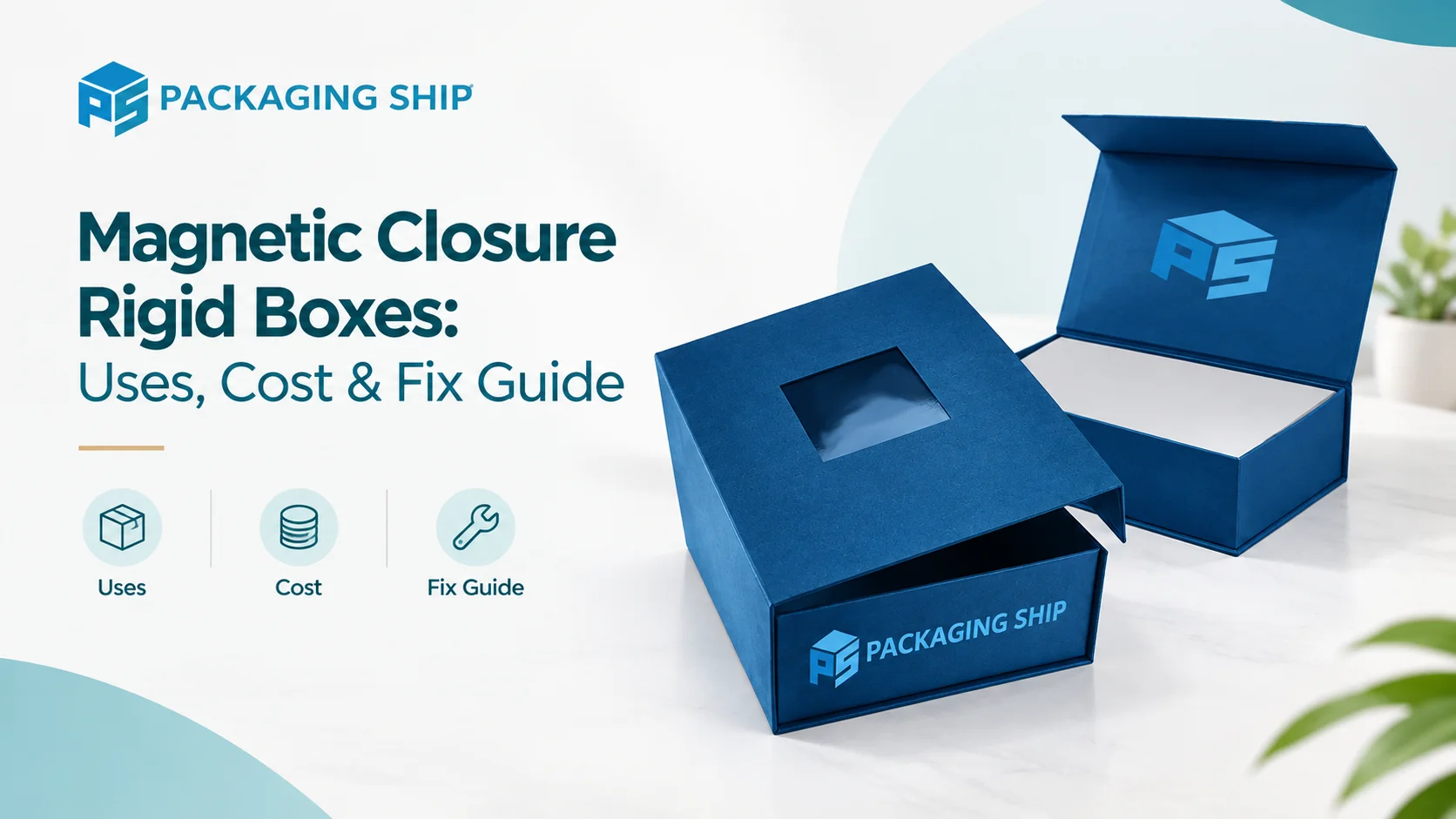
TL;DR: Magnetic closure rigid boxes are flip top boxes built from rigid boards with neodymium magnets set into the lid and base. They cost more than standard folding cartons because of the extra material and hand assembly. Most placement failures come from misaligned magnets, boards that are too thin or too thick, or weak pull strength for the product weight. Getting these right keeps lids shut through shipping and gives your brand a premium unboxing moment.
Magnetic closure rigid boxes are flip top packaging boxes made from thick, sturdy board with small magnets built into the lid and base. When the lid closes, the magnets pull together and hold the box shut without tape, ribbon, or a separate clasp. Brands use them for cosmetics, jewelry, electronics, and gifting because the closure feels solid the moment a customer touches it.
At Packaging Ship, we manufacture these boxes in house, which means every claim in this guide comes from what actually happens on a production floor, not from a spec sheet written by a sales team. Unlike a folded carton that ships flat and gets taped shut, this box is a small piece of engineering. Two magnets have to line up, every single time, across hundreds or thousands of units. That single detail is where most of the buying questions, and most of the complaints, actually start.
These boxes show up most often in categories where the first touch matters as much as the product inside. Cosmetic and skincare brands use them for gift sets and limited releases. Jewelry and watch brands use them because the weight of a rigid lid signals value before the box even opens. Electronics brands use them for accessories and premium bundles. Corporate gifting and subscription boxes use them because a magnetic snap photographs well for social unboxing content, which is exactly the kind of organic marketing small brands can’t buy. You can browse the full range of magnetic closure boxes to see sizing and finish options before you spec your own.
You have two structural choices here, and they solve different problems.
Non-collapsible boxes arrive pre-assembled. They’re sturdier out of the box and give a slightly heavier, more premium feel, which suits high-end retail and gifting. Collapsible magnetic rigid boxes ship flat and fold into shape at the point of use, which lowers your freight cost per unit and saves storage space if you’re a smaller brand working out of a garage or a shared warehouse. If you’re testing a new product line and don’t want a pallet of pre-built boxes taking up floor space, collapsible rigid boxes are usually the smarter first order.
Pricing for magnetic closure rigid boxes typically starts around fifty cents per unit at wholesale volume, before you add finishes like foil stamping or soft touch lamination. The final number moves based on four things: board thickness, magnet grade, order quantity, and finish. Thicker board and stronger magnets cost more per unit but reduce the chance of a weak or misaligned closure later. If you want an exact number for your box size and quantity, it’s faster to get a free quote than to guess from a price range online, since ranges you’ll see across suppliers vary wildly depending on what’s actually included.
Here’s what a properly specified magnetic closure rigid box actually looks like on paper, so you know what to ask for when you request a quote.
| Specification | Detail |
| Box style | Flip top rigid box with magnetic lid, available collapsible or non-collapsible |
| Board material | Rigid board 800 GSM to 2000 GSM, grey board 1.2mm to 3mm, chipboard 1.5mm to 3mm |
| Recommended board thickness | 1.5mm to 2mm for most magnet grades |
| Magnet type | Neodymium (NdFeB) magnets, commonly specified in N35 to N52 grade |
| Printing | CMYK full color, CMYK plus PMS spot color, inside and outside printing available |
| Finishing options | Matte or gloss lamination, soft touch lamination, spot UV, foil stamping, embossing, debossing |
| Interior lining | Velvet, satin, foam inserts, cardboard risers, ribbon pulls |
| Starting price | Around $0.50 to $0.55 per unit at wholesale volume |
| Minimum order | No minimum order required on most product lines |
| Standard production time | 8 to 10 business days from proof approval |
| Total delivery time (US) | 10 to 15 business days including free shipping |
This is the part almost nobody explains clearly, and it’s the reason a lot of first orders go wrong.
Package damage and returns are already an expensive problem across e-commerce, and a weak magnet is just one more way a box fails in transit. Research summarized by Pregis found that a large share of shoppers say they’re unlikely to buy from a brand again after receiving a damaged item, which makes closure reliability a real business cost, not a cosmetic detail.
Match the magnet grade and board thickness to what’s actually going inside the box, then confirm your supplier checks alignment during production, not just on the sample.
Magnetic closure is one style within a much wider category. Custom rigid boxes cover everything from two piece lift off lids to drawer style boxes, and magnetic closure sits at the premium end of that lineup because of the added engineering. The global rigid box market itself is growing steadily, valued at roughly 83.9 billion dollars in 2025 and projected to reach around 100.7 billion dollars by 2034 according to Towards Packaging, as more brands shift toward protective, brand forward packaging instead of plain cartons. If you’re weighing multiple rigid box styles for a launch, it helps to look at the full rigid box category before locking in on one closure type.
| Question | Answer |
| What is a magnetic closure rigid box? | A flip top box made from thick board with magnets built into the lid and base so it closes without tape or ribbon. |
| Why did my magnetic box lid pop open in shipping? | Usually a misaligned magnet, board that’s too thin or thick for the magnet grade, or a magnet too weak for the product weight. |
| Are magnetic closure rigid boxes more expensive than standard boxes? | Yes, because of the extra board, magnets, and hand assembly involved. |
| Can magnetic closure rigid boxes be collapsible? | Yes, collapsible versions fold flat for storage and lower freight cost. |
| What magnet grade works best for packaging? | It depends on board thickness and product weight, so this should be specified per order, not assumed. |
| Is there a minimum order for magnetic closure rigid boxes wholesale in the USA? | Some suppliers offer wholesale pricing with no minimum order, which helps smaller brands test a design before committing to volume. |
Talk to a supplier that checks magnet alignment on every run, not just the first sample. Request your free quote and get exact pricing for your size, board, and magnet grade before you order.
Get a Custom Quote
A magnetic closure rigid box is a small piece of engineering wearing a luxury finish, and the closure is what makes or breaks that impression. Get the board thickness, magnet grade, and placement right, and you get a box that snaps shut with confidence every single time, whether it’s sitting on a shelf or bouncing around in a delivery truck. Skip that step, and even the nicest print job won’t save a box that arrives open. Whether you’re comparing collapsible and non-collapsible builds or just trying to price out your first run, the goal is the same: a magnetic closure rigid box that holds up long after the unboxing photo is taken.