
Three days before her product launch, a skincare founder rang us in a panic.
Her supplier had delivered 4,000 laminated tubes. Right there on the side, in clean serif font: “sustainable packaging.” Except laminated multi-layer tubes fail every recyclability test curbside, drop-off, specialist stream, all of it. Her retail buyer flagged it before a single unit hit the sales floor.
Re-packaging, reprinting, lost shelf slot. Six weeks and $38,000 gone.
We tell that story a lot. Not to scare people, but because it is genuinely the most common expensive mistake in this industry, and it almost always happens to founders who thought they had done their due diligence. They had researched materials. They had asked the right questions. Their supplier had just not answered them honestly.
So before you print anything with “eco,” “green,” or “sustainable” on it, here is what you actually need to know about materials, about sourcing, about what retail buyers check for, and about what the FTC will hold you to.
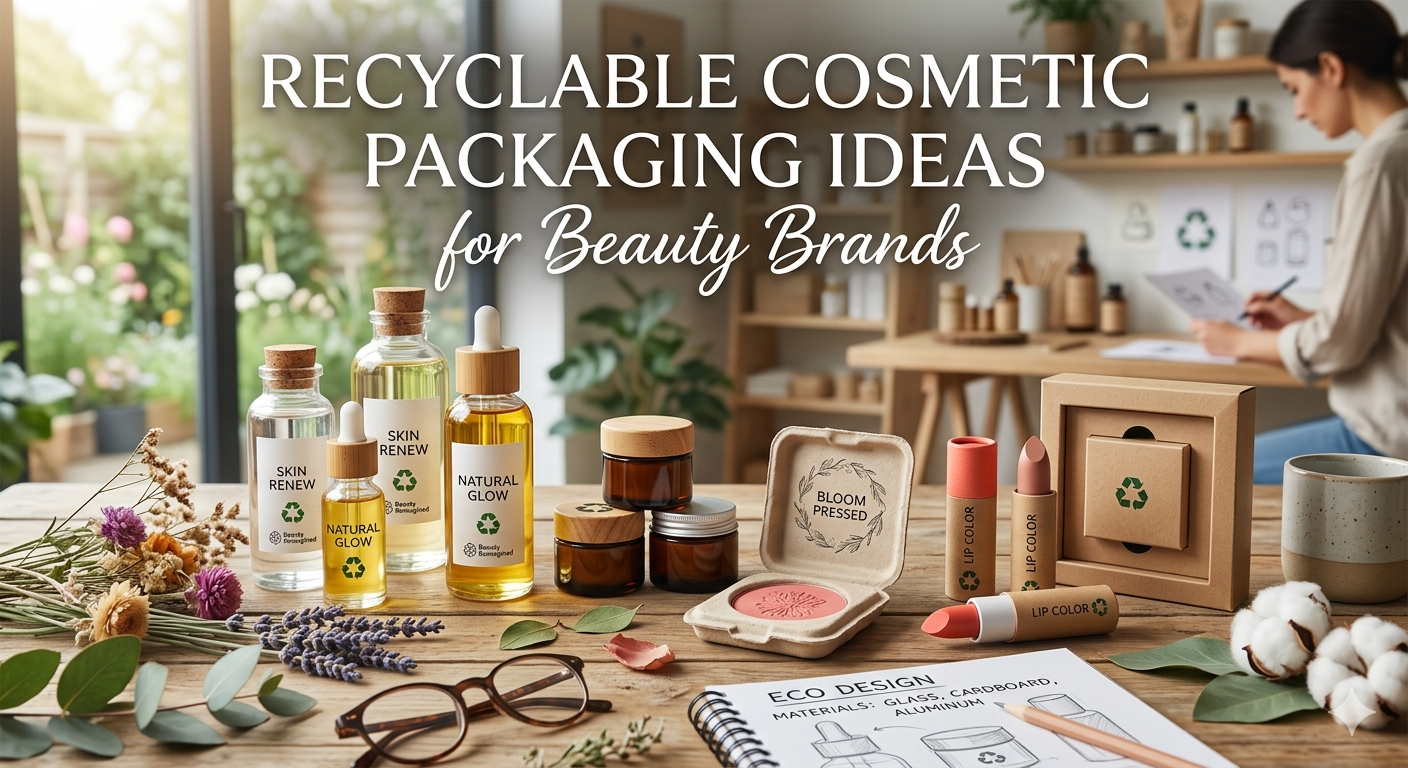
Recyclable cosmetic packaging means containers, cartons, and labels that US municipal recycling systems can genuinely process, not just materials that sound sustainable on a product page. PCR plastic, glass cosmetic jars, aluminum tins, FSC-certified paperboard, refillable bottles these qualify. A lot of what gets marketed as eco-friendly packaging cosmetics does not, and that distinction is costing brands money.
Take this number seriously: the Recycling Partnership’s 2024 State of Recycling Report found that only 21% of recyclable material gets captured across the US. Read that again. Twenty-one percent.
So even brands using fully recyclable substrates are still losing the end-of-life battle, because the packaging never communicates clearly enough for the consumer to act. Brands that go through verification earn the right to print standardized disposal instructions on their packaging. One brand we supply passed a Sephora vendor audit on their second attempt, after their first failed despite correct substrates because nobody had assessed their label system separately.
Labels. That is what sank them.
Meanwhile the EPA has confirmed recycling aluminum saves roughly 95% of the energy required to produce it from raw ore. Glass sits around 30% energy savings. PCR plastic cuts virgin resin extraction out of the picture entirely. These figures matter because retail sustainability buyers request them by name in vendor questionnaires.
Post-consumer recycled plastic starts as something someone already used a bottle, a container that got collected, cleaned, reprocessed into new packaging-grade resin. PET #1 and HDPE #2, the two grades most relevant for beauty, are accepted in curbside programs across the vast majority of US markets. For serums, toners, lotions, and pump formats, PCR is usually the most straightforward sustainable choice because it behaves almost identically to virgin resin through filling equipment.
One thing suppliers tend not to volunteer: PCR resin shows color variation between batches. It is inherent to working with post-consumer streams you cannot fully control what comes back through the recycling system. For packaging with clear or light-toned designs, set your color tolerances before sampling. Discovering that problem during production is an entirely different financial conversation than discovering it at sample stage.
Our Custom Mascara Boxes use PCR-compatible paperboard with soy-ink printing and How2Recycle compliant label stock, built for brands that need documentation ready for retail buyers.
Glass does not degrade through recycling. It melts, reforms, and performs identically on its fiftieth cycle as its first. That is a material property no plastic substrate can match. US glass recycling rates hover around 31% per EPA data lower than they should be, mostly a collection infrastructure problem rather than a material problem but glass is curbside accepted across virtually every major US metro market.
Face creams, body butters, premium serums: glass cosmetic jars are almost always the right call here. The weight tells a story the moment a customer picks it up. That tactile quality is a genuine brand asset.
The tradeoff is real though. Glass is heavy. For DTC brands eating their own shipping costs, that weight compounds fast at scale. For retail distribution, where the retailer manages final-mile logistics, the calculus flips and glass often wins on economics too.
Nothing in beauty packaging recycles better than aluminum. The Aluminum Association confirms it holds the highest consumer recycling rate of any packaging material in the category, and recycled aluminum uses 95% less energy than producing it from raw ore. For a brand building a zero-waste story, that is not a talking point. That is a verifiable fact you can put in front of a retail buyer.
Beyond the numbers, aluminum is infinitely recyclable with zero material degradation, lighter than glass, and has real premium tactile quality. Clean beauty buyers have developed a strong category association with aluminum over the past several years. It photographs well, it fixtures cleanly in retail, and for brands building a zero-waste narrative, aluminum tins give you a specific, verifiable data point to anchor the story.
Best fits: solid balms, pressed powders, travel formats, compact refills.
FSC-Certified Paperboard: What Retail Buyers Expect on Every Outer Carton
Any outer carton in your packaging lineup needs FSC certification. FSC means Forest Stewardship Council certification confirms the wood fiber in your paperboard came from a responsibly managed forest with an audited, documented chain of custody from harvest through manufacturing.
FSC paperboard is curbside recyclable, accepts soy-based inks cleanly across a full range of decorative finishes, and is available in calipers covering lightweight folding cartons through rigid retail-grade boxes. The practical reality: major retail accounts include FSC documentation requests in standard vendor onboarding packages. Having it ready removes friction from the approval process. Not having it creates delays that are entirely preventable.
Our Custom Beard Oil Boxes are FSC-certified with reinforced base seals engineered for oil-based formats, including brands running refillable outer carton SKUs alongside primary units.
NielsenIQ tracked a 64% spike in consumer searches for refillable beauty packaging in one reporting period alone. Brands that ignore that signal are not just missing a trend. They are leaving repeat purchase revenue on the table.
Brands running a primary unit plus a lower-priced refill SKU consistently outperform single-format brands on customer lifetime value. The refill purchase has lower friction than the original. The customer already trusts the brand, already knows the formula works, and already has the primary container. All they need is the refill to show up and perform.
Liquid skincare, facial oils, grooming products, and foundation are the natural fits. The engineering detail that actually determines success or failure is the refill mechanism itself, not the container material. A mechanism that spills, misaligns, or takes five steps to operate damages brand perception faster than almost anything else a product can do. Test the mechanism before you commit to production, not after.
Recyclable Labels: The Specification That Sinks Most Sustainable Packaging Programs
A PCR bottle with the wrong label is not recyclable. The label material, the adhesive chemistry, and the liner all factor into whether a finished package passes sustainaible assessment. Brands fail audits constantly because they specified the right bottle and a completely incompatible label system.
Water-soluble adhesives, film labels matched to the substrate resin type, and independently assessed label systems are what you need. This is a five-minute conversation with your manufacturer upfront. Having it after failing an audit is a much more expensive version of the same conversation.
Our Custom Hair Extension Boxes include fully recyclable label systems on FSC-certified board, engineered to satisfy retail eco-compliance documentation from the first order.
Plenty of suppliers use “eco” and “sustainable” in their category descriptions without documentation behind it. Five questions to ask directly before placing any order:
Can you show FSC chain-of-custody documentation? Can you provide verified PCR content percentage with sourcing records? Are you an active How2Recycle program participant? Do all production runs use soy-based or water-based inks exclusively? Do you have third-party recyclability test results for your label systems?
Hesitation on any one of those tells you what you need to know about whether that manufacturer is ready to support retail requirements or just talking about it.
Worth knowing: biodegradable and recyclable are not the same claim, and the FTC treats them differently. PLA bioplastics, bagasse, and molded pulp are genuinely useful for specific beauty formats, sample sachets, sheet mask pouches, and protective inner inserts. But most biodegradable materials require industrial composting conditions to break down properly. Those facilities are not accessible to most US households, which means printing “biodegradable” on your packaging without qualification can create Green Guide exposure.
If your product format and channel make biodegradable packaging worth exploring, the material selection and certification conversation is deeper than this post covers. Want to go further? Click here for our full biodegradable packaging guide.
Under Green Guides (16 CFR Part 260), “recyclable” can only appear on packaging if recycling programs are available to a substantial majority of US consumers; the FTC interprets that as roughly 60% of households. That threshold eliminates many materials that appear regularly in eco-friendly marketing.
Before anything goes to print with sustainability language, verify the material through the How2Recycle accepted materials list and get your label system independently assessed. This is not optional once your distribution includes major retail accounts. The FTC has pursued personal care and beauty brands for exactly these claims, and correcting courses after the fact is always more expensive than getting it right initially.
PackagingShip works with indie founders launching their first SKU and enterprise procurement teams managing hundreds of SKUs. No die charges and there are no plate fees. No minimum order. Packaging built to pass retail audits and hold up through full production runs.
By 2026, recyclable cosmetic packaging is not a differentiator. Retailers expect documentation. Regulators enforce claims. Customers read labels before they buy. The question is not whether to go sustainable it is which materials suit your product format and your channel, and whether your manufacturer can document what they deliver. PCR plastic, glass cosmetic jars, aluminum tins, FSC-certified paperboard, refillable bottles, and correctly specified recyclable labels each answer a different brief. None of it is complicated to source when you work with a manufacturer who has been through retail sustainability audits enough times to know exactly what buyers are looking for. We have. When you are ready, one quote request is all it takes.
Yes, when sourced from verified post-consumer streams and meeting ASTM D7611 resin identification standards, PCR plastic is compliant for cosmetic contact applications. Get chain-of-custody documentation from your manufacturer before finalizing any order.
There isn’t one. Order 150 units for a soft launch or 50,000 for a national rollout. Free design support and free US shipping on every order, regardless of volume.
Yes, without compromise. PCR bottles support foil stamping, soft-touch matte coating, and embossing. FSC paperboard prints sharply with soy-based inks. Finish quality and substrate recyclability are completely separate decisions.
Only use claims verified through How2Recycle or an equivalent third-party program. Vague language like “earth-friendly” or “planet-conscious” without a specific, documented material statement behind it is what the FTC targets most actively.
Standard runs complete 10 to 14 business days after artwork approval. Rush timelines are available depending on material and volume.