Custom Bakery Boxes No Minimum Order: Order 50 Boxes for Your Home Bakery or Cottage Business TL;DR: You can now order as few as 50 fully custom bakery boxes with your logo, in kraft or cardboard, with free design support and free US shipping. No die charges, no plate fees, no 500-unit trap. Production takes 7 to 10 business days. Packaging Ship serves home bakers and cottage businesses across all 50 states. Table of Contents What Is a Custom Bakery Box No Minimum Order? (2026 Guide) A custom bakery box with no minimum order means you can print your logo, choose your material, pick your finish, and order as few as 50 units, without paying setup fees, die charges, or plate costs. For most of the past decade, this was simply not possible. Large packaging manufacturers required 500 to 1,000 units per run. A home baker testing a new cookie flavor had two choices: order 500 branded boxes she might not fill, or sell her products in plain white boxes from a restaurant supply store. That gap is exactly what Packaging Ship was built to close. Starting at 50 units and $0.20 per unit for standard formats, home bakeries and cottage businesses across the USA can now access the same branded packaging that premium retail bakeries use, without the minimum order barriers or hidden fees. The Real Problem With Generic Boxes for Home Bakeries Here is a scene that plays out every Saturday at farmers markets across the country. Two home bakers are set up side by side, selling nearly identical artisan snickerdoodle cookies. One has hers stacked in plain white bakery boxes picked up 100-count from a restaurant supply store. The other has hers in a matte kraft box, a small debossed logo on the lid, and a kraft sticker that reads “Small-Batch. Austin Kitchen. Baked Fridays.” By 11 AM, the second baker had a line. The first baker has half her inventory left. The cookies? Nearly identical. The packaging? Not even close. This is not an anecdote. The science behind it is well documented. A June 2025 systematic review published in Nature’s Humanities and Social Sciences Communications, which analyzed 221 peer-reviewed academic studies on packaging and purchase behavior, confirmed that packaging design consistently ranks among the top drivers of first-impression quality perception, particularly in food and specialty product categories. The review found that color, structure, and material choice work together to shape how consumers judge product quality before they taste, touch, or open anything. For a home baker competing at a farmers market or selling through Instagram, that finding has a direct dollar value. The customer who picks up the plain white box versus the branded kraft box is making a judgment about your bakery’s quality before she reads a single ingredient. Generic boxes lose that judgment almost every time. Generic home bakery packaging does three specific things that hurt your brand. First, it signals mass production, which contradicts the handcrafted story you have spent months building. Second, it provides no dedicated space for the labeling information most US cottage food laws require on every product. Third, it gives customers nothing to photograph, share, or remember you by. Home bakery packaging is not a nice-to-have. For a small batch producer competing on quality and story, it is the most visible part of the product. What Cottage Bakery Laws Require From Your Packaging This is the section most packaging blogs skip entirely. It also happens to be the section that matters most to home bakers operating legally. As of July 2026, most US states permit home-based food production under Cottage Food Laws. Texas, California, Florida, Michigan, and North Carolina have among the most active cottage baker communities in the country. But nearly every state version of the law carries specific labeling requirements that must appear on or be attached to the product at the point of sale. Common required elements include the producer’s full name and home or registered address, the product name, a complete ingredient list, allergen declarations under the Food Allergen Labeling and Consumer Protection Act, net weight, and in most states a printed statement along the lines of “Made in a Home Kitchen Not Inspected by the State Department of Agriculture.” Your box must physically accommodate all of this. A plain, logo-free kraft box with no dedicated label panel forces you to apply a large printed adhesive sticker over a blank surface, which looks unprofessional, peels in transit, and creates inconsistency across every batch you sell. When you order custom bakery boxes from Packaging Ship, the in-house design team builds a dedicated back-panel label area directly into your artwork, at no extra charge. That panel stays consistent across every box in the run. No sticker alignment issues. No peeling edges. No compliance gaps. For cottage bakeries selling at markets, through local retailers, or shipping direct via Etsy or Instagram, this matters both legally and professionally. Custom Bakery Boxes No Minimum Order: What 50 Units Actually Looks Like Let us be specific, because vague promises are useless when you are making a real purchasing decision. At Packaging Ship, a 50-unit order of custom bakery boxes includes full CMYK color printing on your choice of 14pt cardboard or natural kraft stock, your logo, your brand colors, any text panels or labeling space you need, and a full-color digital proof reviewed and approved by you before a single box is printed. Pricing starts at $0.52 per unit for most standard bakery box formats at 50 units. There are no die charges, no plate fees, and no design fee. Free FedEx or UPS shipping to any address in the continental US is included on every order. Production takes 7 to 10 business days from the date you approve your proof. Rush production in 4 to 5 business days is available if you need boxes sooner. That means you can go from “I need branded boxes for my pop-up this month” to custom boxes in your hands in under two
Custom Bakery Boxes With Windows: The Complete Guide for US Bakeries and Patisseries TLDR A custom bakery box with a window is a printed box with a clear cutout on the lid or front panel so customers can see the product before they open it. In 2026, most US bakeries choose this style because it increases impulse purchases at the counter and online, protects the item during delivery, and still allows full logo branding on the rest of the box. This guide covers material choices, window placement by product type, real pricing, and how to order without a large minimum. Table of Contents A dozen assorted cookies leave your counter every Saturday morning in a plain white box. The customer can’t see what’s inside until they get home. That gap between the sale and the reveal is where you lose free advertising, and a window closes it the moment the box leaves your hand. This guide covers how custom bakery boxes with window packaging works, what keeps it food safe, how to pick the right window for cookies, cupcakes, and cakes, what you’ll pay in 2026, and how to order small without a bulk commitment. Why Your Boxes Need a Window, Not Just a Logo Plain boxes hide two things. They hide the product, and they hide the work behind it. When customers cannot see through packaging, they buy on trust alone instead of desire. A window changes that. It gives the customer a reason to want the item before they even read your label. This matters even more for windowed bakery packaging USA brands selling online or through third party delivery apps, where the customer never sees the product in person until the box arrives at their door. A study from the Paper and Packaging Board, conducted with Ipsos, found that 72 percent of US consumers say packaging design influences their purchase decision, and 67 percent say the packaging material itself plays a role too. You can read the full breakdown of that research on the Ipsos site. For a bakery, that means the box is not just protection. It is part of the sale. There is a second problem generic boxes create. If you spend an hour piping frosting details or laminating a fondant top, a solid box hides that work completely. A well placed window shows off the decoration you spent time on, not just a beige lid. This is why many small bakeries are moving away from plain kraft mailers toward windowed bakery boxes for gift orders, wedding favors, and daily case displays. Is the Window Actually Food Safe? PET vs PVC Most bakery box listings say food safe without explaining what that actually means. Here is the real difference. Window film usually comes in one of two materials, PET or PVC. PET film handles heat better and resists warping during warm delivery routes. PVC costs less but can soften faster under direct heat, which matters during summer deliveries. Neither film touches the food directly in a properly built box, since the film sits in the lid and the product sits below it on a paperboard base. Still, the film needs to meet food contact material rules under the FDA framework for substances that come into contact with food, which you can review on the FDA website. Ask your supplier which film they use and whether it is documented as food contact compliant, not just labeled food safe on a product page with no backup. If you are searching for clear window bakery boxes food safe wholesale, ask for the film specification in writing before you place a bulk order. A supplier who answers quickly usually controls their own production instead of reselling boxes from an unknown source. Matching the Window to Cookies, Cupcakes, and Cakes Not every product needs the same window. Cookies are flat and stack well, so a front facing tuck end box with a rectangular window shows the full stack without exposing the edges to open air. Cupcakes need height and airflow around the frosting, so a top window with an insert tray works better, since it keeps the swirl from touching the film during transit. Cakes need the largest window, usually a full panel oval or rectangle, so the customer can see the full decoration and layer height from the counter or through a delivery bag. For custom bakery boxes with windows for cookies and cupcakes USA, this is the biggest mistake bakeries make. Using one box style for every product means a window sized for cookies will crush a cupcake top, and a small cupcake window hides a cake’s real detail. Packaging Ship builds these as separate product lines rather than one generic box, since a cookie box, a cupcake box, and an assorted sweets box each need different structural support and window placement. You can browse custom cookie boxes for a stackable front window design built for flat products, custom cupcake boxes built with insert trays and a top window that protects frosting, or custom sweet boxes for mixed assortments that need a wider display panel to show several treats at once. Print and Finish Choices That Affect Presentation The window is only part of the presentation. What surrounds it matters just as much. Full color CMYK printing lets you match your brand colors closely, while a kraft paperboard base gives a more natural, handmade look that many small bakeries prefer for cookie boxes and rustic pastry lines. Finish choices change how the box feels in a customer’s hand. A matte or soft touch lamination gives a premium texture that photographs well for social media, since customers often post photos of bakery orders before they even taste them. A gloss finish makes colors pop under store lighting, which works well for cake boxes. Foil stamping on a logo adds a small upgrade for gift boxes and holiday orders without moving your base cost much. None of these choices affect food safety, since they sit on the outer print
Custom Food Packaging Boxes: What “FDA Food-Safe” Actually Means for Your Brand TL;DR Most food brands order custom boxes without ever checking if the materials meet FDA food contact rules. “FDA food-safe” is not a label your supplier slaps on a box. It means the board stock, adhesives, and inks all clear specific federal thresholds under 21 CFR. No certificate exists for this. You verify it through documentation. And yes, you can get compliant custom food boxes starting from 50 units without a massive minimum order commitment. Table of Contents What Does “FDA Food-Safe” Actually Mean? Last spring, a cookie brand out of Houston printed 1,500 kraft boxes and felt great about them. The design was sharp. The stock felt premium. Then a regional retailer asked one simple question: can you confirm the inks are food-contact safe? The brand went back to their supplier. The supplier went quiet. The whole order sat in a warehouse for six weeks while they sorted it out. That is not a rare story. It happens to small food brands constantly, and most of them never see it coming. So what does FDA food safe packaging boxes actually mean, in plain terms? Direct answer: FDA food-safe packaging means the box is made from materials cleared under Title 21 of the Code of Federal Regulations, specifically Parts 176 and 177, and printed with inks that won’t transfer harmful substances into or near your food. Here is the part that trips up almost every new food brand: the FDA does not hand out a food safety certificate for packaging boxes. There is no stamp, no sticker, no approval letter. What exists instead is a set of federal rules that govern which substances are legal to use in food contact applications. Your supplier either follows those rules or they don’t. Your job is to get written proof that they do. The FDA’s guidance on food contact substances is clear on one thing: any material touching food must go through a safety review confirming that chemical migration stays within limits considered safe for human consumption. That covers the board, the glue, and every color you see printed on the outside. Direct vs. Indirect Food Contact: Why the Difference Matters Not every food box touches food the same way. The FDA splits this into two categories, and the distinction shapes everything from which cardboard grade you need to which ink formulation your supplier must use. Direct food contact means the box surface physically touches your product. A burger box sitting against a patty. A cake box where the frosting grazes the inner wall. Packaging in this category carries stricter material requirements because any chemical migration goes straight into whatever someone is about to eat. Indirect food contact means something sits between the packaging and the food. Think of an outer gift box with a wax paper liner inside, or a shipping carton around an already-sealed inner package. Compliant materials are still required, but the migration threshold is slightly more forgiving because the food isn’t touching the box directly. For small food businesses ordering custom food packaging, this matters most when you’re requesting a quote. Tell your supplier upfront whether your product will touch the box directly. That single detail changes the spec. The 4 Materials Used in Custom Food Packaging Boxes and Their Compliance Status Cardboard and Paperboard Cardboard is the backbone of most custom food packaging boxes wholesale orders. Under 21 CFR Part 176, paperboard intended for direct food contact must come from virgin fiber or from post-consumer fiber that’s been tested to confirm chemical contaminants fall within safe migration thresholds. Recycled cardboard is not automatically food grade. Prior use can leave ink residues, mineral oils, or other chemical traces in the material. Before you order, ask your supplier if the board stock is virgin fiber or tested recycled material certified specifically for food contact use. If they can’t answer that question directly, that’s your answer. Kraft Paper Boxes A lot of food brands assume kraft paper is inherently safe because it looks natural and unbleached. That’s partly right. Unbleached kraft paper made from virgin wood pulp generally clears the bar under 21 CFR Part 176.170, which covers paper components used in food contact applications. The problem is the extras applied on top. Coatings, inks, and adhesives on a kraft box must each meet food contact standards on their own, separate from the base material. Kraft is a solid choice for custom bakery boxes when the supplier can provide full material traceability on every layer, not just the paper itself. Corrugated Boxes Corrugated boxes used for food shipping fall under 21 CFR Part 177. Both the inner fluted medium and the outer liners must meet food grade specs, especially when food inside has no additional inner packaging separating it from the corrugated wall. Recycled corrugated is common, and when it’s used, the supplier needs to show that mineral oil aromatic hydrocarbons and mineral oil saturated hydrocarbons stay within FDA permissible limits. Rigid Boxes Rigid boxes for premium food gifting use high-density greyboard wrapped in decorative paper. The greyboard core needs to clear indirect food contact requirements under 21 CFR Part 176. Beyond that, any wrapping paper, foil stamping, or lamination applied to the exterior must also be free from restricted substances. The more finishing layers a box has, the more documentation you should request. Food Safe Ink for Custom Packaging Boxes: The Part Most Brands Get Wrong Here is the thing most packaging suppliers won’t tell you upfront: the printing on the outside of a food box can travel through the box wall and reach your product. It’s called set-off migration, and it doesn’t require the ink to be wet or the box to be heated. It happens in sealed shipping environments at room temperature, slowly, over time. The FDA doesn’t publish a single approved ink list for food packaging. Instead, it regulates ink components as indirect food additives under 21 CFR Parts 175 and 178. That means
Custom Rigid Boxes Wholesale USA: Pricing, Minimum Orders, and What to Expect TL;DR: Custom rigid boxes wholesale in the USA start around $0.52 per unit once you’re ordering 500+ units, and Packaging Ship will still work with you at 50 units. Standard turnaround runs 7 to 10 business days, shipping is free across all 50 states, and you won’t get hit with die charges or plate fees after the fact. You’ll also get a free design proof before anything goes to print. Table of Contents 1. What Are Custom Rigid Boxes? (2026 Guide for US Brands) You’ve held one of these before, even if you didn’t know the name for it. The heavy box your phone shipped in. The stiff, almost too-nice-to-toss packaging your last skincare order arrived in. That’s a rigid box, and for brands selling anything premium, it’s arguably the most effective packaging format there is. A rigid box (sometimes called a set-up box) is built around thick greyboard, then wrapped in printed paper, fabric, or another specialty covering. The key difference from a folding carton is that a rigid box never ships flat. It holds its shape permanently, straight out of the factory. Press on the sides and there’s no give. Stack weight on it and it won’t cave. That kind of structural presence matters most in the exact moment a customer first picks the box up. A 2018 Paper and Packaging Board study conducted with Ipsos found that most consumers, 72% to be specific, say packaging design plays into their buying decisions. If you’re selling something above $25, that first physical impression is doing real work. A well-built rigid box doesn’t just keep your product safe in transit; it tells the customer something about what they bought before they’ve even lifted the lid. 2. Custom Rigid Boxes Wholesale USA: Real Pricing, No Hidden Fees Here’s the question most brands have and most US suppliers dance around: what does a custom rigid box actually cost, in real numbers? At Packaging Ship, pricing starts at $0.52 per unit once you’re ordering 500 or more. Here’s roughly how the pricing scales down at lower volumes: Order Quantity Estimated Price Per Unit 50 to 99 units $0.85 to $1.20 100 to 249 units $0.65 to $0.90 250 to 499 units $0.55 to $0.75 500+ units $0.52 and lower That price already covers full-color CMYK printing, your material choice, a digital proof, and free FedEx or UPS shipping anywhere in the continental US. No die charges tacked on afterward. No plate fees buried in the invoice. Nothing added at checkout that wasn’t in your quote. For comparison, a lot of US packaging suppliers will quote you the per-unit price and then add $200 to $800 in die fees plus another $150 to $500 for plates. Packaging Ship skips both, on every order, every time. The number in your quote is the number you pay, not a starting point that grows once you’ve committed. 3. Can You Order Custom Rigid Boxes With No Minimum in the USA? Yes, the Packaging Ship’s floor is 50 units. That’s a bigger deal than it might sound. Most rigid box manufacturers set their minimum somewhere between 500 and 1,000 units, which is a real problem if you’re a small DTC brand testing a new SKU or a cosmetics founder about to launch your first product. Committing to a thousand boxes before you know whether the product sells isn’t a risk most founders can take. Packaging Ship built around that gap intentionally. Orders under 250 units go through digital printing, which skips the physical plates entirely and keeps short runs affordable. Once you’re past 500 units, offset printing takes over, with better Pantone matching and a lower cost per unit. Practically, that means you can start with 100 units, see how the market responds, and scale your packaging orders alongside actual sales instead of ahead of them. A Dotcom Distribution study found that customers are significantly more likely to buy again from a brand when the product arrives in premium packaging, with figures cited across the packaging industry putting that lift as high as 61%. You don’t need a thousand units to start building that kind of loyalty. Fifty gets you in the door. 4. What Is 2mm Greyboard, and Why Does Your Box Material Matter? If you request a rigid box quote, “2mm greyboard” is a phrase you’ll run into pretty quickly, and it’s worth knowing what it actually means before you sign off on anything. Greyboard is the dense, compressed board inside the box that gives it its structure. Thickness is measured in millimeters, and most luxury packaging in the US settles on either 1.5mm or 2mm as the core. The gap between those two isn’t subtle. A 1.5mm box feels sturdy enough, but press on the side panel and you’ll notice a bit of flex. A 2mm box doesn’t budge; it feels closer to something engineered than something folded. That’s why cosmetics, jewelry, and wellness brands tend to default to 2mm: it protects fragile products in transit and reads as higher-quality the second someone touches it. Packaging Ship uses 2mm greyboard as the standard on every rigid box, so you’re not paying extra to “upgrade” into what’s really the industry baseline for anything premium. The outer wrap is printed paper at 128 GSM or heavier, which holds color well and takes coatings or embellishments cleanly. 5. Rigid Box Styles: Magnetic Closure, Drawer, Clamshell and More Not every product wants the same box style. A rundown of the common formats and where each one fits: Every style above can take finishes like soft-touch lamination, foil stamping, spot UV, embossing, or debossing, and most brands don’t stop at just one. Layering two or three treatments is pretty common when you’re going for that premium feel. 6. Custom Rigid Boxes for Cosmetics, Jewelry and Wellness Brands The industries leaning hardest on rigid boxes tend to share a common thread: their customers judge a product by how
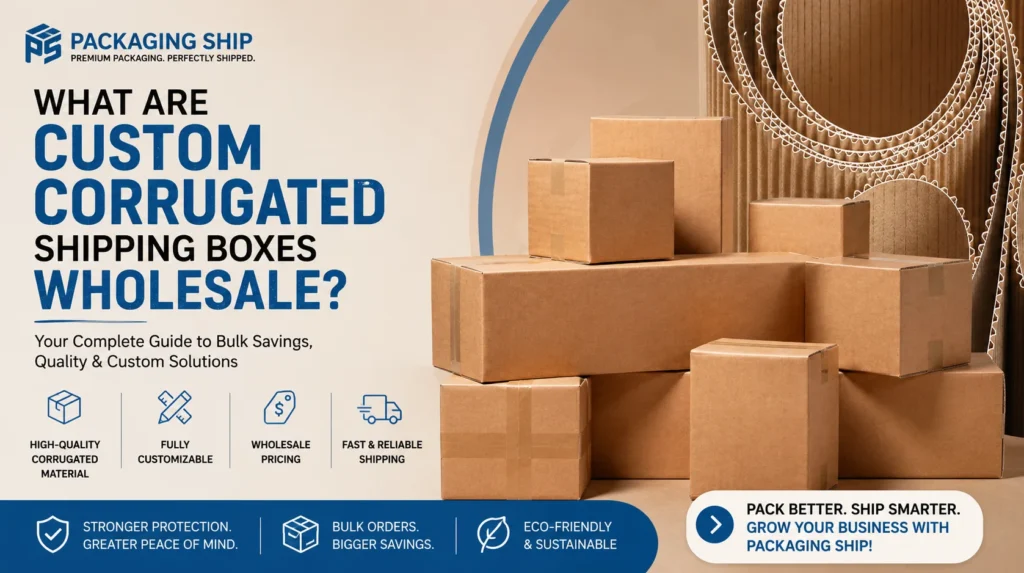
What Are Custom Corrugated Shipping Boxes Wholesale? (2026 Buyer’s Guide) Last Tuesday, a procurement manager in Ohio sent us a message that stuck. She had just processed her fourth damage claim that week, all from the same carrier route, all from the same undersized box her previous vendor swore was “industry standard.” Four refunds. Four reshippings. One vendor relationship that was ending that afternoon. Her story is not rare. According to the Fibre Box Association, corrugated packaging protects over 90% of products shipped across the United States every single year. Yet damage claims from poor box selection cost US businesses hundreds of millions annually. The box was never just a box. This guide is for buyers who already know they need custom corrugated shipping boxes wholesale. You are past the awareness stage. You want the specs, the decision framework, and a vendor you can actually trust. Why “Wholesale” Changes the Math Completely The Real Per-Unit Cost Gap Nobody Talks About Here is something most suppliers will not tell you upfront. The price gap between retail packaging and wholesale corrugated boxes is not 10% or 15%. On a standard 32 ECT single wall box, retail buyers routinely pay 60% to 80% more per unit than wholesale buyers ordering the same product. Multiply that across 500 monthly shipments and you are losing thousands of dollars a year on packaging alone. Why Consistency Is Worth More Than the Discount Wholesale pricing matters for a second reason that gets overlooked constantly. When you lock into a wholesale relationship with a reliable corrugated shipping box manufacturer in the USA, you get the same board weight, same interior dimensions, and same flute profile on every single reorder. That consistency protects your fulfillment operation as much as it protects your budget. Your packers stop guessing. Your damage rates drop. Your returns shrink. For operations teams managing multiple product lines across several SKUs, that is not a minor benefit. That is the whole point. Single Wall vs Double Wall Corrugated: Which One Do You Actually Need? When Single Wall Is Enough Let me be straight with you here, because most packaging content dances around this question to upsell heavier materials. Single wall corrugated works for the majority of what most businesses ship. If your product weighs under 20 pounds and travels via standard carriers like UPS or FedEx Ground, a 32 ECT or 44 ECT single wall box does the job well. Apparel, cosmetics, electronics accessories, dry food products, book sets, candles. All fine in a single wall. The vast majority of e-commerce businesses, somewhere between 85% and 90%, ship their entire catalog in a single wall without significant damage issues. When You Actually Need Double Wall Double wall corrugated is a different conversation entirely. You need it when your product exceeds 25 pounds, when you are shipping fragile glassware, ceramics, or industrial components, or when your boxes travel long freight routes where stacking pressure accumulates over several days. Two fluted layers instead of one raises the ECT rating to 48 and above, and that structural difference shows up in your damage claim data within weeks of switching. The Fix That Most Buyers Miss If your products are getting damaged in single wall boxes, do not automatically assume you need a double wall. Sometimes the problem is a box that is slightly too large, leaving product movement room that causes breakage during transit. An accurate interior dimension and a corrugated insert often solves what a heavier box wall simply cannot. Always match your spec to your actual product weight and fragility before spending more on materials. Custom Printed Corrugated Boxes With Logo Wholesale: Brand That Scales What the Unboxing Data Actually Says In 2022, Dotcom Distribution surveyed online shoppers and found that 40% said they would purchase again from a brand specifically because the packaging felt premium. Not the product. The package. That number should permanently change how you think about your corrugated box budget. How Wholesale Printing Became Accessible at Any Volume The interesting shift in recent years is that custom printed corrugated boxes with logo wholesale are no longer a large-volume-only benefit. At Packaging Ship, full CMYK offset printing is available on wholesale orders with zero die or plate charges attached. Your logo goes on the box. Your brand colors print true. No setup invoice lands in your inbox before production starts. No Minimum Means No Barrier to Brand Packaging For brands growing from 100 monthly orders toward 1,000, this matters enormously. The decision to invest in branded shipping boxes used to require committing to 5,000 units minimum. That barrier is gone. Wholesale custom boxes with no minimum quantity means you print your brand on every box from your very first wholesale order, at the same unit price as the businesses ordering ten times your volume. Eco Friendly Corrugated Shipping Boxes: The Spec Your Buyers Now Expect What the Recycling Numbers Actually Show The US Environmental Protection Agency tracks paper and paperboard recycling annually. According to the EPA’s most recent materials and waste data, corrugated fiberboard sits at approximately 68% recovery rate nationally, which makes it one of the highest-performing packaging materials in the entire US recycling system. That stat matters because your buyers increasingly ask about it before they sign purchase orders. When Sustainability Becomes a Procurement Requirement Eco friendly corrugated shipping boxes recyclable content has moved from a brand differentiator to a procurement checkpoint in several industries. Retail buyers, beauty distributors, and food and beverage companies now include packaging recyclability in their vendor onboarding checklists. FSC-certified corrugated board and soy-based inks address those requirements directly, and the cost premium is minimal compared to the doors they open. The Carrier Cost Benefit That Gets Ignored There is a practical business case here that goes beyond compliance. Cardboard boxes sourced from recycled fiber are lighter than many alternative materials, which directly reduces your dimensional weight charges with major carriers. Lighter packaging, lower shipping cost, stronger sustainability profile. That combination is genuinely rare in procurement decisions,
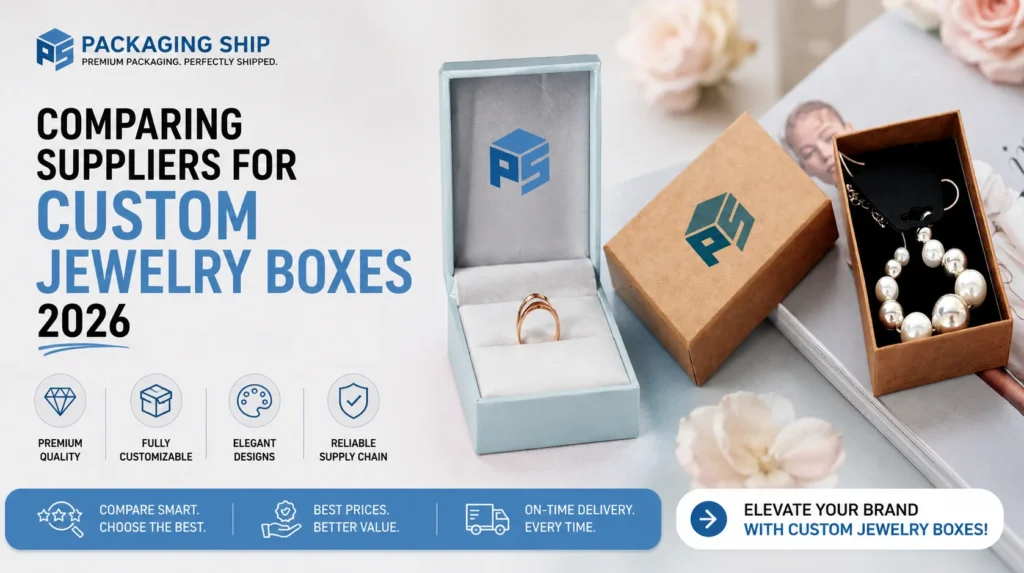
Comparing Suppliers for Custom Jewelry Boxes: What Every Jewelry Brand Must Know in 2026 Picture this. Three days before your biggest product launch. The boxes arrive at your door. You slice the tape open, pull one out, and something feels immediately wrong. The foil stamp is sitting 4mm off-center. The velvet insert slides when you tilt the box because it was cut short. You call your supplier. No answer. You email. Nothing back. I wish that scenario was unusual. It is not. Jewelry founders across the US run into this exact situation every quarter, usually because the supplier decision got made in a rush, based on a quote and one decent sample. So before you sign off on anything, use this guide. It will save you a painful lesson. What Are Custom Jewelry Boxes and Why Do They Matter for Your Brand? Simply put, custom jewelry boxes are branded packaging made specifically for your product, whether that is rings, necklaces, pendants, anklets, bracelets, or earrings. Materials range from rigid chipboard to kraft board to corrugated card, with interior linings and exterior finishes chosen to match how your brand wants to be perceived. Now, why does the box itself matter so much? There is actual research behind this. A peer-reviewed study in Humanities and Social Sciences Communications cites a global Ipsos survey showing 72% of consumers say packaging design directly influences whether they buy. That number is not from a supplier’s marketing page. It is from a study indexed in Nature. And on the market side, Verified Market Reports projects the US jewelry packaging sector growing from $1.9 billion in 2025 to $2.7 billion by 2033. Think about what that actually means for your brand. Your packaging lands in your customer’s hands before the jewelry does. That physical moment, lifting a lid, feeling a liner, weighing a box in their palm, is already forming their opinion of what is inside. A cheap box works against your price point before they have even seen the product. The 7 Criteria That Separate Reliable Suppliers from Risky Ones 1. Customization Depth, Not Just Customization Claims Walk into any supplier conversation and they will say the word “customizable” before you finish your first sentence. What you need to dig into is what that actually covers. Ask them directly: do they produce Pantone-matched colors with a physical proof you can approve before production begins? Can they build a ring roll insert for a Custom Ring Boxes order, or a flat foam cavity for a pendant? Do they print inside the lid? Vague answers here mean vague results at the end of your production run. Press for specifics every time. 2. Material Range Across All Types of Jewelry Packaging Boxes Good suppliers carry real range. You need a rigid jewelry box for your fine pieces, a kraft jewelry box for your sustainable line, a velvet jewelry gift box for gifting collections, and a drawer jewelry box packaging style for presentation sets. If a supplier keeps steering you toward one material because it is easier for them to produce, that is not a sign of expertise. That is a sign of limited capability. Your product line will evolve. Your supplier needs to keep up. 3. Print Consistency, Especially Across Bulk Orders Most supplier problems do not show up in the sample. They show up in box number 847 of a 1,500-unit run, when the CMYK dot gain shifts slightly on an uncoated kraft stock and your brand red starts reading as orange under retail lighting. Ask every supplier what their AQL (Acceptable Quality Level) sampling protocol looks like during bulk production. If they cannot explain their in-line inspection process, you are carrying all the risk. A good sample means little if the supplier has no documented process for maintaining that standard at scale. 4. MOQ Flexibility for Where Your Brand Is Right Now Overseas manufacturers typically require 500 to 1,000 units for standard designs, and anywhere from 1,000 to 2,000 units for complex constructions like magnetic closure jewelry box styles or multi-material builds, based on verified supplier data from Alibaba’s B2B sourcing platform. That works well for established brands with predictable volume. For everyone else, a domestic US supplier with no minimum order quantity lets you test a new box style on 100 units before committing to a full season’s run. That flexibility is genuinely valuable, not just a nice-to-have. 5. Turnaround Time That Matches Your Launch Calendar The industry standard for overseas production is 3 to 6 weeks from artwork approval. US-based suppliers with domestic production can often move in 6 to 10 business days. For seasonal campaigns, trade shows, or a product drop tied to a specific date, that gap matters enormously. Get the turnaround time in writing, not as an estimate in an email thread, but as a confirmed commitment before you place your order. 6. Free Design Support, Because Most Jewelry Brands Are Not Packaging Engineers Most small jewelry brand founders are not structural packaging designers. They should not have to be. Free design support should be a standard expectation, meaning a custom dieline, a digital proof, and a physical pre-production sample at minimum. Suppliers who charge for dieline creation are essentially billing you for work they need to do anyway to print your order correctly. Walk away from that model. 7. Shipping Transparency and No Hidden Costs This one catches brands off guard constantly. You compare two supplier quotes and one looks significantly cheaper. Then the final invoice comes with die charges, plate fees, proof revision charges, and shipping surcharges that were never mentioned. Always ask for a fully itemized all-in quote before you commit. The per-unit price is almost never the whole story. Jewelry Packaging That Goes Beyond the Box Jewelry packaging is not just the outer box. The interior lining, insert structure, tissue paper wrap, ribbon pull, and the sequence in which your customer opens the piece all contribute to how they feel in that moment. According to the 2026
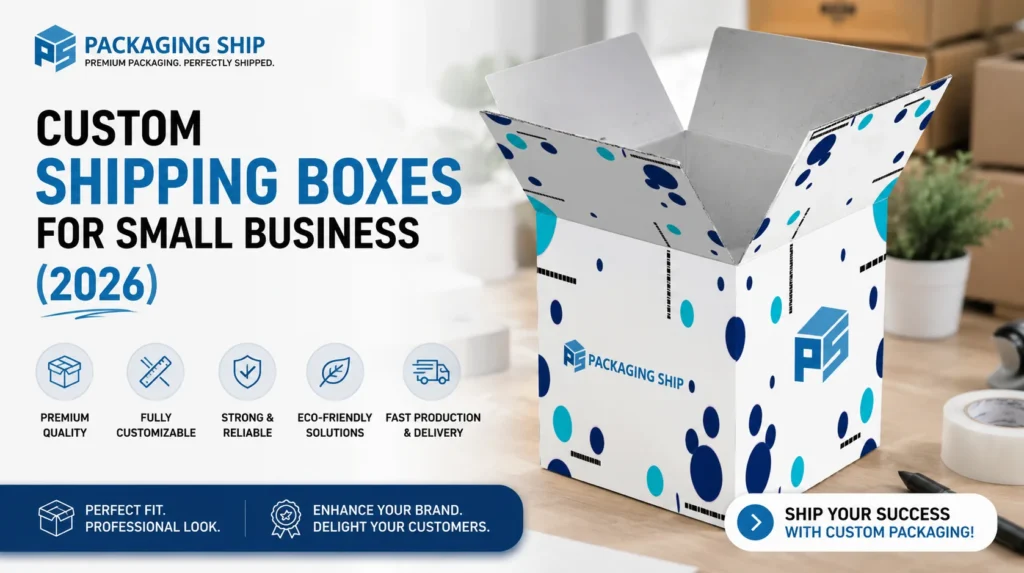
Custom Shipping Boxes for Small Business: What Actually Works Last quarter, a candle brand owner reached out to us frustrated. She had spent eight months perfecting her scent collection, invested in a Shopify store, ran paid ads, and got decent sales. But customers were not coming back. When she finally asked one of them why, the answer stopped her cold. “I forgot which brand sent me that candle. The box looked like everything else.” That one conversation changed how she thought about packaging. And it will probably change how you think about it too. This guide is for business owners who are past the basics. You know you need branded packaging. What you actually need now is someone to walk you through which box works for your product, what it costs, and how to get it done without a design team or a big budget. What Are Custom Shipping Boxes for Small Business? Custom shipping boxes for small businesses are branded, product-specific packaging solutions built to carry your logo, your colors, and your identity from your warehouse to your customer’s hands. They are not stock boxes with a sticker slapped on the side. They are printed, finished, and structured around your actual product dimensions and brand goals. They are made from corrugated cardboard, kraft paper, rigid board, or specialty materials, printed via offset or digital methods, and finished with coatings like matte lamination, gloss UV, soft-touch, foil stamping, embossing, or Spot UV. At Packaging Ship, orders start at $0.20 per unit with zero minimum quantity and free US shipping on every order. Want to explore every box style available for your products? Click here to browse the full custom shipping boxes catalogue. Why a Plain Brown Box Is Slowly Bleeding Your Revenue Most small business owners frame packaging as an expense. That framing is the first mistake. Sifted’s 2025 Consumer Delivery Survey found that 76% of shoppers said their packaging and delivery experience directly shaped whether they bought from that brand again. A year earlier, that number sat at 72%. It keeps climbing. Here is the part nobody talks about enough. Nearly half of consumers said they stopped purchasing from a brand entirely after one bad packaging or delivery experience. Not one bad product. One bad box. That is not a fulfilment issue or a logistics problem. That is a brand problem, and packaging is where it starts. Stord’s 2025 Mystery Shopping research found something equally striking. Only 56% of e-commerce brands are currently using any form of branded packaging. That leaves 44% of your competitors showing up with generic boxes and handing you a free point of differentiation every single day. The custom packaging box market was valued at $62.38 billion in 2024, according to Market Research Future, with projections pointing toward $100 billion by 2035. Small businesses joining this space now are not chasing a trend. They are getting ahead of the curve before the rest of the market catches up. Best Custom Shipping Boxes for Ecommerce: Which Style Is Right for You? Box type matters more than most people realise. The wrong box wastes material, drives up shipping costs, and sends the wrong brand signal even before your customer opens it. Corrugated cardboard is where most small ecommerce businesses start, and for good reason. Single-wall corrugated covers the majority of lightweight to mid-weight products at a low per-unit cost. If your items are heavier or fragile, double-wall offers the structural support that prevents transit damage without dramatically increasing your spend. This is your most versatile starting point, whether you are shipping 50 units or 5,000. If your product carries a premium price, your packaging needs to match that message. Rigid Boxes hold their shape, feel substantial in the hand, and signal quality before the customer even sees what is inside. Jewellery brands, luxury cosmetics lines, and high-end gifting businesses use rigid boxes specifically because that first physical impression justifies the price point. Customers who receive a rigid box remember it. That memory drives the second purchase. The handle-top design of a Gable Box does something no other box shape does. It makes your packaging immediately functional and visually distinct at the same time. Bakeries, food brands, seasonal gift businesses, and hamper companies choose gable boxes because they stand out on a retail shelf without needing any extra marketing materials around them. They are fully printable and available in custom sizes. There is a reason jewellery brands keep coming back to Pillow Boxes. The curved, foldable structure is lightweight, compact, and looks considerably more expensive than it actually is. For subscription box packaging ideas for small businesses on a tight per-unit budget, pillow boxes deliver a boutique feel that customers genuinely appreciate and photograph. How Much Do Custom Shipping Boxes Actually Cost? Here is the honest answer. Less than you think, and probably less than what you are spending on ads to win back customers you lost because of forgettable packaging. At Packaging Ship, custom printed shipping boxes in bulk pricing start at $0.20 per unit. There are no die charges, no plate fees, and no minimum order quantity. Free US shipping is included across the board. To put that in perspective, customboxes.io’s published ROI analysis found that switching from blank to branded boxes generated between $65,514 and $263,313 in net annual returns for their customers, depending on order size and customisation level. The break-even point in their model was a 0.4% increase in repeat sales. That is not a big ask. For affordable custom shipping boxes with no minimum order, Packaging Ship’s structure is built around exactly that model. Whether you are testing a new product with 25 boxes or restocking 5,000, the pricing scales cleanly without surprise fees appearing at checkout. Turnaround is 6 to 7 business days in production, with 4 to 5 additional days for US delivery. For fast turnaround custom shipping boxes online, that is one of the tightest timelines available from any US-based supplier, significantly faster than the 6 to 10
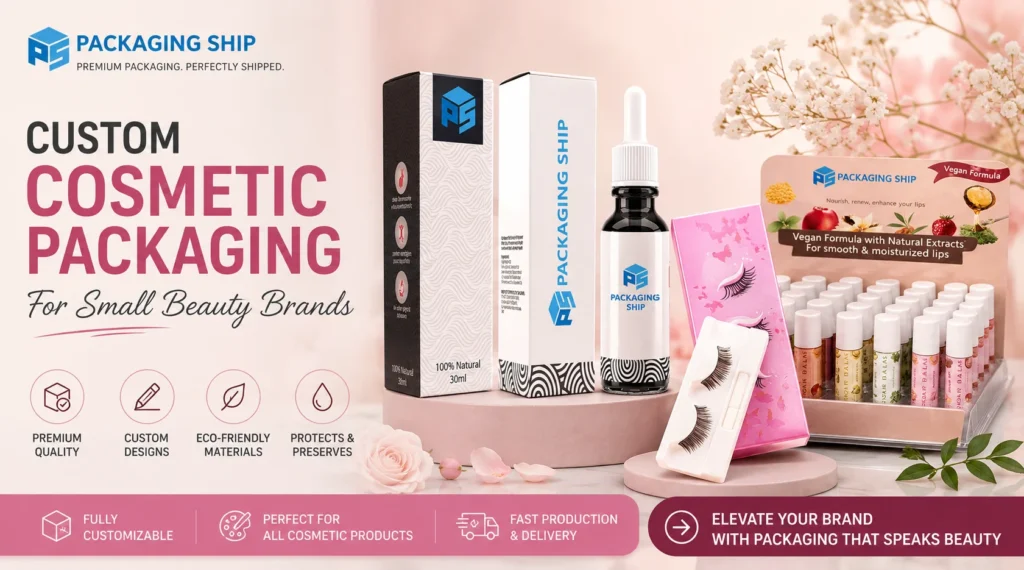
Custom Cosmetic Packaging Boxes in 2026: What Beauty Brands Need to Know TLDR: Packaging does more than protect the product now. Brands spending on rigid board, soft-touch lamination, foil, and FSC-certified kraft are converting better on the shelf, earning more repeat orders, and picking up organic shares from unboxing. The old 1,000-unit wall is gone too. You can get premium finishes from 50 units at roughly $0.20 each, which means a small US beauty brand no longer has to buy like a wholesaler to look like a premium one. Table of Contents Why Cosmetic Packaging Is a Revenue Decision in 2026 A founder ships a vitamin C serum that beats almost everything near its price. Cleaner activities, an honest label, a formula that holds up. Online, it sells fine. Then it lands on a shelf between three competitors at the same price point and gets passed over anyway. Nothing to do with what is in the bottle. The box beside it has a soft matte finish and a small gold logo, and hers has neither. That is the gap that quietly sinks good beauty brands, and it is wider going into 2026 than it has ever been. The numbers back it up. In research the Paper and Packaging Board ran with Ipsos, 72 percent of shoppers said the design on the package influenced what they bought.Dotcom Distribution has reported that 61 percent of shoppers are much more likely to reorder a premium product when it shows up in premium packaging. So the box stops being a container and starts being a salesperson, the thing that closes on the shelf and the first physical contact most buyers ever have with the brand. Statista puts the US beauty and personal care market at over $106 billion in 2026. In a category that is dense, your packaging has to position the product, not just hold it. Beauty Packaging Trends Shaping 2026 The real change in 2026 is who these trends belong to. Premium finishes used to be a big-brand conversation. Now indie labels, DTC founders, and small skincare lines are ordering the exact same finishes, because the minimum-order wall that used to keep them out has mostly come down. Four trends are doing the most work right now. Soft-touch matte is winning over gloss. High-gloss UV ran retail for most of the last decade. Buyers have moved on. Soft-touch has a slight velvet drag to it that reads as expensive the second a hand lands on it, and on a higher-priced product that one change lifts perceived value without touching the formula. Rigid boxes are within reach for small brands. A $38 serum in a thin folding carton tells the buyer something before the lid is even open, and it is not flattering. Rigid setup boxes used to mean a 5,000-unit commitment. In 2026 you can order them from around 50 units, so the structural upgrade that signals “premium” is available on day one, not year three. Clean brands are reaching for FSC-certified kraft. Clean beauty stopped being only about the ingredient list. Shoppers now read the material of the box the way they read the back label. Kraft board from responsibly managed forests (FSC-certified), printed with water-based low-VOC inks, gives those brands a packaging story that matches what is inside. Unboxing is driving repeat purchases. Dotcom Distribution has found that around 40 percent of shoppers will post an image of packaging on social media when it is unique or branded. For a DTC brand, that is free reach. Which is why magnetic closures, ribbon pulls, and tissue layers now get argued over as much as logo placement. Best Materials for Cosmetic Boxes Wholesale Material is the biggest structural call you make, and it sets the ceiling on how the whole thing feels. Here is what each one actually gives you, and where it fits. This is what sits under luxury skincare, prestige sets, and high-end gifting. It does not flex or crush, and it reads as quality on weight alone. Above a $30 retail price, rigid board tells the buyer the product earns the ask. It also takes every premium finish: soft-touch, foil, debossing. You can compare rigid against folding-carton options across the full cosmetic packaging box range. Solid bleached sulfate is the workhorse folding carton. Bright white, clean to print, and happy with full CMYK at 300 DPI. For anyone ordering custom cosmetic boxes wholesale at volume, SBS hits the balance of cost, print, and structure for mid-range retail. FSC-certified kraft. For clean lines, organic skincare, and any brand with a real sustainability position, kraft brings a warmth synthetic stock cannot fake. Natural tone, a little texture, recyclable credentials. It has become the default for brands aimed at health-conscious buyers. If you ship direct, subscription boxes or DTC orders going straight to a doorstep, corrugated adds protection without killing print quality. Double-wall is worth it for glass bottles and anything fragile. Here is how the four compare at a glance: Material Best for Retail price point Premium finishes Rigid board (2mm) Luxury skincare, prestige sets, gifting Above $30 All: soft-touch, foil, emboss and deboss SBS (14pt to 18pt) Mid-range retail, higher-volume runs Mid-range Full CMYK, most coatings and foils FSC-certified kraft Clean and organic beauty, eco-led brands Any, natural positioning Blind deboss, kraft-friendly foils Corrugated DTC and subscription shipping, fragile items Shipping-focused Print quality retained, built for protection Luxury Cosmetic Box Finishes That Actually Sell Which combination is right comes down to three things: your price point, your buyer, and the stock underneath. Custom Cosmetic Packaging for Small Beauty Brands: No Minimum, No Compromise The most stubborn myth in this industry is that professional packaging requires a big first order. Most large manufacturers still want 1,000 to 5,000 units, plus die charges of $200 to $800 and plate charges of $150 to $500 on top. For a brand launching one SKU or testing a seasonal run, that is simply out of reach. Packaging Ship works differently. You can order custom
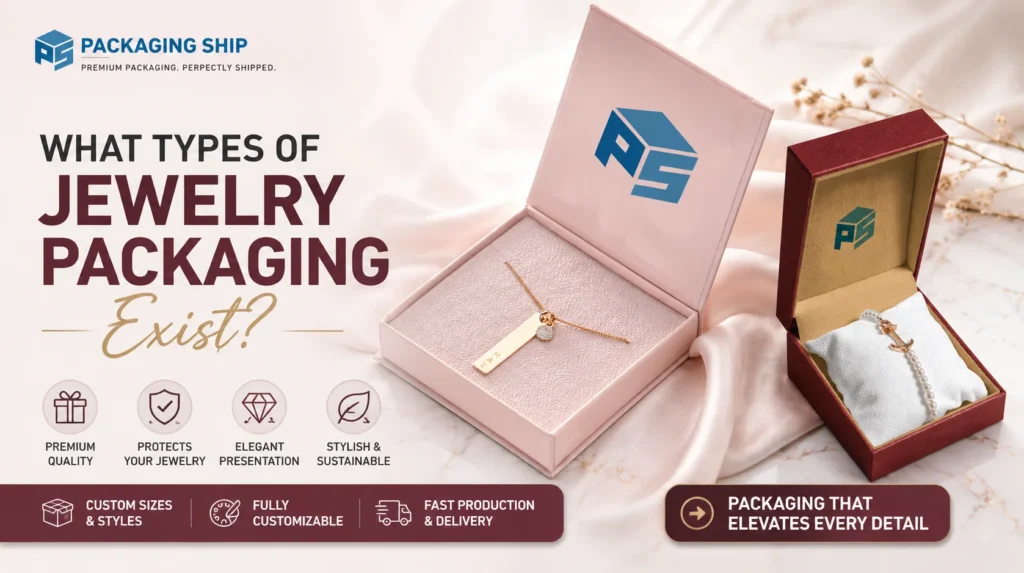
What Types of Jewelry Packaging Exist in 2026? Most jewelry brand owners spend months perfecting the product. Then they ship it in a box they found on Alibaba for $0.08 a unit. The customer opens it, feels nothing, and never reorders. Jewelry packaging is the moment your brand either lands or disappears. Eight main types exist: rigid boxes, kraft boxes, velvet pouches, pendant boxes, magnetic closure boxes, drawer-style boxes, cardboard boxes, and custom mailer boxes. Here’s what each one actually does and more importantly, when each one is wrong for your brand. Why This Decision Matters More Than You Think The US jewelry packaging market was worth $1.9 billion in 2025, growing toward $2.7 billion by 2033 at a 5.0% annual rate, per Verified Market Reports. That growth is tied almost entirely to e-commerce, where the box is the only physical thing a customer ever touches from your brand. There’s no store. No staff. No moment to recover from a bad first impression. Your packaging carries everything. The 8 Types of Jewelry Packaging, Honestly Explained 1. Rigid Boxes Made from dense chipboard that never collapses. Pick one up and the weight alone tells the customer something valuable is inside before they even open the lid. Right for: fine jewelry, engagement rings, anything above $80 where the brand story depends on perceived quality. One mid-tier jewelry brand switched from standard cardboard to custom magnetic rigid boxes and saw satisfaction scores climb 34% in six months. The jewelry didn’t change at all. Wrong for: fashion pieces under $25. The box costs more than the product warrants. 2. Kraft Jewelry Boxes Natural, uncoated board that reads sustainability and craft without needing a word of copy. Take soy-based ink well, so you can still print a sharp logo or full-color design without killing the organic feel. Artisan sellers and Etsy founders who’ve built their entire identity around “handmade from natural materials” this is your box. Pair it with branded tissue paper and a handwritten-style insert. That combination gets photographed and posted. Our Custom Kraft Jewelry Boxes carry FSC-certified board and ship with no minimum order, so your eco claims actually hold up if a customer asks. Wrong for: anything at a luxury price point. Kraft reads “craft market,” not fine jeweler. 3. Velvet Pouches They’ve been used for over a century because they genuinely work. Soft texture prevents scratches. The look signals value. They store flat and ship without adding meaningful dimensional weight. Best for fashion jewelry, mass-market pieces, trade show giveaways, or as secondary packaging nested inside a rigid box. The pouch holds the pendant while the box handles the brand experience. Don’t use them as your only e-commerce layer. Velvet has zero structural protection in transit. You need something around it. 4. Pendant Boxes Chains tangle. Pendants shift. A beautiful necklace can arrive looking bent or damaged even when it arrived physically fine, and the customer won’t know the difference. They’ll just return it. A purpose-built pendant box fixes this with a necklace card insert or foam slot holding everything in place. Standard sizing is 3.5 x 3.5 inches or 4 x 4 inches, which is enough space to display the piece cleanly. Our Custom Pendant Boxes handle the insert, custom sizing, and full print surface as standard. No minimum order required. Skip these for oversized layered sets, which need compartmentalized boxes instead. 5. Magnetic Closure Boxes There’s a click when the lid seats itself. It’s engineered, not accidental. Luxury brands understood this long before most, which is why magnetic close has become shorthand for premium jewelry gifting. Right for engagement rings, anniversary pieces, corporate gifting, anything where the moment of opening is emotionally loaded. The slow draw-and-close builds anticipation that translates directly to social sharing. The global jewellery box packaging market hit USD 4,347 million in 2024 and is heading to USD 6,134 million by 2032, according to Credence Research, with premium design and sustainability as the two named growth drivers. Magnetic closure on the FSC board sits exactly at that intersection. High-volume fashion pieces under $40? The unit cost math doesn’t work. 6. Drawer-Style Boxes A ribbon tab. A sliding inner tray. The slow reveal as it pulls out. It sounds simple, but that motion creates genuine anticipation — not theatrical, just quiet. The feeling that something good is coming. Lots of customers keep these long after the jewelry is out, which means your brand lives in their drawer or on their shelf for years. Good fit for earring sets, ring-and-earring pairs, curated gift collections. Also smart if you want customers to reuse the packaging as storage rather than throwing it away. Not justified for a single $18 everyday purchase. 7. Cardboard Jewelry Boxes The workhorse. Cotton-filled, lightweight, full-color printable, and significantly cheaper per unit than rigid. The cotton fill cushions rings, studs, and small pendants without costing what velvet or foam costs. Fashion jewelry retailers and silver brands reach for these because they give proper branded presentations at a margin-friendly price. Cardboard also takes finishing techniques well matte lamination, gloss, spot UV, foil stamping, so the final box can look far more premium than the raw material suggests. One thing: these are retail-grade, not transit-grade. Ship them inside a mailer. 8. Custom Mailer Boxes The corrugated outer layer with your brand on it. Every delivery becomes a marketing moment on someone’s doorstep before they’ve even seen the jewelry. Print on the inside lid too. The customer gets a second brand moment when they open it. Small detail, real impact. The practical approach is box-in-box: your presentation box inside a mailer sized tightly around it, eliminating void fill and reducing dimensional weight. Keeps shipping costs lower and reduces theft risk from a plain exterior. Browse the full range of custom jewelry packaging boxes to find the right combination for your product and shipping setup. What Your Material Choice Actually Tells the Customer Before they read a word of your copy, the material speaks. Rigid chipboard says permanent and confident.
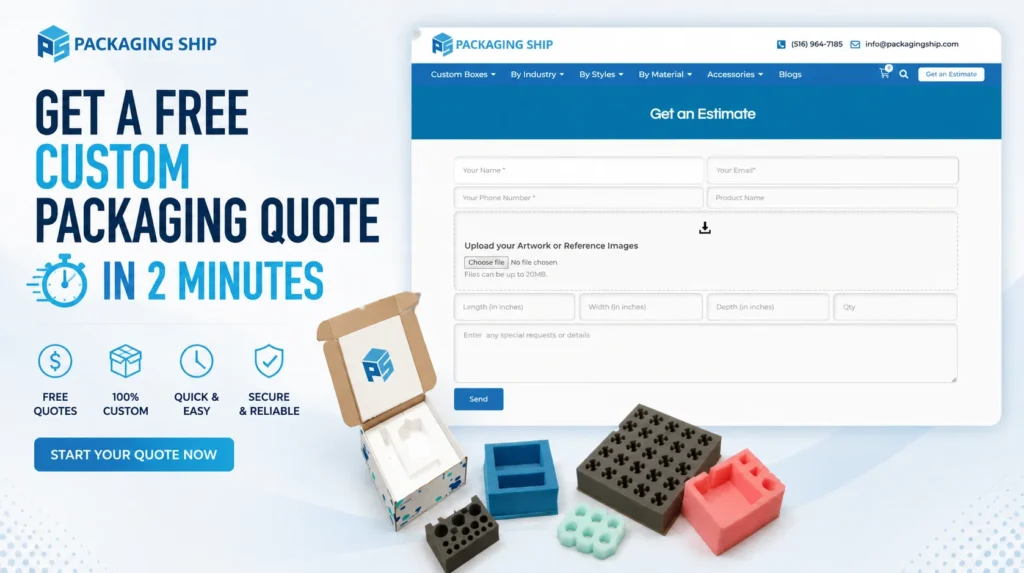
TLDR: Getting a free custom packaging quote online in the USA takes under 2 minutes when you know what to bring. You need your box dimensions, approximate quantity, preferred box style, material type, design status, and timeline. No minimum order. No artwork required. No sales call unless you want one. Table of Contents What Is a Custom Packaging Quote and Why Does It Matter in 2026? A custom packaging quote is a free, no-obligation price estimate you receive from a packaging manufacturer. It is based on your box specifications, quantity, and design needs. It tells you the per-unit cost, production timeline, and material options before you spend a single dollar. Here is the challenge most small brand owners face. They want custom branded packaging. They know their generic boxes are hurting them. But they delay requesting a quote because they feel unprepared. That delay is costing real money. According to a 2025 Swell research report on B2B marketplace behavior, 73% of B2B buyers are now millennials who prefer online self-service ordering over traditional sales interactions. These buyers want to request a packaging quote online, review pricing, and move forward without a phone call. If your packaging supplier cannot deliver that experience, your buyer moves on. On top of that, Gartner data confirms that 61% of B2B buyers now prefer completing a purchase without any sales representative involvement. The packaging quote process, how fast it is and how little it asks of the buyer, is already doing the selling for you. This guide removes every barrier between you and your first quote. What You Actually Need to Get a Custom Packaging Quote Online USA Most business owners overthink this step. A free packaging quote request requires exactly six pieces of information. That is all. Here is each one in plain language. 1. Your Box Dimensions (Approximate Is Fine) You need the internal dimensions of your box in inches, measured as Length x Width x Height. Measure your product at its widest points and add about 0.25 inches on each side for a snug, protective fit. If you do not have exact measurements yet, a rough estimate works for the initial quote. The Packaging Ship team refines dimensions with you during the proof stage at zero cost. 2. Your Quantity Range You do not need an exact number. A range such as “around 200 units” or “between 500 and 1,000” is enough to generate accurate pricing. Packaging Ship accepts orders starting from 50 units with no minimum order quantity requirement, so even a test run for a new product launch qualifies for a full free packaging estimate. Per-unit pricing decreases as quantity grows. At 50 units, digital printing handles your run efficiently. At 500 units and above, offset printing can reduce the per-unit cost significantly. More on that below. 3. Your Box Style or Product Description You do not need to know the technical name of the box you want. Describing what you are packaging works just as well. A narrow skincare serum, a set of four candles, a subscription kit with multiple small items inside. The production team matches your product description to the right structure automatically. If you already know the style you want, you can explore custom tuck-top boxes for retail products, display boxes for shelf presentation, and mylar bags for food, coffee, or supplement products. Each box type has a slightly different spec checklist, covered later in this guide. 4. Material Preference (Or Let the Team Advise) If you know your preferred material, mention it. Cardboard is the standard choice for retail folding cartons. Corrugated boards add structural strength for shipping heavy or fragile items. Kraft delivers an eco-friendly, natural look. Rigid board creates a premium, luxury-feel box for cosmetics or gifting. According to a 2025 ProCarton consumer survey, 87.1% of consumers say they would choose cardboard over plastic packaging. That shift matters when you are deciding your material at the quote stage. The Packaging Ship team recommends the right substrate based on your product type and brand positioning, completely free. 5. Your Design Status You do not need a print-ready file to submit a packaging quote request. A JPEG or PNG of your logo is enough to begin. The in-house design team builds your full packaging artwork at no additional cost. They accept PDF, AI, EPS, and PSD files for brands that already have production-ready assets. The custom box design free support at Packaging Ship covers layout, color matching, and dieline preparation. You review and approve a full-color digital proof within 24 to 48 business hours before anything goes to print. 6. Your Timeline or Launch Date A rough launch date helps Packaging Ship prioritize your production slot. Standard production runs 7 to 10 business days from artwork approval. Rush production in 4 to 5 business days is available for most box types. Free FedEx or UPS delivery adds 2 to 5 business days to any US address after production. What You Do NOT Need Before Submitting a Quote This clears up the four most common misconceptions that delay first-time buyers. You do not need print-ready artwork. A logo file and a brand color preference are enough. The design team handles the rest. You do not need exact dimensions. Approximate measurements get the quote started. Final dimensions are confirmed before production begins. You do not need a large order. The minimum order at Packaging Ship starts at 50 units. There is no pressure to commit to bulk quantities on your first box quote. You will not be pushed into a sales call. The quote is fully no-commitment. You receive a digital proof and pricing. You approve or revise. Nothing moves forward without your sign-off. How Packaging Ship’s Quote Process Works Step by Step The free packaging estimate process at Packaging Ship is built to take under 2 minutes. Here is exactly what happens from form to delivery. Step 1. Visit the Packaging Ship quote form and fill in your box dimensions, quantity, style preference, and timeline.