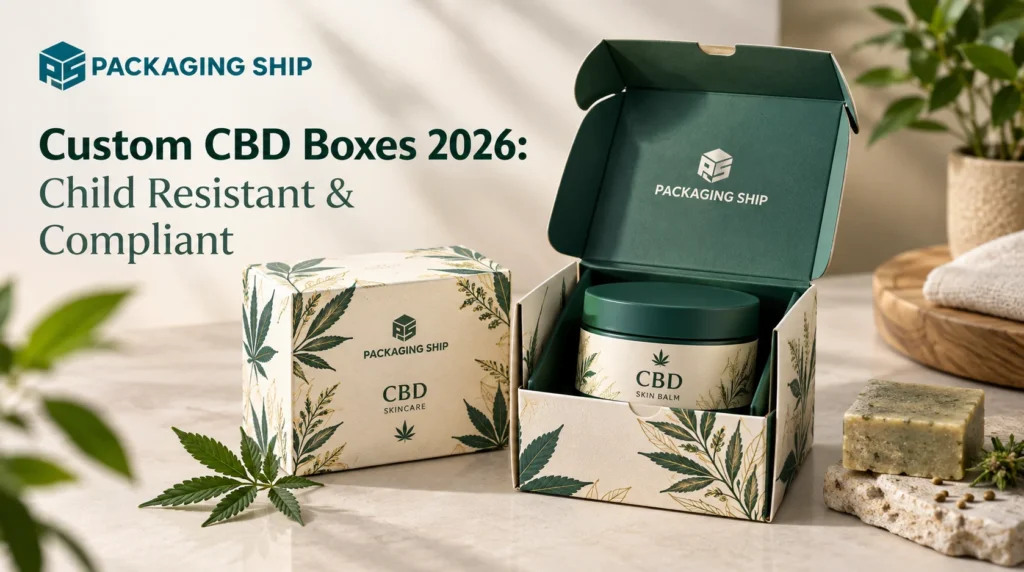
Custom CBD Boxes in 2026: Compliance, Child-Resistance, and Branding for Hemp Brands TLDR: If you sell CBD, your box has two jobs now, not one. It has to pass federal child resistant testing under the Poison Prevention Packaging Act, and it still has to look good enough that someone wants to buy it off a shelf. Below, we walk through what your warning panel legally needs, which formats actually meet child resistant rules, real specs and pricing you should expect, and how Packaging Ship handles compliant CBD packaging starting from just 50 units, no minimum order required. What Are Custom CBD Boxes in 2026? Custom CBD boxes are packaging built to your exact size, material, and design for hemp products like tinctures, edibles, vapes, and topicals. These days a compliant box also needs child resistant features, a properly laid out warning panel, and a tamper evident closure. Get that right and your packaging is doing three jobs at once: protecting the product, protecting the customer, and protecting your license to keep selling. Table of Contents Why CBD Packaging Compliance Cannot Wait We build custom CBD boxes for hemp brands who’ve stopped treating packaging as an afterthought, and honestly, most of them learned this the hard way. States are auditing CBD packaging almost the way they audit cannabis now. A box that looks great on Instagram but fails a child resistant test can get pulled off a retailer’s shelf in one visit, sometimes with the whole batch behind it. And the market backing this shift is genuinely large. Grand View Research puts the global cannabis packaging market at 3.2 billion dollars in 2025, growing to 3.8 billion in 2026, and heading toward roughly 19.3 billion by 2033, a 26 percent annual growth rate. A lot of that isn’t driven by more people buying CBD. It’s driven by more states writing rules that force brands to rethink their packaging entirely. So the box you’re choosing right now needs room to grow into whatever your state adds next year, not just enough room for this order. Here’s a number that catches most founders off guard. Under the federal testing protocol, a package earns child resistant certification only if fewer than 20 percent of a test panel of up to 200 children, ages 42 to 51 months, manage to open it in the allowed time, even after being shown how. Print “child resistant” on your box without that behind it, and you’re making a claim you can’t actually back up. Is Child Resistant Packaging Legally Required for CBD? In most states, yes, if your CBD product can be eaten or looks like something that could be mistaken for food. The federal floor comes from the Poison Prevention Packaging Act, which the Consumer Product Safety Commission enforces. Several states, California, Colorado, and New York among them, stack their own hemp and cannabis rules right on top of that. What the Act actually asks for is packaging that a child under five would struggle to open, but that a normal adult can still handle without a fight. There are two flavors of child resistant packaging worth knowing. Single use packaging only has to resist a child before it’s opened the first time. Reusable, or lifetime, packaging has to keep doing that job every time it gets closed again. If your product has more than one dose in the package, you’re almost certainly going to need the reusable kind. What Must Go on a CBD Box Warning Panel The warning panel is small, but it carries a lot of legal weight for its size. Miss one required line and you risk a retailer bouncing your order or a compliance flag showing up at the audit. At minimum, plan space for: The FDA hasn’t been shy about this. The agency’s position is that CBD isn’t approved as a food additive or a dietary supplement, and it keeps a close eye on how brands label it. You can read the FDA’s own consumer guidance on cannabis and CBD here if you want the source directly. This panel takes up real space, so design around it early. Trying to squeeze legal copy into a box that’s already been designed is how brands end up with warning text nobody can actually read. Custom CBD Box Specifications: Material, Sizes, and Price Before you send us a quote request, it helps to know what you’re actually picking from. Here’s a fast reference for the specs most hemp brands ask about. Specification Common Options Material Cardboard, kraft paper, corrugated stock, rigid board up to 2mm, mylar film Box Style Tuck top, mailer box, pillow box, gable box, magnetic closure rigid box, mylar pouch Typical Sizes 1oz to 8oz for tinctures, 3.5g to 1oz for flower or concentrate, fully custom on request Print Method Digital printing for 50 to 500 units, offset printing for 500 plus units, full CMYK color Finish Options Matte, gloss, soft touch lamination, spot UV, foil stamping, embossing Price Range Starting around $0.20 per unit, varies by size, material, and quantity Minimum Order 50 units, no minimum order required Production Time 7 to 10 business days standard, 4 to 5 business days rush Child Resistant Formats That Actually Work Not every packaging style passes child resistant testing, and picking the wrong one usually shows up in an audit, not before. Child resistant mylar bags rely on a press and pull or tear notch closure that keeps working after repeated openings. They’re a solid fit for flower, concentrate, or loose dose edibles that need an opaque, moisture blocking barrier. Our child resistant mylar bags are built around that exact closure. If a package holds more than one dose, a basic zip lock won’t cut it. Resealable mylar bags give you a zip closure that actually holds up through repeated use, which is often what separates a compliant gummy or capsule package from one that gets flagged. Take a look at our resealable mylar bags if you need kraft or foil lined
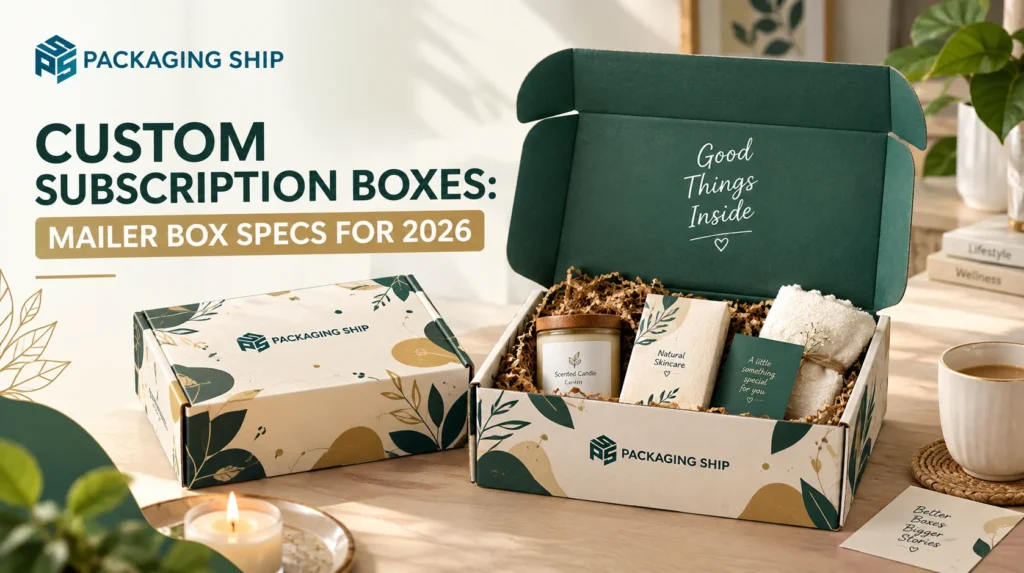
Custom Subscription Boxes: What Mailer Box Specs Do the Top DTC Brands Use? TL;DR Custom subscription boxes work best when the flute type, size, and finish match the product inside, not just the brand’s color palette. Top DTC brands lean on E-flute for lightweight items and B-flute for anything fragile or heavier. This guide breaks down the exact specs, costs, and formats that make subscribers stop scrolling and start photographing. Table of Contents Your product is good. Your marketing works. Subscribers still sign up every month. But when you scroll through Instagram or TikTok, it’s not your unboxing video getting shared. It’s a competitor’s. That gap usually has nothing to do with what’s inside the box. It comes down to the box itself, and more specifically, the exact specs your printer used to build it. What Are Custom Subscription Boxes in 2026? Custom subscription boxes are branded mailer boxes built to hold a curated product set and survive shipping while still looking good on camera. The global subscription box market is valued at $49.7 billion in 2026, projected to reach $101.81 billion by 2030 (The Business Research Company) In 2026, most top DTC brands specify the flute type, board weight, and interior finish before they touch the design, because those three choices decide whether the box protects the product and photographs well once opened. Why Your Subscribers Are Screenshotting Someone Else’s Box Here’s the pattern. A subscriber opens a plain brown box, pulls out the product, and moves on. No photo, no story post, no tag. Then they open a competitor’s box with a color printed interior, a branded insert card, and a layer of crinkle paper sitting on top like a small reveal moment. That box gets photographed. This isn’t about spending more money. It’s about specifying three things correctly: a printed interior instead of plain kraft, a simple insert card with your logo, and some kind of texture or fill that creates a visual reveal when the lid opens. None of these require a premium budget. They require you to actually ask for them when you place your order. This first impression carries more weight than most founders assume.Nearly half of all subscription cancellations, 44%, happen within the first 90 days, according to consumer subscription data reported by DontPayFull and compiled in Ringly.io’s 2026 subscription box statistics report. That window covers roughly the first one to three boxes a subscriber receives, which means the unboxing moment isn’t a nice extra. It’s directly tied to whether that subscriber sticks around. Packaging Ship, a US based custom packaging manufacturer, builds exactly this kind of subscription box daily for beauty, food, and lifestyle brands, and the pattern holds across categories. Brands that specify these three details see their boxes shared. Brands that don’t, don’t. The Mailer Box Specs Top DTC Brands Actually Order This is where most founders get stuck. They know they want custom subscription mailer boxes wholesale, no minimum, USA made, but they don’t know which flute, size, or finish to request. Here’s the breakdown. Flute type is the wavy inner layer of corrugated cardboard, and it decides both thickness and protection level. E-flute measures roughly 1.5 to 2 millimeters thick. It’s thin, prints sharp, and works well for lightweight items under two pounds, like cosmetics, candles, or small apparel bundles. Most beauty subscription boxes use E-flute because the thin wall keeps shipping costs down without sacrificing print quality. B-flute measures roughly 2.6 to 3 millimeters thick. It absorbs more impact and handles heavier or bundled items better, which is why food and snack subscription boxes often use it. If your box holds glass jars, multiple SKUs, or anything fragile, B-flute earns its slightly higher cost. EB-flute combines both layers for double wall strength, used mostly by premium subscription tiers that want both crush resistance and a high end print finish. A simple rule: if your product is light and ships in a compact box, go E-flute. If it’s fragile, heavy, or bundled, go B-flute. You can view real examples and request either option through Packaging Ship’s custom mailer boxes page. Here’s how the three main flute options compare side by side: Flute Type Thickness Best For Common Subscription Category E-flute 1.5 to 2 mm Lightweight items under 2 lbs, sharp print detail Beauty, cosmetics, small apparel B-flute 2.6 to 3 mm Fragile or bundled items, higher impact resistance Food, snacks, glass or ceramic products EB-flute 3.8 to 4.3 mm Premium tiers needing both strength and finish Luxury skincare, multi-SKU curated boxes Board weight affects how rigid the box feels in hand, which matters more than most brands realize since it’s the first physical touchpoint a subscriber has with your brand. Matte lamination and soft touch coating both photograph better than gloss under phone camera flash, which is worth knowing if unboxing content matters to your growth strategy. Inserts matter just as much as the box itself. A printed insert card, even a simple one with a thank you note and your logo, gives subscribers something to photograph beyond the product. Molded pulp dividers work for fragile items, while crinkle paper or tissue creates that reveal moment subscribers screenshot. Mylar Bags and Paper Bags: When a Box Isn’t the Right Call A box isn’t always the right format. If your subscription includes items sensitive to moisture or light, like coffee, tea, or certain skincare products, custom mylar bags protect better than cardboard and cost less per unit at low volumes. They’re also standard for CBD and food brands that need child resistant or resealable closures. For lighter, lower cost subscription add ons like samples or single item bundles, custom paper bags offer a simpler, more sustainable option than a full box build. Many subscription brands actually combine formats: a mailer box as the outer shipper, with a paper bag or mylar pouch inside for a specific product. Mixing formats this way often solves protection and budget problems at the same time. How Much Do Custom Subscription Boxes Cost