
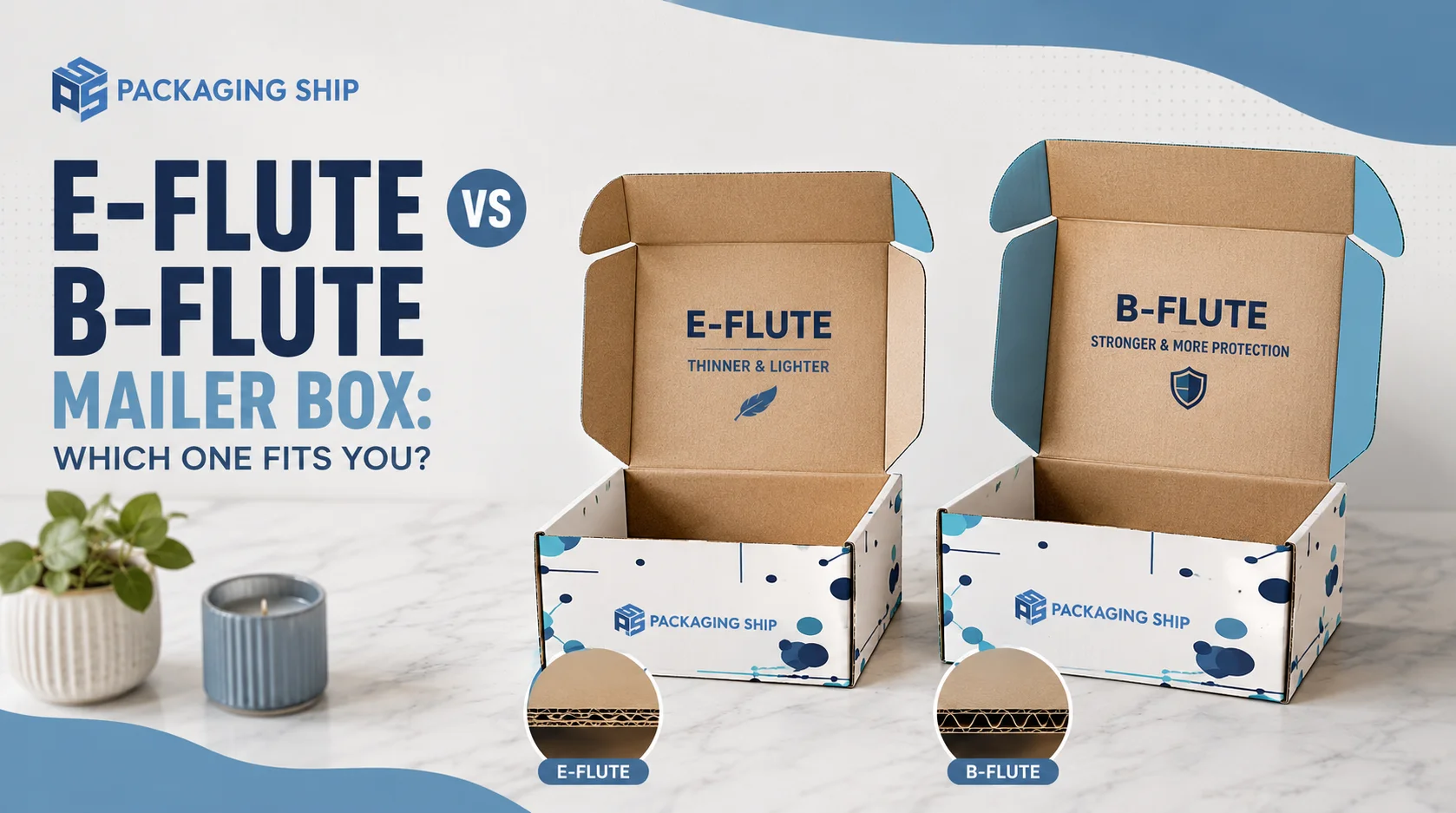

E-Flute vs B-Flute Mailer Boxes: Which Corrugated Is Right for Your Product Weight?
TL;DR
E-flute suits lightweight, print-forward products under roughly 3 to 5 pounds, like cosmetics, jewelry, and apparel. B-flute suits heavier or more fragile items, generally above that range, where cushioning matters more than a flawless print surface. Both are single wall corrugated boards. Neither is “better,” they’re built for different jobs. Get the flute wrong and you risk crushed corners, damaged goods, and returns that cost far more than the box itself.
Table of Contents
- What’s Actually Different Between E-Flute and B-Flute
- E-Flute Mailer Boxes: Best for Light, Print-Forward Products
- B-Flute Mailer Boxes: Built for Heavier, Higher-Risk Shipments
- Why Your E-Flute Order Might Have Arrived Crushed
- E-Flute vs B-Flute Mailer Box Comparison Table
- How to Choose the Right Flute for Your Product Weight
- Mailer Box vs Shipping Box: Do You Need Corrugated at All
- Custom Print on E-Flute and B-Flute Mailer Boxes
- FAQs
- Get a Free Quote
Every mailer box order starts with a question nobody warns you about. Do you want E-flute or B-flute? Most small brands find this out the hard way, either on a quote form that assumes they already know, or after a customer opens a box with a dented corner and a bruised product inside.
This guide settles the e-flute vs b-flute mailer box decision using actual product weight, not guesswork. We manufacture both at Packaging Ship, so this comes from what we see on the production floor, not a spec sheet copied from a supplier catalog.
What’s Actually Different Between E-Flute and B-Flute
Both are single wall corrugated boards. A single fluted layer sits between two flat liner sheets. What changes is the size of that fluted wave.
E-flute runs about 90 flutes per linear foot, packed tightly together. That tight structure keeps the board thin, around 1.5 millimeters, and gives it a flat, smooth surface. Ink sits cleanly on flat surfaces, so E-flute prints crisp logos, fine text, and detailed graphics without the corrugation showing through.
B-flute runs about 47 flutes per linear foot. Fewer, taller waves mean more air pocket and more material between the two liners, pushing thickness to roughly 3 millimeters. That extra bulk is what absorbs shock. When a box gets dropped, stacked, or squeezed on a conveyor belt, B-flute’s taller arches compress and spring back instead of transferring the full force straight to your product.
Neither flute is stronger in every sense. E-flute holds its shape well under light stacking loads. B-flute wins clearly on cushioning and puncture resistance. The right pick depends entirely on what’s inside the box.
E-Flute Mailer Boxes: Best for Light, Print-Forward Products
E-flute earns its reputation with direct to consumer brands for a simple reason. It looks premium straight out of the box, and it protects lightweight goods just fine. Most of our custom mailer boxes are ordered in this weight class ship in E-flute for exactly that reason.
Ideal Product Weight and Use Cases
E-flute suits products generally under 3 to 5 pounds where branding matters as much as protection. Think skincare jars, lip gloss sets, jewelry, folded apparel, candles under a certain size, and small subscription box items. If your unboxing photo is going on Instagram, E-flute usually gives you the sharpest result.
The tradeoff is real. E-flute has less cushioning, so it’s a poor match for anything heavy, dense, or already fragile before it hits a box. Glass, ceramics, and anything over a few pounds put E-flute at risk in a standard parcel network.
B-Flute Mailer Boxes: Built for Heavier, Higher-Risk Shipments
B-flute trades a bit of surface polish for real durability. It’s the flute most manufacturers reach for when a product needs to survive rough handling, not just look good sitting on a shelf.
Ideal Product Weight and Use Cases
B-flute fits heavier items, generally above the 3 to 5 pound range, along with anything fragile, dense, or prone to shifting in transit. Candle jars, ceramic mugs, bundled products, and multi item kits do better in B-flute because the taller flute profile absorbs impact instead of passing it straight through to the product.
You’ll notice B-flute boxes feel slightly bulkier when folded, and fine print detail loses a touch of sharpness compared to E-flute. That’s the fair trade for meaningfully better crush and puncture resistance.
Why Your E-Flute Order Might Have Arrived Crushed
If you’ve ordered E-flute mailer boxes before and had a product arrive damaged, you’re not dealing with a defective batch. In almost every case we see, this comes down to a weight mismatch, not a manufacturing problem.
E-flute is engineered for light loads and clean printing, not shock absorption. When a heavier or denser product goes into an E-flute box, the board simply doesn’t have enough material to cushion the impact of a standard parcel network drop, a sort facility conveyor, or a stack of boxes in a delivery van. The box does exactly what it was built to do. It just wasn’t built for that product.
There’s a second, less obvious cause. Even a correctly matched E-flute box can fail without proper void fill or an insert. A perfect flute choice paired with an empty box that lets the product slide around will still arrive damaged. Fixing this usually takes two changes, moving to B-flute for the heavier item, or keeping E-flute and adding a simple insert or crinkle paper to stop product movement inside the box.
Either way, the fix is a small change on your next order, not a full packaging redesign. And since you can order mailer boxes with no minimum, testing the corrected flute before committing to a full production run costs you almost nothing.
E-Flute vs B-Flute Mailer Box Comparison Table
| Feature | E-Flute | B-Flute |
| Thickness | About 1.5 mm | About 3 mm |
| Flutes per linear foot | About 90 | About 47 |
| Wall type | Single wall | Single wall |
| Print surface | Flatter, sharper detail | Good, slight texture show through |
| Cushioning | Light | Moderate to strong |
| Crush and puncture resistance | Lower | Higher |
| Best product weight | Roughly under 3 to 5 lbs | Roughly above 3 to 5 lbs, or fragile items |
| Best for | Cosmetics, jewelry, apparel, subscription boxes | Candles, ceramics, kits, heavier or fragile goods |
If your product isn’t boxed at all, powders, gummies, dried goods, or anything better suited to a flexible pouch, corrugated may not be the right category to begin with. Our mylar bags line covers flexible, non-corrugated packaging for that kind of product.
How to Choose the Right Flute for Your Product Weight
Skip the guesswork with three questions.
First, how much does your product weigh, packed, not just the item alone. Second, is it fragile, glass, ceramic, or anything that dents or cracks under pressure. Third, how far is it traveling, a local delivery route versus a cross country parcel network with multiple handling points.
Light, sturdy, and local generally points to E-flute. Heavy, fragile, or long distance generally points to B-flute. If you’re unsure, send your product’s weight and dimensions with your quote request and ask for a recommendation before you commit to a print run. Getting this right the first time avoids the far more expensive problem of reprinting a full batch after a bad first shipment.
Mailer Box vs Shipping Box: Do You Need Corrugated at All
Not every product needs a full corrugated mailer. If you’re comparing options more broadly, our guide on mailer boxes vs. shipping boxes breaks down when a branded mailer makes sense versus when a plain, functional box is the smarter call.
For bulkier, non branded, or wholesale shipments where print quality isn’t the priority, corrugated shipping boxes are usually the better fit than either mailer flute, since they’re built for stacking and freight handling rather than a retail unboxing moment.
Custom Print on E-Flute and B-Flute Mailer Boxes
For brands choosing E-flute specifically for its clean, litho quality surface, the branding opportunity doesn’t have to stop at the outer print. Our interior-printed mailer box guide covers how to spec a fully branded unboxing moment, printed inside and out, without upgrading to a heavier flute your product doesn’t structurally need.
This matters because packaging isn’t just protection anymore. Research from Ipsos and the Paper and Packaging Board found that 72% of Americans say packaging design often influences their purchase decisions, and 67% say the same about the materials used. A flute choice that also looks great on camera is doing double duty for your brand.
Frequently Asked Questions
| Question | Answer |
| What flute is best for mailer boxes? | E-flute for light, print-forward products under about 3 to 5 pounds. B-flute for heavier or fragile items that need more cushioning in transit. |
| Does E-flute crush easily? | E-flute can crush if it’s used for a product heavier than it’s built for, or shipped without proper void fill. Matched to the right weight, it holds up fine. |
| How much weight can a single wall corrugated mailer box hold? | It depends on the flute and the ECT rating, but as a general rule, E-flute suits lighter loads and B-flute suits heavier or bulkier ones within standard parcel weight limits. |
| Is B-flute more expensive than E-flute? | Not always. E-flute uses less material, which can offset the price difference. Final cost depends on box size, print complexity, and order quantity. |
| Can I order E-flute mailer boxes wholesale in the USA with no minimum? | Yes. Packaging Ship produces custom mailer boxes starting from 50 units, so you don’t need a bulk commitment to test a new flute or product line. |
| What is ECT and why does it matter for flute choice? | ECT, or Edge Crush Test, measures how much stacking force a corrugated board can resist before it buckles. It’s an industry standard reference used to compare board strength across flute types. |
Ready to Order the Right Flute for Your Product?
You don’t have to guess between E-flute and B-flute on your own. Send us your product weight, dimensions, and how it’s shipping, and we’ll recommend the right flute before you commit to a print run. Every order includes free design support, and you can start with as few as 50 units.
Conclusion
The e-flute vs b-flute mailer box decision comes down to one question: what does your product actually weigh, and how rough is its trip to the customer. E-flute gives you a sharper print and a lighter, more refined unboxing feel for products under roughly 3 to 5 pounds. B-flute trades a little print sharpness for real cushioning when your product is heavier, fragile, or headed across the country through multiple handling points. Get this choice right and you cut damage claims, protect your margin, and give every customer an unboxing moment that matches your brand. If you’re still unsure which flute fits your product, that’s exactly what a quote conversation is for.