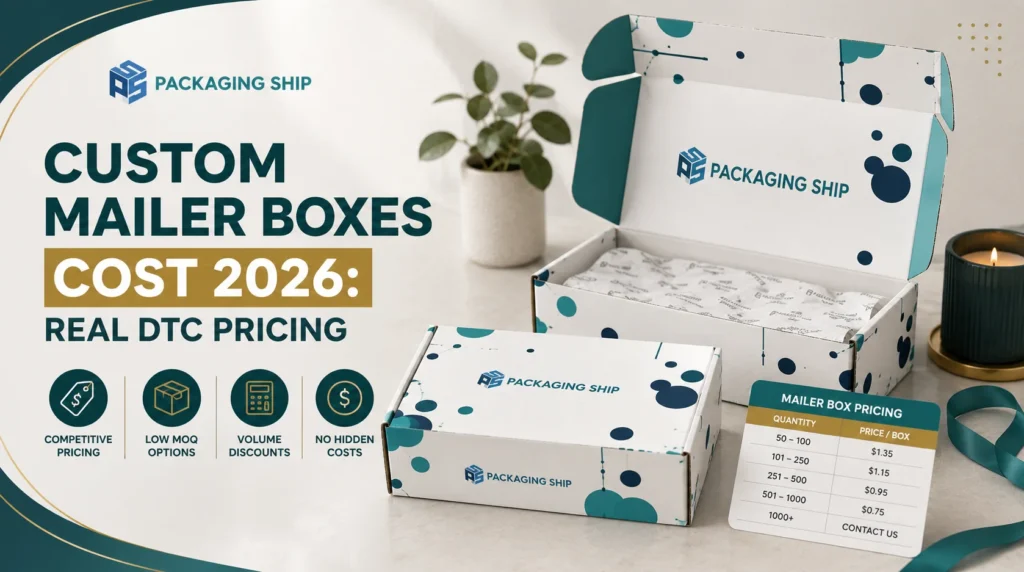
Custom Mailer Boxes Cost 2026: What Should You Really Pay? TL;DR: Custom mailer boxes cost between $0.20 and $4.50 per unit in 2026, depending on order size, material, and print method. Small test orders under 200 units usually land near $0.50 to $1.20 per box. Bigger orders drop the price fast. Compare your quote against real 2026 mailer box pricing below. Table of Contents What Sets Mailer Box Pricing in 2026 Four things move your mailer box cost. Size is the first. A bigger box uses more board. Material is second. Kraft paper runs cheaper than coated cardboard. The print method is third. Digital printing skips plates, so it wins on small runs. Offset printing needs plates, so it wins at higher volume. Quantity is the fourth, and it matters most. The U.S. e-commerce packaging market is growing fast, valued at $106.46 billion in 2025 and projected to reach $392.85 billion by 2033, according to Grand View Research. That growth is why more suppliers now compete on small order pricing instead of turning small brands away. Custom Mailer Box Cost by Order Quantity Mailer box price per unit drops fast as your order grows. Here’s the general 2026 market range: Order size Typical cost per box 50 to 100 units $0.50 to $1.20 250 to 500 units $0.60 to $1.80 1,000 to 5,000 units $0.35 to $1.20 5,000+ units $0.20 to $0.80 These are market ranges, not a fixed price. Your exact custom mailer boxes price quote depends on size, finish, and how the custom mailer boxes you’re picturing are actually built. What’s Included in Your Quote (and What Isn’t) A clean quote should have one number, not five line items added later. At Packaging Ship, that number already includes production and free U.S. shipping. Watch for suppliers who quote low, then add a die charge or plate charge afterward. Those fees typically run $200 to $800 for a die and $150 to $500 for a plate. Ask directly if your quote already includes them before you compare two suppliers side by side. Is Your $3 Per Box Quote Fair? Got a quote around $3 a box and it doesn’t feel right against your margin? Do this math first. Take your average order value and multiply it by 0.03 to 0.06. That’s roughly what packaging should cost as a share of revenue for a lightweight product, based on current DTC financial benchmarks. How to Check If Your Mailer Box Cost Is Reasonable Say your AOV is $45 and your gross margin sits around 65 percent. A $1.20 box is about 2.7 percent of that order, which is reasonable. A $3.00 box on the same order is closer to 7 percent, which is high unless the box itself is doing real work, like driving unboxing shares or repeat purchases. McKinsey’s 2025 consumer survey found that price and perceived quality still outrank premium presentation for most shoppers. Your packaging budget needs to work on paper before it needs to look expensive. Mailer Boxes vs Other Packaging Not every product needs a mailer box. Lightweight items that ship directly to a customer’s door are the best fit. Heavier or bulkier shipments often do better in plain shipping boxes, which cost less but skip the branded unboxing moment. Products like CBD, coffee, or supplements that need airtight protection usually move to mylar bags instead, which run cheaper per unit than a printed box. Match the packaging to the product first. The cost comparison sorts itself out after that. How to Get an Accurate Quote Skip suppliers demanding 1,000 units before they’ll even talk to you. Digital printing removed that requirement years ago. If you’re testing a new product, a no minimum order run of 50 to 100 units lets you check fit and print quality before you commit to a real budget. When you request a custom mailer box price quote, USA suppliers with a genuine no setup fee policy are worth prioritizing first. You can get a free quote in under two minutes and see your exact number before deciding anything. FAQs Question Answer How much do custom mailer boxes cost in 2026? Most orders fall between $0.20 and $4.50 per unit, depending on size, material, and quantity. What’s a good price for custom mailer boxes? For a standard branded mailer at mid volume, $0.50 to $1.80 per unit is typical in 2026. Do custom mailer boxes have hidden fees? They shouldn’t. Ask if die charges and plate charges are already included before comparing quotes. What’s the minimum order for custom mailer boxes? Digital printing allows orders as small as 50 to 100 units with no minimum requirement. Get Your Free Mailer Box Quote You don’t need to guess your packaging budget. Request your quote now and get real pricing for your exact size, material, and quantity in minutes. Conclusion Custom mailer box cost isn’t a mystery once you know what actually moves the number. Size, material, print method, and quantity set the range. What separates a fair quote from an expensive one is whether it fits your margin, not just whether it looks premium. Run the math against your AOV before you sign off on any quote. Then get a real number instead of a guess.
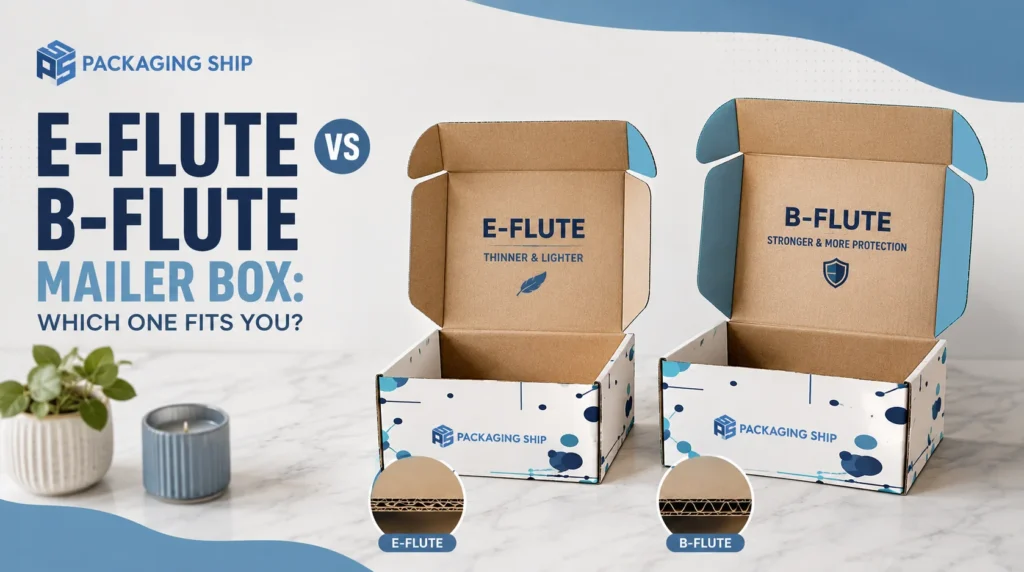
E-Flute vs B-Flute Mailer Boxes: Which Corrugated Is Right for Your Product Weight? TL;DR E-flute suits lightweight, print-forward products under roughly 3 to 5 pounds, like cosmetics, jewelry, and apparel. B-flute suits heavier or more fragile items, generally above that range, where cushioning matters more than a flawless print surface. Both are single wall corrugated boards. Neither is “better,” they’re built for different jobs. Get the flute wrong and you risk crushed corners, damaged goods, and returns that cost far more than the box itself. Table of Contents Every mailer box order starts with a question nobody warns you about. Do you want E-flute or B-flute? Most small brands find this out the hard way, either on a quote form that assumes they already know, or after a customer opens a box with a dented corner and a bruised product inside. This guide settles the e-flute vs b-flute mailer box decision using actual product weight, not guesswork. We manufacture both at Packaging Ship, so this comes from what we see on the production floor, not a spec sheet copied from a supplier catalog. What’s Actually Different Between E-Flute and B-Flute Both are single wall corrugated boards. A single fluted layer sits between two flat liner sheets. What changes is the size of that fluted wave. E-flute runs about 90 flutes per linear foot, packed tightly together. That tight structure keeps the board thin, around 1.5 millimeters, and gives it a flat, smooth surface. Ink sits cleanly on flat surfaces, so E-flute prints crisp logos, fine text, and detailed graphics without the corrugation showing through. B-flute runs about 47 flutes per linear foot. Fewer, taller waves mean more air pocket and more material between the two liners, pushing thickness to roughly 3 millimeters. That extra bulk is what absorbs shock. When a box gets dropped, stacked, or squeezed on a conveyor belt, B-flute’s taller arches compress and spring back instead of transferring the full force straight to your product. Neither flute is stronger in every sense. E-flute holds its shape well under light stacking loads. B-flute wins clearly on cushioning and puncture resistance. The right pick depends entirely on what’s inside the box. E-Flute Mailer Boxes: Best for Light, Print-Forward Products E-flute earns its reputation with direct to consumer brands for a simple reason. It looks premium straight out of the box, and it protects lightweight goods just fine. Most of our custom mailer boxes are ordered in this weight class ship in E-flute for exactly that reason. Ideal Product Weight and Use Cases E-flute suits products generally under 3 to 5 pounds where branding matters as much as protection. Think skincare jars, lip gloss sets, jewelry, folded apparel, candles under a certain size, and small subscription box items. If your unboxing photo is going on Instagram, E-flute usually gives you the sharpest result. The tradeoff is real. E-flute has less cushioning, so it’s a poor match for anything heavy, dense, or already fragile before it hits a box. Glass, ceramics, and anything over a few pounds put E-flute at risk in a standard parcel network. B-Flute Mailer Boxes: Built for Heavier, Higher-Risk Shipments B-flute trades a bit of surface polish for real durability. It’s the flute most manufacturers reach for when a product needs to survive rough handling, not just look good sitting on a shelf. Ideal Product Weight and Use Cases B-flute fits heavier items, generally above the 3 to 5 pound range, along with anything fragile, dense, or prone to shifting in transit. Candle jars, ceramic mugs, bundled products, and multi item kits do better in B-flute because the taller flute profile absorbs impact instead of passing it straight through to the product. You’ll notice B-flute boxes feel slightly bulkier when folded, and fine print detail loses a touch of sharpness compared to E-flute. That’s the fair trade for meaningfully better crush and puncture resistance. Why Your E-Flute Order Might Have Arrived Crushed If you’ve ordered E-flute mailer boxes before and had a product arrive damaged, you’re not dealing with a defective batch. In almost every case we see, this comes down to a weight mismatch, not a manufacturing problem. E-flute is engineered for light loads and clean printing, not shock absorption. When a heavier or denser product goes into an E-flute box, the board simply doesn’t have enough material to cushion the impact of a standard parcel network drop, a sort facility conveyor, or a stack of boxes in a delivery van. The box does exactly what it was built to do. It just wasn’t built for that product. There’s a second, less obvious cause. Even a correctly matched E-flute box can fail without proper void fill or an insert. A perfect flute choice paired with an empty box that lets the product slide around will still arrive damaged. Fixing this usually takes two changes, moving to B-flute for the heavier item, or keeping E-flute and adding a simple insert or crinkle paper to stop product movement inside the box. Either way, the fix is a small change on your next order, not a full packaging redesign. And since you can order mailer boxes with no minimum, testing the corrected flute before committing to a full production run costs you almost nothing. E-Flute vs B-Flute Mailer Box Comparison Table Feature E-Flute B-Flute Thickness About 1.5 mm About 3 mm Flutes per linear foot About 90 About 47 Wall type Single wall Single wall Print surface Flatter, sharper detail Good, slight texture show through Cushioning Light Moderate to strong Crush and puncture resistance Lower Higher Best product weight Roughly under 3 to 5 lbs Roughly above 3 to 5 lbs, or fragile items Best for Cosmetics, jewelry, apparel, subscription boxes Candles, ceramics, kits, heavier or fragile goods If your product isn’t boxed at all, powders, gummies, dried goods, or anything better suited to a flexible pouch, corrugated may not be the right category to begin with. Our mylar bags line covers flexible, non-corrugated packaging for that kind