
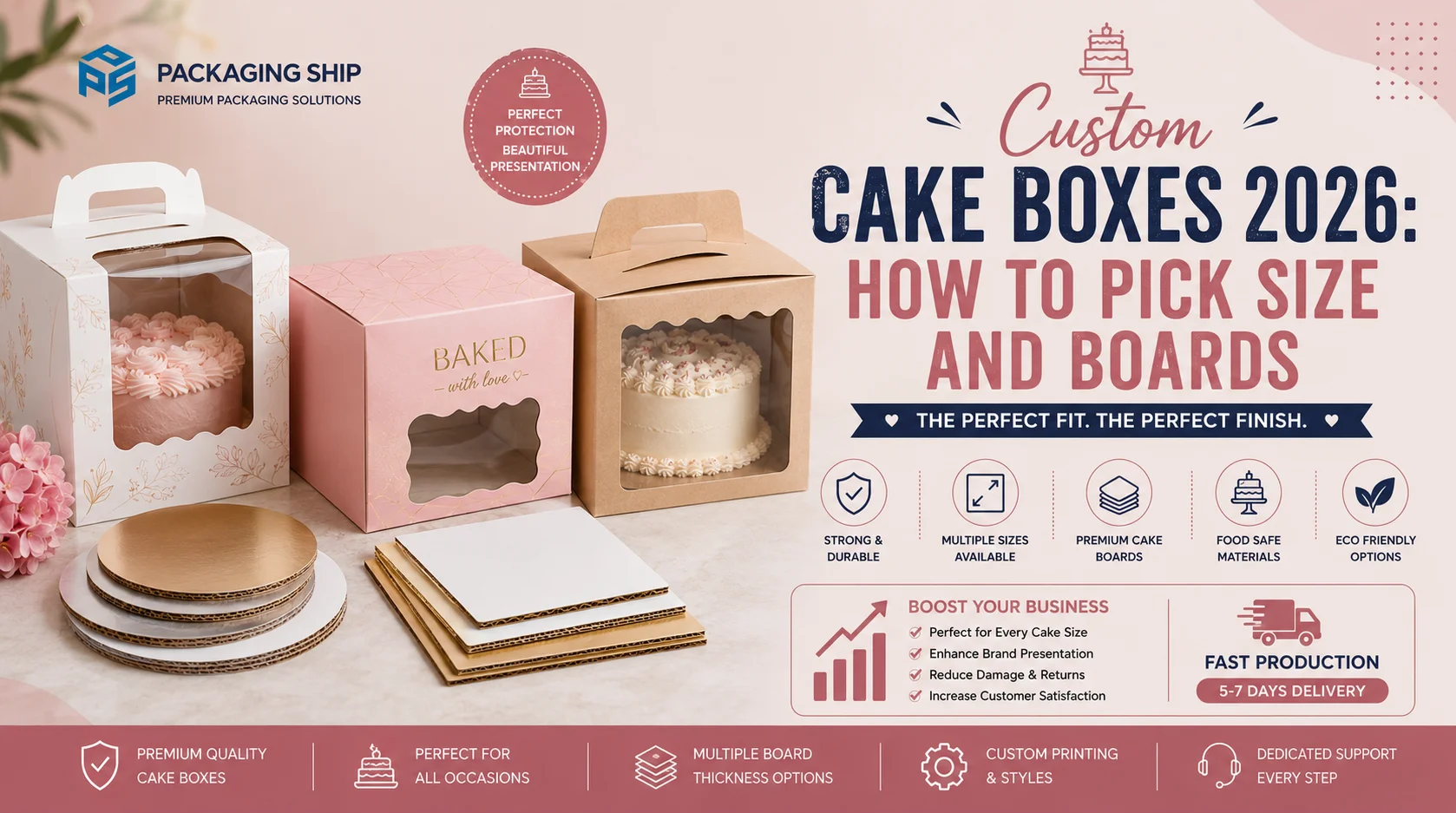
Custom cake boxes should match your cake’s diameter plus one to two inches of clearance on every side, with a board that fits the box footprint within a quarter inch. Tiered cakes above three tiers usually ship in separate boxes and get stacked on site. Corrugated stock handles weight and distance better than plain cardboard.
A ten inch round with a fondant topper measured nine and a half inches tall. The box was rated for eight. The topper flattened against the lid before the driver left the parking lot. That happens every week in bakeries that size boxes by guesswork instead of measurement.
A box that is too small crushes the cake. A box that is too big lets it slide. Both problems leave your customer with a cake that looks nothing like the photo they ordered. Getting your custom cake boxes right the first time is what stops that from happening, and it starts with measurement, not the box itself.
According to Ipsos research conducted on behalf of the Paper and Packaging Board, 72 percent of consumers say packaging design influences how they judge a product, and 67 percent say the same about the material it ships in. For a bakery, that means the box is not an afterthought. It is part of what you are actually selling.
Get three numbers before you order anything.
Measure across the widest point. For square or hexagon cakes, measure corner to corner as well, because that diagonal is often wider than the side length and it is what actually has to fit inside the box.
Measure from the base board to the tallest point, including frosting, fondant, and any topper. This is the number bakeries skip most often, and it causes crushed decorations.
A tiered cake is sized by its bottom tier, not an average of all the tiers. If your bottom tier is twelve inches, your box math starts at twelve inches, no matter how small the top tier is.
Add one to two inches of clearance on every side of the diameter, and one inch of headroom above the finished height. That gap keeps frosting from touching a wall during a temperature swing, one of the most common causes of a smear that shows up hours after delivery.
A six inch round needs roughly an eight by eight by four inch box. An eight inch round needs about ten by ten by four. A ten inch round needs twelve by twelve by four, and a twelve inch round needs fourteen by fourteen by four. These four sizes cover most single tier birthday and celebration cake orders.
Expect a box in the eleven to fourteen inch height range once you account for both tiers and a topper. This is where a lot of bakeries start running into standard stock that is either too short or oddly deep.
These typically need seventeen to eighteen inches of height, and depending on the base tier, a footprint wider than most off the shelf boxes offer. Anything past four tiers, or a stack finishing taller than about sixteen inches, is usually safer shipped disassembled in separate boxes and stacked at the venue.
Sheet cakes need a flat, wide footprint rather than height. Bento and mini cakes fit small four to six inch boxes and are one of the few categories where an off the shelf size genuinely works fine.
If your cake does not fit neatly into any of these categories, that is exactly the situation custom sizing solves. A hexagon cake, a very tall buttercream build, or an odd eleven inch tier will always fight standard stock. You can see the full size range in our custom cake boxes collection, built to your exact dimensions instead of the nearest standard one.
A cardboard cake box is a single layer of paperboard. It works well for cakes under about eight inches and light single tier orders, and it keeps your cost per unit low on high volume days.
A corrugated cake box has a wavy fluted layer sandwiched between two flat sheets. That structure is what stops the box from bowing under weight, which matters once you are carrying multiple tiers, a heavy fondant build, or a delivery going more than a few miles. At Packaging Ship, both run through the same printing lines, so switching to corrugated does not mean a drop in print quality. If your bakery ships two or more tiers, or anything traveling more than a short local trip, corrugated is the safer default, not an occasional upgrade.
A window cake box shows off the decoration before the customer opens it, which works well for retail cases and pickup orders where presentation sells the sale. The tradeoff is less climate control inside the box, so window boxes are a better fit for shorter transport times and sturdier frostings. The same tradeoff applies to custom sweet boxes, where a window sells the product but a solid lid protects anything delicate.
A solid lid protects delicate buttercream and fresh floral toppers from light and temperature better, and it is the safer choice for longer deliveries or hot weather months. Neither option is universally correct. Match it to your delivery distance and your topper, not just your branding preference.
Most delivery damage comes down to three separate failure points, and they need three separate fixes.
Horizontal sliding happens when the board is noticeably smaller than the box interior. A gap wider than half an inch between board edge and box wall lets the cake shift during braking and turns. Matching the board to the box footprint within a quarter inch solves this, not padding or extra tissue paper.
Vertical crushing happens when height was measured on the plain cake instead of the finished, decorated cake. This is the fondant topper against the lid problem, and it is fixed at the measuring stage, not the packing stage.
Structural collapse happens when a cardboard box is asked to carry corrugated level weight. A three tier cake in a single layer cardboard box is a common cause of a box bowing inward mid transit, even when the sizing was otherwise correct.
Standard, off the shelf sizes cannot always fix all three at once, especially on an odd tier count or unusually tall build. If your current supplier only stocks a handful of sizes, get a free quote with your exact dimensions, no design file required.
Most large packaging manufacturers require one thousand to five thousand units before they will run a custom size, which is simply out of reach for a bakery testing a new wedding cake line or filling one large weekend order. Packaging Ship builds custom cake boxes wholesale no minimum in the USA, starting from fifty units, as part of a full range of bakery packaging rather than a single isolated product.
This matters most in three cases: a wedding order with an unusual tier stack that won’t fit standard boxes, a branded retail launch needing a size nobody else stocks, and a seasonal run, like a holiday cake line, where thousands of leftover units are not worth storing afterward.
Cake boxes are just one piece of a bakery’s packaging needs. Most bakeries ordering custom cake boxes also need matching cupcake, cookie, and pie packaging to keep branding consistent across every order that leaves the kitchen. We’ve covered how to source all of it without hitting the high minimum orders that trip up small and mid size bakeries in our full guide to custom bakery boxes wholesale in the USA. If you want the complete picture beyond just cake packaging, click here to read more.
Cake orders rarely travel alone. A wedding order often comes with a matching dessert table, and a retail case needs consistent branding across every product on the shelf, not just the cake. If you are already sizing custom cake boxes, it is worth pricing out your custom cupcake boxes, custom cookie boxes, and custom pie boxes at the same time, so your branding stays consistent across everything that leaves the kitchen.
| Question | Direct Answer |
| What size cake box do I need for a 3 tier cake? | Plan for roughly 17 to 18 inches of box height, sized to your bottom tier’s diameter plus one to two inches of clearance on every side. |
| Should the cake board be the same size as the box? | No. The board should match the cake’s diameter, and the box interior should be about one to two inches larger than the board on every side, not the same size. |
| Why does my cake slide around in the box during delivery? | It usually means the board is too small for the box footprint. A gap wider than half an inch between the board edge and the box wall lets the cake shift during turns and braking. |
| What’s the difference between a cardboard and a corrugated cake box? | Cardboard is a single flat layer, best for light single tier cakes. Corrugated has a fluted inner layer that resists bowing under weight, better for multi tier or longer delivery orders. |
| Do I need a window on my cake box? | Windows help sell retail and pickup orders by showing the design, but a solid lid protects delicate toppers better on longer deliveries or in warm weather. |
| How do I order custom cake boxes with no minimum quantity? | Request a free quote with your exact dimensions. Packaging Ship accepts orders starting from fifty units with no minimum order required. |
If your cake does not fit the nearest standard size, stop forcing it. Send us your dimensions and get a proof back for your custom cake boxes within 24 to 48 hours, with no minimum order and free design support included.
Getting cake packaging right comes down to three numbers, diameter, finished height, and tier count, measured honestly before you order anything. Standard sizes cover a lot of ground, but they break down fast on tiered stacks, odd shapes, and tall buttercream builds, which is exactly where custom cake boxes earn their place in a bakery’s packaging plan. Measure first, match the board to the box, choose corrugated when weight or distance calls for it, and you will spend a lot less time remaking cakes that arrived looking nothing like they left your kitchen.