
Picture this. Three days before your biggest product launch. The boxes arrive at your door. You slice the tape open, pull one out, and something feels immediately wrong. The foil stamp is sitting 4mm off-center. The velvet insert slides when you tilt the box because it was cut short. You call your supplier. No answer. You email. Nothing back.
I wish that scenario was unusual. It is not. Jewelry founders across the US run into this exact situation every quarter, usually because the supplier decision got made in a rush, based on a quote and one decent sample.
So before you sign off on anything, use this guide. It will save you a painful lesson.
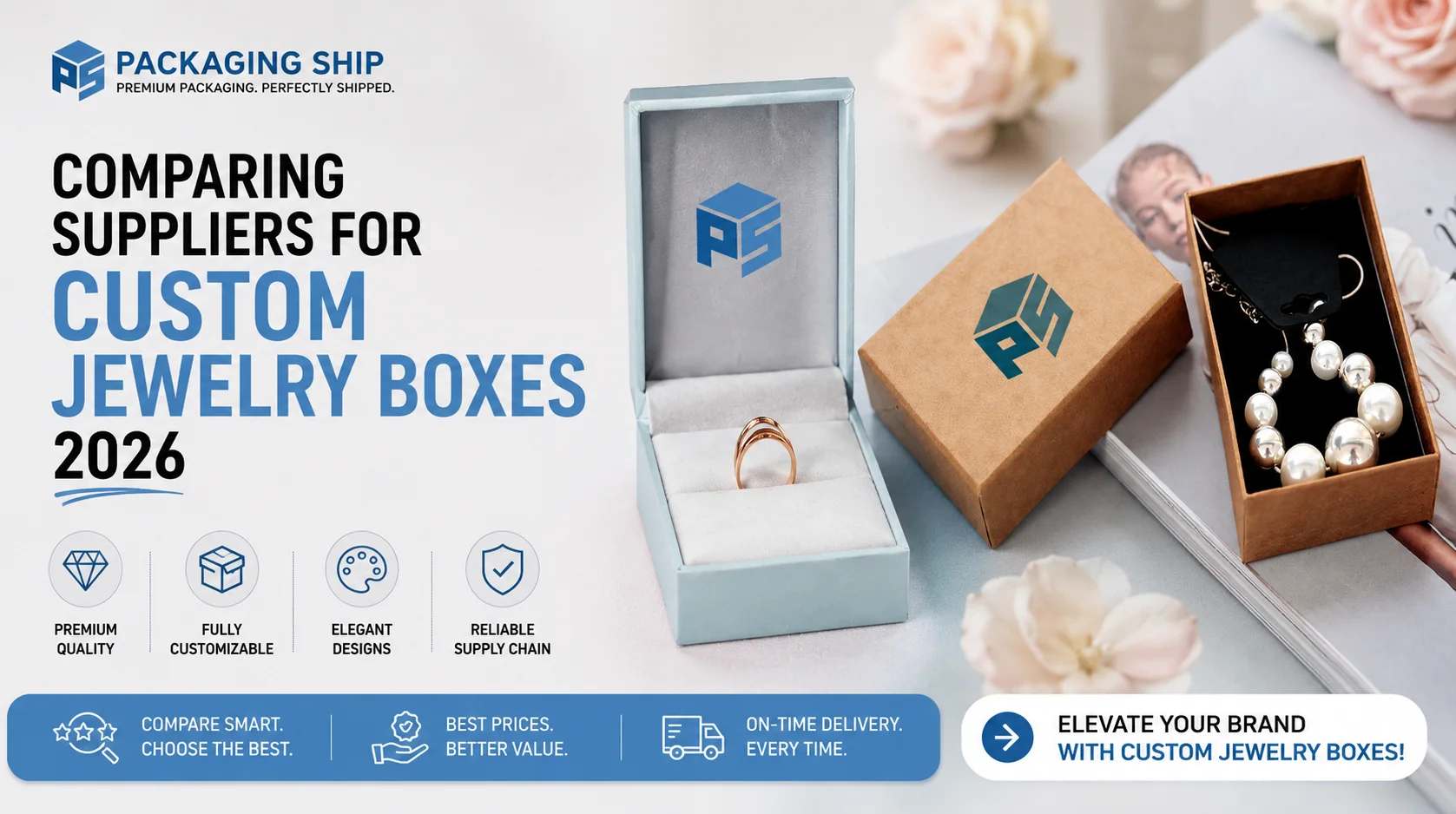
Simply put, custom jewelry boxes are branded packaging made specifically for your product, whether that is rings, necklaces, pendants, anklets, bracelets, or earrings. Materials range from rigid chipboard to kraft board to corrugated card, with interior linings and exterior finishes chosen to match how your brand wants to be perceived.
Now, why does the box itself matter so much? There is actual research behind this. A peer-reviewed study in Humanities and Social Sciences Communications cites a global Ipsos survey showing 72% of consumers say packaging design directly influences whether they buy. That number is not from a supplier’s marketing page. It is from a study indexed in Nature. And on the market side, Verified Market Reports projects the US jewelry packaging sector growing from $1.9 billion in 2025 to $2.7 billion by 2033.
Think about what that actually means for your brand. Your packaging lands in your customer’s hands before the jewelry does. That physical moment, lifting a lid, feeling a liner, weighing a box in their palm, is already forming their opinion of what is inside. A cheap box works against your price point before they have even seen the product.
Walk into any supplier conversation and they will say the word “customizable” before you finish your first sentence. What you need to dig into is what that actually covers. Ask them directly: do they produce Pantone-matched colors with a physical proof you can approve before production begins? Can they build a ring roll insert for a Custom Ring Boxes order, or a flat foam cavity for a pendant? Do they print inside the lid?
Vague answers here mean vague results at the end of your production run. Press for specifics every time.
Good suppliers carry real range. You need a rigid jewelry box for your fine pieces, a kraft jewelry box for your sustainable line, a velvet jewelry gift box for gifting collections, and a drawer jewelry box packaging style for presentation sets. If a supplier keeps steering you toward one material because it is easier for them to produce, that is not a sign of expertise. That is a sign of limited capability.
Your product line will evolve. Your supplier needs to keep up.
Most supplier problems do not show up in the sample. They show up in box number 847 of a 1,500-unit run, when the CMYK dot gain shifts slightly on an uncoated kraft stock and your brand red starts reading as orange under retail lighting. Ask every supplier what their AQL (Acceptable Quality Level) sampling protocol looks like during bulk production. If they cannot explain their in-line inspection process, you are carrying all the risk.
A good sample means little if the supplier has no documented process for maintaining that standard at scale.
Overseas manufacturers typically require 500 to 1,000 units for standard designs, and anywhere from 1,000 to 2,000 units for complex constructions like magnetic closure jewelry box styles or multi-material builds, based on verified supplier data from Alibaba’s B2B sourcing platform. That works well for established brands with predictable volume.
For everyone else, a domestic US supplier with no minimum order quantity lets you test a new box style on 100 units before committing to a full season’s run. That flexibility is genuinely valuable, not just a nice-to-have.
The industry standard for overseas production is 3 to 6 weeks from artwork approval. US-based suppliers with domestic production can often move in 6 to 10 business days. For seasonal campaigns, trade shows, or a product drop tied to a specific date, that gap matters enormously. Get the turnaround time in writing, not as an estimate in an email thread, but as a confirmed commitment before you place your order.
Most small jewelry brand founders are not structural packaging designers. They should not have to be. Free design support should be a standard expectation, meaning a custom dieline, a digital proof, and a physical pre-production sample at minimum. Suppliers who charge for dieline creation are essentially billing you for work they need to do anyway to print your order correctly. Walk away from that model.
This one catches brands off guard constantly. You compare two supplier quotes and one looks significantly cheaper. Then the final invoice comes with die charges, plate fees, proof revision charges, and shipping surcharges that were never mentioned. Always ask for a fully itemized all-in quote before you commit. The per-unit price is almost never the whole story.
Jewelry packaging is not just the outer box. The interior lining, insert structure, tissue paper wrap, ribbon pull, and the sequence in which your customer opens the piece all contribute to how they feel in that moment. According to the 2026 State of Jewelry E-commerce Report by Branvas, premium packaging that genuinely delights the customer on arrival is one of the most effective tools for generating repeat purchases and organic social media content from buyers who share their unboxing without being asked.
For anklet packaging specifically, the fit of the insert matters as much as the exterior finish. A loose insert damages the piece in transit and undermines the entire premium experience you built. For a tailored solution that holds delicate jewelry securely, explore Custom Anklet Boxes designed with precision-cut foam inserts. To read more about how packaging choices affect consumer loyalty and repeat purchase behavior in jewelry brands, click here.
Some signals are easy to miss in a first supplier conversation. Others are obvious in hindsight after the damage is done. Here is what should make you pause.
A supplier shows you prototype samples only and cannot provide a photo or record of a mass production batch. They give you a turnaround time verbally but go quiet when you ask for it in a written purchase order. They cannot tell you what print method they use for your specific material, or whether your file will be printed CMYK or PMS matched. Fees appear on your final invoice that were never part of the original quote. There is no stated reprint policy or satisfaction guarantee anywhere in their terms.
Any one of these matters. Together, they tell you the supplier is used to buyers who do not ask hard questions.
When you are sourcing luxury jewelry gift boxes wholesale, the cheapest per-unit price is rarely the cheapest outcome. A $0.30 box that ships with a misaligned logo or a warped lid costs you far more than the $0.20 price difference per unit, especially when you factor in reshipping, rebranding, and the customer trust you lose in the process.
Market research from Market.us confirms that rigid jewelry boxes lead the entire product category in market share because they create an unboxing experience that reinforces premium price positioning. Bulk jewelry gift boxes are not a line-item cost to minimize. For growing jewelry brands, they are a margin protection tool and a customer retention mechanism in one.
Use this framework before placing any order:
A supplier who answers all eight with confidence and in writing is worth a serious conversation.
Packaging Ship works with jewelry brands across the US. Every order ships with no minimum order quantity, free design support included, a 100% satisfaction guarantee, and no hidden fees from quote to delivery. Production runs in 6 to 7 business days. With over 10,000 completed packaging projects behind them, the team knows how to maintain the same quality across a 50-unit test run and a 5,000-unit seasonal order.
Honestly? It varies wildly. Some overseas factories will not even open a conversation below 1,000 units, and if your design involves anything complex like a magnetic closure jewelry box or a multi-material build, that floor can push to 2,000 or higher. Packaging Ship runs with no minimum at all, which is genuinely useful if you are testing a new collection or just starting out. Order 50, see how customers respond, then scale. No need to gamble a full season’s budget on a box you have never actually sold with.
Hold both in your hands and you will know immediately. A rigid jewelry box, built from chipboard at 2mm or thicker, does not give at all. It holds its shape, it has weight, it feels like something worth keeping. Standard cardboard uses a lighter SBS board, costs less, works fine for everyday retail gifting, and collapses if you press the sides too hard. For a customer spending serious money on jewelry, that physical difference between rigid and cardboard matters in those first few seconds before they even open the lid.
That really depends on where your supplier is based. US domestic production at places like Packaging Ship wraps in 6 to 10 business days after artwork sign-off. Go overseas and you are typically looking at 3 to 6 weeks, sometimes more depending on shipping lanes and production backlog. One habit that saves brands a lot of grief: get that delivery date written into the actual purchase order before anything moves to production. Not in a chat message. Not in an email you might lose. In the order document. That way there is no room for “we thought you meant next month.”
Yes, and when it is executed well the combination is genuinely striking. Velvet lining on the inside, foil stamping or embossing on the exterior lid, it is the kind of packaging people save rather than throw away. Most full-service suppliers can put your logo on the lid, the interior base, or both. Before you confirm production though, ask specifically which logo finish they recommend for your exterior material. Foil stamping sits very differently on a coated rigid board versus raw uncoated kraft, and getting that match wrong is a costly correction.
Three things, and honestly only three things matter here. First, the insert has to hold the piece securely with zero movement in transit. A ring sliding around inside a box during shipping is a return and a bad review before your customer has even tried it on. Second, the finish needs to look clean in a phone photo under natural light, because a huge portion of DTC buyers will post their unboxing on Instagram or TikTok without you asking them to. That is free marketing, but only if the box photographs well. Third, keep the design simple. Matte finishes, foil accents, minimal print, these always outperform busy, heavily decorated boxes in social content because they read as intentional rather than trying too hard.
Let me be direct with you. Most jewelry brands that end up with bad packaging did not make a bad decision about packaging. They made a rushed decision about a supplier. They chose based on a quote and a photo instead of asking the questions in this guide.
The criteria here, material range, print consistency, MOQ flexibility, written turnaround times, transparent pricing, free design support, and a clear satisfaction guarantee, these are not nice extras. They are the baseline your supplier should clear before you spend a dollar with them.
The US jewelry packaging market is growing steadily. The brands taking real share in that growth are the ones who figured out early that the box is part of the product, not just a container for it. Your supplier determines whether that part of your brand shows up well or quietly works against everything else you are building.
Get Your Free Custom Quote from Packaging Ship
No minimums. No hidden fees. Free design support on every order.