
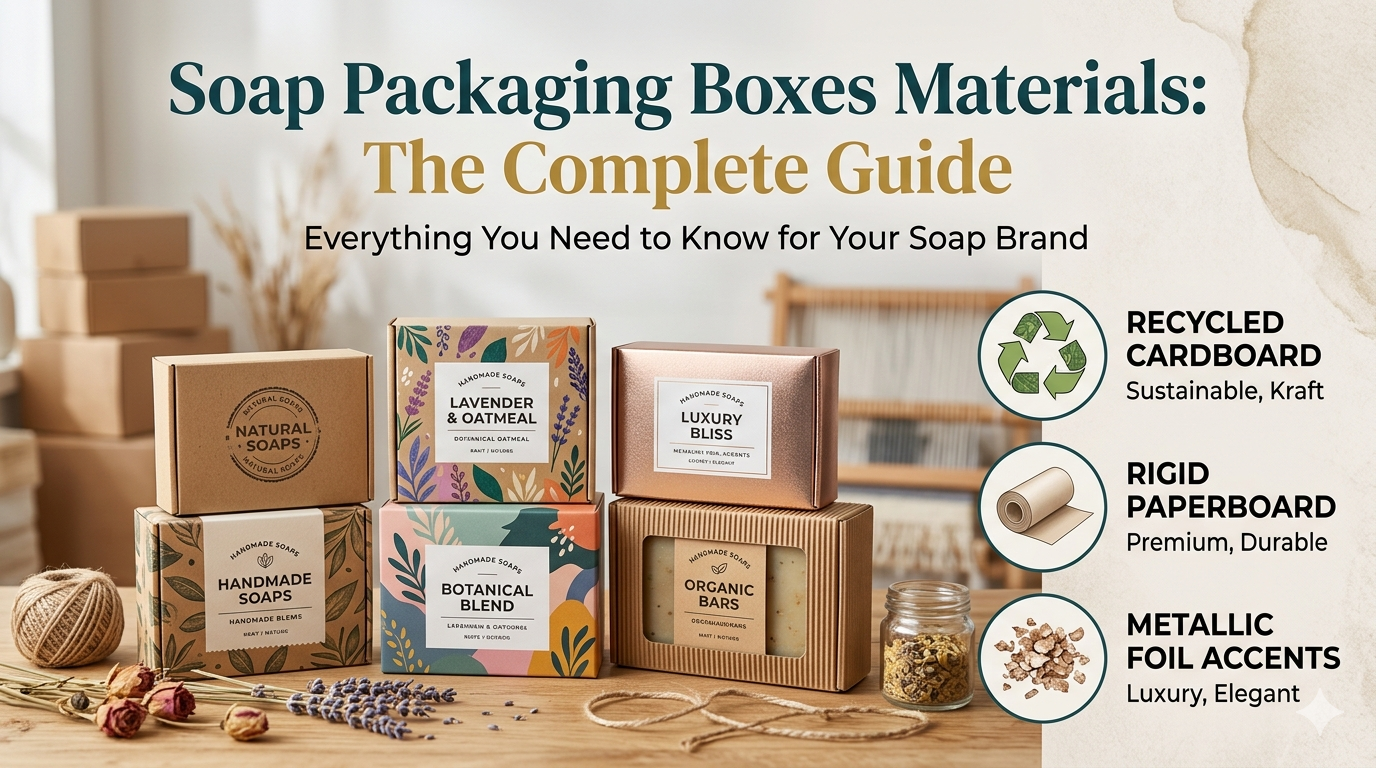
Choosing the right soap packaging boxes materials is one decision that directly shapes your sales, shipping costs, and brand perception all at once. In plain terms: the wrong board thickness collapses on retail shelves, the wrong coating warps in transit, and the wrong style costs you wholesale accounts before you even land them.
This guide gives you a practical, decision-ready breakdown. No padding. No guesswork.
The global soap box market was valued at $5.2 billion in 2024 and is projected to reach $7.8 billion by 2033, growing at a CAGR of 5.1%, according to Verified Market Reports. That growth signals one thing for B2B buyers: competition on shelves is intensifying, and packaging is your first salesperson.
Here is what most brands get wrong. They choose a material based on price per unit without factoring in print compatibility, moisture resistance, or structural performance under retail stacking. One artisan soap brand we spoke with switched from 250gsm SBS board to 350gsm kraft after two wholesale clients returned orders with crushed corners. That single material upgrade reduced returns by over 30% and justified a 12% price increase at retail. The numbers backed the change.
Your packaging material is a business decision not a design afterthought.
Kraft is the most versatile material for soap boxes packaging today. It runs between 300gsm and 400gsm for bar soap applications. It absorbs moisture better than coated boards, resists minor humidity, and communicates an organic, natural brand identity without a single word of copy. Eco-conscious buyers respond to it immediately. Kraft also costs less per unit than rigid stock, making it ideal for wholesale soap boxes ordered at volume.
The limitation: full-color printing on uncoated kraft requires higher ink coverage, which increases print cost. If your soap box design relies on vivid photography or gradient artwork, coated kraft or SBS board is a smarter call.
Cardboard soap boxes specifically SBS (Solid Bleached Sulfate) give you the sharpest print surface available at a commercial price point. CMYK printing on 350gsm SBS produces retail-grade color accuracy. This is the go-to material for retail soap packaging that needs to compete visually in high-traffic environments like Target, Whole Foods, or specialty wellness boutiques.
SBS also pairs cleanly with UV spot coating, soft-touch lamination, and embossing the finishes that separate a $4 bar from a $14 bar in the shopper’s hand.
Rigid boxes run at 1.5mm to 2mm board thickness. They do not fold flat, which increases shipping costs for empty boxes. However, for luxury soap packaging gift sets, hotel amenity lines, spa collections, rigid chipboard delivers an unboxing experience that cardboard cannot replicate. A 2mm rigid box with magnetic closure communicates premium value before the lid opens. Brands in the $18–$35 per bar range typically use rigid for their soap gift boxes and seasonal editions.
For shipping outer cases and wholesale mailer-ready packaging, E-flute corrugated board at 3mm offers superior crush resistance without adding significant weight. If your wholesale soap boxes travel through third-party logistics or Amazon fulfillment, E-flute reduces damage rates compared to standard cardboard on multi-unit packs.
Your material choice intersects directly with your box style. Here is how to match them.
GSM (grams per square meter) is the single most underspecified number in custom soap box design. Here is a working reference:
If you are ordering custom soap packaging without specifying GSM, you are letting the supplier make that decision for you. Always specify it.
More than 54% of new soap launches in 2025 were organic or botanical, according to Market Reports World. That shift in formulation is driving an equal shift in packaging expectations. Wholesale buyers at wellness retailers increasingly require FSC-certified board, soy-based inks, and compostable or recyclable construction as vendor prerequisites not differentiators.
Kraft board, recycled SBS, and molded pulp all qualify. Avoid laminated foil liners if recyclability is part of your brand claim they contaminate the paper stream. For brands building a full sustainable product suite, pairing eco-certified soap boxes with Custom Soap Wrapping Paper gives you a zero-plastic, shelf-ready presentation across your entire line. You can click here to explore wrapping paper options that align with your sustainability positioning.
Retail soap packaging prioritizes visual impact and structural integrity under shelf stacking. Wholesale soap boxes prioritize flat-pack efficiency, pallet density, and durability through logistics chains. The material choice may be the same 350gsm kraft is excellent for both — but the finish differs. Retail gets spot UV or soft-touch lamination. Wholesale runs matte or uncoated to reduce cost per unit at volume.
One important note: if you are expanding your product range, Custom Bath Bomb Boxes built on the same board spec as your soap line give you visual brand consistency across every SKU without managing multiple material standards.
Before you request a quote, have these seven specs ready: bar weight in grams, bar dimensions (L x W x H in mm), intended distribution channel (retail, wholesale, or DTC), required GSM, preferred finish (matte, gloss, soft-touch, spot UV), print method (digital for short runs, offset for 1,000+ units), and whether FSC certification is required by your buyer.
If you are launching a full handmade bar line, Custom Handmade Soap Boxes built to your bar’s exact dimensions eliminate the shifting and interior damage that standard-size boxes cause on artisan products.
Soap packaging boxes materials are not a background variable. They determine shelf performance, transit survival, print quality, and brand positioning — simultaneously. Start with your bar weight and distribution channel. Choose GSM before choosing finish. Match your style to your buyer’s context: tuck end for retail velocity, rigid for gifting margins, corrugated for wholesale logistics. Get the spec right at the source, and your packaging works as hard as your formula does.
Ready to Spec Your Custom Soap Packaging?
No minimum orders. No die charges. Free US shipping on every order.
Get Your Free Custom Packaging Quote →
The best material depends on your bar weight and distribution channel. For retail, 350gsm SBS cardboard or kraft delivers the ideal balance of print quality and structural performance. For luxury gifting, 2mm rigid chipboard is the industry standard.
Use a minimum of 300gsm for bars under 120g and 350gsm for bars between 120g and 200g. Bars over 200g or multi-bar gift sets should use 400gsm or rigid board.
Yes. PackagingShip offers custom soap boxes with no MOQ, free US shipping, and no die or plate charges making it accessible for brands at any production stage.
A tuck end box is a folding carton where the top and bottom panels tuck into the box to close it. Straight tuck end (STE) and reverse tuck end (RTE) are the two standard styles used in retail soap packaging.
For retail environments, yes. Die-cut window boxes increase purchase intent by letting shoppers see and smell the product. The cost premium is typically under $0.08 per unit at standard retail quantities.
Packaging Ship LLC is a leading online packaging platform offering high-quality custom boxes and branding solutions
Company
Contact Info
Copyright 2026 © All Rights Reserved By Packaging Ship LLC