
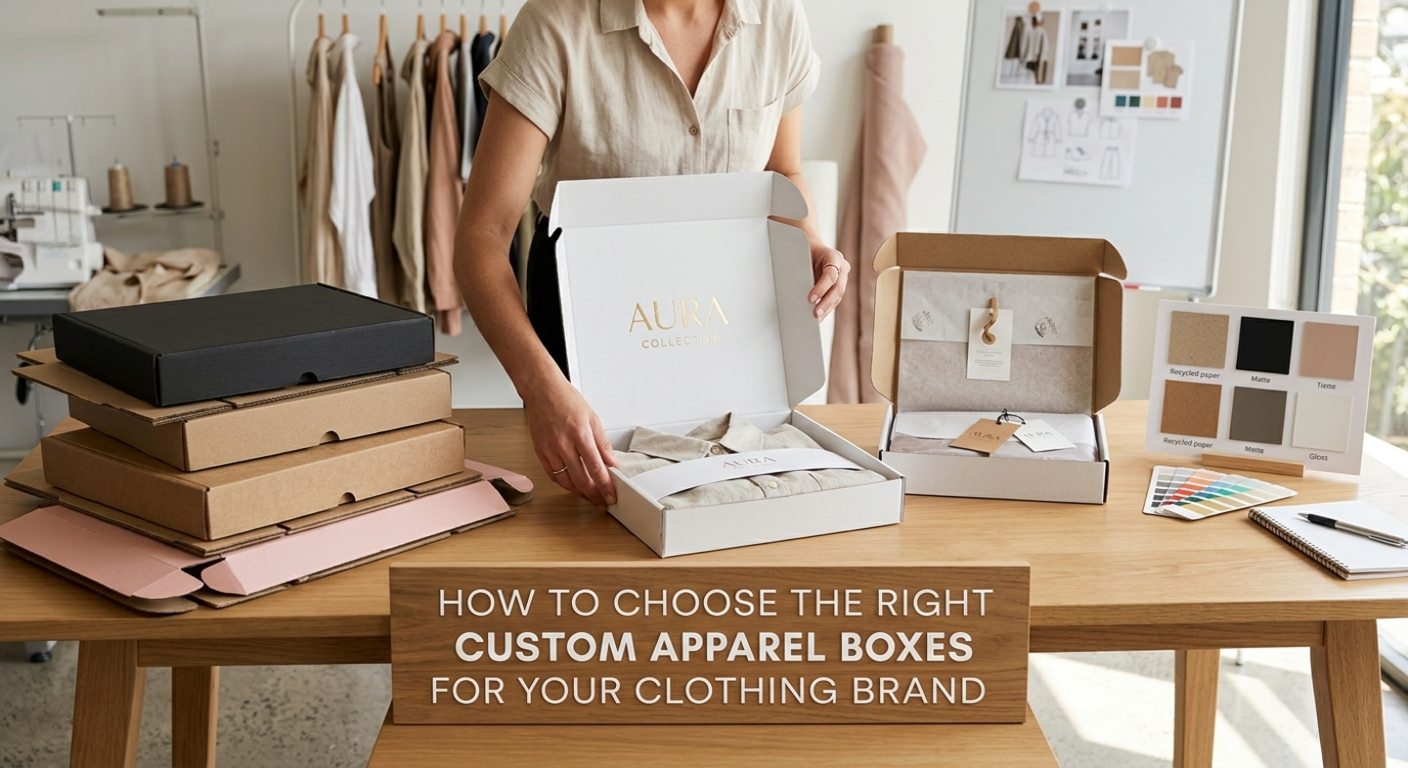
What are custom apparel boxes?
Custom apparel boxes are boxes designed specifically for clothing brands. Apparel boxes are sized, printed and finished to fit your apparel and branded design needs. They keep clothes safe during transit, offer a branded unboxing experience and communicate product quality before your customer even touches the product.
The Box Decision That Costs Brands Thousands
A small streetwear brand in Atlanta placed their first big order last year, 1,500 units in generic corrugated boxes. Wrong flute. Too large. Garments shifted in transit, arrived creased, and three dozen boxes collapsed at the seams. Refunds, reshipping costs, and two one-star reviews later, they lost $4,800 fixing a $900 packaging decision they hadn’t thought through.
That story isn’t rare. It plays out across US clothing brands every week.
The stakes are concrete. A peer-reviewed systematic review published in Humanities and Social Sciences Communications (Nature Portfolio, June 2025) confirmed that 72% of consumers globally say packaging design plays a key role in their purchase decisions, a figure drawn from Ipsos global consumer research cited across the study’s 221 analyzed academic sources.
Your box does real commercial work. Choosing the wrong one undoes it.
So here’s how to get it right.
Step 1: Match the Box Style to Your Product and Channel
Not all clothing boxes are suitable for all garments. It depends on what you’re selling, how you’re shipping it, and the experience you want your customer to have. Research from nobelus university quotes that at least 1/3 of a consumer’s product decision-making results from personal preference as well as packaging.
Custom Mailer Boxes: Best for Online Fashion Brands
Custom mailer boxes are the dominant format in DTC clothing right now. They ship flat, store easily, self-seal without tape, and print cleanly on every surface, inside and out.
The inside lid is where smart brands do their best work. Print a loyalty code there. A brand message. A care guide. Customers look directly at it when they open the box. It costs almost nothing extra and gets read almost every time.
Mailer boxes weigh 30–40% less than rigid alternatives. At high volumes, that single factor meaningfully cuts your FedEx and UPS dimensional weight charges. For subscription clothing boxes and online boutiques, they’re the strongest value-to-impact format available.
You can explore Packaging Ship’s custom mailer boxes, available in sizes suited to folded tees through full outerwear, with full inside and outside print options.
Lid-and-Tray Rigid Boxes: Best for Premium and Gift Apparel
When perceived value is the priority, lid-and-tray rigid boxes deliver it. The structured form, magnetic or friction-fit closure, and substantial feel signal quality before the garment appears.
Brands selling dress shirts, bridal wear, tailored pieces, or high-end gifting use these because the box itself is part of the product. Customers keep them. They reuse them. They photograph them. That’s earned marketing you don’t pay for separately.
Add soft-touch matte lamination and a single foil-stamped logo and you have packaging that rivals brands spending ten times your budget on retail experience.
Folding Carton Boxes: Best for Retail and Lightweight Items
Folding cartons work well for lighter garments, socks, underwear, ties, scarves, and for retail shelf display. They’re cost-effective, lightweight, and print in vibrant color.
They’re not built for premium unboxing moments. But for retail-facing brands that need high-volume, shelf-ready packaging at competitive cost, folding cartons are a reliable workhorse.
Tuck-End Boxes: Best for Accessories and Branded Add-Ons
Tuck-end boxes close with folding flaps rather than a lid. They’re quick to assemble and efficient at scale. Many fashion brands use them for accessories, belts, hats, sunglasses, that ship alongside main clothing orders.
They don’t project luxury. But they project professionalism, hold their shape in transit, and print well with your logo and brand palette.
Step 2: Choose the Right Material for Your Garments
Material choice is where most clothing brands make their most expensive mistakes. Wrong material means damaged goods, wasted budget, or packaging that contradicts the brand image you’ve spent years building.
Kraft Board: The Eco-Friendly Foundation
In the US, clothing brands prefer FSC-certified kraft boards in 2026. As a material it’s recyclable, prints cleanly in full color and has verified sustainable credentials that stand up to government and consumer audits.
Kraft works for both budget-conscious small brands and premium labels. The natural texture reads as intentional, earthy, considered, on-brand for sustainable fashion. At bulk volumes, it frequently costs less per unit than coated plastic-adjacent alternatives.
Corrugated Cardboard: When Structure Matters
Corrugated cardboard, typically E-flute (1/16″) for lighter garments or B-flute (1/8″) for heavier or bulkier items, provides structural protection that flat materials can’t match.
If your garments are heavy, if they ship long distances, or if your return rate from transit damage is climbing, corrugated is the right call. It handles stacking pressure, resists corner crush, and keeps its form through rough carrier handling.
Rigid Chipboard: When Perception Is the Product
Rigid chipboard is the premium tier. It doesn’t fold. It holds its shape completely. And it communicates a level of quality that no other material replicates.
Custom luxury apparel boxes, the kind used for designer shirts, couture pieces, and premium gift packaging, use rigid chipboard wrapped in specialty paper, then finished with soft-touch lamination, embossing, or foil stamping. This is the material behind the unboxing moments customers film and share unprompted.
SBS Cardstock: For Retail-Ready Clothing Packaging
Solid bleached sulfate (SBS) cardstock offers a brilliant white surface that holds print with exceptional clarity. It’s the preferred material for folding cartons in retail environments, where print vibrancy and shelf presence matter more than structural depth.
Step 3: Get Printing and Branding Right
Custom apparel boxes with logos are only as good as the print process behind them. Two options dominate the US market.
Offset Printing vs. Digital Printing
- Offset printing is the right choice for bulk orders, typically 500+ units. It delivers superior color consistency, sharper detail, and a lower per-unit cost at volume. Color stays accurate across a full run of 5,000 boxes. It’s the standard process for custom printed apparel boxes at scale.
- Digital printing suits smaller runs, under 300 units, and brands that need variable elements (different names, seasonal artwork, regional messaging). Setup costs are lower and turnaround is faster. The per-unit cost is higher, but the flexibility is worth it for brands testing new packaging before committing to bulk.
Finishes That Add Perceived Value
The finish on your custom garment boxes does more than protect the surface. It actively shapes how customers perceive your brand.
- Soft-touch matte lamination is the most requested finish in premium fashion packaging right now. The velvety texture signals luxury before the box opens.
- Spot UV on your logo over a matte surface creates a contrast, gloss against matte, that customers notice and remember.
- Hot foil stamping in gold or silver adds dimension that flat printing can’t replicate.
- Embossing or debossing your logo presses your brand mark into the material permanent and tactile.
None of these require a luxury price point. Even small brands applying one premium finish to an otherwise simple box see meaningful shifts in how customers talk about their packaging.
What Apparel Packaging Trends Mean for Your Box Choice in 2026
Before you finalize your box decision, it’s worth knowing what’s shifting across the US fashion market right now. Eco-friendly kraft apparel boxes and custom mailer boxes are the two fastest-growing formats in 2026, driven by DTC brands that need both sustainability credentials and strong unboxing performance. Minimalist design with a single premium finish, one foil stamp, one debossed logo, is consistently outperforming busy, over-printed packaging in customer retention metrics. Smart packaging, specifically QR codes printed inside box lids linking to brand stories or care guides, is becoming a standard feature rather than a novelty among mid-market US clothing brands. Right-sized packaging engineered to your exact garment dimensions is reducing dimensional weight shipping charges by 20–35% for brands that make the switch.
👉 Want to go deeper on this topic? Read our full guide to apparel packaging trends in 2026 here.
Step 4: Size Your Custom Apparel Boxes Correctly
Sizing is where the budget gets wasted quietly. FedEx and UPS charge dimensional weight , meaning an oversized box with a light garment inside bills at a higher theoretical weight. That gap between actual and dimensional weight is a shipping tax on poor box sizing.
Right-sizing means your box interior matches your folded garment dimensions with minimal excess, typically no more than 1 inch of clearance on each side. This keeps the garment clean and wrinkle-free, eliminates void fill, and brings your carrier costs into alignment with your actual product weight.
How to Measure Your Garments for Box Sizing
Fold your garment to its final pack configuration. Measure length, width, and height of the folded item. Add ½ inch to each dimension for clearance. Add your box wall thickness , typically 3–5mm for corrugated, 2–3mm for rigid. That’s your interior box specification.
At Packaging Ship, every apparel packaging solution is custom-engineered to your exact product dimensions, no standard sizes that sort-of-fit. See our full range of custom packaging solutions to get started.
Step 5: Understand Wholesale Pricing and MOQ
Custom apparel boxes wholesale pricing depends on five variables: material, box style, order volume, print complexity, and finishing options.
Here’s the honest breakdown most suppliers don’t give you upfront.
- Material is typically the biggest cost driver. Rigid chipboard costs significantly more than corrugated kraft at equivalent sizes.
- Volume is the most powerful lever. Per-unit cost drops sharply as order quantities increase, typically 30–40% from 500 to 2,000 units.
- Finishing adds cost but adds disproportionate perceived value. Soft-touch lamination adds cents per unit. The perceived value difference it creates is worth multiples of that cost.
- Inside printing adds minimal cost and delivers strong returns in customer experience.
At Packaging Ship, brands moving from 500-unit to 2,000-unit custom apparel boxes wholesale orders typically see a 35% reduction in per-unit cost, without changing a single design element.
“The brands that treat packaging as an investment rather than a cost line consistently outperform on repeat purchase rate. We’ve tracked this across our client base for years.” — Packaging Ship Operations Team
5 Mistakes Clothing Brands Make When Ordering Custom Apparel Boxes
- Choosing a box that’s too large. Dimensional weight costs compound fast at volume. Right-size every time.
- Skipping the inside of the box. The exterior earns the first impression. The interior creates the lasting one. Branded tissue paper and one printed card cost almost nothing. They change everything about how the experience feels.
- Claiming eco-friendly without certification. FSC and PCW verified content are checkable. “Sustainable” without credentials is increasingly a liability, consumers and regulators both push back harder on vague claims in 2026.
- Ordering before sampling. Always request a physical sample before a bulk run. What looks right in a 3D mockup may read differently in hand. The $0 sample saves thousands in unusable inventory.
- Prioritizing aesthetics over structure. A beautiful box that arrives crushed destroys the brand experience it was built to create. Test your structural spec against your heaviest garment and your longest shipping route before committing to production.
Work With Packaging Ship on Your Custom Apparel Boxes
The right custom apparel box protects your garment, represents your brand, and gives your customer a reason to come back. The wrong one does the opposite, quietly and at scale.
At Packaging Ship, we work with US clothing brands from their first 100-unit custom run through to high-volume wholesale operations. Every order includes free design support, free US shipping, and a team that understands apparel packaging from material selection through final print.
👉 Get Your Free Custom Apparel Packaging Quote: No Minimums, Fast Turnaround
Tell us your garment. We’ll build the right box around it.