
Last spring, a soap brand founder called us frustrated. She had spent eight months perfecting a cold-process lavender bar. The scent was right. The lather was right. A regional Whole Foods buyer wanted it on the shelf.
Then their packaging review came back negative.
Her soap was certified organic. Her box was generic white cardboard with no material certification, no recyclability disclosure, nothing. That one oversight cost her a $40,000 first purchase order.
She is not alone. We talk to natural soap founders every week who get this backwards. Months on the formula, 48 hours on the box. The good news is that fixing it is not complicated or expensive. But you do need to know what actually works in 2026, because the retail environment has changed faster than most small brands realize.
According to research published by Towards Packaging, the global eco-friendly packaging market is on track to more than double from $257.73 billion in 2025 to $536.16 billion by 2035. That growth is not coming from idealistic startups. It is coming from mainstream retailers setting hard sustainability requirements at the vendor level.
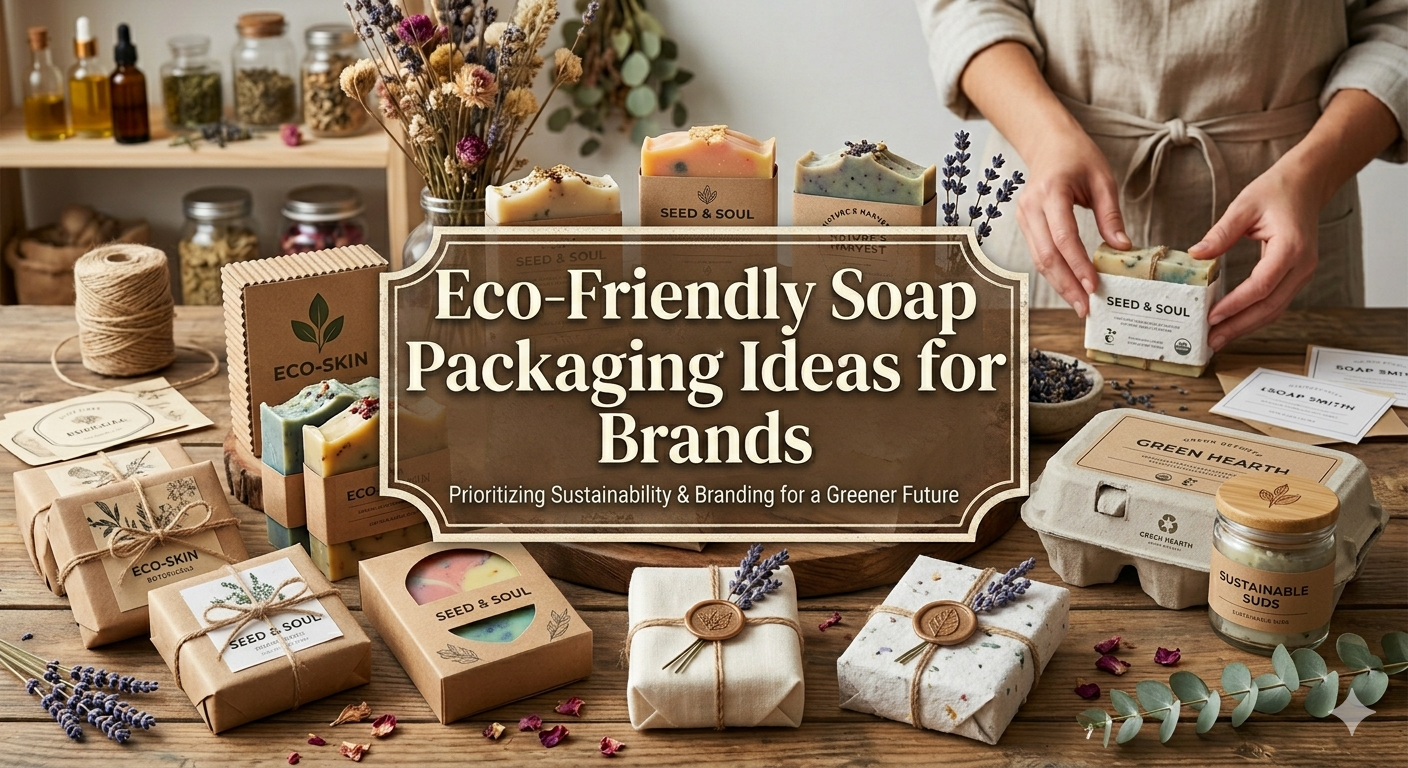
Switching from plastic to kraft paper, recycled cardboard, or compostable wraps counts as eco-friendly soap packaging. These choices cut waste, meet retailer requirements, and tell your brand story before a customer even opens the box.
Three years ago, green packaging was a nice-to-have. Today it sits on the same evaluation sheet as minimum order compliance and lead times.
Natural grocery buyers, wellness boutique owners, and even mid-market pharmacy chains have all tightened their vendor sustainability criteria since 2023. Some of it is regulatory pressure. Some of it is consumer expectations trickling upward through feedback and sales data. Either way, the criteria are real, and they are being enforced.
Beyond retail, your end customers are watching too. People who buy natural and organic soap are not passive. They photograph packaging, and they post it. They write reviews that mention whether the box felt sustainable or wasteful. Your green packaging does real marketing work every single time someone unwraps your product.
Kraft is where most natural soap brands land first, and there are good reasons it has been the go-to for artisan and organic brands for decades.
The material comes from unbleached wood pulp. No chlorine processing. No petroleum-based coating. Curbside recyclable in virtually every major US city and biodegradable on its own timeline without any special composting facility.
From a shelf presence standpoint, kraft reads as genuinely natural rather than packaged-to-look-natural, which is a distinction your customers pick up on faster than you might expect. Pair it with soy-based ink printing and a clean die-cut window box and you have something that works in a Whole Foods planogram and an Etsy shop photo at the same time.
Our custom kraft boxes are available with no minimum order, free design support, and free US shipping. That matters a lot when you are launching a new scent or testing a seasonal product without committing to a full production run.
The post-consumer waste board uses paper products that have already completed a full use cycle. The fiber comes back in, gets reprocessed, and goes into a new box. That closed loop is verifiable in a way that matters to retail buyers.
These boxes qualify for How 2 Recycle labeling. If you have not come across that program yet, it is the label standard that natural retail buyers have started treating almost like a requirement. It removes ambiguity from the sustainability claim. Instead of “eco-friendly” printed on your box with no backup, you get a verified label that your buyer recognizes at a glance.
Sugarcane pulp boxes, seed paper sleeves, plant-based wraps. These are the higher-commitment options, and they come with a premium, typically 20 to 30% above standard kraft on a per-unit basis.
Here is the math that usually surprises founders. On a bar priced between $14 and $22, that cost difference works out to somewhere between $0.18 and $0.30 per unit. At that price point, you are not choosing between sustainability and margin. You are choosing between sustainability and the cost of a single shipping label.
The brand story a genuinely biodegradable package creates is worth considerably more in customer lifetime value than what the material upgrade costs.
A naked bar wrapped in a simple kraft belly band is probably the most underused format in the natural soap category. Minimal material. Clean branding surface. Zero plastic anywhere in the supply chain.
Certified compostable versions carry BPI or TÜV certification. That stamp turns a marketing claim into something verifiable, which matters both to retail buyers running sustainability audits and to end consumers who have learned to spot greenwashing.
One thing worth trying: put a QR code on the band that links to your sourcing story or your farm partnerships. We have seen brands turn that three-centimeter strip of paper into a genuine customer retention tool just by connecting it to something real.
Wholesale is a different challenge than direct-to-consumer. Your packaging goes through multiple handling points before it reaches a shelf. Fulfillment center, distributor warehouse, retail receiving dock, then the floor set.
A 14pt uncoated kraft stock consistently holds up through that chain without requiring any plastic outer wrap or protective insert. More importantly, standardized box dimensions simplify pallet builds, reduce transit damage claims, and make planogram compliance conversations easier with your retail buyers.
Those are not glamorous details. But they are exactly what separates a brand that keeps wholesale accounts from one that loses them after the first reorder cycle.
Most soap window boxes use a plastic film insert to let customers see the product. The eco version either swaps that film for plant-based cellulose, which is home compostable, or skips the film entirely with a clean open-edge cut.
Either approach keeps the box fully recyclable. Your customer still gets to see the actual soap color, texture, and finish before buying. For artisan and premium natural brands specifically, that visual access is often what closes a retail sale at shelf. And at moderate production volumes, the per-unit cost lands comfortably below $1.50 for most standard bar sizes.
The pet care category inside natural personal care is growing fast. Dog shampoo bars, flea-repellent soap bars, grooming soaps formulated for sensitive pet skin. If your product line goes in that direction, your packaging needs to reflect the same values as your human soap range.
Our Custom Dog Soap Boxes use the same FSC-certified kraft board and soy-based inks as our full soap packaging range. No minimum order. Free US shipping. Free design support. The niche-specific format does not carry a custom premium because it should not have to.
Most founders working in this space are surprised to find they can launch eco-certified pet soap packaging at the same cost structure as their core line.
Selling at a farmer’s market or through a small DTC channel is a genuinely different situation than wholesale. Your customer chose you specifically because your product feels personal. That expectation extends directly to the packaging.
Hand-stamped kraft belly bands, twine-wrapped bars with a small branded hang tag, seed paper labels embedded with wildflower seeds, simple tuck boxes with a hand-written batch number. All of these work at low volume. All of them cost less than plastic alternatives. More importantly, they create a physical experience your customer connects to your brand personally and remembers when they come back to reorder.
The consistent mistake we see with handmade soap packaging is treating it as an afterthought. Even a fully manual packaging process can look polished and intentional with the right material choice and a consistent brand mark. Sloppy packaging and a beautiful product send a confusing message. Intentional packaging and a beautiful product send a coherent one.
Want to go deeper on this topic? Click here to read more about handmade soap packaging ideas.
Your retail channel should drive the first cut. Direct-to-consumer brands have more latitude to try premium biodegradable materials and test formats that would not survive a wholesale logistics chain. Wholesale and retail brands need packaging that clears sustainability audits, holds up through distribution, and shows up on shelf looking consistent across multiple stockist locations.
Price point should drive the second. Premium bars at $14 and above can absorb biodegradable material costs without any meaningful margin impact, and the material story adds genuine perceived value. Value-positioned bars should go kraft and PCW board. Same sustainability credentials, lower cost basis, better fit for the price architecture.
Print finish drives the third. According to the U.S. Environmental Protection Agency, paper and paperboard packaging achieves a recovery rate above 89% in the United States, the highest of any packaging material category. Soy-based inks and water-based coatings keep your box in that recovery stream. Metallic foil laminates and wax coatings remove it. That distinction belongs on your retailer pitch sheet.
We work with natural soap brands at the wholesale level consistently enough to know what shows up on retail sustainability review documents.
Five things come up every single time: board stock certification (FSC or PEFC), ink type (soy or water-based only), window film material (no PVC), end-of-life pathway (curbside recyclable or certified compostable), and coating type (no wax that contaminates paper recycling streams).
Our kraft and recycled cardboard range clears all five by default. No modifications, no upcharges, no special requests required.
There is a version of the story that the founder told us where she gets the Whole Foods shelf. She picks the right board stock and she adds the How2Recycle label. She spends one afternoon on it instead of zero afternoons. The purchase order goes through.
That version is available to any natural soap brand operating today. The materials are accessible. The costs are reasonable. The certification pathways are straightforward.
Start with kraft. Add verifiable certifications as your volume and price point grow. Every claim on that box should have something real behind it, because buyers check now. And customers are starting to check too. Ready to Build Your Eco-Friendly Soap Packaging?
PackagingShip works with natural and organic soap brands across the US. Custom eco-friendly boxes. Free design support. Zero minimum orders. No die or plate charges. Free shipping to anywhere in the United States.
Get Your Free Packaging Quote Today →
Uncoated kraft goes into standard curbside recycling in virtually every US city. The one thing to avoid is wax coating or foil laminate on the exterior. Both pull an otherwise recyclable box out of the recycling stream at the sorting facility level.
Kraft tuck boxes and belly bands consistently come in as the lowest cost entry point. At PackagingShip, no minimum order and free US shipping keeps per-unit costs manageable even at 50 to 100 unit quantities.
Yes. Custom-printed eco soap boxes at PackagingShip come with no minimum order, no die or plate charges, and free design support on every order.
Recyclable material goes back into the paper supply chain through standard infrastructure. Biodegradable material breaks down naturally over time without that infrastructure. Both reduce landfill volume meaningfully. Biodegradable costs more per unit and supports stronger sustainability claims in premium retail channels.
Packaging Ship LLC is a leading online packaging platform offering high-quality custom boxes and branding solutions
Company
Contact Info
Copyright 2026 © All Rights Reserved By Packaging Ship LLC