
Picture this: You just received a call from your biggest retail client. Three pallets of your product arrived damaged. The boxes collapsed mid-transit. The items are unsellable. The client wants a refund, and they’re reconsidering the entire relationship.
The culprit? Standard cardboard boxes that looked perfectly fine in your warehouse but failed completely under real shipping conditions.
This scenario plays out across American businesses every single day. And in almost every case, the root cause is the same: someone treated cardboard vs corrugated boxes as the same thing. They’re not. And for any business that ships, stores, or displays products, understanding the difference isn’t just useful, it’s essential.
What Most Businesses Get Wrong About Packaging
Walk into any conversation about packaging, and you’ll hear “cardboard box” used to describe everything from a cereal box to a double-wall industrial shipping container. It’s one of the most common and costly misconceptions in the business world.
To understand the scale of corrugated packaging in America, consider this: according to the Fibre Box Association’s 2024 Annual Report, the US corrugated industry shipped 381 billion square feet of corrugated board in 2024, with a combined industry value of $40.8 billion. Single-wall corrugated alone accounted for nearly 90% of all production. These are not niche numbers. Corrugated packaging is the backbone of American commerce.
Yet businesses across every industry continue losing thousands of dollars annually from product damage caused by under-specifying their packaging simply because the terminology confuses them at the decision-making stage.
What Is a Cardboard? A Clear Definition
Cardboard, also called paperboard, is a single-layer, heavy paper-based material made from compressed wood pulp or recycled paper fibers. It is flat, lightweight, and flexible. You see it every day in cereal boxes, cosmetic cartons, greeting cards, and retail shelf packaging.
How it’s made: Cardboard is produced by pressing and drying moist wood pulp fibers into a single uniform sheet. That straightforward manufacturing process is what keeps its cost low — but also what limits its structural capability.
Common types used in packaging:
- Chipboard: Recycled gray board used for lightweight cartons, puzzle boxes, and backing cards
- Solid Bleached Sulfate (SBS): Premium white board used for cosmetics, pharmaceuticals, and high-end retail
- Recycled Chipboard (CRB): 100% recycled content used in folding cartons and sustainable applications
Where cardboard truly excels is in retail environments, where visual appeal, print sharpness, and lightweight handling matter more than structural strength. It’s the right choice for cosmetic boxes, subscription inserts, apparel packaging, and point-of-sale displays. In other words, anywhere your packaging is seen, not stressed.
How Is Cardboard Manufactured?
Cardboard starts as raw wood pulp or recycled paper fiber mixed with water into a slurry, then pressed and dried under heat into flat, uniform sheets. The process is straightforward, which keeps costs low. But that simplicity also limits structural performance. A single pressed sheet can only bear so much before it bends, buckles, or tears under real shipping conditions.
What Are Cardboard Boxes Used For?
Cardboard performs best where packaging is seen, not stressed. It dominates retail shelf packaging, folding cartons for food and cosmetics, subscription box inserts and dividers, gift and luxury set-up boxes, and point-of-sale display faces. The moment your packaging needs to survive a freight carrier, a warehouse pallet, or long-distance transit, cardboard’s limitations become a liability.
Benefits of Cardboard Packaging
Cardboard offers superior print quality with sharper graphics and finer detail than corrugated. It costs less per unit due to simpler manufacturing. It’s lighter, which helps with dimensional weight pricing on appropriate products. It’s also highly versatile, die-cut, embossed, foiled, and shaped into complex structures easily. For retail-facing packaging where presentation drives purchase decisions, cardboard is genuinely the right tool.
What Is a Corrugated Box? The Engineering Behind the Strength
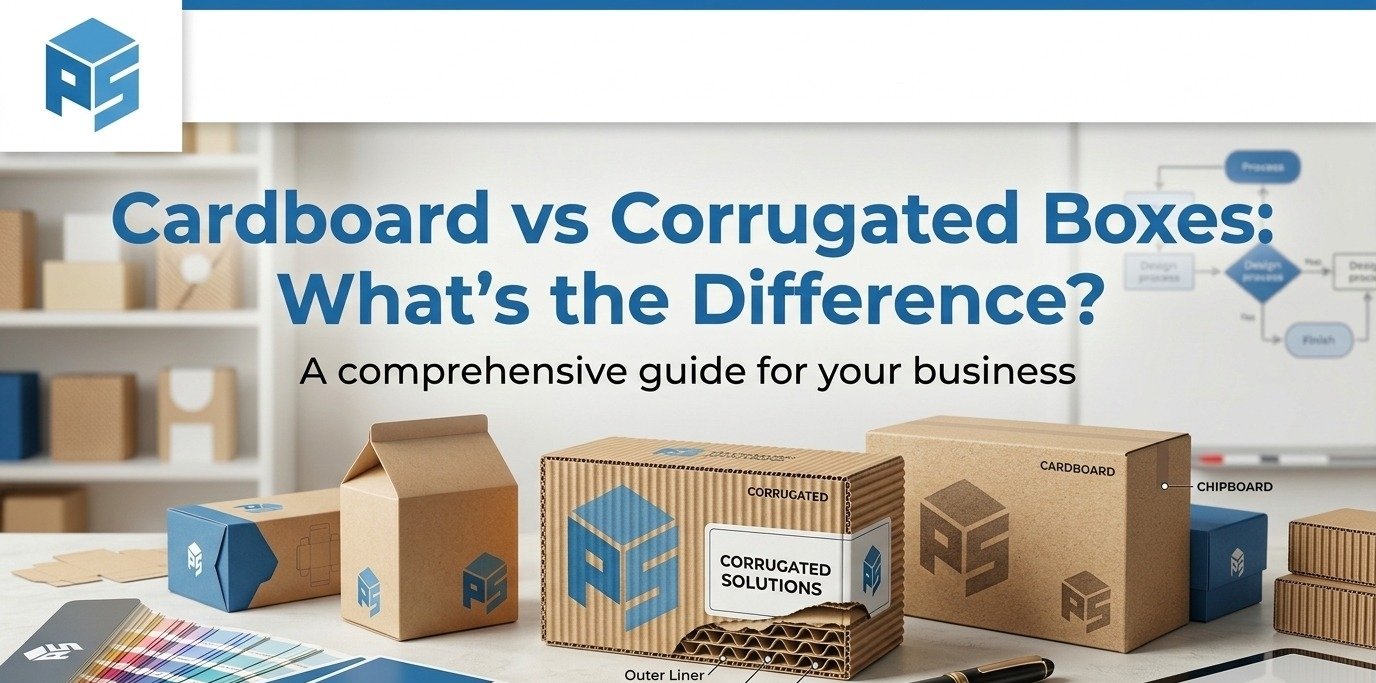
A corrugated box is a multi-layer packaging structure made of two flat outer linerboards sandwiching a wavy, fluted inner layer called the “medium.” This architecture creates a series of hollow columns that provide exceptional strength, cushioning, and resistance to compression — making corrugated the gold standard for shipping and freight.
Here’s an analogy that makes it click: Roman engineers discovered over 2,000 years ago that the arch shape could distribute enormous weight without collapsing. The fluted medium in a corrugated box uses the exact same physics. Each wave is an arch. Hundreds of tiny arches running side by side create a material that supports far more weight than its individual components ever could alone.
The three layers, explained:
- Outer liner: The smooth external face, printable for branding
- Fluted medium: The wavy inner layer, the source of strength and shock absorption
- Inner liner: The smooth internal face that protects the product
Types of Corrugated Boxes
| Type | Layers | Load Capacity | Best For |
| Single-Wall | 2 liners + 1 flute | Up to 65 lbs | Standard e-commerce, retail shipping |
| Double-Wall | 3 liners + 2 flutes | Up to 150 lbs | Electronics, appliances, heavy goods |
| Triple-Wall | 4 liners + 3 flutes | Up to 300 lbs | Industrial, machinery, bulk freight |
Corrugated Flute Types: Which One Do You Actually Need?
| Flute | Thickness | Best Application |
| A-Flute | ~3/16″ | Fragile items, glassware — maximum cushioning |
| B-Flute | ~1/8″ | Cosmetics, canned goods, display boxes |
| C-Flute | ~3/16″ | Standard e-commerce shipping (used in ~80% of boxes) |
| E-Flute | ~1/16″ | High-end retail, luxury packaging, cosmetics |
| F-Flute | ~1/32″ | Ultra-premium packaging, fine food cartons |
How Is Corrugated Manufactured?
Corrugated manufacturing starts at the paper mill, where linerboard and medium paper are produced separately. The medium is fed through heated, ridged rollers on a corrugator machine, forming the distinctive wavy flute. It’s then bonded to the linerboards using starch-based adhesive. The finished board is cut, scored, slotted, and folded into the specific box dimensions you order. Printing is applied via flexographic or digital press. The result is an engineered structure, not just a box.
What Are Corrugated Boxes Used For?
Corrugated is the standard for everything that moves. E-commerce shipping, food and beverage transport, electronics protection, industrial freight, retail floor displays, and pharmaceutical shipping all rely on corrugation. Its combination of strength, cushioning, stackability, customization, and carrier compliance makes it the only responsible choice for any product that faces real-world logistics.
Benefits of Corrugated Packaging
Corrugated delivers where cardboard cannot. The fluted medium absorbs shock and distributes load, protecting fragile and heavy products through rough transit. It stacks reliably on pallets without collapsing. It meets all major carrier compliance requirements. It’s fully customizable in size, print, coating, and insert configuration. And it’s the most recycled packaging material in the United States, maintaining approximately a 90% recovery rate, making it the right call for businesses with sustainability commitments.
Cardboard vs Corrugated: The Side-by-Side Comparison
| Factor | Cardboard | Corrugated |
| Structure | Single flat layer | 3+ layers with fluted core |
| Strength | Low to moderate | High to very high |
| Shock Absorption | Minimal | Excellent |
| Stacking Capacity | Poor | Excellent — built for pallets |
| Print Quality | Superior (smooth surface) | Good (improving with digital print) |
| Unit Cost | Lower upfront | Slightly higher upfront |
| Shipping Suitability | Lightweight items only | Industry standard for all freight |
| Recyclability | High | Very high (91%+ recycling rate in the US) |
| Best Use | Retail display, light packaging | Shipping, storage, freight, bulk orders |
How Strong Is Corrugated? Understanding Box Strength Tests
When you’re sourcing corrugated boxes for your business, you’ll encounter strength ratings. Here’s what they actually mean:
- ECT (Edge Crush Test): The most important rating for shipping. It measures how much vertical pressure a box can withstand before collapsing. A “32 ECT” box resists 32 lbs of force per linear inch along its edge. For standard e-commerce shipments, 32 ECT is the industry baseline. Heavy industrial freight typically requires 44 ECT or higher.
- Mullen Burst Test: Measures how much pressure the walls of a box can take before bursting. Useful when your products could puncture or pierce from the inside during rough handling.
- Flat Crush Test (FCT): Measures how well the fluted medium resists being crushed flat. Critical for boxes that will be stacked horizontally in storage.
A quick rule of thumb: if you’re shipping with UPS, FedEx, or USPS, your carrier’s packaging guidelines almost always specify a minimum corrugated ECT rating. Cardboard boxes alone do not meet those requirements.
Which Box Is Right for Your Industry?
- E-Commerce & D2C Brands: Single-wall C-flute corrugated. It protects through multiple carrier touchpoints and can be fully customized for a branded unboxing experience. This is non-negotiable if you’re shipping more than 100 orders a month.
- Food Service & Perishables: B-flute or E-flute corrugated with moisture-resistant treatment. Ideal for pizza boxes, delivery packaging, and temperature-sensitive products where contamination prevention matters.
- Beauty & Cosmetics: A two-layer approach works best: SBS cardboard for the inner retail box (premium print finish) and B-flute corrugated for the outer shipping carton (protection in transit).
- Electronics & Fragile Items: Double-wall corrugated with custom inserts. For high-value products, this is the only responsible choice. The additional investment in packaging is a fraction of the cost of one damaged return.
- Industrial & B2B Bulk Shipping: Double-wall or triple-wall corrugated, often palletized. Handles heavy loads and warehouse stacking without failure, which matters enormously when you’re moving product at volume.
- Retail Display: Cardboard for shelf-facing display cartons; corrugated for floor displays and POP (point-of-purchase) structures that need to hold weight and stay upright under store conditions.
Eco-Friendly Packaging: Which Is Actually Greener?
Both materials are paper-based and recyclable, but corrugated has a clear edge in real-world environmental performance.
The Fibre Box Association reports that corrugated packaging has maintained approximately a 90% recovery and recycling rate, making it the most recycled packaging material in the United States, well ahead of glass, plastic, and aluminum.
For businesses with ESG reporting requirements or corporate sustainability commitments, corrugated packaging isn’t just the smart logistical choice; it’s a verifiable, documentable one. Your procurement team can cite it. Your sustainability report can reference it. Your customers can trust it.
The American Forest & Paper Association, using updated methodology for 2024, places the corrugated recovery rate at 69%–74% still the highest recycling rate of any packaging material in the country. In 2023 alone,65%-69% of paper was recycled in the United States, equating to 71% to 76% of cardboard recycling products created every single day.
The Real Cost Question: Which Is More Cost-Effective?
Here’s the conversation most packaging guides skip: the true cost calculation entirely.
Yes, corrugated boxes cost slightly more per unit than cardboard. The upfront difference might be $0.20–$0.40 per box. But factor in what happens when the wrong box fails:
Imagine you ship 1,000 units per month. Using cardboard, 3% arrive damaged, that’s 30 returns, 30 refund conversations, 30 potential negative reviews, and the cost of replacement product plus reshipping. Using corrugated, the damage rate drops below 0.5%, that’s 4 or 5 incidents, not 30.
The $200–$400 you save monthly on cheaper cardboard packaging evaporates entirely against the cost of a single high-value return. For businesses shipping fragile, heavy, or premium products, corrugated almost always wins the real cost analysis.
How to Choose: A 5-Question Decision Framework
Run through these before placing your next packaging order:
1. How heavy is your product?
Under 5 lbs and non-fragile? Cardboard may work for retail. Over 5 lbs or fragile in any way? You need corrugated.
2. How far is it being shipped?
Local in-store delivery? Cardboard can handle it. Long-distance freight with multiple carrier touchpoints? Corrugated only.
3. Will boxes be stacked in a warehouse or on pallets?
Any stacking scenario requires corrugation. Look for a minimum 32 ECT rating for standard needs.
4. Does it need to represent your brand?
Both materials support custom printing. For retail display boxes, SBS cardboard delivers finer resolution. For branded shipping boxes at scale, white-top corrugated is the industry standard.
5. What’s your true cost per unit, including returns?
Run the damage-rate math honestly. In most B2B and e-commerce scenarios, corrugated is the more cost-effective choice when you factor in the full picture.
FAQS about Cardboard vs Corrugated boxes
Is corrugated stronger than cardboard?
Yes, corrugated is significantly stronger due to its fluted layers that absorb shock and distribute weight.
Can you ship products in cardboard boxes?
Cardboard works for lightweight, non-fragile items, but corrugated is recommended for most shipments.
Are corrugated boxes eco-friendly?
Yes, they are highly eco-friendly with a high recycling rate and recycled fiber content.
Can corrugated boxes be custom printed for branding?
Yes, modern printing allows for vibrant branding on corrugated boxes in both small and large quantities.
What does single-wall vs double-wall mean?
Single-wall has one fluted layer, while double-wall adds a second fluted layer for added strength.
The Bottom Line
Cardboard and corrugated boxes are not the same, and treating them as interchangeable is one of the most common and costly packaging mistakes American businesses make.
Cardboard is your go-to for retail display, lightweight product cartons, cosmetic packaging, and any situation where print quality and elegance take priority over structural strength.
Corrugated is the industry standard for everything that moves e-commerce shipments, bulk freight, food delivery, electronics, industrial goods, and any packaging that needs to survive a carrier network, a warehouse, and a customer’s front door.
Choosing the right one protects your product, your brand reputation, and your bottom line. And if you’re not sure which specification your business needs, that’s exactly what Packaging Ship is here for.
Read to make the right choice?
The right packaging isn’t just a box. It’s a promise to your customer and to your brand.
At Packaging Ship, we help US businesses make that promise with confidence. Whether you need custom corrugated boxes for bulk shipping, eco-certified sustainable packaging, or a complete solution for your e-commerce operation, we’re your partner, not just your supplier.
Get Your Free Custom Quote Today →