
Last spring, a skincare founder walked into a Sephora vendor review with a product she’d spent nearly a year developing. The buyer opened the box, tested the formula, and nodded. Good stuff. Then she flipped the carton over.
“We updated our sustainability criteria in January. This material won’t pass our scorecard.”
Eight months of work. Rejected over packaging.
I keep hearing versions of this story. Beauty founders are losing retail opportunities not because their product failed, but because the box around it did. In 2026, sustainable cosmetic packaging has become the default expectation from retail buyers, not a bonus they reward you for.
The brands still treating this as a future consideration are finding out the hard way it already happened.
Most definitions make this sound more complicated than it is. Sustainable cosmetic packaging means choosing materials that cause less harm during production, during shipping, and after the customer throws the box away.
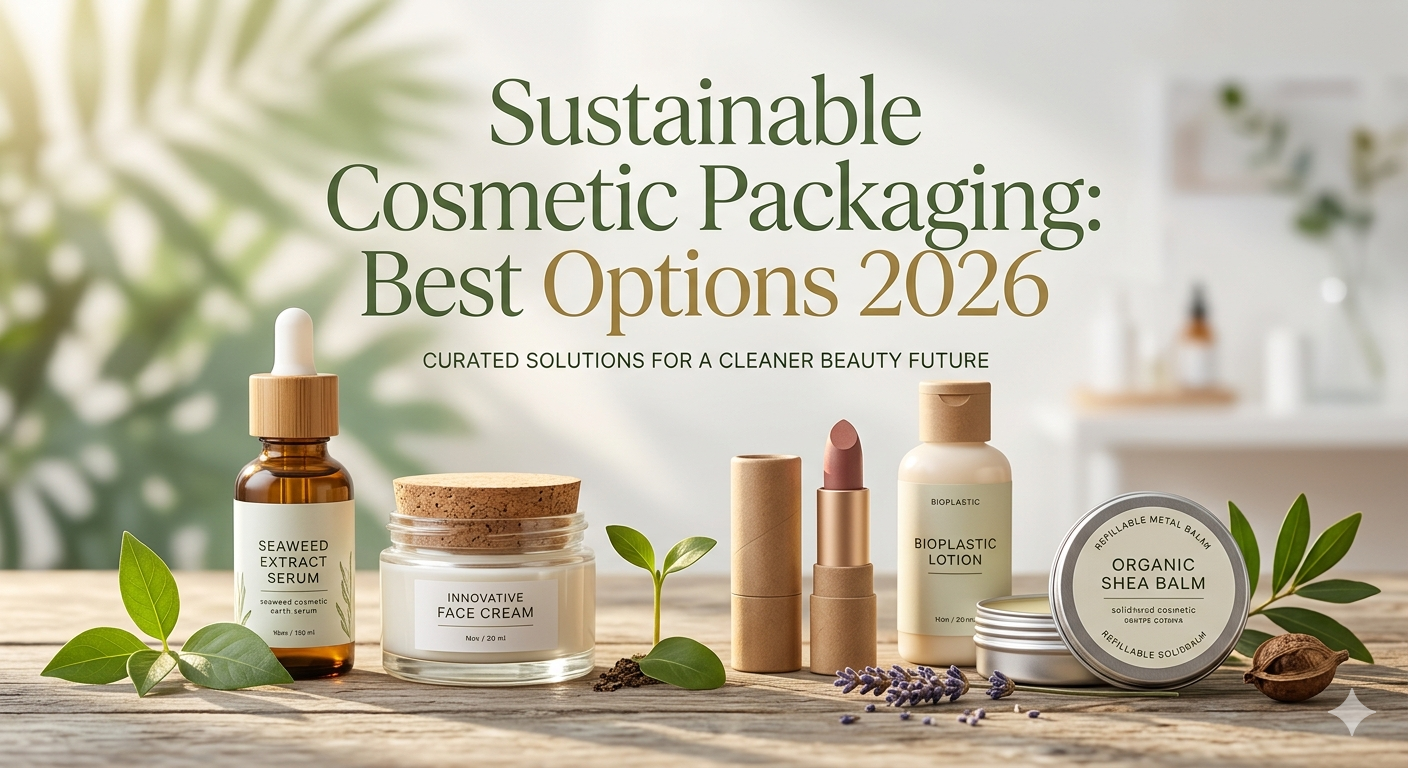
That covers a wide range of options. Recyclable jars made from glass or aluminum. Biodegradable packaging built from plant-derived inputs. Cosmetic containers using post-consumer recycled content. Refillable packaging systems customers top up instead of replacing. Plastic-free packaging options built from paper, glass, or metal.
The practical question isn’t which definition you prefer. It’s which option works for your product and your price point right now.
Here’s where things stand. The global cosmetics industry generates over 120 billion units of packaging waste every year. Most of it ends up in landfills, largely because cosmetic packaging typically combines materials laminated paper layered onto plastic, attached to metal closures in ways that make sorting for recycling nearly impossible. BeautyMatter’s 2026 packaging trends report covers this in detail, including how brands are now being pushed toward mono-material formats specifically to address this.
Retail buyers know this problem well. And they’re acting on it.
Target, Sephora, and Ulta have all introduced formal packaging sustainability reviews as part of new product onboarding. Fail the scoring and the conversation ends before it starts. On the regulatory side, California’s SB 54 requires consumer product packaging to hit 100% recyclability by 2032, with a verified 65% recycling rate built in. The EU’s PPWR regulation moved into full enforcement in August 2026.
I want to be direct about something. Brands in the US sometimes treat European regulation as irrelevant to them. But if you sell internationally, or if you work with any retailer running ESG commitments, these regulations set the standard your buyers are already benchmarking against.
Your outer box speaks before your customer reads a single word of your product copy.
Every material has tradeoffs. Here’s the honest version.
Paperboard is where most brands should start. It’s curbside recyclable in the majority of US cities, straightforward to customize, and accepted without question by major retailers. Paper-based cosmetic packaging grew 40% between 2020 and 2023 as brands rushed to meet new retail requirements. Water-based coatings have improved enough that moisture resistance is no longer the barrier it used to be for secondary cosmetic containers.
If your brand sells through retail channels and you haven’t switched your outer boxes yet, paperboard is the obvious first move.
The shift toward recycled materials in cosmetic packaging isn’t just a trend it’s becoming measurable. Estée Lauder is one of the clearest examples: the company started with just 8.7% PCR content across its packaging in fiscal year 2019, pushed that to 15% by FY2021, and reached 19% by 2023 steady, consistent progress that signals where the premium segment is heading. Looking ahead, the brand has set a target of 25% PCR by 2025 and pledged to bring virgin petroleum plastic down to 50% or less of its total packaging by 2030.
What’s driving this momentum isn’t just pressure from regulators or consumers, it’s the fact that PCR plastic actually works. It holds up structurally, protects against moisture, and performs on the shelf the same way virgin plastic does. That makes it especially well-suited to formats like pump bottles, tubes, and dispensers, where switching to glass or paperboard simply isn’t a practical option. For these product types, PCR isn’t a compromise, it’s the logical next step.
Genuinely infinitely recyclable, and it signals quality in a way other materials simply don’t match. The downside is weight. Heavier shipping means higher freight costs and more breakage risk in transit. For prestige skincare, facial oils, or serums where the weight and feel of the container are actually part of the product experience, glass makes sense. For high-volume mass-market products, the logistics math often doesn’t work in its favor.
Aluminum’s environmental credentials are strong. Recycling requires only 5% of the energy needed to produce virgin aluminum, and European recycling rates for aluminum packaging sit around 75%. In the beauty industry, aluminum is growing fastest in lip balm, deodorant, and waterless concentrate formats. Brands pivoting toward solid or waterless beauty formulations are finding aluminum the most natural packaging fit for the category.
PLA deserves a longer explanation than it usually gets. It’s derived from plant starch — often corn or sugarcane and it does break down under the right conditions. The critical detail is that those conditions require industrial composting facilities. Put PLA packaging in a standard landfill and it behaves almost identically to conventional petroleum plastic. So if you’re considering PLA for your eco-friendly packaging story, you need to honestly assess whether your customers have realistic access to industrial composting. In most US cities, they don’t. If your market lacks that infrastructure, recyclable paperboard communicates your sustainability commitment more credibly.
Material options are one thing. Applying them to specific products is different. Here’s what actually works per category.
Lip balm has constraints most other cosmetic categories don’t. Units are small, SKU counts run high, and direct skin contact means certain materials are off the table entirely. Recycled paperboard sleeves and aluminum tins are the leading formats for retail-ready eco-friendly lip care in 2026. Water-based inks replace solvent-based finishes without sacrificing print quality. Brands making this switch are generally finding it less disruptive than expected, particularly with a supplier who handles custom die-cutting and sizing.
PackagingShip’s Custom Lip Balm Boxes are built around exactly these requirements, with no minimum order if you’re testing a new SKU or launching a smaller run.
Cream packaging has to handle moisture, maintain structural integrity on shelf, and look credible next to premium competitors. Laminated recycled paperboard with water-based coatings now handles all three reliably. The shift away from plastic overwrap on cream boxes has moved fast among brands pursuing retail placement in 2025 and 2026. Retail buyers notice the difference immediately.
Custom Cream Boxes from PackagingShip are designed to meet current retailer sustainability standards while giving you full control over branding and finish.
Most brands focus their sustainability upgrade on the primary container, the pump or bottle, and leave the outer box unchanged. This is a mistake. Retail buyers assess outer packaging first. It’s what gets photographed for category reviews, shared in buyer presentations, and scored against sustainability criteria before the buyer ever opens the product. Switching to PCR-content outer packaging with soy-based inks is one of the fastest changes a lotion brand can make with immediate retail impact.Custom Lotion Boxes are a practical starting point if you want to move the needle on your retailer sustainability score without overhauling your primary containers in the same cycle.
Greenwashing from packaging suppliers is genuinely common. Some of it is deliberate. A lot of it is simply vague language that nobody has challenged yet. Here’s how to get a straight picture before committing.
Ask four specific questions before you sign anything with any supplier.
First: what certifications do they hold, and can they send the documentation today? FSC for paperboard, ISO 14001 for environmental management, and How2Recycle for labeling guidance are the three worth verifying. Self-declared sustainability claims without third-party verification aren’t worth the PDF they’re printed on.
Second: what exact percentage of PCR content is in the specific material you’re ordering — not their product range in general?
Third: what’s their actual average fulfilled lead time over the past six months, not the quoted estimate sitting on their website?
Fourth: do they accommodate small batch orders, or do their minimum order quantities effectively lock out growing brands?
The Sustainable Packaging Coalition, the leading US nonprofit authority on packaging sustainability since 2004 publishes practical guidance on what credible sustainable packaging looks like across material health, reutilization, renewable energy, and end-of-life. Reading through their public resources before any supplier conversation gives you a solid baseline for what to push on.
A supplier worth working with answers all four questions without hesitation. Vagueness on certifications is the most common tell.
Eco-friendly cosmetic packaging typically runs 8 to 15% more per unit than conventional options at equivalent volumes. Worth saying plainly rather than burying in a paragraph somewhere.
What’s also true: that premium compresses as PCR supply chains scale. Refillable cosmetic packaging adoption grew 28% in 2023, according to industry tracking data, and the volume gains are steadily pushing unit costs down for brands already committed to the model.
The longer-term case isn’t complicated. Brands with verified sustainable packaging pass retailer sustainability reviews faster. They generate more earned media from publications covering clean beauty. Among buyers who actively check eco-friendly credentials before purchasing, conversion rates are consistently higher. The upfront cost is real. So is the return.
PackagingShip offers custom eco-aligned cosmetic containers with free US shipping, no die or plate charges, free design support, and no minimum order requirement.
Whether you’re preparing for a retail submission, launching a new skincare line, or replacing a supplier who can’t meet your retailer’s updated criteria we can help you move fast without cutting corners on compliance.
Sustainable cosmetic packaging in 2026 isn’t a trend you can monitor from a distance anymore. Retailer requirements are live. Regulatory deadlines are set. Consumer preferences have shifted from preference to expectation across a large part of the market.
Sixty-five percent of cosmetic brands made public commitments to sustainable packaging. Only 22% followed through as of 2024. The brands in that second group are the ones winning shelf reviews and building retailer relationships that hold long-term.
The path forward is specific: start with secondary packaging, verify certifications before committing to any supplier, and stop waiting for the perfect moment to make the switch.
Packaging for beauty products that causes less environmental harm across its full life, from how the material is made through to how it’s disposed of. This covers recyclable jars, biodegradable packaging, refillable packaging, plastic-free packaging, and formats made with post-consumer recycled content.
Usually 8 to 15% more per unit at similar volumes. That gap narrows at scale, and the payback through faster retail approvals and higher conversion among eco-conscious buyers typically comes within 12 to 18 months.
Yes. PackagingShip offers fully customized eco-friendly beauty product packaging with no minimum order requirement, so brands at early or growth stages aren’t locked out.
FSC for paperboard sourcing, How2Recycle for end-of-life labeling, and ISO 14001 for environmental management practices. All three are independently audited rather than self-declared.
Biodegradable means the material breaks down eventually under sufficient conditions. Compostable means it breaks down within a specific timeframe under specific composting conditions. Neither delivers environmental benefits if your customers’ local waste infrastructure doesn’t support the right disposal route.