
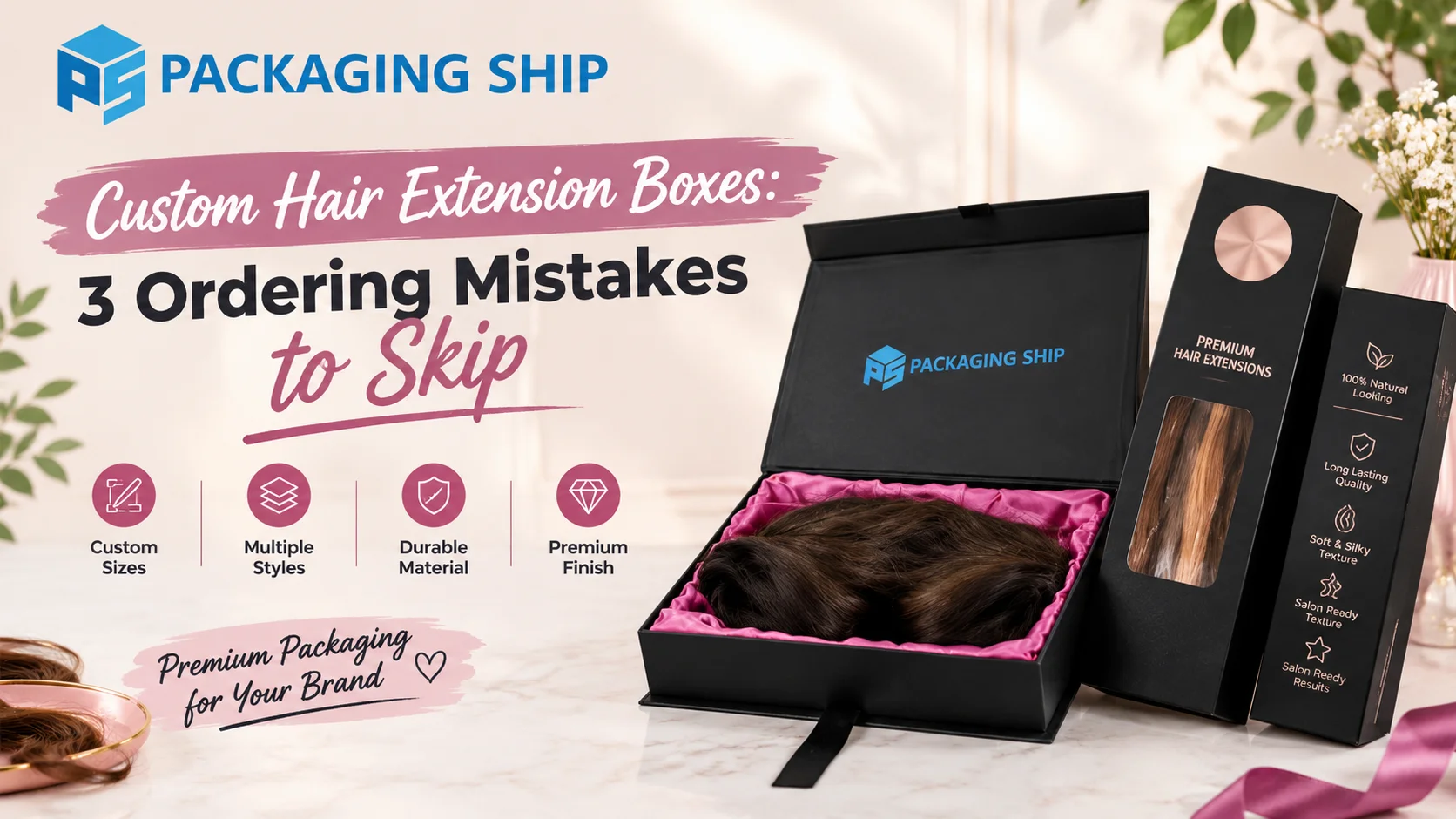
When we say custom hair extension boxes, we mean the printed box your bundles, wefts, clip-ins, tape-ins or wigs actually go out in, with your name on it and sized for your hair. Over the years we’ve noticed that a bad first order nearly always traces back to the same short list. Either the box was cut for hair lying flat when it actually ships coiled, or the customer can’t see a single strand through it, or somebody signed off on 200 units without realizing 400 would’ve been cheaper per box.
Table of Contents
Talk to a few extension sellers and most will admit the hair was the easy bit, and the box gave them more grief than they expected. You can have a bundle that looks perfect on your table. Put it in a box that’s a little too tight or a little too loose, and suddenly it looks squashed, or cheap, or both.
We’ve seen plenty of first orders go sideways, and the reasons repeat. A lid that won’t close over a satin scarf. A reprint bill nobody budgeted for. Boxes sitting on a salon shelf where no one can tell what’s inside. Below are the three mistakes we see most with custom hair extension boxes, and what to do about each one before you sign off on a print run.
Nobody worries whether a candle is “real.” With hair, buyers do. From a photo, it’s hard to tell virgin hair apart from a cheaper blend, so people look at everything else for clues. The box is one of the first.
If it’s thick, the corners are sharp and the lid closes with that little bit of resistance, people assume the hair got the same care, and honestly, when a box feels thin and floppy, they start wondering about the hair too.
That pressure grows as prices go up. Good human hair sets often sell for $150 to $500. Someone spending that much expects the box to feel like it. A national study by Ipsos and the Paper and Packaging Board found 72% of consumers agree packaging design can influence what they buy, and another shopper survey reported by Retail Dive found most people expect better packaging when they order expensive products online. You see the same thing across cosmetic packaging in general, and it’s why fragrance brands put so much into custom perfume boxes. With hair, it matters even more, because the buyer can’t really judge the product until it’s in their hands.
Most reprint requests we get come down to the same problem. Someone measured the hair lying flat on a desk, not the way it actually goes into the box.
Picture a 22-inch body wave bundle. You coil it, wrap it in a satin scarf, maybe add tissue on top. That scarf alone adds real height and width. Your spec sheet didn’t account for it. So either the lid won’t sit flat, the scarf bunches up in a corner, or you overcorrect, and the hair slides around in transit because there’s too much empty space.
Getting the fit right matters for shipping too. In Ryder’s 2026 e-commerce packaging survey, protection during transit was the top reason shoppers gave for preferring boxes over mailer bags. A box that lets the hair rattle around undoes that.
One box size won’t cover your whole range, and here’s roughly why. Bundles and wefts tend to get coiled or doubled over, so whatever height you measured flat is wrong once they’re folded. Clip-in sets sit flatter, but that row of clips running down one side eats more width than people think. With tape-ins you want a shallow tray, otherwise the strips start curling up toward the lid. Halos need a well in the middle so the wire isn’t digging into the cardboard. Wigs and full cap pieces need the most depth, often with an insert to keep their shape.
A quick reference by format:
| Format | Typical Fold Inside the Box | Best Box Style | Window Recommended |
| Bundles | Coiled or folded in half | Rigid or heavy cardboard with extra depth | Yes |
| Wefts | Folded flat or loosely rolled | Shallow rigid tray | Yes |
| Clip-in sets | Laid flat with a raised clip row | Wide, flat cardboard box | Yes |
| Tape-in sets | Flat, stacked strips | Shallow flat tray | Optional |
| Halo and wire | Coiled around a center well | Box with an internal well | Optional |
| Wigs and full cap | Shaped around an internal form | Deep rigid box | No, closed luxury box preferred |
Our advice is simple. Grab one of your actual bundles, fold or coil it the way your packer does on a normal day (scarf, tissue, all of it), then put a ruler on that. Sounds obvious, but it’s the step most people skip, and it’s behind most of the sizing complaints that land in our inbox.
A solid, sealed box looks great on a shelf. Then a customer picks it up, turns it over, and still has no idea what the hair looks like. That’s a lost sale.
People buying extensions want to see the texture, the color, the length. With virgin or Remy hair, where quality swings a lot from brand to brand, they really want to see it.
A hair box with a window fixes this. A clear die-cut window shows the hair while the box stays sealed and protected. If you sell bundle packaging hair or virgin hair boxes custom made for retail, you’ll feel the difference fast. Store buyers don’t like stocking things they can’t check at a glance. Shoppers don’t spend long deciding either. If they can’t tell what’s inside in a few seconds, they move on.
So which should you pick? It depends where you sell. A brand that only sells through its website or Instagram can get away with a fully closed box, since the photos already did the persuading and the customer gets a bit of a reveal when they open it. Salons and boutiques are a different story, and so is anywhere a stranger is picking your box up cold. That’s where we’d push for the window every time. The hair needs to help sell itself.
This one hits your wallet directly.
A brand asks for a quote on 200 boxes. Later they learn that 400 would have nearly halved the price per box. Or a die charge shows up on the final invoice that nobody mentioned. Both happen more often than you’d think.
Two things to know first. Your quantity decides how the boxes get printed. For a small run, say a launch batch or a few hundred to test a new texture, digital printing is usually the sensible route. Once you’re past roughly 500, it’s worth asking about offset. Offset runs off physical plates, which keeps your brand color from drifting between batches, and the more you print, the more that setup cost gets spread thin.
Second, ask about die and plate fees up front. At a lot of manufacturers these run $150 to $800 on top of your unit price, and they often aren’t mentioned until the invoice arrives. When a supplier offers custom hair extension boxes wholesale to the USA no die charge, it should mean that the fee is already built into your quote, not tacked on after you approve the proof.
Three questions worth asking any supplier before your first order:
How a supplier answers those will tell you more than any sample photo.
It’s not only about cost, either. Going back to that Retail Dive piece, the survey behind it had 52% of online shoppers saying they’d likely buy again from a store that shipped in premium packaging. Think about how often your regulars reorder bundles (every couple of months for a lot of them), and that number starts to look pretty relevant. That stat matters.
Once you’ve got these three mistakes in mind, the quote itself is easy. Here’s what we’ll ask you about anyway, so you might as well have it ready.
First, what you’re boxing (clip-ins, tape-ins, wefts, bundles, a halo, a full wig) and how it gets folded, whether flat, coiled, or wrapped in a scarf or tissue. Then material: kraft suits brands with an eco angle (look for FSC-certified board if you want to back that claim up), rigid board gives you the heavy luxury feel, and standard cardboard is fine for everyday retail. Window or closed: depends where the box will sell. For finish, most hair brands pick between matte, gloss, or soft-touch, sometimes with foil on the logo. And give us your real quantity. If it’s 340, say 340 and not “around 300,” since the price per box shifts at different tiers.
At Packaging Ship, that’s the information we work from when we put together custom hair extension boxes, whether it’s a two-bundle box or a deep case for a lace front wig. Before a single sheet gets printed, we send you a digital proof to look over and approve.
| Question | Answer |
| What is a custom hair extension box? | Basically your own branded box, cut to fit your hair the way it’s actually packed. That could mean a coiled bundle, a stack of wefts, a clip-in set or a wig on a form. |
| What size box do I need for hair bundles? | There’s no universal size, sadly. Pack a bundle exactly as you’d ship it, measure it, and leave a little wiggle room. Most “box too small” problems we see started with someone measuring the hair flat. |
| Do hair extension boxes need a window? | If you sell in salons or stores, we’d say yes. People like to check the curl pattern and shade before paying, and with virgin and Remy hair there’s a big difference between suppliers. |
| What is the minimum order for custom hair extension boxes? | That varies quite a bit. Plenty of US printers will start you at 50 boxes on digital, and offset usually becomes worth it somewhere past 500. |
| How much do custom hair extension boxes cost? | Honestly, it depends on size, board and finish. What you shouldn’t see is a surprise die or plate fee on top. Send us your measurements and we’ll give you a proper per-box number. |
If you’re tired of guessing at sizes, send us the fold, the format and how many you need, and we’ll do the measuring math on our end. Request a free quote and a digital proof usually lands in your inbox within a day or two, with no die charge sneaking onto the bill afterward.
We’d boil it down like this. Measure the hair the way it really ships, think about who’s going to be holding the box when they decide whether to buy, and get your real price in writing before anything goes to print. Brands that sort those three out tend to stop thinking about packaging as a headache, and their customers keep coming back for the next bundle.