
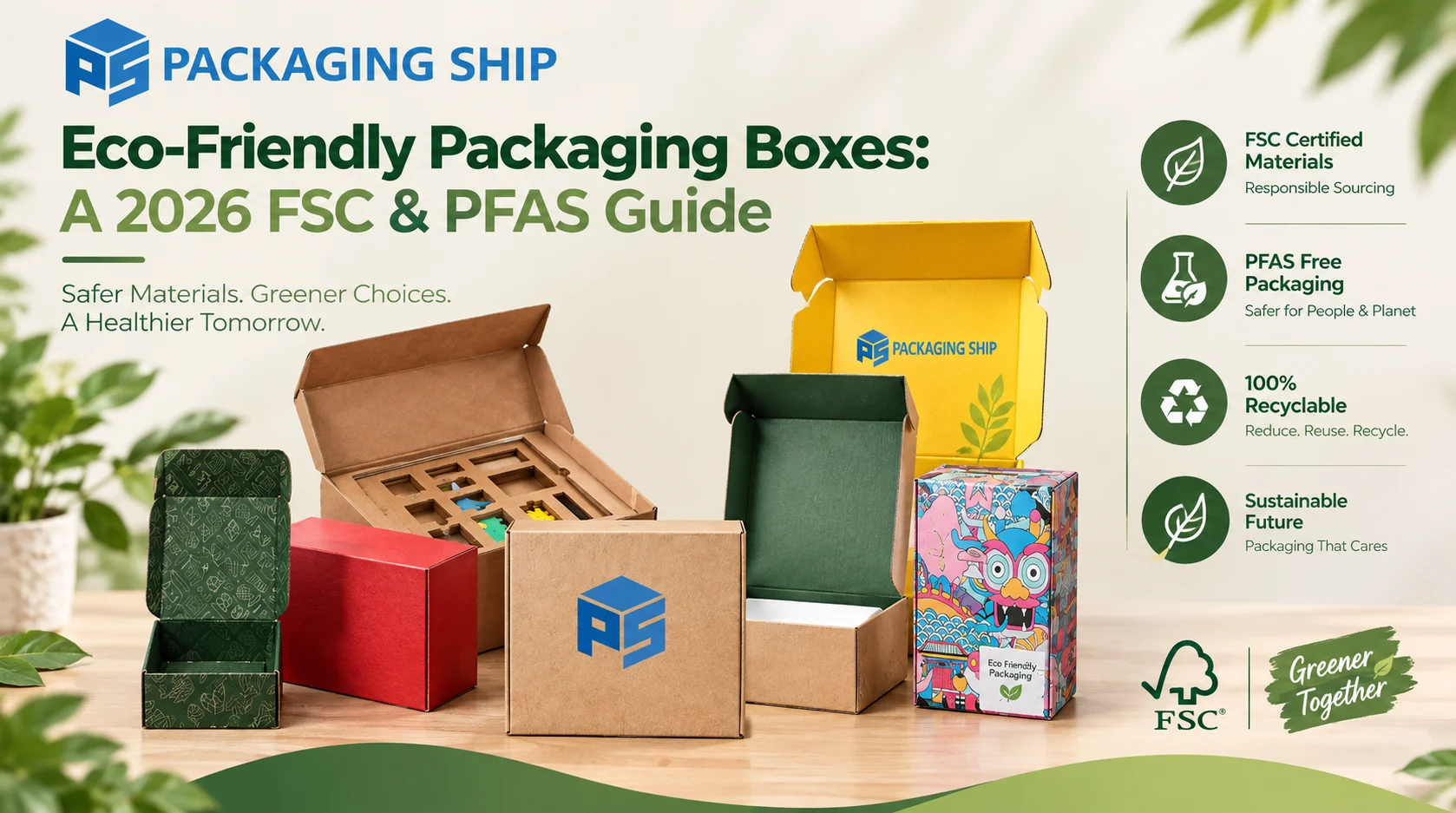
FSC, recyclable, and compostable aren’t interchangeable, and treating them like they are can land your brand in real legal trouble. Below: what each label actually proves, why unverified claims keep landing brands in court, and how to find a supplier who can back up whatever goes on the box.
Eco-friendly packaging boxes are boxes made from certified, recyclable, or compostable material and that material has to meet a real, provable standard, not just look green. The word alone proves nothing. In 2026, US regulators and buyers care about what backs the claim, not the claim itself. A box is only as green as its paperwork.
A small skincare brand I knew of in New York once printed “eco-friendly” on ten thousand boxes before it occurred to anyone to ask the supplier for the license number behind that FSC logo. Nobody checked. The claim wasn’t backed by anything. That gap between what’s printed and what’s provable is exactly where brands get hurt in 2026.
The FTC has said as much for over a decade now. Its Green Guides are blunt about it, broad terms like “green” or “eco-friendly” are nearly impossible to prove, so marketers should stick to specific, provable claims instead of hiding behind the word itself. This isn’t a friendly suggestion; it’s the exact yardstick regulators reach for once they open a file on you.
Which means the question worth asking isn’t whether your packaging is “eco-friendly.” It’s what your supplier can actually prove, on paper, if someone asks. Businesses researching this shift can start with Packaging Ship, where every certified material is documented before it ships.
FSC is short for the Forest Stewardship Council, an independent nonprofit that certifies forests and the products that come out of them. When packaging is FSC certified, it means the paperboard has a documented paper trail back to a forest managed under set environmental and social rules. It doesn’t automatically mean the box is better for the planet in some broader, sweeping sense.
Here’s the part most brands skip. FSC certification is issued to a supplier, with a license number attached to it. If a packaging partner throws around “FSC certified” and can’t hand over that number when asked, that’s your cue to walk. Browsing the full range of eco-friendly packaging options first lets you see exactly which materials carry the paperwork before you commit to a print run.
A box only counts as recyclable if curbside programs where your customers actually live will take the material. Plain kraft and cardboard usually qualify. Foil laminated stock, glossy coatings, and mixed materials often don’t, no matter what the box says.
Why it matters: slapping “100% recyclable” on something most facilities won’t take is exactly the kind of claim the FTC calls out as deceptive. Swap it for “recyclable where facilities exist” instead. It’s a small wording change with a real legal difference.
Compostable packaging USA claims split into two categories, and they are not interchangeable. Industrial compostable material, certified under the ASTM D6400 standard, breaks down in a commercial composting facility with controlled heat and moisture. Home compostable material breaks down in a backyard bin, a much higher bar.
Most of the compostable packaging sold in the US falls into the industrial category, and most American households have no access to an industrial composting facility. That’s not really a reason to skip the material. It’s a reason to say so clearly on the pack. If you want a real example of this done right, look at custom compostable mailers, which are labeled for exactly the composting environment they’re built for.
PFAS free packaging has gone from a nice to have to a legal requirement in a growing number of states. As of 2026, roughly a dozen states, including California, Colorado, Connecticut, Maine, Maryland, Minnesota, New York, Oregon, Rhode Island, and Washington, restrict intentionally added PFAS in food packaging, with Maine’s rule for plant fiber food packaging taking effect May 25, 2026. If you sell food or cosmetics packaging into more than one state, this isn’t optional homework anymore.
The cost side is straightforward. Brands have faced class action lawsuits and FTC settlements running from tens of thousands to millions of dollars over compostable, recyclable, and carbon neutral claims they couldn’t back up. The fix is simple and cheap compared to the risk. Ask your supplier for the certificate, the license number, or the lab report before the word goes on your box, not after.
Here’s the part most brands overlook: the upside. A 2026 consumer packaging survey of 1,000 Americans found 77% trust a brand more when the packaging looks eco-friendly, and nearly a third said they’d pay six to ten percent more for it. But that trust evaporates fast the moment a customer, or a regulator, actually checks the claim and it doesn’t hold up.
Custom kraft boxes do most of the heavy lifting in sustainable packaging. They’re typically unbleached or lightly bleached paperboard in the 300 to 400 GSM range, work fine for retail, shipping, or food use, and can carry FSC eligibility when sourced the right way.
Custom kraft cigarette boxes have to survive daily handling without losing shape, all while leaving room for the mandatory warning panels, and kraft stock still prints clean, sharp branding without the extra coatings that make a box harder to recycle.
Custom kraft pillow boxes fold into shape without tools or glue and work well for samples, small gifts, and subscription add ons, since the format keeps shipping weight low while still looking premium on unboxing.
Soy based inks replace the petroleum in standard offset ink with soybean oil, cutting the volatile organic compounds released during printing without changing color quality, which matters most on higher volume offset runs, and pairs naturally with a plain, unlined format like custom kraft soap boxes where the ink sits directly on visible kraft stock.
Custom vape boxes and disposable vape packaging carry their own compliance load, since most states now require specific warning language and, in several cases, child resistant features, so material choice and print space both need to account for that from the design stage, not after.
Material, weight, and certification vary by box style. Here’s a general specification snapshot to use as a starting point when you brief a supplier always confirm exact figures against the spec sheet for your specific run.
| Packaging Type | Typical Material | Common Weight/GSM | Certification Path | Best Use Case | End-of-Life |
| Custom Kraft Boxes | Unbleached or lightly bleached kraft paperboard | 300–400 GSM | FSC eligible | Retail, shipping, food-safe packaging | Recyclable; industrial compostable option |
| Custom Kraft Pillow Boxes | Kraft paperboard, glue-free fold | 250–350 GSM | FSC eligible | Samples, small gifts, subscription add-ons | Recyclable; home compostable if uncoated |
| Custom Kraft Cigarette Boxes | Kraft paperboard | 300–350 GSM | FSC eligible | Tobacco/CBD retail with warning panels | Recyclable |
| Custom Kraft Soap Boxes | Uncoated kraft stock, soy-ink compatible | 300–350 GSM | FSC eligible | Cosmetics, soap, personal care | Recyclable; compostable if uncoated |
| Custom Compostable Mailers | Certified compostable film or paper blend | Varies by film gauge | ASTM D6400 / BPI certified | E-commerce shipping | Industrial compostable (check facility access) |
A genuinely sustainable box supplier hands you three things without making you ask twice the certificate backing every claim, a material spec sheet, and a straight answer on where the packaging is actually made. If they hesitate on even one of those, you already have your answer.
Ready to move from guesswork to a documented, defensible packaging choice? Request your free, no obligation quote and get real specs, not just a label.
Eco-friendly packaging boxes only mean something when the claim behind them can be checked, dated, and proven. FSC, recyclable, and compostable are three separate standards, each with its own paperwork, and in 2026 that paperwork is what protects your brand from both customer distrust and legal exposure. Ask for the documentation first, then print the claim.
| Question | Direct Answer |
| What does FSC certified mean on packaging in 2026? | It means the paperboard can be traced, step by step, through an audited chain of custody back to an FSC-certified forest — verified by an actual license number, not just a general sustainability claim. |
| Is compostable packaging actually compostable at home? | Only when it’s specifically certified home compostable, not just labeled “compostable” in general. Most US compostable packaging is industrial compostable and needs a commercial facility to break down properly. |
| How do I verify a supplier’s eco packaging claims? | Ask for the FSC license number, the ASTM D6400 or BPI certificate, or the material spec sheet — before you sign off on any claim going on your packaging. |
| Is eco-friendly packaging more expensive? | Not always. Kraft, recycled cardboard, and FSC certified stock often price close to standard materials, especially at low order volumes with no minimum requirement. |
| What is PFAS free packaging and why does it matter now? | PFAS free packaging contains no intentionally added forever chemicals, and a growing list of states now require this for food contact packaging by law. |