
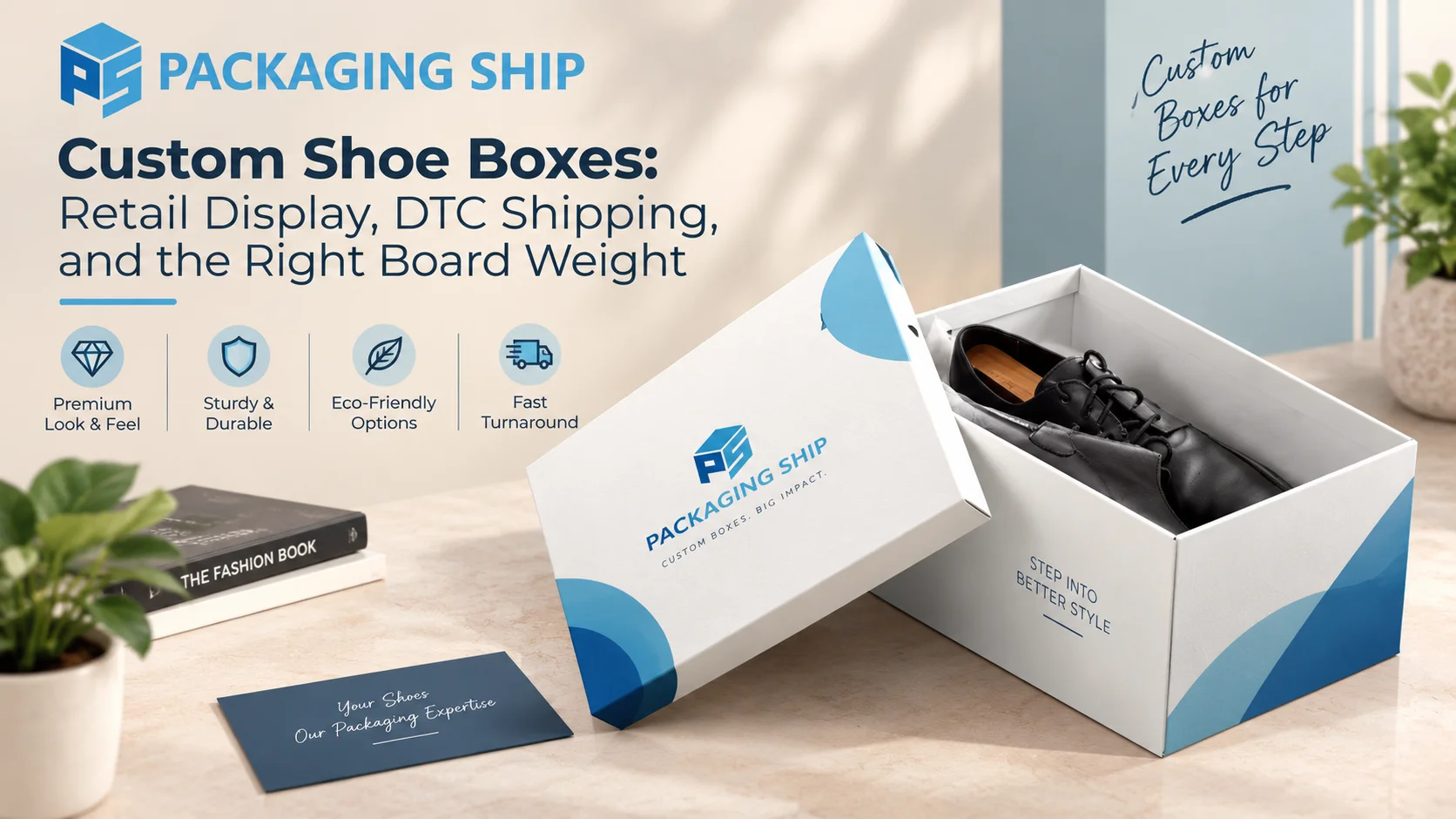
Custom shoe boxes are packaging built for one shoe, one retail job, one shipping route. Not three separate things really, just three pressures on the same box. A box on a store shelf and a box riding in a delivery van look the same in a photo. They are not the same box. Most brands in 2026 spec caliper and ECT ratings before they print anything, not after something shows up crushed.
A sneaker startup ships its first wholesale order to a boutique. The boxes look great sitting in the warehouse, stacked neat and square. Then, three weeks later, the retailer calls. Half the cartons showed up with the corners caved in, because someone in the stockroom piled them five high overnight and left them there. One call like that can end a retail relationship before it really starts.
Here’s what nobody tells you going in: shoe boxes fail in two completely different ways, and most brands only brace for one of them. Stacking failure happens at retail, when the board underneath the print job isn’t rated to hold weight on a shelf or in a crowded backroom. Transit failure is the other one. It sneaks up on brands who already nailed the retail side. A box built to look sharp on a shelf? Often has zero corner protection once it’s riding a conveyor belt or bouncing around in a delivery van.
So when someone says a board is “too light,” that’s rarely about the shoe sitting inside it. It’s really about what’s stacked on top of the box, or what it has to survive on the way there.
Most people just guess at board weight. You don’t have to, not anymore. Two numbers do almost all the real work here.
Caliper, sometimes called point thickness, is simply how thick the board is. A 14pt chipboard is thin and light. Fine, if the product inside never gets stacked on anything. A 24pt rigid board is a different story. It holds its shape under real pressure. Picture the bottom box in a five high stack at a crowded boutique.
ECT stands for edge crush test. It’s a measure of how much weight a corrugated box can take before the walls buckle. Wikipedia’s container compression test entry lays out this method, which is more or less the industry standard for predicting how a box holds up once it’s stacked.
| ECT Rating | Wall Type | Weight Capacity | Stacking Layers | Best Use Case |
| 32 ECT | Single wall | ~65 lbs | 3–4 layers | Most e-commerce and DTC shoe boxes |
| 44 ECT | Single wall | ~95 lbs | 5+ layers | Wholesale and warehouse pallet orders |
| 51 ECT | Double wall | ~140 lbs | Heavy-duty | Bulk/industrial shipping (rarely needed for shoe boxes) |
Those figures come from rating breakdowns published by Cubit Packaging’s ECT guide, for anyone who wants to dig further.
And if your boxes keep showing up crushed? The fix usually isn’t a new supplier. It’s a higher ECT rating or a heavier caliper, decided before the first print run goes out, not after the first angry email.
A retail ready custom shoe box and a DTC shipping box. Different problems, really, even when it’s the exact same shoe sitting inside both of them.
Retail packaging has one job, more or less. Survive a cramped backroom. Stack cleanly on a shelf. It still looks sharp the second a shopper picks it up. It usually skips its own shipping carton. The store gets it in bulk anyway.
A direct to consumer order is a different animal entirely. No shelf involved. It goes straight into a parcel network, bouncing between trucks and sorting facilities for days. So that box needs reinforced corners. A snug fit, so nothing shifts around inside. Often a separate mailer wrapped around the display box too.
Packaging Ship builds both versions out of the same factory. That keeps print colors and branding the same, shelf in Ohio or doorstep in Oregon, doesn’t matter. Ask one box to pull double duty, though, and it usually does neither job all that well.
Footwear brands rarely stick to just shoes, not for long anyway. A streetwear label drops a sneaker collab, and suddenly there’s apparel launching the same week. Every category drags in its own packaging problem.
Say a brand adds swimwear. Now there’s a need for custom swimwear boxes, boxes that can shrug off moisture without crushing something delicate underneath.
Move into intimates and lingerie packaging boxes come into play. Usually smaller. Usually leaning into more of a gift style unboxing moment.
Selling accessories too? Custom tie boxes are sized nothing like a sneaker carton, but they still print to match the same brand kit.
Headwear brings its own version of the same puzzle. A custom hat box has to hold its shape around something curved. Without crushing the brim. It still has to look retail ready sitting right next to the shoes, which is its own small headache. Brands that plan footwear and headwear together, same board logic, same supplier, skip the part where one box looks premium and the other looks like it got packed as an afterthought.
Worth a look if that sounds familiar. The apparel boxes lineup covers most of what a growing footwear brand eventually ends up needing anyway.
Most manufacturers won’t even quote custom printing below 1,000 or 5,000 units. For a brand testing a new silhouette, that’s a lot of money tied up in boxes before anyone knows if the shoe actually sells.
Searching for custom shoe boxes wholesale USA no minimum usually means you’re trying to test a small batch before committing to anything bigger. Digital printing makes that realistic, starting from as few as fifty units, without the die charges or plate fees that quietly inflate a bigger manufacturer’s quote. Standard production takes seven to ten business days. Rush options exist too, for when a launch date just won’t budge.
One more thing before locking in a full run. Ask for a physical proof. Not just a digital mockup, an actual printed sample. Screen colors and board colors rarely match exactly. A physical sample catches that gap before your customer does.
Curious what your own numbers look like? Get a free estimate and you’ll have pricing back the same day.
| Question | Answer |
| What is the minimum order for custom shoe boxes? | Most suppliers want 1,000-plus units before they’ll talk. Packaging Ship starts at 50, no die charges tacked on. |
| What board weight is best for a shoe box? | For retail stacking, 24pt rigid or 32 ECT works well. Heavier wholesale pallets need 44 ECT instead. |
| How much do custom shoe boxes cost? | Somewhere between $0.20 and $0.50 per unit usually, depending on size and how complex the print is. |
| Can I add a window or tissue paper? | Yes, and it’s common. Window cutouts, a shoe box with tissue, both show up a lot on premium sneaker lines. |
| How long does production take? | 7 to 10 business days, once the proof gets approved. Rush options are there if you need them. |
A box that collapses on a shelf, or crushes somewhere in transit, ends up costing more than the box ever did. The reorder. Sometimes the whole account.
Request your free quote here. Shoe size, order quantity, and whether this box needs to survive a shelf, a shipping van, or honestly both.
Custom shoe boxes earn their keep one way: when the board weight actually matches the job. A box built for a crowded retail shelf needs a different spec than one built for a parcel network, full stop. Guess between the two and you get caved in corners, plus a retail buyer who stops picking up the phone. Match the caliper and ECT rating to your real use case. Test a small batch first if you’re launching something new. Do that much, and packaging quietly stops being the weak link in your launch.