
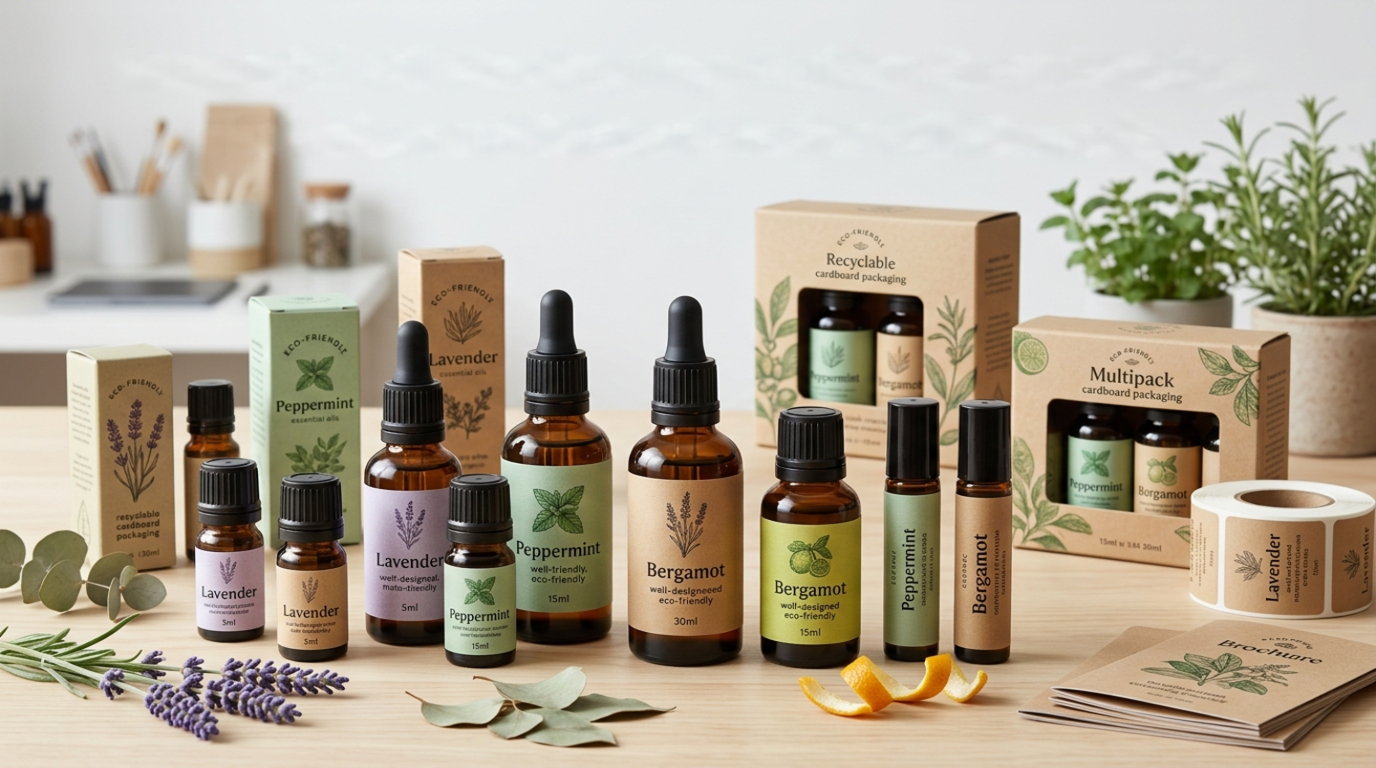
A lavender brand spent eight months perfecting its formula. The scent was incredible. The branding looked sharp. But when it came to essential oil packaging, one critical mistake changed everything. The first bulk shipment landed at a retailer and the labels were already lifting at the corners. Bottles were clouding. Two weeks later, the brand pulled the SKU.
Nothing was wrong with the oil. Everything was wrong with the packaging system around it.
That story plays out more often than most brand owners admit. And it almost always traces back to the same decision point: choosing containers, labels, and boxes based on cost or aesthetics rather than material compatibility.
This guide walks you through every layer of that system—bottles, labels, outer boxes, and compliance—so you get it right before your first order ships.
At its core, essential oil packaging is the full protective system around your product. It starts with the primary container that touches the oil directly, includes the closure and applicator, extends to the label bonded to the container surface, and ends with the outer carton or box that carries everything to its destination. Every layer either protects or undermines what came before it.
This matters because essential oils are chemically aggressive. Terpenes, esters, and phenols react with incompatible plastics, dissolve standard adhesives, and oxidize rapidly when exposed to UV light and oxygen. The packaging has one job: keep those compounds stable until the consumer opens the bottle.
The market reflects how seriously brands are starting to take this. The global essential oil containers market sits at an estimated US$5.7 billion in 2026 and is on track to reach US$9.8 billion by 2033, according to Persistence Market Research. That kind of growth means more competition on shelves and packaging that performs is no longer optional.
Walk into any wholesale supplier and you can get a clear glass bottle for almost nothing. Brands buy them constantly. And brands lose product quality constantly because of it.
Clear glass passes UV light straight through to the oil. Limonene, linalool, and other photosensitive compounds degrade within weeks under fluorescent retail lighting. You will not see it happening, but your customers will taste it, smell it, and return it.
Amber glass is the standard for good reason. It filters out more than 97% of UV wavelengths, keeping photochemically unstable oils intact from production through to the consumer’s shelf. Cobalt blue glass offers a middle ground moderate UV protection with strong visual differentiation and works well for brands targeting premium wellness retail where the aesthetic carries real commercial weight. Green glass provides some UV resistance and occasionally makes sense for market differentiation, but amber remains the technically superior choice for most SKUs.
Glass currently holds around 63.7% of the essential oil containers market, according to the same Persistence Market Research data, largely because nothing else matches its chemical inertness for undiluted therapeutic-grade oils.
The three primary bottle formats for essential oil bottle packaging come down to application:
It has most therapeutic and wellness applications. The precision dispensing, tamper-evident closure options, and oil-resistant glass pairing make them the workhorse format across the industry.
It has worked particularly well for topical blends and travel sizing. The stainless steel or glass roller ball keeps contamination from fingertip contact out of the bottle entirely, which matters for skin-contact products sold in the wellness channel.
It suits room sprays, linen mists, and heavily diluted blends. One firm rule here: if your oil concentration exceeds 5%, do not use HDPE or PET. The terpene load will degrade the polymer over time. Glass is the only responsible call at higher concentrations.
They are acceptable for carrier-heavy formulations where the oil concentration is low. PET handles moderate concentration reasonably well. Neither replaces glass for undiluted oils at any commercial scale.
Most small brands discover label incompatibility the hard way after production, after shipping, sometimes after retail placement. Standard paper stock looks fine on a dry bottle. Once oil residue hits the surface during filling or consumer use, the adhesive softens, the material absorbs moisture, and the label starts peeling from the edges inward.
BOPP biaxially oriented polypropylene solves this. It resists oil and moisture exposure, stays bonded on cylindrical glass surfaces where other materials lift, and maintains adhesion in the humidity variations typical of warehouse storage. Wizard Labels and Blue Label Packaging both confirm this as their recommended base material for essential oil bottle labels, and the practical results across brands back that up consistently.
For finish selection, think about the channel first. Matte polypropylene reads premium in the wellness and natural beauty channel it feels considered and high-end without being loud. Gloss finishes amplify color and work well for mass retail or high-visibility SKUs. Soft-touch laminate signals luxury positioning and commands a price premium in gifting and spa retail. Hot foil stamping and embossing push perceived value further and tend to pay off on hero SKUs where the unboxing moment justifies the cost.
One practical note most suppliers will not tell you upfront: specify a high-tack adhesive explicitly if your bottles will move through cold-chain storage or experience significant temperature swings. Standard adhesive formulations fail at the label edges within a few weeks of cold exposure. It is a cheap specification upgrade that prevents expensive relabeling runs.
The compliance section of any packaging decision is where brands most commonly underinvest. Then they receive a warning letter.
Under FDA 21 CFR, whether your essential oil product is classified as a cosmetic or a drug depends entirely on the claims you make on the label and in marketing. An oil labeled for aromatherapy enjoyment is a cosmetic. An oil your label describes as able to “relieve stress” or “support immune function” is a drug and drug labeling, registration, and approval requirements are an entirely different regulatory category. The distinction lives in your wording, not your formulation.
Every compliant essential oil label must carry: the product identity statement, net quantity declared in both metric and US customary units, the responsible party’s name and address, a full ingredient declaration in descending order by weight using INCI nomenclature, and any required warning statements for the specific formulation.
Under the Modernization of Cosmetics Regulation Act (MoCRA) of 2022 now being fully enforced through 2025 and into 2026 all cosmetic labels must also include domestic contact information. Consumers need a way to report adverse events directly to the manufacturer. Labels missing this element are now considered non-compliant under FDA’s updated enforcement posture.
The wellness consumer increasingly treats packaging sustainability as a purchasing criterion, not a bonus. Retail buyers in the natural channel now ask about it during line review. Ignoring it is a positioning choice with real commercial cost.
The practical options that work at commercial scale right now: FSC-certified kraft paperboard for outer cartons, post-consumer recycled glass for primary containers, recycled HDPE for carrier-oil bottle applications, and water-based inks across all secondary packaging. Each of these is available from qualified suppliers without a significant lead time premium.
Refillable bottle programs are gaining meaningful traction in the premium segment. Brands that sell a refill SKU alongside their standard line report stronger repeat purchase rates and lower return volumes. The environmental credential also supports retail positioning in the natural and wellness channels where those conversations happen during buyer meetings.
Getting essential oil packaging right is a system decision. The bottle protects the oil. The label material protects the brand experience. The outer box protects the customer relationship. Compliance protects the business from regulatory exposure. Each layer depends on the one before it.
The essential oil containers market is heading toward US$9.8 billion by 2033. Brands that build a proper packaging system now correct materials, compliant labels, structurally sound outer cartons will hold their shelf position as that market grows and competition intensifies.
Packaging Ship makes professional-grade custom oil packaging accessible at every stage of growth: no MOQ, free US shipping, no die charges, free design support from day one.
Start With a Free Packaging Quote Today →
PackagingShip builds custom essential oil packaging with free US shipping, zero die or plate charges, and no minimum order quantity. Every order includes free design support. You get production-grade packaging from the first box.
Get Your Free Custom Packaging Quote →
Amber borosilicate glass. It filters over 97% of UV light and does not react chemically with terpene-rich oils. Nothing else matches that combination of UV protection and chemical inertness for undiluted essential oils. HDPE is a viable option only for heavily diluted carrier-oil formulas.
For D2C and retail distribution, yes always. Glass containers do not survive courier handling without structural protection. An outer box also gives you branded surface area that drives repeat purchase and handles the retail stocking requirements most buyers impose before a product can go to shelf.
BOPP with a high-tack oil-resistant adhesive. Standard paper labels absorb oil residue from filling and handling and start lifting within days. BOPP stays bonded, resists moisture, and keeps the label looking clean through the full product lifecycle.
Your label needs: product identity, net quantity in metric and US units, manufacturer name and address, ingredients listed in INCI format in descending weight order, and required warning statements. Under MoCRA, domestic contact information for adverse event reporting is also now mandatory.
No. You can order custom-printed tuck-top boxes, mailer boxes, and rigid gift cartons at any volume. That flexibility makes it practical to test new SKU packaging or run seasonal variations without committing to large production runs.