
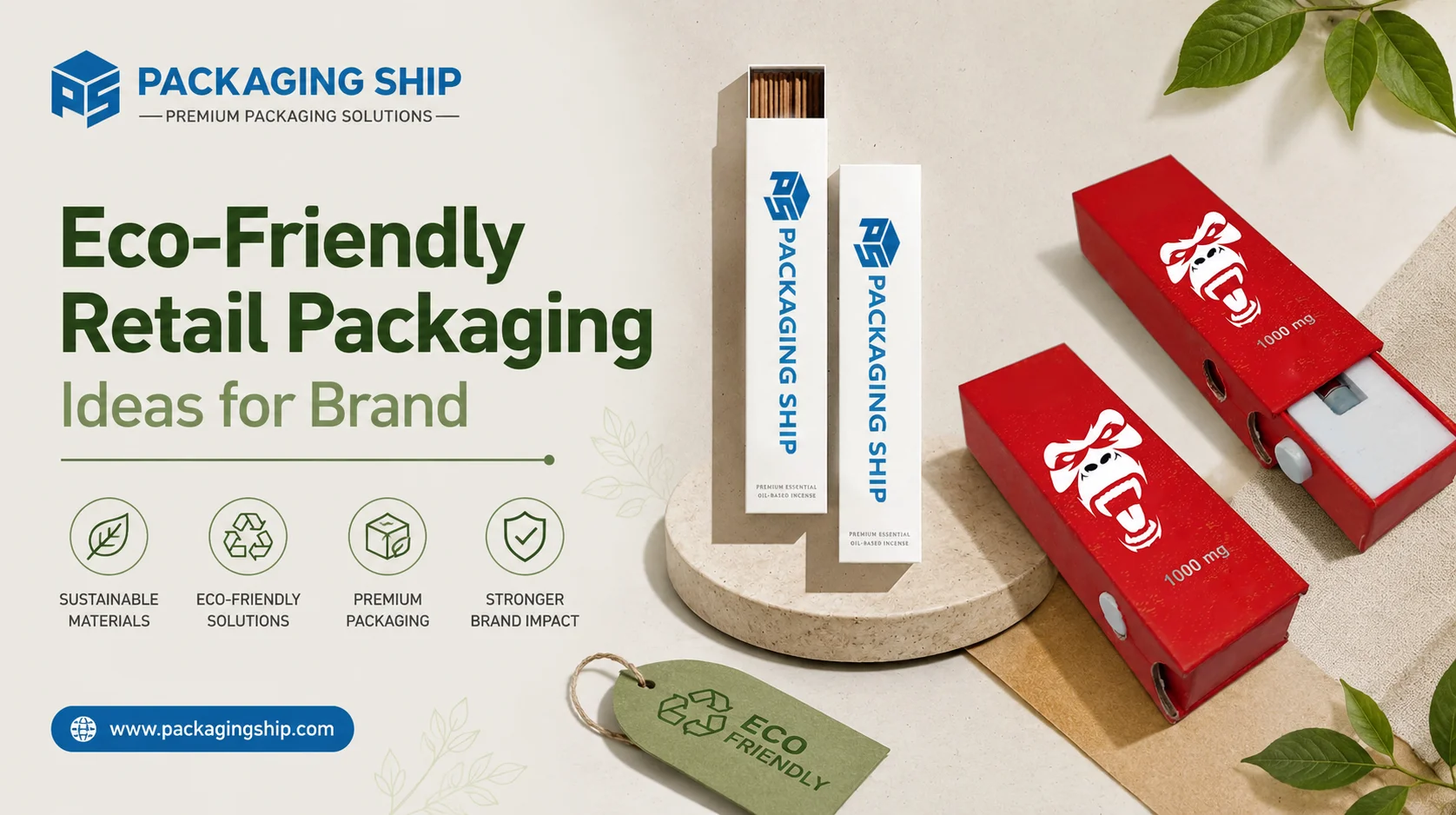
Last spring, a CBD skincare founder in Denver lost a $38,000 Whole Foods placement. Her formula was solid. Her price point was right. But when the category buyer flipped the box over and asked about the packaging’s sustainability credentials, she had nothing.
That story repeats itself every week across the US natural products industry.
Retail buyers in 2026 carry checklists. Eco packaging credentials sit near the top of those checklists. And yet most brand founders still treat sustainable retail packaging as something they’ll figure out “later”, usually right before a buyer meeting, when it’s already too late to change anything.
This guide gives you the practical decisions, not the textbook definitions.
EcoPackables’ 2026 market blog cited, 54% of US consumers chose products with sustainable packaging in the past six months, and 39% have already switched brands specifically over packaging sustainability. That is not a niche trend. That is mainstream consumer behavior your retail buyer sees reflected in sell-through data every quarter.
So let’s talk about what actually works.
Walk into a buyer meeting at any regional natural grocery chain today. Before you finish your pitch, someone in that room will ask whether your boxes are FSC-certified, whether your mylar bags are compostable, or whether your cartons contain recycled content.
The US sustainable packaging market sits at $51.23 billion in 2025 and is projected to reach $76.92 billion by 2035, according to Towards Packaging’s 2026 industry report. That growth is not driven by brand altruism, it is driven by purchasing managers, retail shelf requirements, and state-level Extended Producer Responsibility laws that are tightening across California, Colorado, Oregon, and New York.
For brands in CBD, wellness, and pharma, the stakes go one layer deeper. You need packaging that checks the eco box and the compliance box simultaneously. Most packaging vendors treat those two requirements as separate conversations. They are not. Your material choice, closure mechanism, and barrier spec are all the same decision.
Get that decision right upfront, and you spend zero time backtracking before your next buyer meeting.
Kraft paper has been around forever, but the reason it dominates sustainable retail packaging in 2026 is not nostalgia, it is performance. It is FSC-certifiable, it prints cleanly with soy-based inks, and it biodegrades without leaving microplastic residue.
For botanical, wellness, and incense product lines, kraft retail boxes do something plastic-coated white boards never can: they tell the sustainability story before the customer reads a single word. The material itself communicates that your brand made a deliberate choice.
Kraft tuck boxes are particularly strong for mid-range retail price points, the material feels intentional without reading as cheap. If your brand sits in the $18–$45 retail range, kraft with a matte spot UV finish hits a visual premium that converts at shelf.
Our Custom Incense Packaging uses FSC-certified kraft with full custom print options and zero die-charge setup costs.
Best fit: CBD tinctures, botanical supplements, herbal accessories, incense, loose-leaf tea.
There is a version of sustainable packaging that photographs beautifully and fails in a warehouse. Recycled corrugated is not that.
Recycled corrugated board gives you the flute structure you need for transit protection alongside the eco-credentials your retail buyers want on paper. It accepts water-activated tape, which removes plastic tape entirely from your fulfillment process, a detail some buyers actually ask about during vendor audits.
Paper and paperboard packaging held a 38.7% share of the global sustainable packaging market in 2025 (Data Bridge Market Research), the largest segment by material type. That share exists because the material works at scale, not just on brand mood boards.
For e-commerce brands shipping direct-to-consumer alongside retail, our Custom E-Commerce Packaging uses recycled corrugated board with full print customization so your unboxing experience stays on-brand across every channel.
Best fit: E-commerce fulfillment, multi-SKU product lines, subscription boxes, retail-ready shipper displays.
Most eco packaging guides stop before they get here. This is exactly where CBD and cannabis brands need the most specific information, and where most vendors leave you guessing.
Biodegradable retail packaging means materials that break down naturally in soil or industrial compost within 90 to 180 days without leaving toxic compounds behind. What matters for regulated industries is that biodegradable options now exist in child-resistant formats.
Biodegradable rigid boxes built with push-and-turn closures meet CPSC child-resistance standards. Resealable compostable mylar bags satisfy state cannabis packaging regulations in California, Colorado, Michigan, and Illinois. You genuinely do not have to choose between compliance and sustainability, but you do have to choose a packaging partner who has done this before.
Our Custom Child Resistant Boxes are manufactured with eco-compatible board options that satisfy compliance requirements without defaulting to virgin plastic. That combination is not common in the market.
Best fit: Cannabis concentrates, CBD edibles, pre-rolls, THC vape cartridges, pediatric supplements.
A lot of brands assume going eco means giving up the premium unboxing experience. That assumption is wrong, and it costs those brands shelf space at higher-end retailers.
Rigid boxes built with recycled grey board and wrapped in FSC-certified paper qualify as sustainable packaging materials. They also last longer, which reduces the per-use environmental footprint compared to lightweight single-use alternatives. Add water-based inks and plant-based adhesives, and the entire structure is clean from a material safety standpoint.
For pharma and nutraceutical brands, this matters beyond aesthetics. Material safety documentation is increasingly required by retail buyers in the health category, and eco-liners help you check that compliance box faster.
Our Custom Pharmaceutical Packaging is built to regulatory-grade specifications with eco-material upgrade options available at no additional tooling cost.
Best fit: Pharmaceutical supplements, nutraceuticals, luxury skincare, premium wellness kits.
Standard mylar is a laminated plastic film. It works. It also sits in a landfill for 400 years.
Compostable mylar, made from PLA derived from cornstarch, delivers the same oxygen and moisture barrier performance without the petrochemical footprint. It carries ASTM D6400 and BPI compostability certification, which are the two marks your retail buyers actually recognize.
Brands switching from standard mylar to compostable alternatives often notice something specific: the certification badge on the bag becomes a conversation starter with buyers, not an afterthought. One pre-roll brand we worked with told us their distributor used the BPI certification in a category pitch deck to a grocery buyer, it became a selling point for the entire brand.
Best fit: Pre-rolls, cannabis flower, powdered supplements, protein blends, loose teas, snack brands.
This one gets dismissed as a gimmick. It is not.
Seed paper is made from post-consumer recycled paper embedded with wildflower or herb seeds. The customer plants it after unboxing. It generates zero waste. And it generates a disproportionate amount of organic social content, customers photograph themselves planting it, tag the brand, and caption it without prompting.
Used as a hang tag or thank-you insert rather than primary packaging, seed paper adds a brand story dimension that costs pennies per unit. For boutique wellness and CBD brands targeting eco-conscious demographics, few packaging choices generate as much return per dollar spent on organic social reach.
Best fit: Wellness accessories, herbal skincare, artisan candles, boutique gifting, brand subscription boxes.
When a retail buyer says “sustainable packaging,” they are almost always referring to something specific. Brown kraft without a certification mark often does not satisfy a formal vendor sustainability audit.
Know these four before your next buyer meeting:
Paper and board from responsibly managed forests. The gold standard for kraft packaging, corrugated, and rigid board. Most major US natural retailers require it or give preferential treatment to vendors who carry it.
Verifies compostability to ASTM D6400. Required by most municipal composting programs and increasingly referenced in state cannabis packaging regulations.
Issued by the Sustainable Packaging Coalition. Tells retail buyers and consumers that your packaging has been formally assessed for recyclability in the US collection system. Increasingly common on retail shelf evaluation forms.
Widely accepted by North American retail buyers as an FSC equivalent. Useful if your production partner is SFI-certified rather than FSC-certified.
At PackagingShip, our production partners carry FSC chain-of-custody certification. We help you identify which certification applies to your material choice and retail channel before production starts, included in your consultation, not billed separately.
Eco-friendly choices never exist in isolation from your broader retail product packaging strategy. Material weight, print finish, structural style, and closure mechanism all work together — and changing one variable mid-production usually means changing others. If you want to explore how sustainable materials fit across your complete retail packaging lineup, from tuck boxes and display packaging to rigid boxes and pouches, you can read more about our full range here: Custom Retail Packaging by PackagingShip.
Retail buyers have seen this move. Greenwashing claims, even unintentional ones, get flagged during vendor audits. Only use sustainability language for materials verified by a recognized third party.
A beautiful compostable box that fails a CPSC drop test costs you your retail placement and potentially triggers a product recall. Design for compliance first. Optimize for sustainability within that boundary.
High-moisture products in uncoated kraft fail on the shelf within weeks. Oily formulations can bleed through unlined boards. Match barrier properties to your product before choosing based on visual mood boards.
Every eco-friendly retail packaging idea in this guide is something your brand can order and ship within a realistic production timeline, no massive MOQ, no tooling investment, no design retainer required. The brands winning shelf placements in 2026 made their sustainability decisions at the packaging stage, not as a retrofitted afterthought six months after launch.
At PackagingShip, we produce custom sustainable retail packaging with free US shipping, free design support, no die or plate charges, and no minimum order quantity , for CBD, pharma, wellness, and e-commerce brands across the country.
Ready to Switch to Eco-Friendly Retail Packaging?
Talk to our packaging team today. Get compliance guidance, material samples, and a free custom quote with zero obligation and zero surprise fees.
Get Your Free Eco Packaging Quote →
FSC-certified kraft paper and recycled corrugated cardboard are the most accessible and cost-effective options for most product brands. For high-barrier product categories, BPI-certified compostable PLA delivers sustainability without sacrificing the moisture and oxygen protection your product requires.
Yes, with the right construction. Kraft board, recycled rigid board, and compostable mylar can all be engineered to meet CPSC child-resistance standards and state cannabis packaging regulations simultaneously. The closure mechanism and material thickness are the key variables, not the eco status of the material itself.
Kraft retail boxes are often priced comparably to standard white boards. Compostable mylar carries a modest premium over standard mylar, typically 10 to 18 percent, which most brands recover through retail buyer differentiation and consumer willingness to pay.
FSC, BPI, How2Recycle, and SFI are the four most commonly requested by US retail buyers. Carrying at least one transforms your sustainability claim from a marketing statement into a verified fact.
Yes. Recycled grey board wrapped in FSC-certified paper, printed with water-based inks and assembled with plant-based adhesives, meets pharmaceutical-grade material safety requirements while satisfying retail sustainability audits. Several US state pharmacy boards now explicitly encourage sustainable packaging materials where product integrity is not compromised.