Custom Window Boxes for Retail: Which Film, Which Placement, and Which Board Weight?
TL;DR: Put the barcode on a solid board before you draw the window, and keep both away from folds and seams. Match board to cutout: 14pt, 18pt or 24pt carton, or rigid for heavy products. Name your film, PET or PVC, on the proof. Custom window boxes retail buyers accept start there.
Retail Window Boxes: The Three Inspections Every Box Must Pass
Before a window box sells, it gets looked over three times. A receiving clerk scans it. A stockroom stacks it. Then a shopper picks it up, which is the only inspection most brands plan for. The custom window boxes retail teams approve have passed all three. At Packaging Ship, we cut, print and finish window packaging for retail at our own factory in Valley Stream, New York.
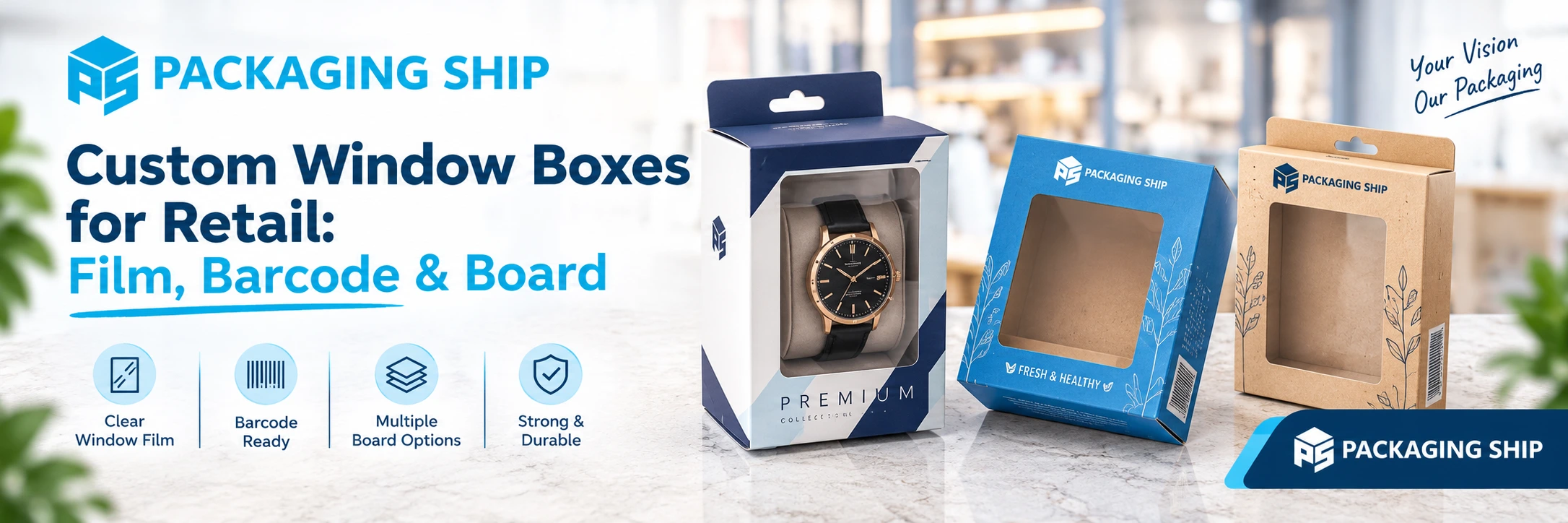
A display window box is just a carton with a die-cut opening and clear film glued behind it. That gluing step is called window patching. It works best for cosmetics, candles, bakery items and gifts, products good-looking enough to sell themselves.
Inspection 1: Window Placement and Barcode Rules at the Receiving Dock
Start with the scanner, because it has no opinion about your design. If it can’t read the UPC, the shipment can be rejected, however good the window looks. The GS1 symbol placement guidelines are blunt about it: no barcode, quiet zone included, on perforations, die-cuts, seams, edges, folds or flaps. (The quiet zone is the blank margin a scanner needs on either side of the bars.) They also want the barcode 8 mm (0.3 in) to 100 mm (4 in) from the nearest edge where possible, ideally on the lower right of the back. A window is a die-cut, so treat the opening, plus a margin around it, as off limits. In practice, draw the barcode and its margin first and fit the window around them, then print the dieline at 100% and hold a ruler to it before you sign off the proof. Routing guides differ from one retailer to the next, so read yours while you finalize custom retail packaging for a big-box account.
Window Placement on Triangle and Other Non-Rectangular Boxes
Non-rectangular boxes give you less flat surface to work with. Triangle boxes carry their die-cut window on the top or one side face, so work out which flat face is left for the UPC before the artwork goes to approval.
Inspection 2: Which Board Weight Holds a Window Box? (14pt, 18pt, 24pt)
Match board weight to window size. Every window takes board out of the panel, and what’s left still has to carry the stack. Our retail range runs 14pt, 18pt and 24pt folding carton in SBS paperboard or kraft, plus 1 to 1.5 mm rigid chipboard for two-piece boxes. A decent rule of thumb is to go up one weight as the window takes over more of the panel, then test a sample stacked to your real case count. Tumbler boxes show the idea well: they’re built from 18pt or 24pt boards for retail and gifting, with an insert fitted to the vessel’s diameter and taper.
Inspection 3: Do You Need a Window, and Which Film? PET vs PVC
Ask first whether you need a window at all. A series of seven studies with 2,157 participants, summarized by City St George’s, found that windows raised purchase intention for appealing products but not for unappealing ones. Among 867 nut, trail mix and seed products on Kroger’s US site, 25% had a window and 62% were fully opaque, so window what looks good and print the rest. Film comes next, and PET vs PVC usually comes down to buyer rules and recycling claims. Clear PVC is the familiar choice. PET is the alternative when a buyer asks for a PVC-free window box retail spec. An open die-cut skips film entirely, though dust and fingerprints can reach the product. And since a cube has no built-in front, on custom cube boxes you have to pick the window face and the barcode face on purpose.
Display Window Box: How the Shipper Becomes the Retail Display
If the carton should double as a counter display, perforated packaging adds a scored tear strip. Staff pull off a panel and skip the repacking, so it arrives as retail-ready packaging. Just keep the window, the tear line and the barcode apart, since GS1 bars barcodes from perforations too.
What to Send for a Custom Window Box Quote (No Die Charges)
For custom window boxes retail orders, gather these before you ask for a price:
- Length, width and depth, in inches
- Quantity (no minimum order; we start at 50 units)
- Window size and position, with the barcode zone marked
- Film: PET, PVC or open die-cut
- Board: 14pt, 18pt, 24pt or rigid
- Finish, such as matte, gloss, soft-touch or spot UV
- Retailer rules and how many SKUs you’re ordering
The estimate form only has fields for dimensions and quantity, so put items 3 to 7 in the message box. Wholesale custom window boxes in the USA come with no die charges, a free digital proof within 24 to 48 hours, and free FedEx or UPS shipping.
FAQS About Window Box Packaging
| Question | Answer |
| Can you put a barcode on a window box? | Yes, but only on solid board. Keep it off the die-cut, folds, seams and flaps. |
| How big should the window on a retail box be? | Ask your supplier for the minimum margin to fold and glue flaps, then match the board weight to the cutout. |
| Should I choose 18pt or 24pt for a window box? | Go with 24pt or rigid if the product is heavy or the window is large. |
| Is a clear window carton recyclable? | Often the film has to be separated from the paperboard, so check local rules and ask for the film spec. |
| Is shipping free on custom window boxes in the USA? | Yes. We ship free by FedEx or UPS to the continental US. |