
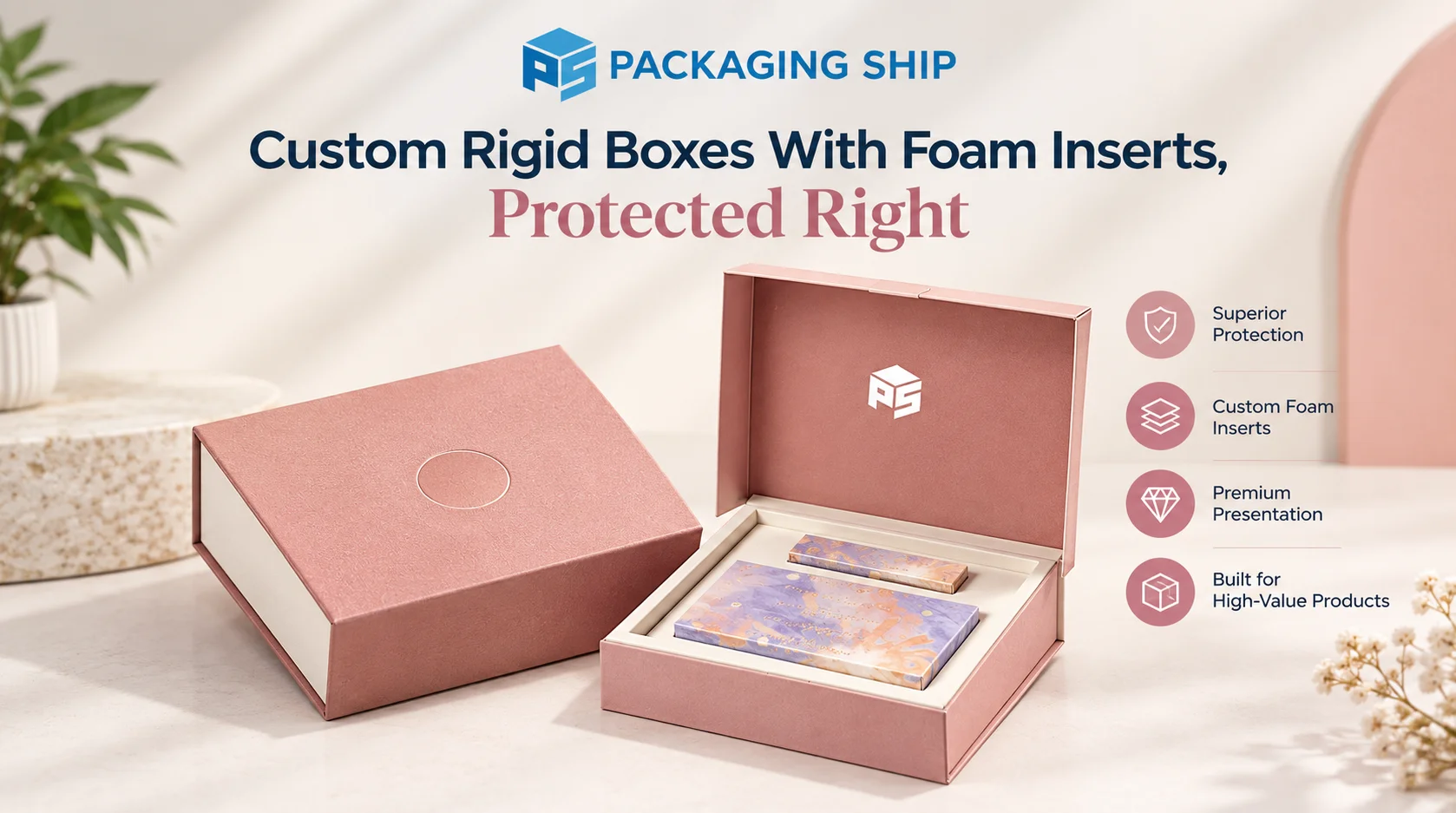
TL;DR: Custom rigid boxes with foam inserts only work when the foam matches the product’s real shape, not the spec sheet. Pick the right foam type, the right density, and the right cut, then test it before a full run. That is protection without wasted spend.
In this article:
Picture this. Your product ships out looking perfect. It arrives with a crushed corner or a scratch that was not there before. Ask around and you will hear the same story from a lot of small brands: about two boxes out of every ten come back damaged, and foam gets blamed first. Custom rigid boxes with foam inserts are built to stop exactly this problem, but only when the foam fits the actual product. At Packaging Ship, we treat this as a specification problem first and a packaging problem second. The box is strong. The foam looks fine. The fit is off by a few millimeters, and that small gap is where the damage starts.
A rigid box with a foam insert is a sturdy box made from thick paperboard, fitted with a foam piece cut to hold the product in place. The foam cradles the item so it cannot shift, slide, or knock against the box wall. Brands use this setup for glass, electronics, cosmetics, and anything that cannot survive a rough ride through a delivery truck.
Most foam failures are not about bad foam. They are about a bad fit. A cavity gets cut to match a spec sheet, not the finished product coming off the line. Real products vary by a millimeter or two, and foam does not forgive that gap.
Die cut tolerance is the part nobody talks about. Most foam cutting runs within one to two millimeters of the target size. For a glass bottle or a ceramic piece, that is enough space for the product to knock against the cavity on every turn of a truck. That single gap is why so many custom rigid boxes with foam inserts get blamed for damage that was never really about the foam.
The fix starts before you pick a material. It starts with cutting the insert from the actual product, not the drawing. Brands that order custom rigid boxes from a factory that checks fit at this stage report far fewer damage claims.
Not every product is a simple rectangle, and that is where foam earns its keep.
For flat, compact items, a shallow foam layer with a tight edge works best. You see this in compact rigid packaging like credit card boxes, where even a small shift can scuff the surface before it reaches a customer.
For round or tall items, the foam needs a curved cavity that hugs the shape on every side. This shows up in cylindrical packaging such as custom tube packaging, where bottles and jars need support all the way around, not just top and bottom.
Three foam types cover most cases. EVA foam holds its shape under repeated pressure, so it fits heavier items or reused packaging. PE foam is lighter and cheaper, a solid choice for one time shipping. PU foam is soft and springy, better for delicate curves.
Use this as a starting point when you request a quote. Exact specs are always matched to your product during the design proof stage.
| Spec | Typical Range |
| Box material | Rigid chipboard or greyboard, 36pt to 48pt |
| Foam material options | EVA foam, PE foam, PU foam |
| Foam density | Roughly 18 to 35 kg per cubic meter, based on material |
| Foam thickness | 0.5 inch to 2 inches, custom cut on request |
| Cavity style | Single cavity, multi cavity, cradle cut, finger pull cutout |
| Finish options | Matte, gloss, soft touch lamination, foil stamping |
| Minimum order | Starts at 50 units |
| Standard turnaround | 7 to 10 business days |
| Shipping | Free FedEx or UPS shipping within the continental US |
| Sampling | Free digital proof, physical sample available on request |
Foam adds a small cost per unit. Damage adds a lot more.
Amcor reports that damaged ecommerce shipments push return rates well above normal in store returns, and replacing a damaged item can cost several times more than the original shipping label. A cracked bottle does not just cost one refund. It often costs a repeat customer.
This is why testing beats guessing. ISTA, the International Safe Transit Association, publishes packaging test standards built around real shipping stress, drops, vibration, and rough handling included. Running a design through a real test before a full production run catches a bad foam fit before it ever reaches a customer.
If you are comparing rigid boxes foam inserts custom wholesale USA options, resist the urge to pick the thickest foam out of fear. A well built foam insert rigid box does not need to be oversized to work. Pick the foam and the cut that match your product’s weight and shape. That is protection without overspending.
| Question | Quick Answer |
| What foam works best for fragile items? | EVA foam suits heavy or reused items. PU foam suits delicate, curved products needing a soft cradle. |
| How thick should a foam insert be? | Most run between half an inch and two inches, based on product weight and drop risk. |
| Can foam inserts be recycled? | Standard foam is hard to recycle at home. Molded pulp and rigid card inserts are common alternatives. |
| Do foam inserts raise packaging cost much? | Foam adds a small per unit cost, usually far less than a damaged product plus a return. |
| Is there a minimum order for custom foam? | Some manufacturers cut custom foam starting at fifty units, with no large minimum required. |
Every quote request for custom rigid boxes with foam inserts should start with your product’s real dimensions, not a generic template. Stop guessing on thickness and density.
Fragile products do not need the thickest, most expensive foam on the shelf. They need an insert cut to their real shape, made from a material suited to their weight, and specs that were checked before production started. That is the whole point of custom rigid boxes with foam inserts done properly. Get the die cut tolerance right, pick EVA, PE, or PU based on what you are shipping, and test the fit before a full run. Do that, and you protect the product and the margin at the same time.