
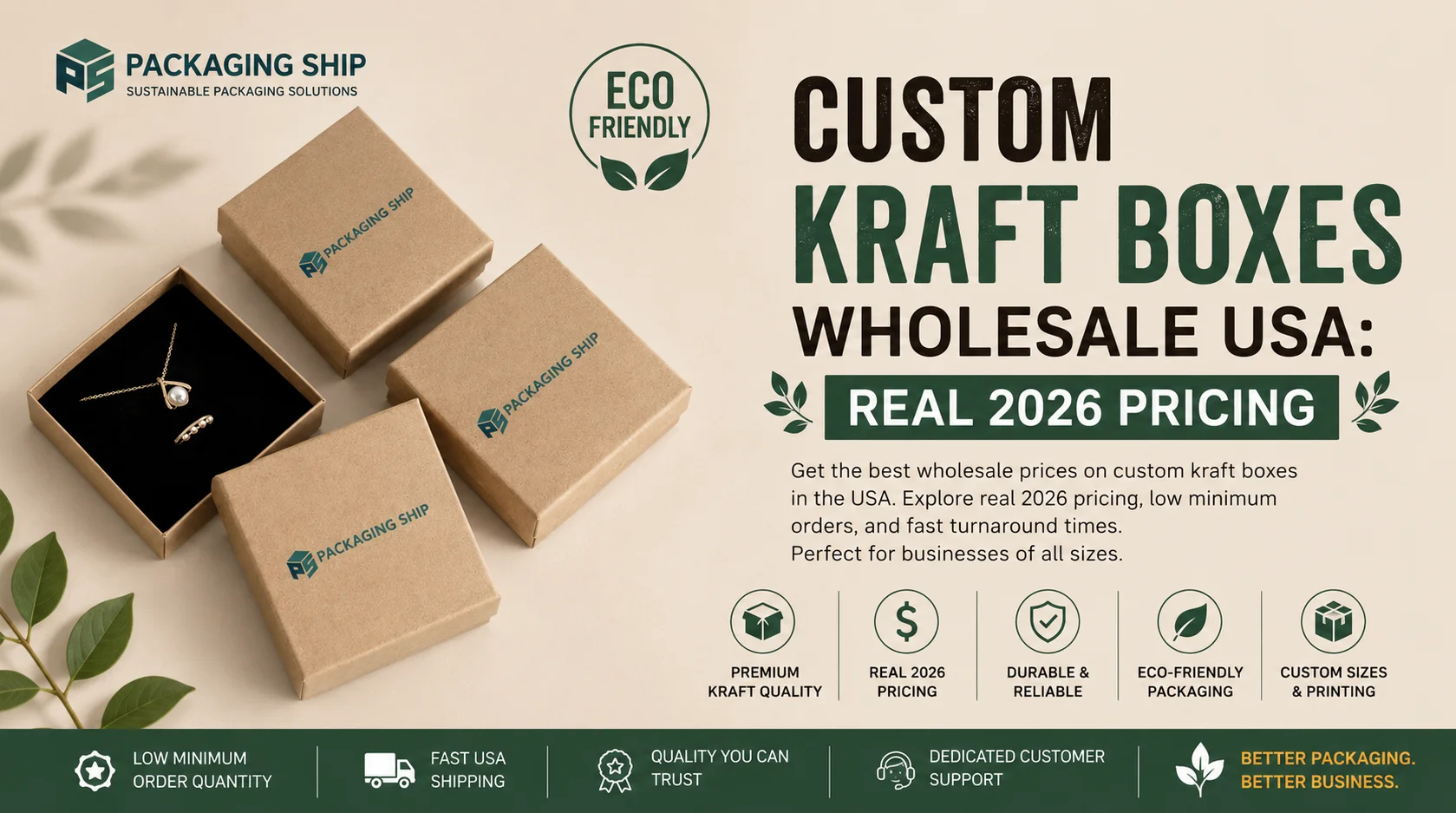
TLDR: Expect to pay $0.20–$0.55 per box, depending on size, ink coverage, and quantity. You don’t need a 1,000-unit commitment; several U.S. manufacturers, Packaging Ship included, will run as few as 50–100 units, turn a digital proof around in under two days, and ship finished boxes in 7–10 business days.
We got an email at 11:40 p.m. last spring from a founder launching a skincare line. Her exact words: “Every supplier I’ve called wants 2,000 units minimum. I need 150 for my first drop.” That’s not an unusual message, it’s the single most common one we get from first-time brands.
The good news: that 2,000-unit wall isn’t a law of physics, it’s a leftover from how offset printing works. A wholesale kraft box, in plain terms, is a natural unbleached kraft paper box printed and cut to your size and logo, priced per unit, where cost drops as volume climbs. What changed in the last few years is that digital printing lets manufacturers run small batches without eating a loss, which means the minimum-order wall doesn’t have to apply to everyone anymore.
Most packaging sites make you fill out a form just to see a number. That’s backwards, so here’s what actual quotes look like.
At Packaging Ship, pricing runs $0.20 to $0.55 per box. A plain mailer box in a single ink color at 500 units sits near the bottom of that range. A small tuck box with a full-color coated finish at 100 units sits closer to the middle, smaller runs simply cost more per piece because there’s less volume to spread setup costs across. If your product needs more structural protection in transit, it’s worth comparing kraft against our corrugated shipping boxes line, which sit in a similar price range.
Three things move that number the most:
One line item to watch for: many suppliers tack on die charges ($200–$800) and plate fees ($150–$500) after the quote. Packaging Ship folds both into the unit price, so what you’re quoted is what you pay, no add-ons at checkout. You can see this reflected directly on our free quote form, where the number you get back is the number you’re billed.
| Quantity | Print Method | Typical Price/Unit | Turnaround |
| 50–100 units | Digital, 1–2 colors | $0.45–$0.55 | 7–10 business days |
| 100–300 units | Digital, full color | $0.35–$0.45 | 7–10 business days |
| 300–500 units | Digital, full color | $0.28–$0.35 | 7–10 business days |
| 500–1,000 units | Offset, full color | $0.22–$0.30 | 10–14 business days |
| 1,000+ units | Offset, full color | $0.20–$0.25 | 10–14 business days |
Yes, 50 units is a real minimum order, not a marketing line. You don’t need to commit to 1,000 or 5,000 boxes just to get your logo printed.
The reason most manufacturers still enforce big minimums comes down to plates. Offset printing needs them, plates cost real money to produce, and suppliers recoup that cost by spreading it across thousands of boxes. Order 100 units through that process and you’re effectively paying for capacity you’ll never touch.
Digital printing sidesteps the plate step. A manufacturer can print your exact design on 50 boxes as easily as 5,000, no setup cost to amortize. Packaging Ship runs digital for anything under 500 units and switches to offset above that line, where plates finally start paying for themselves.
If you’re still validating a product before committing warehouse space, this is the part that actually matters: you can launch on a small run, see how customers respond, and reorder based on real numbers instead of a guess sitting in a storage unit.
Nobody selling kraft boxes wants to bring this up, but it’s a fair question: kraft is uncoated. Ink sits differently on it than it does on smooth white board.
Because the surface is porous, ink soaks into the fiber a little instead of sitting on top of it. Pastels and pale colors, think blush pink or soft yellow, can come out a shade more muted than they would on white stock. That’s not the same as looking washed out or cheap. It just means the design has to be built for the material, not fought against it.
Black, dark tones, and simple one- or two-color logos print cleanly on raw kraft at standard 300 DPI CMYK, whether the run is digital or offset. If your brand leans on brighter, more saturated colors, ask about a white ink undercoat, it goes down before the main design and restores full color punch while keeping the natural brown edge visible around it.
Digital printing tends to be the better call for small-batch orders specifically because it handles fine text and gradients more cleanly on raw stock than older offset setups did at low volume. If your logo has a small type or a photo-based element, it’s worth asking your supplier directly whether they’d recommend digital for that specific file before you sign off on a proof, or send it to our design and proofing team directly and they’ll flag it for you.
“Eco-friendly” gets slapped on packaging copies constantly with nothing behind it. Worth separating the marketing from what’s actually verifiable.
Kraft paper is genuinely recyclable and breaks down naturally, that part’s true regardless of branding. But the word “eco-friendly” only carries weight when there’s a certification attached. FSC certification specifically means the Forest Stewardship Council has verified the wood pulp came from a responsibly managed forest. That’s the line to look for on a spec sheet, not just the word “eco” on a landing page. Our own eco-friendly packaging line is built around this distinction, certified stock first, marketing language second.
Recycled kraft, made from post-consumer fiber, is the other verifiable route, and it’s gaining ground fast. Virgin kraft paper held about 72% of the kraft paper market in 2025, but recycled kraft is the fastest growing segment as more companies pursue circular sourcing, according to market research firm Global Market Insights.
There’s also a business case here, not just an environmental one. A 2018 Ipsos study conducted for the Paper and Packaging Board found that 72% of consumers say packaging design influences their purchasing decisions, with a similar share saying the material itself shapes how they judge a product. Raw, unbleached kraft tends to read as intentional and authentic to shoppers rather than as a cost-cutting choice, which is part of why it’s held on as a packaging trend well past when people expected it to fade.
Here’s what the actual process looks like, no guesswork:
Realistically, that’s from blank ideas to boxes on your doorstep in about two weeks — no phone calls required.
| Question | Answer |
| How much do custom kraft boxes cost per unit? | Typically $0.20–$0.55, depending on box size, ink coverage, and how many you order. |
| Is there a minimum order for kraft boxes? | No, digital printing has made 50–100 unit orders realistic without a bulk commitment. |
| How do I order 100 custom kraft boxes with a logo? | Request a free quote, approve a digital proof (24–48 hours), then wait 7–10 business days for production and free U.S. shipping. |
| Does kraft paper print logos clearly? | Dark colors and simple logos print sharp on raw kraft. Bright or pastel colors may need a white ink undercoat to hold their saturation. |
| Is kraft packaging actually eco-friendly? | Only when it’s backed by something verifiable, FSC certification or recycled content, not just the word “eco-friendly” in the copy. |
| How long does custom kraft packaging take to produce? | Standard production is 7–10 business days after proof approval; rush is 4–5 business days. |
You don’t need a five-figure order to get packaging that actually looks like your brand. If you’re testing your first 100 units or setting up a recurring monthly order, pricing should be visible upfront, minimums shouldn’t lock out small brands, and the boxes that show up should match the proof you signed off on.
Request a free custom kraft box quote → No die charges. No plate fees. No minimum standing between you and your first run. Curious how kraft compares to our other sustainable packaging materials? They sit in the same price range and ship on the same timeline.