
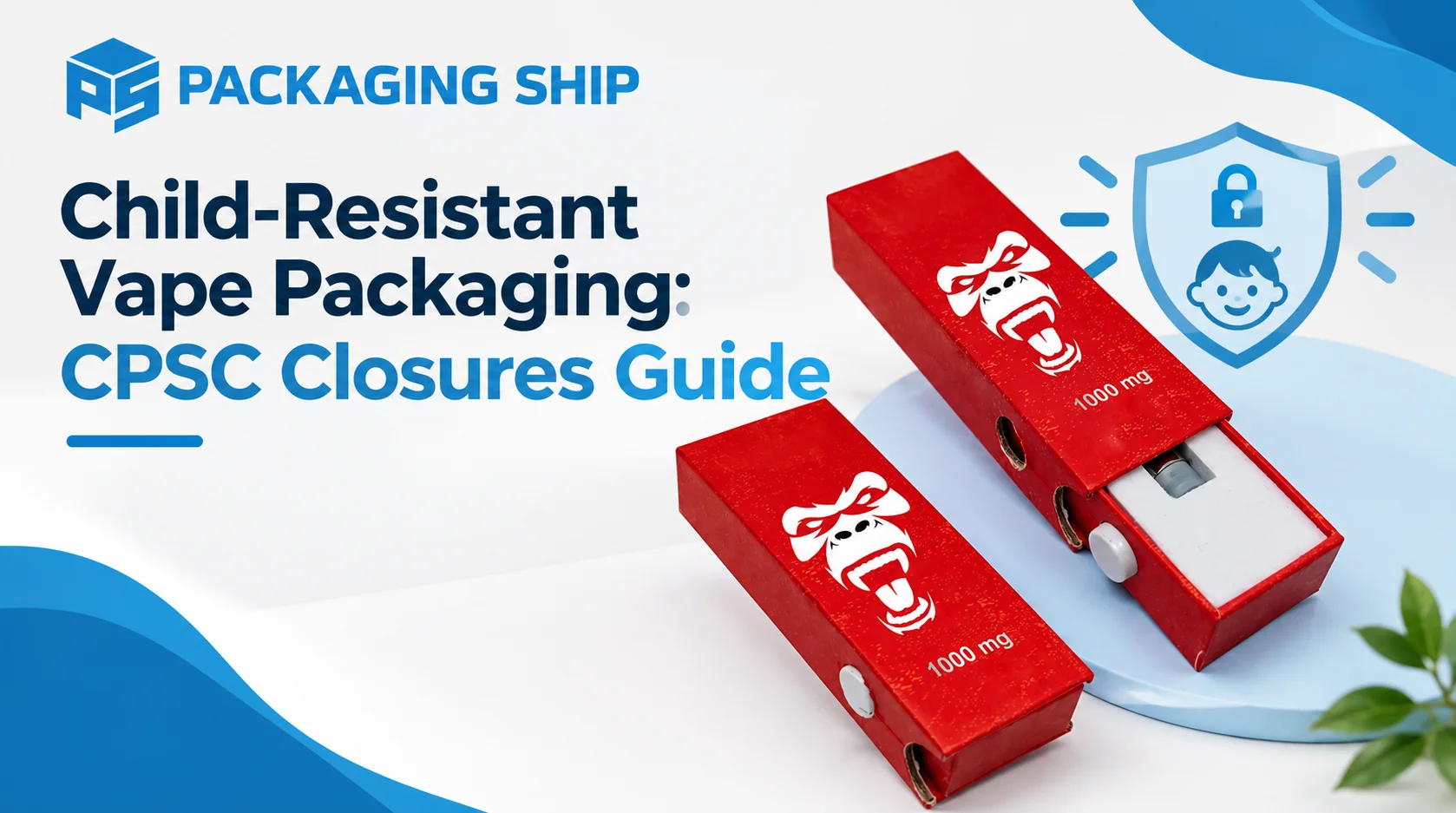
TL;DR: CPSC testing requires that at least 85% of children under age five fail to open a package within five minutes. Push and turn, slide and lock, squeeze bottom, and push tab closures all pass when engineered correctly. State cannabis law, not federal nicotine law, drives most vape cartridge box requirements today.
Table of Contents
Last month, a vape cartridge brand shipped ten thousand units to a California dispensary two weeks before launch. The retailer’s intake team rejected the whole order on sight. The box said child resistant on the label, but the supplier never handed over a certificate. The brand had to repack everything on a tight deadline, at their own cost. That is avoidable once you know which child resistant vape packaging closures actually meet the standard, and why the paperwork matters as much as the mechanism.
Child resistant vape packaging is any box, tube, or bottle built so a young child cannot open it, while a trained adult still can. In 2026, this mostly applies to vape cartridge boxes sold through state licensed cannabis programs, which borrow a federal testing method even though cannabis is not legal federally. A box only counts as compliant once it has been lab tested and certified, not simply printed with the words child resistant.
Five closure types show up again and again in certified child resistant vape packaging, and the logic applies whether you are looking at bottles or custom vape boxes. Each one forces a coordinated action a small child cannot manage but an adult learns in seconds.
The Consumer Product Safety Commission runs a set protocol under 16 CFR 1700.20. A panel of children aged 42 to 51 months gets five minutes to open the package alone, and at least 85% must fail. After a short demonstration, they get five more minutes, and at least 80% must still fail across all ten minutes. Separately, a panel of adults must open and reclose the same package, with at least 90% succeeding within five minutes. Read the exact legal text of 16 CFR 1700.20 through Cornell Law’s Legal Information Institute.
Most articles get this wrong. Federal law, specifically the Child Nicotine Poisoning Prevention Act, only covers refillable liquid nicotine bottles. Sealed, closed system disposable vapes are exempt federally, since the liquid never touches the consumer’s hands.
Cannabis works differently. Almost every legal cannabis state requires child resistant exit packaging on vape cartridges, and most point straight to the CPSC 16 CFR 1700.20 protocol as their technical standard, even though CPSC has no authority over cannabis. California’s Department of Cannabis Control lays this out in its own child resistant packaging guidance, which lists vape cartridges directly under single use CRP. If you sell into a licensed cannabis market, your boxes almost certainly need certified child resistant vape packaging, no matter what federal nicotine rules say.
The biggest mistake is ordering boxes marked child resistant with no ASTM D3475 or CPSC certificate attached. Another is assuming your regular custom vape cartridge boxes qualify once you glue on a locking tab, without third party testing. Certification travels with the exact design, material, and closure combination you plan to ship, not a similar one from a catalog.
Not every vape cartridge box needs a certified closure. If you sell closed system disposables outside a cannabis regulated state, a plain custom box may be enough, and unneeded child resistant features just raise your unit cost. Separate two decisions early: confirm what your state requires, then pick your box style, size, and finish around that answer.
| Spec | Detail |
| Material | 14pt to 24pt cardboard, kraft, or 2mm rigid board |
| Closure options | Push and turn, slide and lock, squeeze bottom, push tab locking |
| Certification | Tested to ASTM D3475 and CPSC 16 CFR 1700.20, certificate provided |
| Printing | Full color CMYK, up to 8 colors, digital or offset |
| Minimum order | 50 units, no minimum order requirement |
| Production time | 7 to 10 business days standard, 4 to 5 days rush |
| Shipping | Free FedEx or UPS to the continental United States |
| Sizing | Custom dimensions built to your exact cartridge spec |
You should not have to guess whether your child resistant vape packaging will pass at intake. At Packaging Ship, we build child-resistant vape cartridge boxes at our own New York factory, with certified closures and no minimum order. Send your dimensions and get a free quote, and our team will confirm the right closure for your state before you print.
[ Get Your Free Quote Now ]
Getting child resistant vape packaging right comes down to two things: the closure and the paperwork behind it. Push and turn, slide and lock, squeeze bottom, and push tab mechanisms all pass CPSC testing when engineered and certified correctly. Confirm what your state requires, ask every supplier for a real certificate, and you will avoid the rejection that cost that California brand two weeks and ten thousand units.
| Question | Direct Answer |
| Is child resistant packaging required for all vapes? | No. Only refillable liquid nicotine bottles and most state regulated cannabis cartridges require it, not sealed disposables sold outside cannabis markets. |
| What is the difference between CPSC and ASTM standards? | CPSC 16 CFR 1700.20 is the federal test method. ASTM D3475 is the classification standard states and suppliers reference alongside it. |
| Do disposable vapes need child resistant boxes? | Federally exempt disposables usually do not, but state cannabis rules can still require it for cartridges sold through a dispensary. |
| How do I confirm a supplier’s claim is real? | Ask for the specific test certificate tied to your exact box design, not a general claim on their website. |
| Single use versus multi use CR packaging, what is the difference? | Single use stays child resistant only until first opened. Multi use must stay child resistant every time it gets reclosed. |