
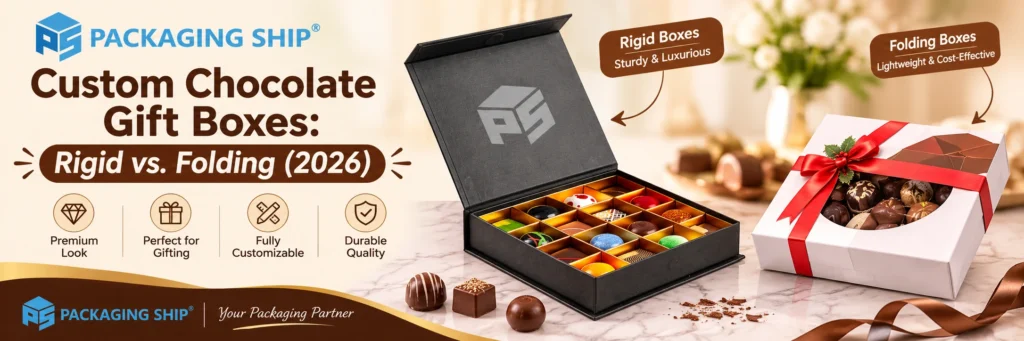
Custom Chocolate Gift Boxes: When to Use Rigid vs Folding for Holiday and Corporate Orders TL;DR: Heading to clients, or riding in a gift bag? Pick rigid chocolate gift boxes in 1–2 mm boards. Shipping flat, selling at retail or covering a long staff list? A folding carton in 16–24 pt paperboard does the job. Need both? Rigid for clients who matter, folding for everyone else. Why Do Chocolate Gift Boxes Fail Before They Reach the Recipient? Picture the Friday before the office party. Someone lifts a chocolate box into a gift bag, next to a bottle of wine, and the lid bows. The chocolate is fine. The box just wasn’t built for that ride. Most custom chocolate gift boxes fail at one of four hand-offs, and this guide walks through each so you can pick rigid or folding before you order from Packaging Ship, our factory in Valley Stream, New York. There’s an order sheet near the end, so you can brief us in a single message. Hand-off 1: Which Chocolate Box Insert Stops Pieces Shifting? A tray that fits the piece stops chocolates shifting. Dead space looks cheap, and loose pieces scuff each other. Count the pieces first. Our bonbon boxes come in 4, 6, 9, 12, 16 or 24 pieces, and other counts are possible if yours isn’t listed. Pick the tray by mood and budget: pulp for a natural look, clear PET when you want it to feel premium, cardboard dividers when cost matters most. Then grab a ruler and measure one truffle: its diameter, its depth, and how much gap you’d like between neighbours. The cavity gets cut to those numbers. If the chocolate will touch the board itself, mention that in your quote request, because it changes the board and coating we’d use. Cocoa butter has a habit of leaving grease spots on bare board, which is what a grease-resistant coating is there to stop. Want something a bit greener? FSC-certified and recycled boards are on the list too. Hand-off 2: Which Chocolate Gift Box Won’t Collapse in a Gift Bag? A rigid chocolate gift box in 1 mm, 1.5 mm or 2 mm board won’t collapse in a gift bag. A folding carton can bow under the handles and whatever else is in there. Lid-and-base, magnetic closure, drawer, shoulder: any of the rigid styles keeps its shape, so the choice is really about how the box feels to open. A magnetic closure feels right for a client. A drawer with a ribbon pull suits a set. A window lets people see what’s inside before they touch the lid. Our custom chocolate gift boxes can be finished with gold or silver foil, embossing and soft-touch lamination, and that finish does a lot of the work of making a luxury chocolate box feel luxurious. Finishing pays off, too. In a 2017 Clemson University lab study, foil-stamped Swiss chocolate was purchased 23% more than its plain control. We wouldn’t bet the budget on one study, mind you: seventy people took part, and a foil manufacturer paid for it. Hand-off 3: When Do Folding Cartons Beat Rigid Boxes? Folding cartons are the sensible pick when you’re buying a lot of boxes and don’t want to pay to ship air. They arrive flat, they store flat, and the per-unit price drops as the quantity climbs. Think retail bars on a shelf or mailers in a stack, where nobody’s judging the lid. Our chocolate bar boxes use 16, 18, 20 or 24 pt food-grade paperboard, and they come as sleeve-and-tray, tuck-end, lid-and-base, window or pillow styles. Add a sleeve or a divider and a folding carton gets a lot closer to rigid. For staff gifts, that’s usually good enough. One catch on price: rigid boxes arrive assembled and eat more truck space, so freight narrows the gap. Everything goes out by FedEx or UPS with tracking. For a corporate chocolate box program, here’s how we’d split it: rigid for the 20 clients who matter, folding for the other 400 people. Hand-off 4: What Makes a Luxury Chocolate Box Look Premium? What makes a box feel luxurious? Mostly the lid. Foil, soft-touch lamination, embossing, a logo in exactly the right colour: that’s what a client sees before they’ve touched a single piece. Pantone matching takes care of the colour. A digital proof comes as standard, and if the finish matters to you, ask for a physical sample before the full run. Want a quiet look? Deboss the logo. Want it to catch the light on a dark lid? Add spot UV. Browse our chocolate box styles for lid, drawer and sleeve options, then ask for that sample. Rigid vs Folding Chocolate Box Specifications Rigid boxes use 1–2 mm board and arrive assembled. Folding cartons use 16–24 pt paperboard and arrive flat. Here’s how the options on each product page compare. Specification Rigid chocolate gift box Folding carton (bar boxes) Board 1, 1.5 or 2 mm rigid board 16, 18, 20 or 24 pt food-grade paperboard Styles Lid and base, magnetic closure, drawer, shoulder, window Sleeve and tray, tuck end, lid and base, window, pillow Inserts Paper pulp, PET tray, cardboard divider, foam Die-cut window with food-safe PVC sheet Finishes Soft-touch, matte and gloss lamination, spot UV, gold or silver foil, embossing, debossing Matte, gloss, soft-touch, spot UV, aqueous coating, foil, embossing, debossing Arrives Assembled Flat Best for Client gifts, bag-carried sets, premium lines Retail bars, mailers, large staff lists Both styles: offset, digital or screen printing, CMYK or Pantone, a digital proof as standard, physical samples on request, and orders from 50 units. What to Send for an Accurate Chocolate Box Quote Send these and your first quote is far more likely to be right. How Far Ahead Should You Order Holiday Chocolate Packaging? Work backward from your delivery date, because timing sinks more holiday orders than price does. The four big confectionery seasons drive 64% of US chocolate and candy sales, according to the National Confectioners Association, and