
Custom Soap Boxes With Window: PVC vs PET Film Guide
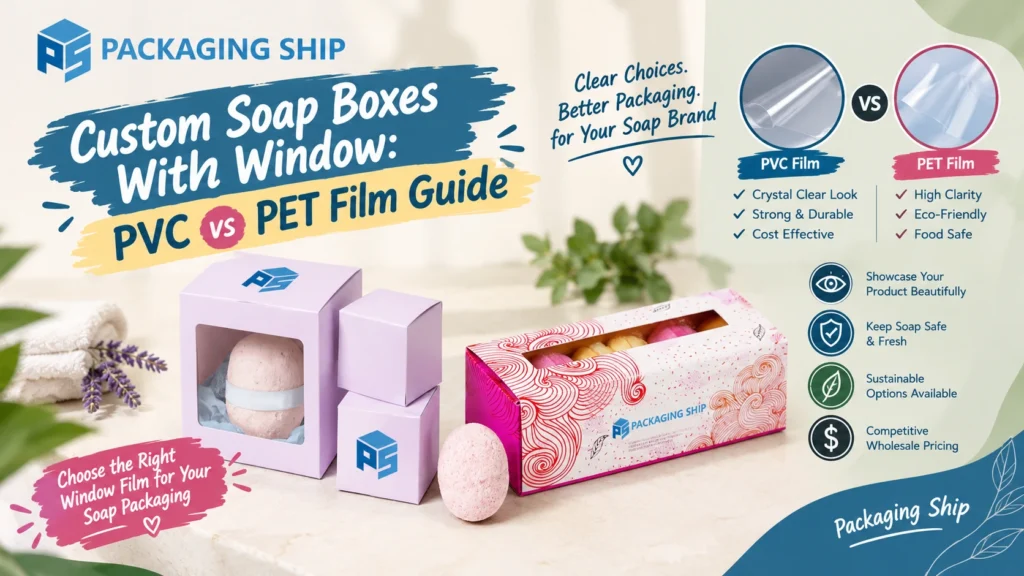
Custom Soap Boxes With Window: Which Film Is Food-Safe and Which Looks Cheapest at Retail? TL;DR: PVC windows tend to fog when heat and humidity go up and down. Under store lights they also pick up a yellow tint, and within a few months the box starts to look cheap. This happens even though the FDA allows PVC for food contact. PET and RPET stay clear for longer and don’t fog as easily, so they’re the better pick for custom soap boxes with windows that ship across the country or sit near a shop front. One more tip: lock in your film, its gauge, the window size and where it sits on the box first. Then get your quote. Why Did Your Soap Box Window Look Great in the Studio and Foggy on the Shelf? Here’s a story we hear a lot. A soap brand ships out a big wholesale order in the middle of July, and honestly, the boxes look perfect when they go out the door. Three weeks go by and the retail buyer calls. About half the windows have turned cloudy in a stockroom with no climate control. Nothing went wrong in shipping. The film was the problem. If you’re ordering custom soap boxes with window, you’re really making two choices at once. First, the material has to be safe for food and cosmetic contact. Second, it has to still look good after a month on display. One film doesn’t always do both, and most packaging guides never compare the two. What Film Options Exist for Custom Soap Boxes With a Window? You’ll usually come across four kinds of film for soap box windows. Each one acts a bit differently, and humidity or bright shop lights will show you how fast. Film Food/Cosmetic-Contact Status Fog Resistance Recyclability Best For PVC (polyvinyl chloride) FDA-permitted for food contact, though more retailers and brands now steer clear of it Poor, fogs when humidity or temperature changes Hard to recycle; most curbside programs won’t accept it Short shelf life, climate-controlled stores only PET (polyethylene terephthalate) Safe for food contact, approved pretty much everywhere Good. It doesn’t cloud up when the weather shifts Goes in curbside bins (#1 plastic) Shipping across the US, products that sit on shelves a long time RPET (recycled PET) Safe for food contact Good, same as new PET Made from old plastic, and you can recycle it again Brands that talk up their green side Cellophane / Acetate Acetate can’t always be trusted near food. True cellophane breaks down on its own, but it’s pricier and tears easier So-so. Damp air can make it soft or wavy Acetate: not really. Cellophane: you can compost it Tiny runs, gift boxes for display, nothing near food PVC is still everywhere mostly because it costs the least. The catch is that it’s also the film most likely to make a good-looking box look cheap by the time a customer sees it. Is PVC Food-Safe for Soap Packaging? Yes, it is. Back before 1958, the FDA cleared PVC for food contact, and that hasn’t changed. Nobody eats soap or bath products, so PVC raises no regulatory concerns here. So the issue isn’t rules, it’s how the stuff ages. PVC gets foggy and yellow and starts looking dated way sooner than PET or RPET does. That’s a problem on the shelf. It’s got nothing to do with passing any regulations. Why Does a Soap Box Window Fog Up After Shipping? PVC lets moisture through more easily than PET. Say a box comes out of a chilly warehouse and goes straight into a warm shop. Little droplets form on the inside of the window. Trucks do the same thing to it, because the temperature in the back can climb 15 to 20°F between morning and afternoon. Think of a cold can of soda on a hot day. PET and RPET just don’t react much to all that, so they stay clear from the truck to the stockroom to the shelf, even months later. Shipping nationwide, or stuck with a stockroom that has no AC? Then skip PVC as your default. Safety isn’t the reason. The reason is that the window won’t look like it did in your product photos. What Makes a Soap Box Window Look Premium Instead of Cheap? Most shoppers glance at a box for maybe three seconds, and in that time they’ve already decided whether it looks pro or cheap. Under fluorescent store lights, PVC windows slowly turn a little hazy and yellow over a few months. You’d hardly spot it on one box, but next to a competitor’s clear window it stands out. PET keeps its clarity longer and gives a cleaner die-cut edge, and that clean edge is what makes a box look high-end at first glance. Glue showing along the window seam does the same kind of damage. So does a window that doesn’t lie flat against the cut-out. Either one looks like a manufacturing flaw, even if everything else about the box is well made. What Window Specs Should You Confirm Before You Order? Before asking for prices on custom soap boxes with windows, pin down these five details. That way your quote matches what you actually need: Having these five answers ready is usually what decides whether your boxes match the proof or need a reprint. Which Film Fits Your Type of Soap Line? What goes inside the box also affects which film works best. Bar Soap and Handmade Lines Bar soap and handmade or artisan soaps sold in boutiques get the most out of PET or RPET. These products stay on shelves long enough for fog and yellowing to show, and boutique buyers pay close attention to materials. Handmade soap boxes with a PVC-free window also back up the eco-friendly claims many small brands already make on the rest of their packaging. Bath Bomb Boxes Bath bomb boxes face more moisture because of the product itself. So a fog-resistant film matters even more
Custom Soap Sleeve Boxes | No Die Charge, Wholesale USA
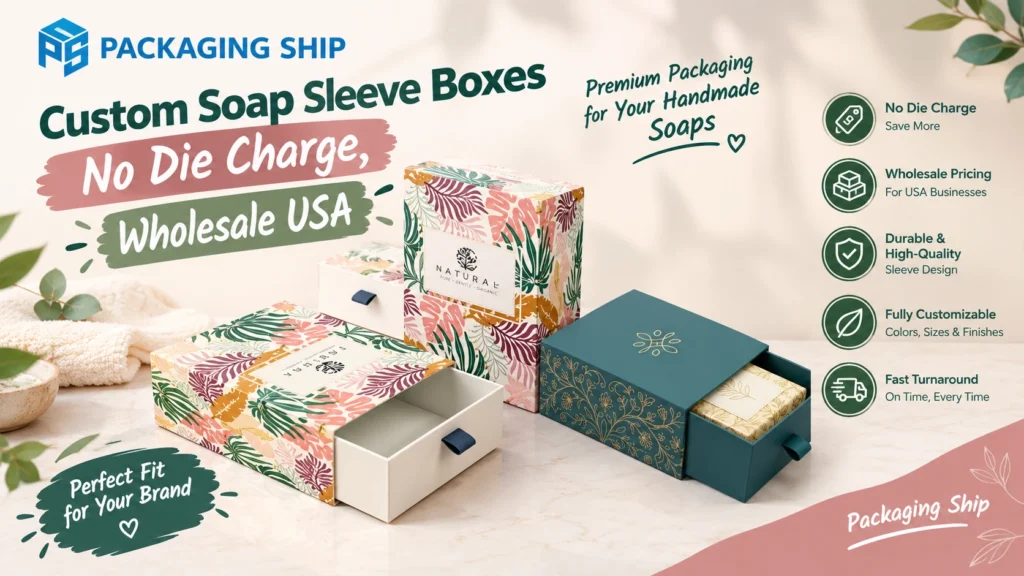
Custom Soap Sleeve Boxes: How Sleeves Cut Packaging Cost Without Losing Brand Impact TL;DR Pull up your cost spreadsheet and the packaging line is usually the one number that doesn’t add up. Say your soap costs $1.50 to make and sells for $7 a $0.55 box alone can eat 7-8% of that price, before shipping, labels, or a single ad dollar even enters the math. Here’s the part most people miss: that cost isn’t really about print or branding. It’s cardboard, your soap bar never needed in the first place. A custom soap sleeve box skips the enclosure and wraps the bar instead, and you’ll see the difference on your next quote from Packaging Ship. Why Does Soap Packaging Cost More Than You’d Expect? A standard tuck-top box runs four to six panels die-cut, scored, folded, glued. Every extra panel means more board, more ink, more time on the line, and all of it gets billed per unit. A sleeve skips most of that. It’s one flat piece, wrapped around the bar, sealed at a single seam. Less material, a faster die-cutting run, and that’s really where the savings come from. Not the printing. Not the design. Just less board. Why Are Small Soap Brands Still Stuck on Full Boxes? “Custom packaging” means a box. It really doesn’t. A soap band sleeve, a soap packaging sleeve, a paper sleeve soap wrap have different names, same basic idea: a printed wrap, not a full enclosure. If you’ve been quoting boxes because that’s the only “custom” option you knew about, sleeves have been sitting there the whole time. Usually for less money, too. A sleeve will look like a downgrade. It won’t, not if the stock and print hold up. A soft-touch coated sleeve with a foil edge looks deliberate, not cheap. A lot of premium bar-soap brands actually prefer a sleeve wrap, because it shows more of the product through the wrap while the branding still does its job. And perception matters more than most brands think. In a 2026 VistaPrint survey, 89% of shoppers said packaging quality shaped how they saw the product inside it, and almost half, 46%, said it affected whether they’d buy from that brand again. Box vs. Sleeve: What Actually Changes on the Spec Sheet? Full Soap Box Soap Sleeve Panels 4-6, die-cut and glued 1, wrapped and sealed at one seam Material use Full enclosure Wrap only, open or closed ends Typical cost impact Higher per-unit cost at the same run size Noticeably lower per-unit cost on the same 50-unit order Minimum order 50 units, no die charge 50 units, no die charge Best for Shipping protection, stacking, gift sets Retail shelf, subscription boxes, farmers-market and Etsy sellers Both run through the same soap packaging lineup, by the way, so moving from one to the other on your next order isn’t really starting over. What Sizes, Materials, and Finishes Work Best for a Soap Sleeve? Sizing and fit: standard bar dimensions run around 2″x1″x4″, adjustable to your mold. Cold-process soap shrinks a little as it cures, so there’s a small allowance built into the die line — that’s what keeps the wrap snug months after production. Material options: Both run on the same custom soap wrapping paper line, open-end or closed-end, your call. Worth knowing: the paper also lines up with what people actually believe about sustainability. It ranks in the top three most sustainable packaging materials in nearly every country surveyed for McKinsey’s 2025 global packaging research, and recyclability came out as the trait people cared about most, worldwide. When Does a Full Box Still Beat a Sleeve? A sleeve isn’t right for everything, and it’s worth just saying that outright. If your bars ship loose in a mailer, go into multi-bar gift sets, or are genuinely fragile in transit, a full handmade soap box with real corner protection is still the better call. Selling mostly through e-commerce rather than in person? The extra per-unit cost of a box can be worth it. How Does Ordering Custom Soap Sleeves Actually Work? You don’t need a print-ready file for either one. Send your logo in whatever format you have it in, and the design team builds the artwork you’ll get a full digital proof back within 24 to 48 hours. Orders start at 50 units, zero die or plate charges on boxes or sleeves, and standard production runs 7 to 10 business days with free FedEx or UPS shipping. Want to see where your own numbers land? Get a free estimate before you decide either way. Got More Questions About Custom Soap Sleeves? Do sleeves fit every bar size? Mostly, yes. Dimensions get built to your mold with a shrinkage allowance already worked in. Odd shapes might need a quick spec check first, just to be safe. Is a sleeve enough protection for shipping? For retail or local sales, sure. If you’re shipping loose in a mailer, go with a box instead; that’s really what it’s built for. Can I order both a sleeve and a box to test? Yeah, that’s actually pretty common. Most first orders start at 50 units of each, plenty to see how customers react before you commit to one format. Does a cheaper sleeve mean a worse price later? Not really. Reorder pricing usually drops further once you move to offset printing above 500 units, same as it would for a box. Ready to Cut Your Soap Packaging Cost? You’ve got the spec sheet, the cost logic, and a decent idea of which one fits your product. The only number missing is yours. Request a free custom soap sleeve quote from Packaging Ship with your bar size and order quantity, and you’ll get back a real price, a free design proof, and production in 7-10 days. No die charge, no minimum past 50 units, no design file needed to start.