
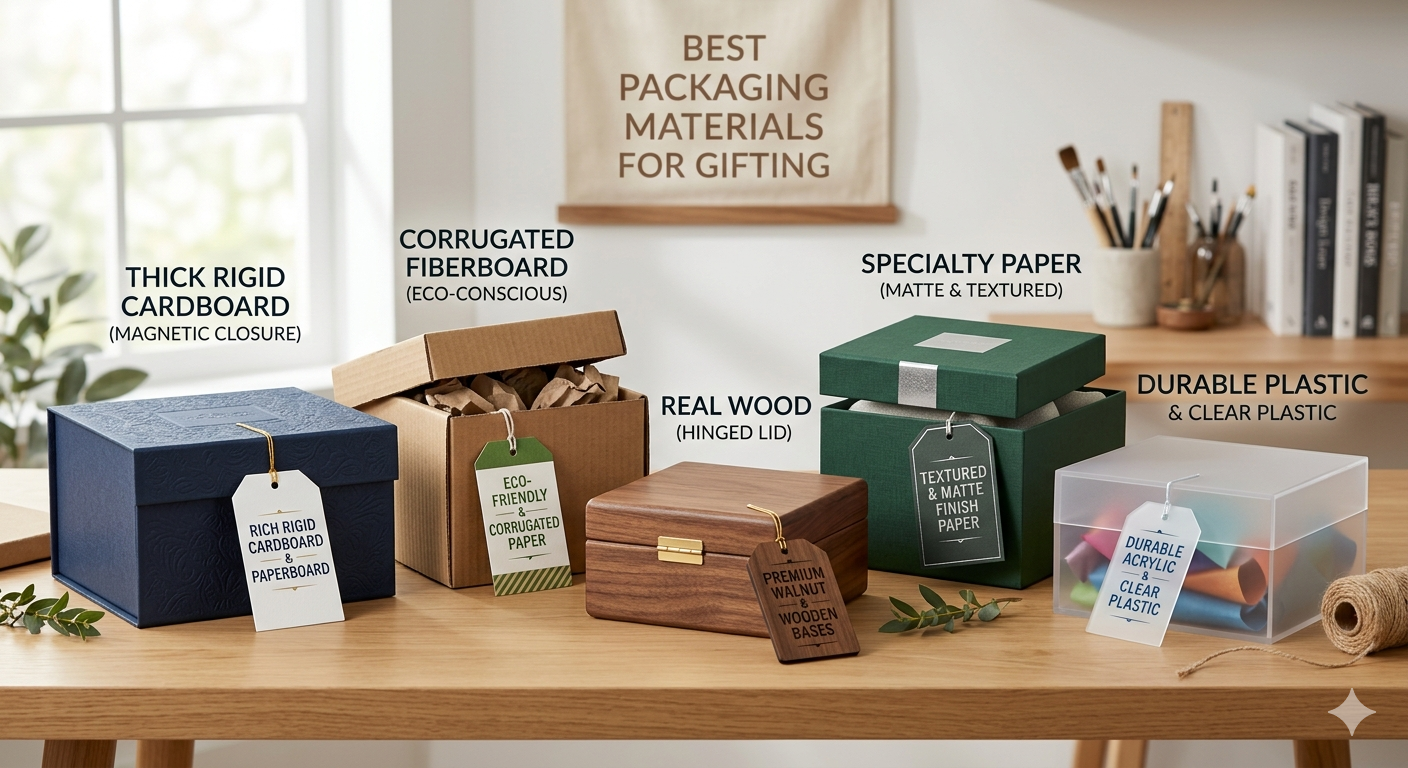
The best gift box materials include rigid greyboard, SBS cardboard, kraft paperboard and corrugated fiberboard. Each one serves a different product tier, shipping context and brand positioning goal. Choosing the wrong material costs you twice — once in damaged product, once in lost customer trust.
Here is something most packaging guides skip: paper and paperboard already account for 43% of the global gift packaging market, which reached USD 27.5 billion in 2025, according to Future Market Insights. That is not a soft trend. It reflects a deliberate shift toward materials that are printable, recyclable and structurally suited to both retail presentation and e-commerce transit.
This guide breaks down each core gift box material by structure, durability, print performance and cost so you can make the right decision before placing your first order.
Most brand owners think about gift box materials in terms of appearance. That is the wrong starting point.
Material determines how your box survives a courier journey. It determines what print finishes will actually adhere cleanly. It determines whether your product shifts inside the box during transit or sits precisely where you placed it. And it determines what your customer feels when they hold the package — before they even open it.
A rigid greyboard box feels substantial and considered. A kraft paperboard box feels honest and intentional. A corrugated box with litho-laminated print feels professional and transit-ready. None of those impressions happen by accident. They come from a deliberate material decision made early in the packaging process.
“According to Zion Market Research, the global gift boxes market is projected to grow from USD 1.82 billion in 2024 to USD 3.50 billion by 2034 at a CAGR of 6.74%.” The brands driving that growth are not choosing materials randomly. They are matching substrate to product tier and shipping model with precision.
Rigid greyboard, also called chipboard, is manufactured by compressing multiple layers of recycled paper fibers under high pressure. The result is a dense, solid board that does not flex, does not collapse under weight and holds its dimensional shape permanently. Standard thickness ranges from 1.5mm to 3mm depending on product weight and presentation requirement.
This is the material inside every premium perfume box, every fine jewelry presentation case, every high-end chocolate gift set you have ever received and thought felt expensive. The greyboard core is then wrapped in printed paper, fabric, or specialty material to create the final exterior surface. That two-component construction is what separates rigid gift boxes structurally from every other format.
Rigid boxes start at approximately USD 3.00 per unit, according to published cost benchmarks from Packings.co. That premium is justified when your product sells above USD 50 and the packaging is part of the perceived value the customer is paying for. Our custom kraft boxes pair naturally with rigid box sets where an inner kraft tray carries smaller items within a rigid outer presentation box.
SBS stands for Solid Bleached Sulfate. It is a single-layer paperboard with a clay-coated smooth surface on one side that accepts full-color digital and offset printing cleanly. Standard GSM ranges for gift boxes run from 300 to 450 GSM. At 350 GSM, SBS cardboard holds a tuck-end closure under normal shelf and handling pressure without reinforcement.
SBS is the most print-compatible of all gift box materials. Colors reproduce accurately. Fine details in artwork render crisply. Spot UV, matte lamination and foil stamping all adhere reliably to the coated surface. This makes SBS the default choice for custom printed gift boxes across retail, cosmetic and corporate gifting applications where visual brand impact on the exterior panel matters most.
Cost per unit typically runs between USD 0.50 and USD 1.50. For brands in the USD 15 to USD 50 product range, SBS cardboard gives the strongest cost-to-presentation ratio of any gift box material available. Adding custom packaging sleeves over an SBS base box is one of the most cost-effective ways to create a premium branded exterior without upgrading to rigid board across the entire run.
Unbleached kraft paperboard goes through the kraft chemical pulping process, which retains more of the wood fiber’s natural lignin. That is what gives kraft its distinctive brown colour, its high tear resistance and its biodegradable profile. FSC-certified kraft stock degrades within two to three months under standard composting conditions, according to published material data from Custom Boxes Lane.
For brands in the organic food, wellness, natural cosmetics and artisan gifting space, kraft is not simply a sustainable choice. It is a brand communication tool. The material itself signals authenticity and environmental responsibility before the customer reads a single word of copy. NielsenIQ and McKinsey’s joint analysis of USD 400 billion in US retail sales data found that products carrying sustainability claims on packaging averaged 28% cumulative sales growth compared to 20% for products without those claims.
Kraft paperboard costs start at approximately USD 0.35 per unit. Dark inks and white ink on brown kraft produce strong results. Vibrant full-bleed color on kraft requires a white liner layer to prevent the brown surface from shifting hue. Pairing kraft boxes with custom roll labels is a practical solution for small-volume runs where full-panel print setup costs are prohibitive.
Corrugated material consists of three layers: a flat outer liner, a wavy fluted middle layer and a flat inner liner. The fluted layer is structural. It absorbs impact, distributes pressure across the box surface and resists crushing under stacking weight. B-flute and E-flute are the most common configurations for gift packaging. E-flute, at approximately 1.6mm thickness, offers a flatter surface that accepts litho-laminated print panels cleanly — making it the right choice when a corrugated box needs to carry full-color exterior branding.
DTC food brands, subscription gifting programs and corporate gifting operations shipping nationally need corrugated gift boxes. A product that survives the production floor and warehouse but arrives at a customer’s door crushed does not represent a packaging failure alone. It represents a material selection failure that happens long before the box is packed.
Corrugated starts at approximately USD 0.40 per unit. For brands shipping fragile or high-value products, the box-in-box approach is standard practice: a rigid or kraft inner box creates the unboxing experience, and a corrugated outer shipper handles the transit journey.
Choosing the right exterior material is only half the decision. What sits inside the box determines whether the product arrives safely and whether the moment of opening feels considered or rushed.Custom packaging inserts hold products precisely in position during transit. They prevent movement that causes cosmetic damage to both the product and the interior box walls. Custom crinkle paper fills void space, absorbs shock and adds a tactile texture layer that customers notice immediately on opening. Together, the exterior material and the interior system create the complete gift packaging experience — not one without the other. If you want to read more about selecting the right combination of gift box materials and interior accessories for your specific product, click here.
Start with three questions. First, what is the price tier of the product inside? Products under USD 20 suit SBS cardboard. And it is between USD 20 and USD 50 to suit SBS or kraft depending on brand positioning. Products above USD 50 typically need rigid greyboards. Second, where does the box travel? Retail shelf presentation suits SBS or rigid. E-commerce transit suits corrugated outer with a kraft or rigid inner. Third, what does your brand need to communicate before the customer opens the box? Luxury communicates through rigid board weight. Sustainability communicates through kraft’s natural texture. Premium retail presence communicates through SBS print quality.
Every gift box material on this list has a specific job. Rigid greyboard carries premium products with the weight and structure that communicates quality on contact. SBS cardboard carries branded retail products with print fidelity that makes every color panel count. Kraft paperboard carries eco-conscious products with a material honesty that no surface treatment can replicate. Corrugated fiberboard carries fragile and e-commerce products with the structural protection that ensures the customer experience survives the journey.
Choosing the right gift box materials is not an aesthetic decision. It is a product integrity decision, a brand positioning decision and a customer retention decision — all made before your product ships.
Ready to Order Gift Box Materials That Match Your Brand? Packaging Ship has helped more than 50,000 US brands choose the right material, design it free of charge and ship it within 6 to 7 business days. No minimum order. Free design support. Free US shipping. 30% off your first order.
Get Your Free Custom Gift Box Quote Today
Rigid greyboard is the most structurally durable gift box material for presentation purposes. Corrugated fiberboard is the most durable for transit and shipping applications. For a combination of both, pair a rigid inner box with a corrugated outer shipper.
350 GSM SBS cardboard is the standard for mid-tier retail gift boxes. It holds tuck-end closures without reinforcement and accepts full-color digital and offset printing cleanly. Boxes below 300 GSM tend to feel flimsy on retail shelves and in customer hands.
Kraft paperboard handles normal retail and short-distance shipping well. For national e-commerce fulfillment, kraft works best as an inner box inside a corrugated outer shipper. Unboxed kraft alone is not recommended for long courier journeys with multiple handling points.
FSC-certified unbleached kraft paperboard is the most credibly eco-friendly gift box material. It is biodegradable, recyclable and produced without bleaching chemicals. Pair it with water-based inks and soy-based coatings for the most sustainable full packaging setup.
Yes, but the print method matters. Litho-laminated corrugated gives the closest result to printing on flat cardboard. Direct flexographic printing on corrugated is lower resolution and suits simple graphics. For premium branded corrugated gift boxes, litho-laminate is the right specification.
Packaging Ship LLC is a leading online packaging platform offering high-quality custom boxes and branding solutions
Company
Contact Info
Copyright 2026 © All Rights Reserved By Packaging Ship LLC