
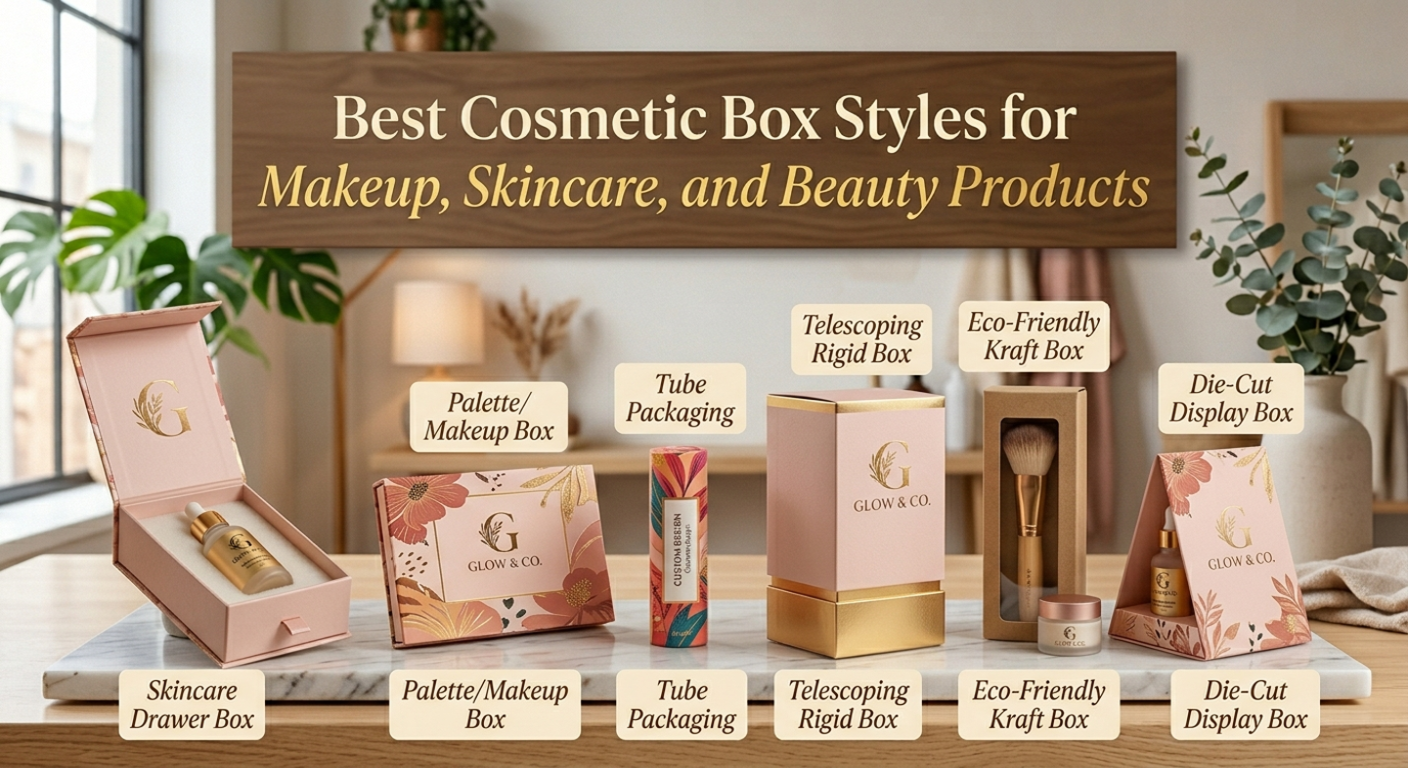
What Are Cosmetic Packaging Styles for Beauty Products in 2026? Cosmetic packaging styles for beauty products refer to the specific structural configurations of rigid boxes, folding cartons, sleeve boxes, window boxes, and display boxes matched to individual product types, retail price points, and sales channels to communicate brand positioning and protect product integrity simultaneously.
Three Boxes, One Serum, One Retail Decision
A Chicago skincare brand founder sat with three sample boxes on her desk in February 2025. Same serum formula inside each one. Same label with same price sticker. Three completely different box structures: a folding carton at 250 GSM, a sleeve box in kraft paper, and a rigid two-piece box at 2mm chipboard with soft-touch lamination.
She sent all three to her retail buyer contact at a boutique wellness chain in the city.
The buyer called back the same afternoon. She chose the rigid box. And she asked for 500 units. She never opened the other two.
The founder had nearly ordered the folding carton because it cost $0.22 less per unit. That $0.22 saving would have cost her the account entirely.
Cosmetic packaging styles for beauty products are not an aesthetic preference. They are a commercial decision with real consequences for retail access, perceived value, and brand credibility at every touchpoint from the shelf to the doorstep.
Why Getting the Style Right Matters More Than Ever in 2026
The US beauty and personal care market was valued at $109.56 billion in 2025 and is projected to reach $196.33 billion by 2033, growing at 7.7% annually, according to Grand View Research’s US Beauty and Personal Care Market Report. Skincare alone accounts for 32.5% of that market, the largest single product segment driving packaging demand across retail and DTC channels simultaneously.
Within that growth, premiumization is accelerating. Consumers are buying fewer products and choosing better ones. Premium beauty products are growing at a faster compound rate than mass-market alternatives, per Mordor Intelligence’s 2026 US Cosmetics Products Market Report. That shift directly impacts packaging decisions. A brand that packages a premium serum in a mass-market folding carton sends a signal that contradicts the product’s price point and that contradiction costs sales before the formula is ever tested.
“The box a beauty product arrives in sets the customer’s expectation for everything inside it. Get the structure wrong and even an exceptional formula struggles to justify its price.” — Senior Packaging Consultant, Packaging Ship
According to the Mordor Intelligence Global Cosmetic Packaging Market Report 2026, skincare retained 45.01% of global cosmetic packaging revenue in 2025, driven by multi-step routines that demand tailored packaging for each SKU in a product line. That figure underscores something every cosmetic brand owner needs to internalize packaging is not a one-size decision across a product range.
6 Cosmetic Packaging Styles Matched to Your Product and Channel
- Rigid Two-Piece Boxes for Luxury Skincare and Premium Beauty
Rigid two-piece boxes are the commercial standard for beauty products positioned above $25 at retail. A 2mm chipboard construction holds its shape under stacking pressure on a retail shelf. It communicates weight and quality at first touch in a way no folding carton can replicate. Serum boxes, face cream jars, and premium skincare sets belong here. Cosmetic display boxes in rigid construction also work for countertop retail environments where shelf presence drives impulse purchase decisions.
- Folding Cartons for Retail-Ready Volume at Scale
For beauty brands moving into retail at wholesale volumes, folding cartons in SBS board at 300 to 350 GSM deliver the full-color printing surface needed for shelf visibility at a per-unit cost that scales cleanly. Foundation boxes, mascara boxes, lipstick boxes, and makeup brush set packaging all perform well in SBS folding cartons when consistent retail presence matters more than premium unboxing weight. At 2,000 units with offset printing, these deliver Pantone-accurate color and sharp detail across the full production run.
- Sleeve Boxes for Minimalist and Clean Beauty Lines
Sleeve boxes use less material than a full rigid structure, which keeps unit costs lower at smaller volumes. They carry a restrained visual language that resonates with wellness, clean beauty, and natural skincare consumers. The reveal of a tray sliding from a sleeve creates an intentional unboxing moment without the production cost of a full two-piece rigid box. Cream boxes and skincare sets positioned in the $15 to $28 range tend to perform particularly well in sleeve configurations.
- Window Boxes for Products That Sell on Sight
Window boxes work when the product itself is the strongest visual selling tool. A lip gloss in a vibrant shade, a setting powder with a distinctive color payoff, or an essential oil in a textured glass bottle all of these benefit from a die-cut window that lets the customer connect with the product before opening the box. One important caveat: window boxes reduce perceived exclusivity for products priced above $30. For luxury skincare or premium fragrance, a closed box structure almost always outperforms a window configuration in retail environments.
- Display Boxes for High-Traffic Retail Countertop Environments
Cosmetic gift boxes and display configurations work for beauty brands selling through high-traffic retail points where countertop visibility is part of the sales strategy. Display boxes present multiple units at once, use shelf space efficiently, and keep the brand visible from multiple angles simultaneously. Votive candles, lip balms, travel-size skincare, and sample-sized fragrance all perform well in display box configurations at beauty counters and specialty retail environments.
- Drawer Boxes for Luxury Gift Sets and High-Value Collections
Drawer boxes signal premium positioning through the physical experience of opening them. The inner tray pulls out smoothly, the reveal is controlled, and that moment of opening is what gift buyers in the $40 and above price tier are purchasing. Seasonal collections, curated skincare sets, and fragrance gift boxes belong in drawer configurations when the unboxing experience is part of the product’s marketing strategy.
Matching Box Style to Each Cosmetic Product Type
- Lipstick boxes:
It needs structural rigidity that communicates formula quality before the product is seen. At 300 GSM and above in SBS board, a lipstick packaging box communicates a price point that supports a $22 to $35 retail position. Below 250 GSM, the same formula reads as mass market regardless of what the label says.
- Mascara boxes
They have a specific structural requirement most brands overlook. The height-to-width ratio of a mascara box determines whether it fits standard beauty retail planogram slots. A box too wide for the planogram slot gets excluded from the shelf layout regardless of how strong the brand presentation is. Standard mascara boxes run 35mm to 40mm wide and 150mm to 165mm tall confirm these dimensions with your supplier before approving artwork.
- Foundation boxes:
These are for liquid formats that need to handle the weight of glass bottles without warping. SBS board at 350 GSM minimum, with a tuck-end closure that locks firmly, prevents the box from opening during transit or shelf handling. Powder foundation boxes can run slightly lighter at 300 GSM because the product weight is lower, but the closure mechanism still matters for retail presentation.
- Serum boxes:
It represents the single most important packaging decision for premium skincare brands. A serum priced above $45 belongs in a rigid box or a premium sleeve box with minimum 350 GSM SBS board. The perceived value gap between a rigid serum box and a standard folding carton at the same price point is significant enough to affect add-to-cart rates in DTC e-commerce as well as in-store purchase rates at boutique retail.
- Essential oil:
Its packaging requires protection for fragile glass first and brand presentation second. Cardboard cosmetic boxes with die-cut cardboard inserts hold glass essential oil bottles securely during shipping and retail handling. The insert prevents lateral movement that cracks glass. For essential oil brands selling through wellness retail, a kraft folding carton with a natural finish and a die-cut insert positions the product authentically within the clean and natural brand category.
- Cream boxes:
These are for skincare jar formats that need internal dimensions that match the jar’s footprint precisely. A box where the jar moves laterally shows visible handling wear within a week on a retail shelf. Confirm internal dimensions against the jar’s widest point, including any lid overhang, before finalizing the box specification with your packaging supplier.
Material Guide: What Each Option Communicates About Your Brand
- SBS board at 300 to 400 GSM is the standard for retail-ready cosmetic boxes packaging across makeup and skincare. It takes full-color offset printing at Pantone accuracy and holds its structure through a retail sales cycle. Rigid chipboard at 2mm thickness communicates luxury positioning and belongs on products priced above $25. Kraft paper carries the sustainability narrative for clean beauty brands without any additional marketing copy required the material makes the statement on its own
- Water-based matte lamination preserves recyclability and reads as premium and intentional. Gloss lamination reads as accessible and bright, appropriate for mass-market makeup but potentially undermining for skincare positioned in the wellness or prestige tier. Soft-touch lamination is in its own category. The tactile experience of picking up a soft-touch box changes the customer’s relationship to the product physically, and that change correlates with higher purchase rates in beauty retail environments.
- Foil stamping on the logo adds visual dimension that no print technique replicates. It catches light at every angle and signals craftsmanship to retail buyers who evaluate hundreds of beauty products every season. For custom cosmetic boxes at the premium tier, foil stamping on the brand mark is a baseline expectation from serious retail buyers not a luxury upgrade.
Conclusion:
Do you get the Right Box for Every Product in Your Beauty Line? Your formulas took time and expertise to develop. Your packaging needs to communicate that quality to every retail buyer and customer who picks up the product. Packaging Ship works with beauty brands across the United States, from indie founders placing their first 100-unit order to established brands managing wholesale accounts across multiple retail channels.
Free design support on every order. No minimum order quantity. Free shipping across the United States. Quote returned within 24 hours.
Get Your Free Custom Cosmetic Box Quote Today →
Free design support. No MOQ. Free US shipping. Results in 24 hours.
Frequently Asked Questions
What is the best cosmetic box style for luxury skincare in 2026?
Rigid two-piece boxes at 2mm chipboard with soft-touch lamination and foil-stamped logo are the category standard for luxury skincare packaging. They communicate quality at first touch, hold their shape under retail shelf stacking pressure, and signal premium positioning before the product is opened or tested.
How do I choose between a rigid box and a folding carton for my beauty product?
Start with your retail price point. Products above $25 belong in rigid boxes. Products between $12 and $25 suit premium folding cartons in SBS boards at 300 to 350 GSM. Products below $12 suit standard folding cartons. Match the structure to the price point the formula needs to command not to the unit cost you want to hit.
What cosmetic box style works best for retail display?
Rigid display boxes and countertop display configurations work best for high-traffic retail environments. They present multiple units simultaneously, use shelf space efficiently, and keep the brand visible from multiple angles. Folding cartons in SBS board at 350 GSM work for planogram shelf placements in beauty specialty retail.
Can I get custom cosmetic boxes with no minimum order at Packaging Ship?
Yes. Packaging Ship has no minimum order requirement. Digital printing works well from 100 units for indie beauty brand runs. Offset printing delivers Pantone-accurate color and the lowest per-unit cost at 2,000 units and above.
What is the best box for essential oil packaging?
Kraft folding cartons with die-cut cardboard inserts are the most effective essential oil packaging configuration. The insert prevents lateral movement of the glass bottle during transit and retail handling. The kraft exterior positions the product authentically within the clean and natural brand category without additional marketing copy.
How long does production take for custom cosmetic boxes?
Standard production at Packaging Ship runs 10 to 15 business days from artwork approval. Rigid boxes and drawer box styles typically run 15 to 18 business days. Rush production is available. Always build production lead time into seasonal launch timelines and retail sell-in schedules.
What finish makes wholesale cosmetic boxes look most premium?
Soft-touch lamination combined with a foil-stamped logo is the most premium finish combination available in cosmetic packaging. It changes the tactile experience of holding the product and communicates craftsmanship before the box is opened. Matte lamination without soft-touch is the next tier intentional and appropriate for any beauty product positioned above the mass market.