
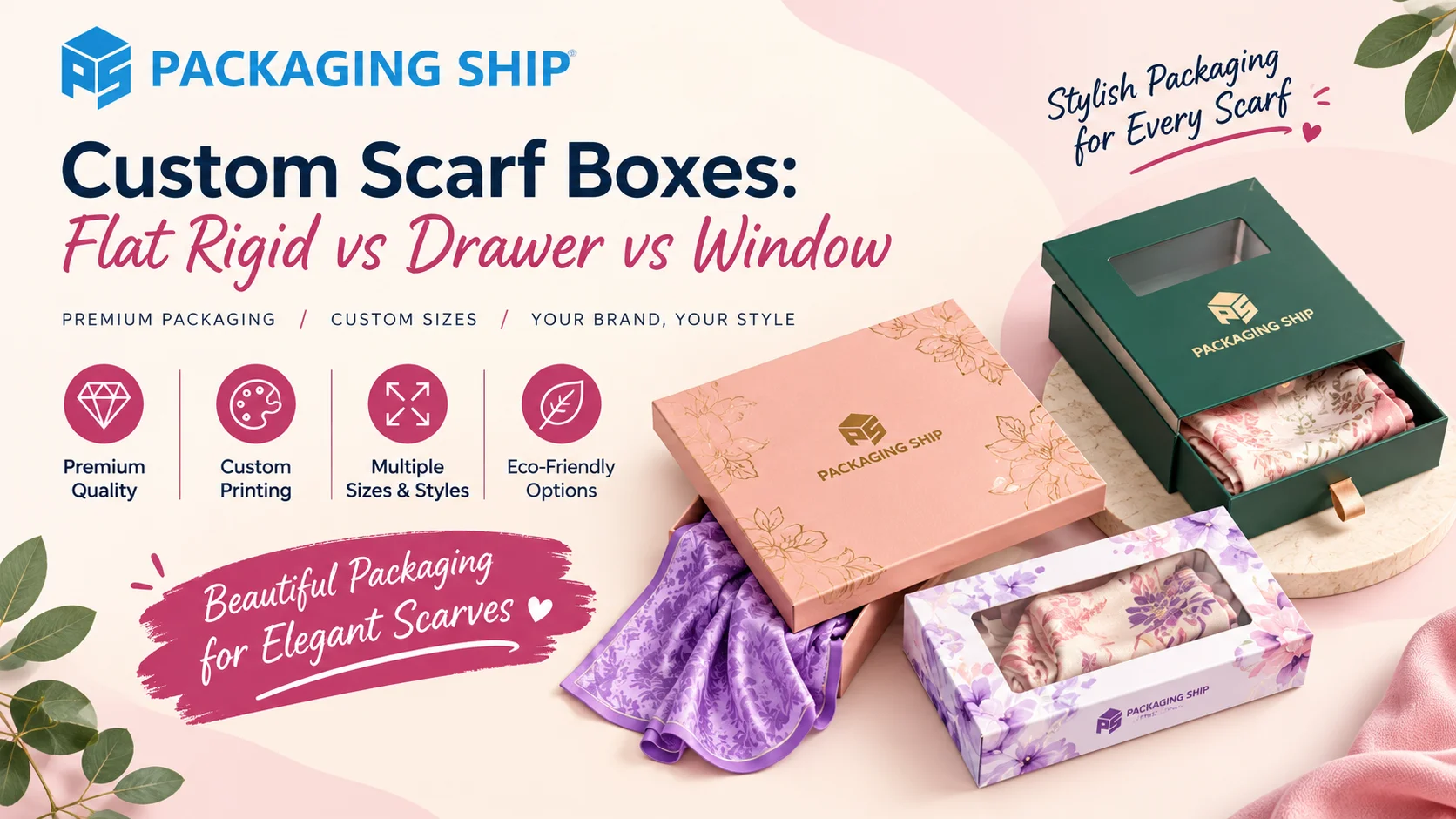
Quick answer, if you’re skimming: there are really three scarf box styles worth considering, flat rigid, drawer, or window, and the fold matters more than the size when you’re picking one. I’ll get into when each one makes sense below, plus sizing, pricing, and how to order without getting stuck behind a 1,000-unit minimum.
In this guide:
Technically, a custom scarf box is just packaging built around one product, in this case your scarf, rather than something generic pulled off a warehouse shelf. But in practice it comes down to three builds most brands end up choosing from in 2026: flat rigid if you want a folded presentation, a drawer style for gifting, or a window box if it’s heading to a retail shelf. Honestly, the fold matters more here than the price point does.
Here’s a real one. A brand owner reached out last spring because her square silk scarves kept arriving with a crease running straight through the print. Nothing wrong with the box itself, it just wasn’t built for how the scarf was folded. That’s a five-minute fix once you know to look for it, and it’s the reason this post exists. We build custom scarf boxes at Packaging Ship around the fold first. Branding comes second.
If I had to boil it down, most of these problems trace back to one habit: sizing the box for the product itself, not for how that product actually gets folded, shipped, or set out on a shelf.
Ship a quarter-folded scarf in a box that was really sized for a flat lay, and it comes out creased. Every single time, in my experience. Thin folding cartons crush somewhere between the warehouse and the doorstep because there’s no real structure holding the shape. Window boxes look great on a shelf until UV light starts fading silk or dyed fabric, sometimes within a few months.
Then there’s the money side. A scarf selling for $80 or more looks cheap in plain packaging, no matter how good the product is. And plenty of small brands want to test one new print run and run straight into a 1,000-unit minimum before they’ve sold their first hundred units.
There’s actual data behind this too, not just opinion. Adobe Express ran a survey of consumers and small business owners and found that 73% of shoppers said premium packaging changed how they saw a brand, and 57% of the ones who’d had a genuinely memorable unboxing experience went on to buy from that brand again. So no, packaging doesn’t stop mattering the second someone hits checkout.
Flat rigid tends to be the go-to for a scarf folded in quarters or in half, and that covers most silk scarves out there. The board’s thick enough to hold its shape under pressure, which keeps the fold crisp rather than crushed somewhere in a delivery van.
Drawer boxes make more sense once you’re building a gift set, a scarf paired with a candle or some small accessory, that sort of thing. The sliding tray also just photographs better, which matters more now that half your customers are unboxing on camera anyway.
Window boxes are kind of the odd one out here. They do great on a retail shelf, but silk and UV light don’t mix, the dye fades over time under direct light. If you’re set on a window, stick to cotton or a synthetic blend and leave silk out of it.
Our custom scarf boxes page breaks sizes and finishes out by style if you want to compare before requesting a quote.
This is the part most packaging guides skip entirely, and it’s probably the single biggest fix available here.
Say you’ve got a square silk scarf folded into quarters, the box should land somewhere close to a quarter of the scarf’s finished size, with maybe half an inch extra on each side for tissue. French fold is a different animal, since the scarf runs lengthwise into a long strip, so you actually want something narrow and deep instead of square. And if the scarf gets rolled instead of folded, forget the flat box entirely, you need a tube or a deep drawer box, or it’ll crease right at the roll no matter how much tissue you stuff in there.
Check the apparel packaging lineup for dimensions sorted by fold type.
Most manufacturers won’t even send a quote under 1,000 to 5,000 units. Packaging Ship starts at 50, no die charges, no setup fee buried in the invoice later.
Custom scarf box pricing by material: price tracks material and finish more than it tracks quantity. Kraft and standard cardboard sit at the lower end. Rigid board costs more but holds up to repeat gifting and handling. Foil stamping or a ribbon closure adds a little to the unit cost, but it’s usually the difference between packaging that matches an $80 scarf and packaging that undersells it.
We also carry FSC-certified kraft. The Forest Stewardship Council has certified more than 165 million hectares of forest worldwide, so that’s not a label we’re slapping on for effect, it’s backed by an actual certification body.
You’ll get a free design proof back within 24 to 48 hours on every order, and nothing goes to print until you’ve actually signed off on it. Once you know your scarf’s dimensions and fold type, get a free estimate and we’ll take it from there.
None of this logic is scarf-specific, really. Hair extension boxes run into the same issue, a bundle of 18 or 22-inch extensions needs a box sized to how it’s coiled or laid flat, not a generic rectangle grabbed off a size chart, or the hair shifts around and tangles up before it even reaches the customer.
It’s the same story with custom tie boxes, narrow and built around the fold, or custom lingerie boxes, which have to balance real structure with something softer underneath. Whatever the product is, measure it and figure out how it’s packed before you even think about the box size.
| Question | Answer |
| What type of box is best for a scarf? | Flat rigid, most of the time. It’s what keeps a quarter-fold or half-fold looking sharp instead of getting crushed somewhere in transit. |
| What size box fits a square silk scarf? | Roughly one quarter of the scarf’s finished size after folding, plus a little breathing room for tissue. |
| Are rigid boxes better than folding cartons for scarves? | For silk, and for anything priced above $50 or so, yes. Folding cartons just don’t hold up the same way under pressure. |
| How much do custom scarf boxes cost wholesale? | Honestly, material and finish move the price more than order size does. Kraft’s on the cheaper end, while rigid board and foil stamping push it up. |
| Can I order scarf boxes in a small batch? | Yes, Packaging Ship starts orders at 50 units, so there’s no minimum order wall to climb over before you even get a quote. |
| Do scarf boxes need a window? | Only if it’s going on a retail shelf and it’s cotton or synthetic. Skip windows on silk, the UV exposure isn’t worth it. |
Send over your scarf’s length, fold type, and quantity. You’ll have a price and a free design proof back within two days, no commitment attached.
Custom scarf boxes are a small line item that does a lot of quiet work for how a brand actually feels in someone’s hands. Match the style to the fold before you match it to the branding. Flat rigid for folded silk, drawer for gift sets, window for shelf display, and all of it available from 50 units with a free design proof included.