
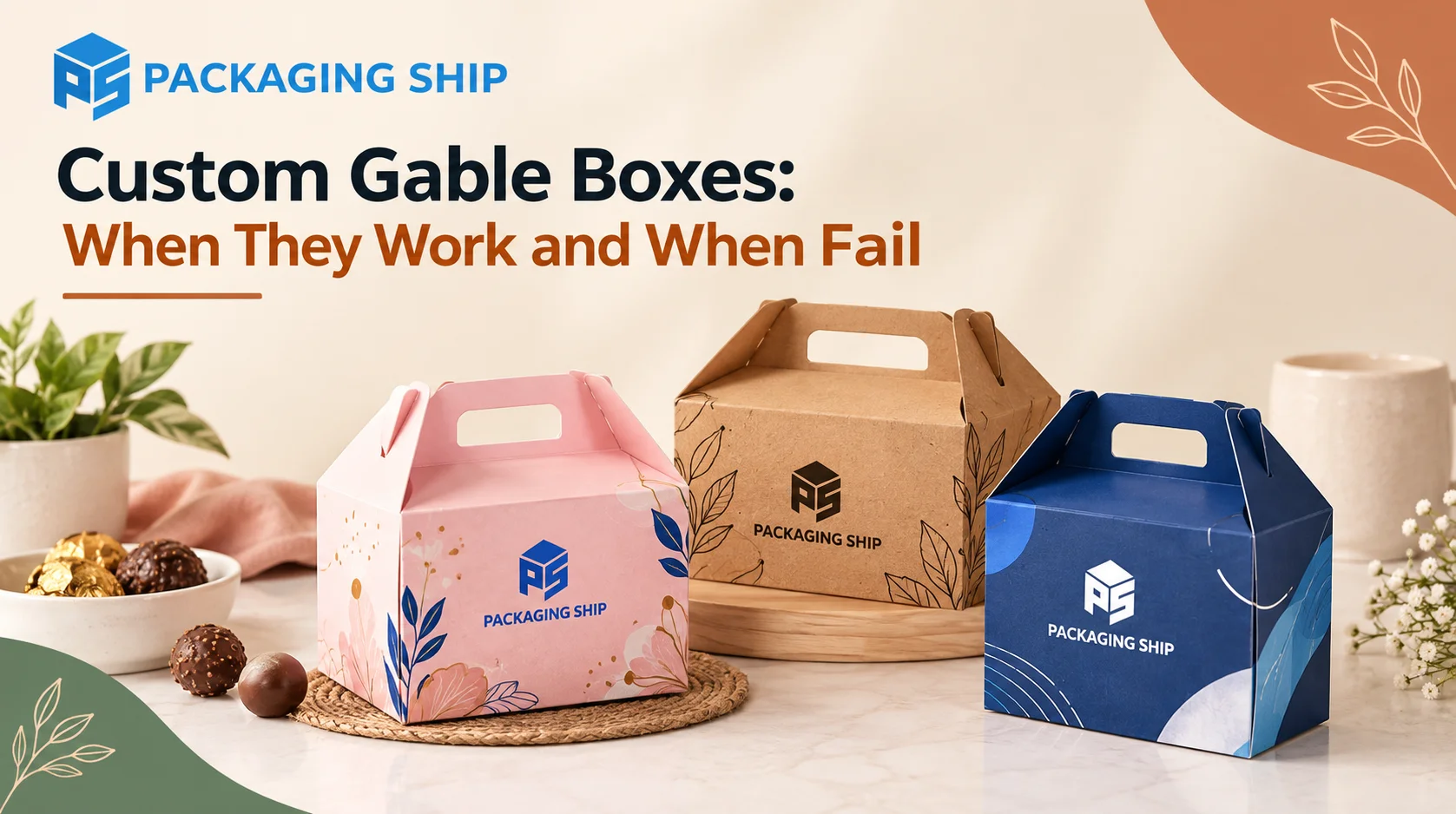
Custom gable boxes are a strong packaging choice for lightweight retail, bakery, and gift products under about two pounds. They fail most often when brands pick a board weight that is too light for the product inside, which causes the handle to tear during carrying. The fix is simple. Match your board weight to your product weight before you print, not after.
Gable boxes earn their keep when three things line up. The product is light, the box needs to be carried by hand, and the brand wants shelf appeal without paying for a rigid box.
Bakeries use them constantly for cookies, small cakes, and gift sets, because the handle turns a simple box into a takeaway item without extra packaging. Candle brands and small gift retailers use them for the same reason. A customer can pick one up off a shelf and walk out holding it, no bag needed.
If you sell through a storefront, a farmers market, or a retail partner, a well built gable box also gives you shelf presence that a flat mailer cannot. Pair that with a display setup and the box becomes part of your merchandising, not just your packaging. This is where our team often points bakery and gift clients toward custom display boxes as a companion piece, since the two work well together at point of sale.
Here is where most packaging guides go quiet, and where most of the actual customer problems show up.
This is the part almost no competitor page explains with real numbers, and it is the part that prevents the handle tear problem above.
| Board Weight (GSM) | Best For | Handle Durability |
| 300 GSM | Light items, individual candies, small favors, light gifts | Adequate for items under 1 lb, not recommended for handle carrying above that |
| 350 GSM | Standard retail and bakery gable boxes, most common everyday use | Reliable for items up to roughly 1.5 to 2 lbs |
| 400 GSM | Heavier gift sets, bundled products, premium positioning | Strong enough for items over 2 lbs, best resistance to handle tearing |
If your product sits close to or above two pounds, do not default to the cheapest board option. Ask for 350 or 400 GSM, or consider moving to a custom mailer box, which distributes weight across the whole structure instead of concentrating it at a handle.
Kraft paper gives a warm, natural look that signals sustainability and craft, and it takes deep, saturated ink colors well, especially metallics. It is the common choice for bakeries, candle brands, and eco positioned gift companies.
Cardboard, usually coated white board, gives sharper color reproduction and a cleaner, more polished look. It suits brands leaning toward a premium or modern retail feel rather than a rustic one.
Neither one is objectively better. The choice comes down to what story your packaging needs to tell on a shelf.
One related note worth mentioning here. Brands packaging assortments like custom chocolate boxes usually run into a different tradeoff than the tear problem above. Chocolate pieces need cushioning inserts and structural support far more than they need heavier boards, since the risk is breakage in transit, not handling failure. The lesson is the same though. Match the spec to the actual failure risk of your product, not to a generic template.
Yes, when it is built for food contact. A food safe gable box uses FDA compliant food contact board, along with a grease resistant coating for items with oil content and water based, low VOC inks. If you are packaging anything that touches food directly, specify this at the quote stage so the right material and coating get selected from the start.
One reason gable boxes work so well for small and growing brands is that you no longer need to commit to a huge print run to get them. Custom gable boxes with no minimum USA production are now standard at manufacturers built for small business volume, meaning you can order as few as fifty units, test the packaging with real customers, and scale up once you know it performs.
Gable boxes fall under the folding carton category, and that category is not a small or shrinking part of the packaging industry. According to a market analysis published by Future Market Insights, the USA folding carton market is valued at roughly 15.6 billion dollars in 2026 and is projected to grow at a 4.4 percent CAGR through 2036, driven largely by demand from healthcare, beauty, specialty food, and sustainable paperboard packaging applications, the exact categories most gable box buyers fall into.
That growth is not happening because folding cartons are the cheapest option on the market. It is happening because brands in food, beauty, and gifting keep choosing paperboard formats that customers can hold, open, and recognize as intentional packaging rather than a plain shipping container. A gable box built to the right spec is part of that same demand curve, not a side product.
Material sourcing matters just as much as format. If sustainability is part of your brand story, look for FSC certified board, verified through the Forest Stewardship Council’s chain of custody system, which confirms the paper came from responsibly managed forests rather than being a marketing claim with nothing behind it.
Your product’s weight, shape, and use case should decide your box spec, not the other way around. Send us your product dimensions and approximate weight, and we will recommend the right board weight and base style before you order, not after a batch of boxes tears in your customers’ hands.
Custom gable boxes are a genuinely good packaging choice for light, hand carried products where shelf appeal and a built in handle add real value. They fail almost exclusively for one avoidable reason, a board weight that does not match the product it is carrying. Spec it correctly from the start, choose the right base for your fill volume, and confirm food safety needs upfront, and a gable box will do exactly what it is meant to do for years of orders.
| Question | Direct Answer |
| What is a gable top box used for? | It is used for carrying bakery items, gifts, candles, and retail products by hand, thanks to its built-in handle. |
| What GSM should a gable box be? | Use 300 GSM for light items, 350 GSM for standard retail and bakery use, and 400 GSM for heavier or premium products. |
| Are gable boxes food safe? | Yes, when made with an FDA compliant food contact board and, for oily items, a grease resistant coating. |
| Why does my gable box handle tear? | The board weight is too light for the product weight, usually 300 GSM boards carrying more than about two pounds. |
| Is a kraft gable box better than cardboard? | Kraft suits a natural, sustainable brand look. Cardboard suits a sharper, more premium retail look. Neither is stronger by default. |
| What is the minimum order for wholesale gable boxes? | Many US manufacturers now accept orders starting at fifty units, with no bulk minimum required. |