
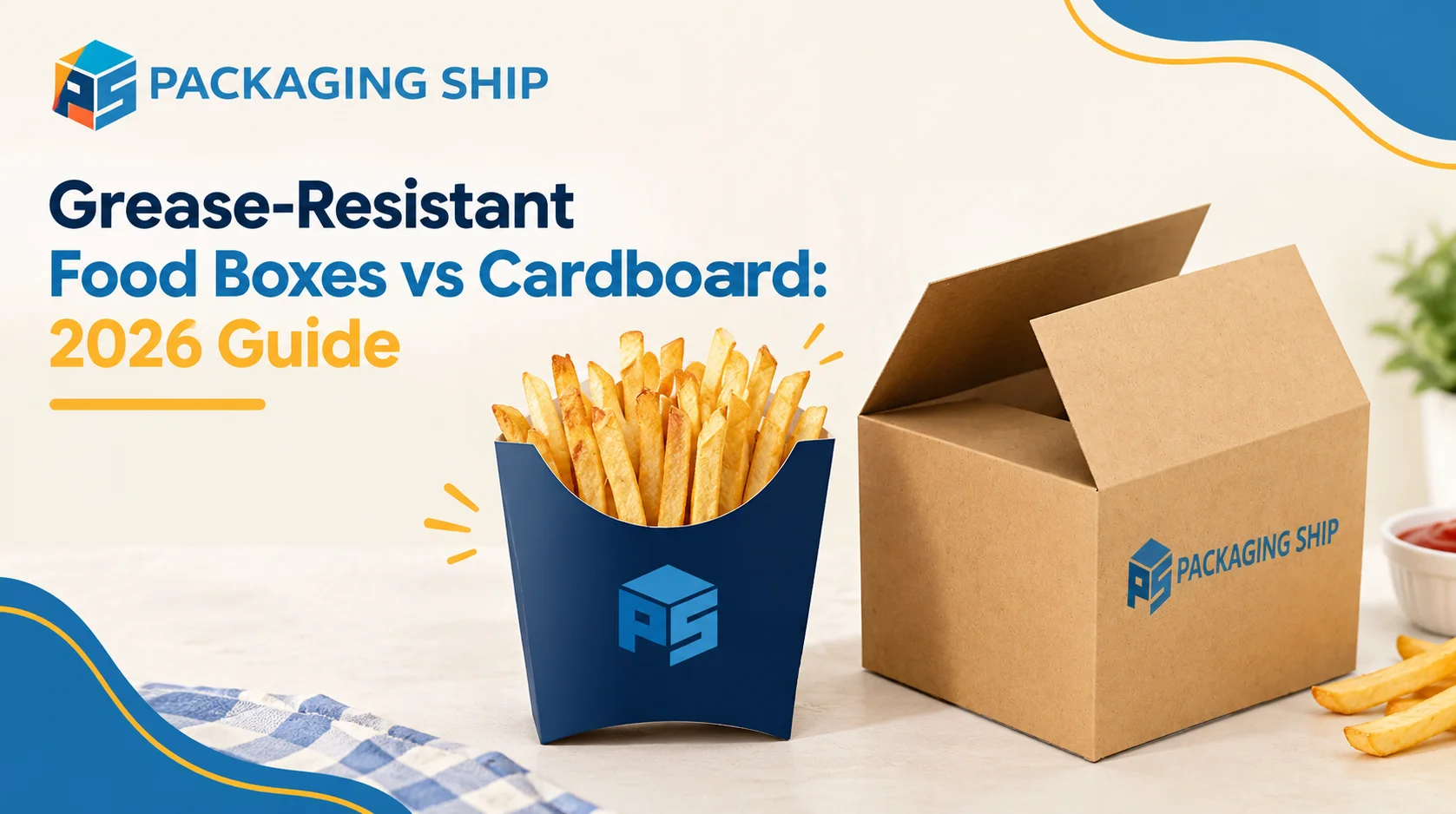
Grease resistant food boxes are paperboard containers treated with a barrier coating, usually PE, wax, or a water based dispersion, that stops oil and moisture from soaking through the fiber. Standard cardboard has no such barrier. Under a hot, greasy food item, plain cardboard absorbs oil within minutes, weakens, and stains through to the outside. That single coating layer is the real difference.
If you have ever pulled a box of fried chicken or a warm empanada out of a paper bag and watched a dark, translucent stain spread across the bottom, you already know why this topic matters. That stain is not just cosmetic. It is the packaging failing at its one job. At Packaging Ship, we get calls almost every week from restaurant owners and food brands who ordered plain cardboard, watched it fail on the first greasy order, and had no idea what to ask for instead. This guide breaks down exactly what separates grease-resistant food boxes from standard cardboard, so you can order the right one the first time.
A grease resistant food box starts as the same base material as standard cardboard, either kraft paperboard or corrugated fiberboard. What changes is a thin functional layer added during production. This layer, known as a food box barrier coating, sits on the inside surface and physically blocks oil from migrating through the fiber.
Here’s why uncoated cardboard can’t do this on its own:
This is different from a box simply being thick or sturdy. Thickness affects strength. Coating affects grease resistance. Mixing the two up is one of the most common ordering mistakes we see.
Standard cardboard was built for dry goods, shipping, and general retail, not hot, oily food. When grease hits uncoated fiber, three things happen in order:
The real cost is bigger than the box itself. A stained, sagging box shows up in delivery photos and quietly damages a brand a business spent real money building. For fried food, sandwiches, or buttery baked goods, plain cardboard is close to a guaranteed failure point, not an occasional risk.
This is the question we hear most, and most suppliers answer it badly. Here’s the direct comparison.
| Coating Type | Grease Resistance | Best For | Watch Out For |
| PE coating | Strongest, most consistent barrier | Hot, oily food like burgers, fried chicken, takeout | Harder to repulp than water-based options |
| Wax coating | Moderate, weakens under heat | Light pastries, low-oil baked goods | Breaks down faster with repeated handling |
| Water-based dispersion | Solid for short contact time | Fast food, dry snacks, sustainability-focused brands | Less durable for long delivery windows |
This one decision point solves the ordering confusion that sends most buyers back to their supplier for a second, more expensive order after the first one fails.
Fried and saucy dishes make grease resistance non negotiable. Our custom Chinese takeout boxes are built with a PE barrier as standard for exactly this reason.
Warm fillings create oil and steam at the same time. A custom empanada boxes order needs a coating that handles both at once.
Mayonnaise, dressings, and deli meats release oil steadily over time. Our custom sandwich boxes are built to hold that back through a full delivery window.
Bakery items are a lighter case but still real. A glazed item in custom donut boxes can leave an oil ring on an uncoated board within an hour on a warm day.
Even custom tea boxes need consideration, since oil-infused blends can transfer natural oils onto uncoated interiors over a longer shelf life.
Hot dogs combine three stresses at once: grease from the meat, steam from the bun, and acidic staining from ketchup or mustard. A box built for hot dogs needs a coating that resists oil migration and moisture absorption together, a tougher combination than most single-category foods require.
This is where outdated information circulates, so the current facts matter.
On February 28, 2024, the FDA confirmed that grease proofing substances containing PFAS chemicals are no longer sold by manufacturers for food contact use anywhere in the US, closing a voluntary phase out that began in 2020, according to the FDA’s official constituent update. PE coating and water-based dispersion coating are the compliant replacement technologies now standard across the industry.
Major paperboard producers, including StoraEnso, publish detailed technical breakdowns of how modern PE and dispersion barrier coatings function as the industry standard replacement. In short: legitimate PE coated and water-based coated boxes sold in the US today are not using PFAS, because that supply chain no longer legally exists.
Grease resistant coating adds a modest cost over plain uncoated board, typically a few cents per unit depending on box size, coating type, and order volume.
For a business ordering custom cake boxes or any grease-exposed product line, that small per-unit increase is almost always cheaper than reprinting a failed batch, or the reputational cost of a stained box reaching a customer.
Ready to stop guessing which coating your food needs? Our design team will match the right barrier coating, board weight, and box style to your exact product, with no minimum order and a quote ready in under two minutes.
The real difference between grease resistant food boxes and standard cardboard comes down to one thin functional layer. That coating stops oil stains, prevents soggy bottoms, and keeps a box structurally sound long enough to reach a customer looking the way it should. Once you match the coating type to your food’s actual oil and heat exposure, ordering the right grease resistant food boxes stops being a guessing game and becomes a straightforward spec decision.
| Question | Direct Answer |
| What makes a food box grease resistant? | A barrier coating, usually PE, wax, or water-based dispersion, applied to the inside surface that blocks oil from soaking into the paperboard fiber. |
| Is PE coated cardboard food safe? | Yes. PE coating used in food packaging is chemically inert and does not react with food, and it does not contain the PFAS chemicals the FDA phased out of grease proofing use. |
| Why do takeout boxes get soggy on the bottom? | Uncoated cardboard absorbs both oil and steam from hot food, softening the fiber bonds until the box loses structure. |
| How long does grease-resistant packaging last before failing? | A properly PE coated box holds up through a typical delivery window of thirty to sixty minutes, while uncoated cardboard can stain in under ten minutes. |
| Can grease-resistant boxes be recycled? | Water-based dispersion coated boxes repulp more easily than PE laminated ones, so check with your supplier if recyclability matters to your brand. |