
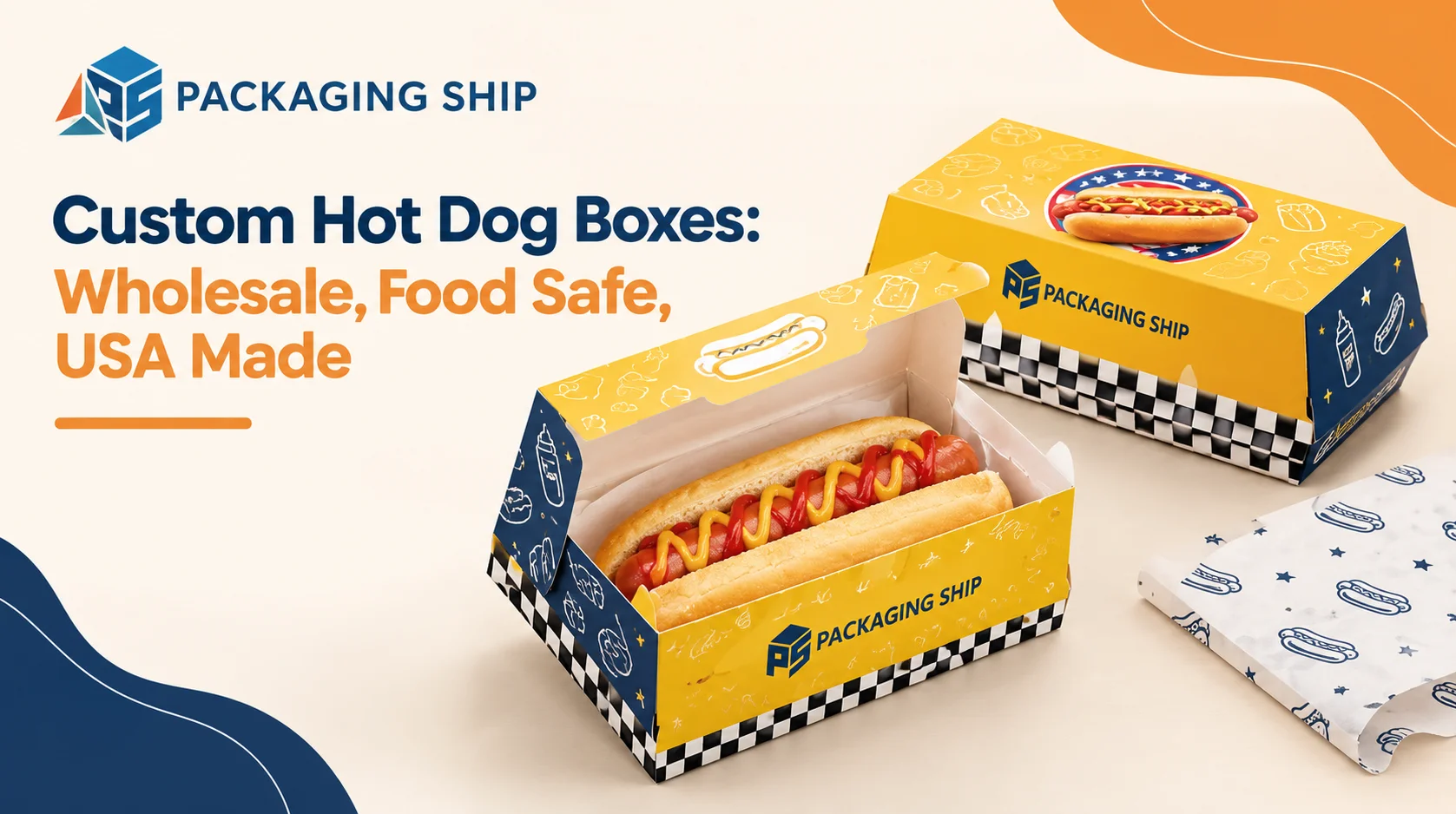
A custom hot dog box is a food safe paperboard container built to hold a loaded hot dog without leaking or going soft from steam. In 2026, the better versions use grease resistant, PFAS free coatings and print in full color. Food trucks, stadiums, and concession stands across the USA use them daily.
If you have ever watched a hot dog box give out mid rush, you already know packaging is not a small detail. It is the difference between a customer who comes back and one who walks away with sauce on their shoes. At Packaging Ship, we build custom hot dog boxes for food trucks, concession stands, and stadiums across the country, and this guide breaks down exactly what each of those buyers actually needs, not just what a catalog page claims.
Ask any vendor who has worked a rainy game day and you will hear the same story. The box looked fine on the counter. Ten minutes later, grease has soaked through the bottom, and the hot dog is sitting in a puddle of its own steam. This happens because too many boxes on the market are made from general purpose cardboard, not a board built for wet, hot, greasy food.
Standard cardboard works fine for dry goods. It has no coating to stop oil or moisture, so it wicks liquid the same way a paper towel does. Add the steam from a fresh hot dog and a loaded bun, and a thin, uncoated box can go soft in twenty to thirty minutes. That is not a shipping problem. That is a material problem, and it shows up right in front of the customer.
The fix is not complicated. A grease resistant coating on the right paperboard stops oil from bleeding through the surface, and a heavier board weight resists steam long enough to make it from the counter to the customer’s hand. That single choice, the board and the coating, decides whether a box holds up or falls apart in front of a paying customer.
A food truck runs on speed and space. During a lunch rush, staff need to grab a box, load it, and hand it off in seconds, not fold it into shape while a line grows outside the window. Pre formed, fast assembly boxes save real time during a rush.
Storage matters just as much. A truck kitchen has almost no spare room, so boxes need to stack flat and tight. And because a food truck’s whole brand often lives on that box, custom hot dog boxes printed in full color turn a five dollar hot dog into a small piece of marketing that customers photograph and share online.
Stadiums operate at a different scale entirely. The National Hot Dog and Sausage Council estimates that Americans eat around 70 hot dogs a year each, adding up to close to 20 billion hot dogs nationwide annually. A meaningful share of that gets sold at the ballpark. Reporting on Major League Baseball concessions found that ballparks moved roughly 19 million hot dogs in a single season, with one stadium alone selling more than 2.7 million.
At that volume, custom hot dog boxes need to hold up across thousands of units without a single batch failing halfway through the game. Stadium concessions can bring in close to two million dollars in a single game, with fans spending an average of around thirty dollars each on food and drink, according to industry reports on stadium concession economics. A box that collapses, leaks, or slows down service at that scale is not a small inconvenience. It is lost revenue, repeated thousands of times in one afternoon.
Because stadium food is almost always eaten standing up or walking, the box also needs to survive being held in one hand while a fan digs for their wallet with the other. That means a stronger fold, a secure closure, and a base that will not buckle under condiment weight.
Not every paperboard behaves the same way once grease and steam get involved. Here is what actually holds up, broken down by material.
Corrugated board brings strength and cushioning, which makes it a solid pick for bulk shipping or stacked storage before service. Kraft paperboard has a natural, rustic look that many food trucks like for branding, and it takes a grease resistant coating well. Coated cardboard, usually 14pt or heavier, gives the cleanest print results for full color branding and holds its shape under a loaded, sauced hot dog.
For most food trucks and concession stands, coated cardboard or coated kraft with a grease resistant finish is the safer default. Save plain corrugated for outer shipping cases, not the box that touches the food directly. Packaging Ship builds its custom hot dog boxes with this logic, matching board weight and coating to how the box will actually be used, not a one size fits all spec.
Sizing is where a lot of buyers guess wrong. Here are the general ranges most vendors start from before customizing to their exact hot dog and topping combination.
| Box Type | Typical Length | Typical Width | Typical Height | Best For |
| Standard single hot dog | 6 to 7 inches | 2.5 to 3 inches | 1.5 to 2 inches | A plain or lightly topped standard hot dog |
| Foot long | 8 to 10 inches | 3 to 3.5 inches | 2 inches | Foot long franks that need extra length without extra topping room |
| Loaded or stadium style | 7 to 8 inches | 3.5 to 4 inches | 2.5 to 3 inches | Chili, cheese, or multiple toppings that need more depth to avoid spillage |
| Combo or multi pack tray | 9 to 12 inches | 4 to 6 inches | 2 to 2.5 inches | Concession stands serving two or more hot dogs per order |
These are common starting ranges, not fixed rules. Since every order is custom, the better approach is to measure your bun, your topping load, and how the box needs to stack, then build the size around that instead of forcing your product into an off the shelf template.
Food safe packaging is not just a marketing phrase. It means a material is legally approved for direct contact with food, and the rules changed recently in a way most packaging buyers have not heard about.
For years, many grease resistant coatings used on paper and paperboard packaging contained PFAS, a group of chemicals sometimes called forever chemicals. In February 2024, the FDA confirmed that manufacturers had voluntarily stopped selling PFAS based grease proofing agents for food contact use in the United States, closing off what the agency called the main source of dietary PFAS exposure from food packaging, according to the FDA’s constituent update. In January 2025, the agency went further and formally declared the related food contact notifications no longer effective, with compliance dates running through June 2025, as detailed on the FDA’s page on authorized PFAS uses.
What this means for a food truck owner or concession manager is simple. If a supplier cannot tell you what their grease resistant coating is made from, or when they last confirmed compliance, that is worth asking before you place a bulk order. Food safe packaging made in the USA under current FDA rules should not contain these older PFAS based coatings anymore.
| Question | Answer |
| What are custom hot dog boxes made of in 2026? | Most are coated cardboard or coated kraft paperboard with a grease resistant, PFAS free finish. Corrugated board is used mainly for shipping cases, not direct food contact. |
| How much do custom hot dog boxes cost wholesale? | Pricing depends on board type, print method, and order size. Digital printing suits smaller runs, while offset printing lowers the per unit cost once an order passes about 500 units. |
| What is the minimum order for custom hot dog boxes? | Many suppliers now accept orders starting around 50 units, which lets a new food truck test a design before committing to a large batch. |
| Are custom hot dog boxes food safe? | They should be. Look for a supplier that confirms FDA food contact compliance and does not use older PFAS based grease proofing coatings, which the FDA phased out starting in 2024. |
| How long does it take to get custom hot dog boxes wholesale? | Standard production typically runs 7 to 10 business days after you approve a design proof, with shipping adding a few more days depending on your location. |
Most food trucks and stadium concession stands do not sell only hot dogs. If your menu is growing, it helps to treat hot dog packaging as one piece of a bigger plan rather than a one time order. Packaging Ship’s food packaging options cover everything from bakery items to hot food service, all built to the same food safe standard.
If your menu includes sliders or classic burgers, custom burger boxes use many of the same grease resistant principles, just built around a wider, flatter shape.
Running a pasta or noodle bowl special changes the packaging needs again. Custom pasta boxes need moisture protection built for sauce and steam over a longer service window, not a quick handoff.
Some concession stands and grab and go retailers also stock packaged breakfast items or snack mixes, and custom cereal boxes come up often in that same conversation. They serve a completely different purpose, built for shelf display rather than hot food service, but they tend to land on the same order sheet when a brand runs a full breakfast and lunch lineup at one venue.
Wholesale pricing on custom hot dog boxes usually comes down to three things: board type, print method, and order size. Digital printing works well for smaller runs, generally under 500 units, and gets a design into production fast. Offset printing brings the per unit price down once an order grows past that 500 unit mark, because the setup cost spreads across more boxes.
Order size matters less than most new buyers expect. A test run of 50 units for a new menu item and a 5,000 unit order for a stadium season should both be possible from the same supplier, without a large minimum order standing in the way. If you want current pricing on wholesale hot dog boxes sized and printed to your exact specs, go ahead and request a free estimate. Most buyers get real numbers back within a day or two, not a week of back and forth.
If your current packaging is costing you customers, torn boxes, grease stains, or a design that does not match your brand, the fix starts with a quote, not a guess.
A hot dog box looks simple until it fails in front of a customer. Food trucks need speed and branding built into that box. Stadiums need it to survive volume and a one handed grip, thousands of times over. Custom hot dog boxes that get the board, the coating, and the size right solve both problems at once, and with FDA rules on grease proofing coatings tightening as of 2025, it is worth confirming your supplier is actually keeping up.