
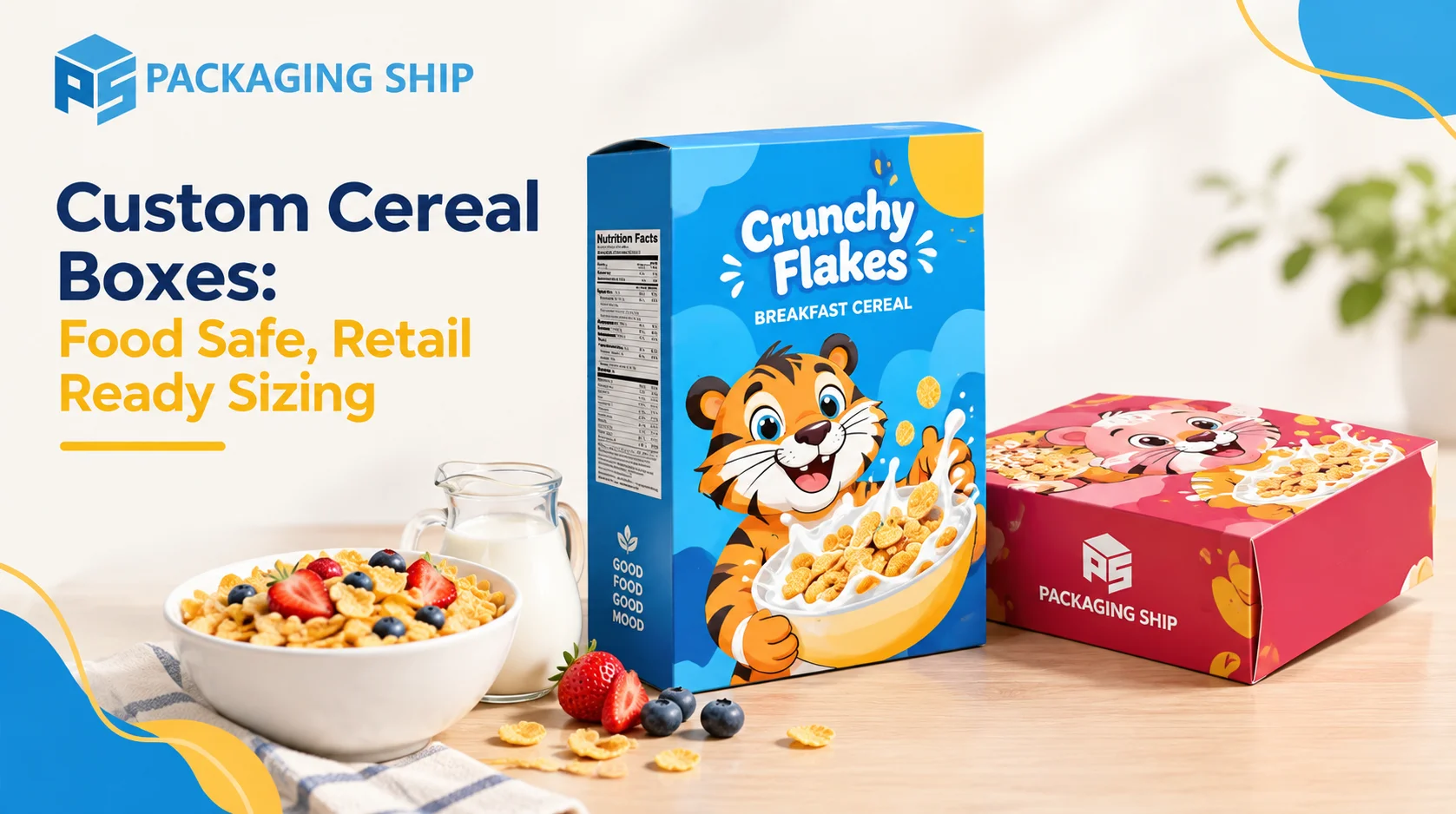
What are custom cereal boxes in 2026? They’re printed, food safe cartons made from corrugated or cartonboard stock, sized to fit standard grocery shelves. A good order solves two things at once. It keeps the cereal food safe, and it fits the exact shelf space a retailer has set aside for it. Miss either part and the box comes back.
Here’s something most first time cereal brands don’t expect. The taste testing goes fine. The branding gets approved. Then the box itself gets sent back, and it has nothing to do with the design. It’s the size. Or it’s a missing material spec on the paperwork nobody asked for until it was too late.
If you sell cereal, or you’re about to, your packaging has to clear two separate checkpoints before a customer ever sees it. Food safety is one. Retail logistics is the other. We’ll walk through both here, with real numbers, so you’re not guessing when you sit down to request a quote.
A buyer almost never rejects a box because they dislike the artwork. They reject it because it doesn’t match what their system already expects from that shelf space.
Grocery chains map out their shelves down to the inch using something called a planogram. It’s a layout diagram that tells every store exactly where a product goes and how much room it gets. A few ways this trips people up:
Any one of these, and the buyer simply can’t place the product. The order stalls before it even starts. It’s one of the most common mistakes in cereal packaging, and honestly, most packaging suppliers don’t even bring it up. That’s why we’re starting here instead of burying it three sections down.
A cereal box has three jobs. Keep the product from getting crushed. Keep moisture and air out. Print well enough that it actually sells itself on a shelf. Three materials cover this reliably, each for a slightly different reason.
This is thin, light, and surprisingly tough for how little it weighs. It’s the go to for most retail cereal cartons because it survives shipping without crushing, and it still takes a clean print.
Short for solid bleached sulphate board. It gives a smoother, brighter surface than corrugated, which is why premium or specialty cereal lines tend to reach for it. Shelf appearance matters as much as shipping strength here.
The eco leaning choice. A lot of organic and natural cereal brands pick kraft because the raw, recycled look already does half the branding work before you even print on it.
Whatever material you land on, ask about a moisture barrier coating. Plain cardboard on its own doesn’t do much against humidity, and cereal that goes soft during transit comes back as a return, not a repeat customer.
According to the Fibre Box Association, the corrugated packaging industry produced more than 40 billion boxes in a single recent year, with a recycling rate above 90 percent, which says a lot about why corrugated stays the default for food shipping (FBA 2022 industry review).
If your brand grows past one product, this material logic tends to follow you. A breakfast sandwich or snack line, for instance, often needs something closer to custom burger boxes, which are built for hot, greasy contact instead of dry shelf stability. Same food safe foundation, different barrier requirements.
Our food packaging line covers all three of these materials under one roof, which keeps quality consistent if you’re running more than one product through us at a time.
Short answer, yes. Any box that touches food, or sits close enough that oils or particles can transfer, falls under FDA food contact rules.
The FDA refers to this as a food contact substance, and it applies to three parts of the box:
Food packaging is a bigger share of the paperboard market than most people assume. Industry reporting on Paperboard Packaging Council data puts food applications, cereal boxes included, at close to 60 percent of all folding carton volume in North America (Packaging Strategies industry outlook). Cereal isn’t a side category here. It’s one of the categories driving the market.
A supplier should be able to answer whether their board and inks are food contact compliant without pausing to check. If they can’t, that’s worth noticing.
US grocery shelves generally work off three size ranges for cereal.
| Box Type | Typical Height | Typical Width | Typical Depth | Common Use |
| Mini / single serve | Under 6 inches | 4 to 5 inches | 1.5 to 2 inches | Promotions, multipacks |
| Standard family size | 10 to 12 inches | 7 to 8 inches | 2 to 3 inches | Main grocery shelf placement |
| Bulk / club size | 12 to 14 inches | 9 to 10 inches | 3 to 4 inches | Warehouse retail |
Treat these as a starting point, not a rulebook. Every retailer has its own planogram, and the only dimensions that really matter are the ones your buyer signs off on.
Two questions to ask your buyer or category manager directly:
Even a quarter inch of extra depth can keep a box from sitting flush against the shelf back. That throws off the whole row and gets flagged the next time the store does a reset. Confirming this before production is genuinely the difference between a smooth placement and a box that gets bounced back for a rebuild on your dime.
Cereal lives and dies on shelf visibility. Most shoppers give a cereal aisle a few seconds before grabbing something they recognize.
Some of the best finishing ideas here actually come from adjacent product lines. Our custom donut boxes and custom cake boxes use similar gloss and matte combinations to create shelf shine on bakery items, and the same approach works just as well on a cereal carton.
Minimum order quantity is probably the single biggest wall new cereal brands run into. Large manufacturers often ask for 1,000 to 5,000 units before they’ll even give you a quote, which is a lot to commit to when you haven’t confirmed retail demand yet.
This same structure carries over for brands testing a second SKU. Our custom tea boxes and custom empanada boxes follow the same no minimum approach, which makes it easier to test a new category without overcommitting. Even something as different as custom takeout boxes runs on the same pricing logic, low unit minimums with full customization built in.
| Question | Direct Answer |
| What material is used for cereal boxes? | Most cereal boxes use E-flute corrugated board, SBS cartonboard, or kraft board, picked based on shipping strength, print quality, or eco branding goals. |
| Are cereal boxes FDA approved? | Cereal boxes aren’t individually FDA approved, but the board and inks used in them have to meet FDA food contact substance requirements. |
| What is the standard cereal box size for retail shelves? | Standard family size boxes usually run around 10 to 12 inches tall, 7 to 8 inches wide, and 2 to 3 inches deep, though the exact fit should always be confirmed with the retailer. |
| How do I get cereal packaging approved by a retail buyer? | Confirm shelf depth and facing width against the retailer’s planogram before your dieline is finalized. Sizing is the most common reason boxes get sent back. |
| Can I order custom cereal box printing wholesale with no minimum? | Yes. Some suppliers, Packaging Ship included, accept orders starting from 50 units with no minimum order required. |
If you already know your dimensions, your material, and your launch date, you don’t need to keep reading. You need a quote. Get a free quote in under two minutes and get a full color digital proof back within 24 to 48 hours, with unlimited revisions before anything goes to print.
Custom cereal boxes come down to two things lining up at the same time. Food safe material and accurate retail sizing. Miss the material, and you’re looking at a compliance issue. Miss the sizing, and you’re looking at a rejected shelf placement no matter how good the branding looks. Confirm both before your dieline gets locked, work with a supplier who can answer FDA and planogram questions on the spot, and you skip the single most avoidable reason cereal packaging gets returned. When you’re ready, request your quote through Packaging Ship and get your order into production in days, not weeks.