
TLDR: Grease soaks, soggy bottoms, and boxes that pop open mid delivery are not bad luck. They come down to material choice, coating, and structure. This guide breaks down what fast-casual restaurants actually order for custom burger boxes in 2026, why the FDA’s PFAS phase out changed what grease resistant even means, and how to pick a box that survives a real delivery run. You will also find a quick FAQ table and a straightforward path to get a free quote from Packaging Ship.
It is 9 p.m. on a Friday. A double patty order goes out the delivery window. Fifteen minutes later, grease has found the one weak seam in a cheap box, and the bag arrives with a translucent bottom. The customer does not post about the burger. They post about the box.
That moment is why packaging decisions matter more than most owners expect. Packaging Ship has spent fifteen years building custom burger boxes and other food packaging for restaurants that cannot afford a box failure mid rush, so this guide walks through exactly what to look for.
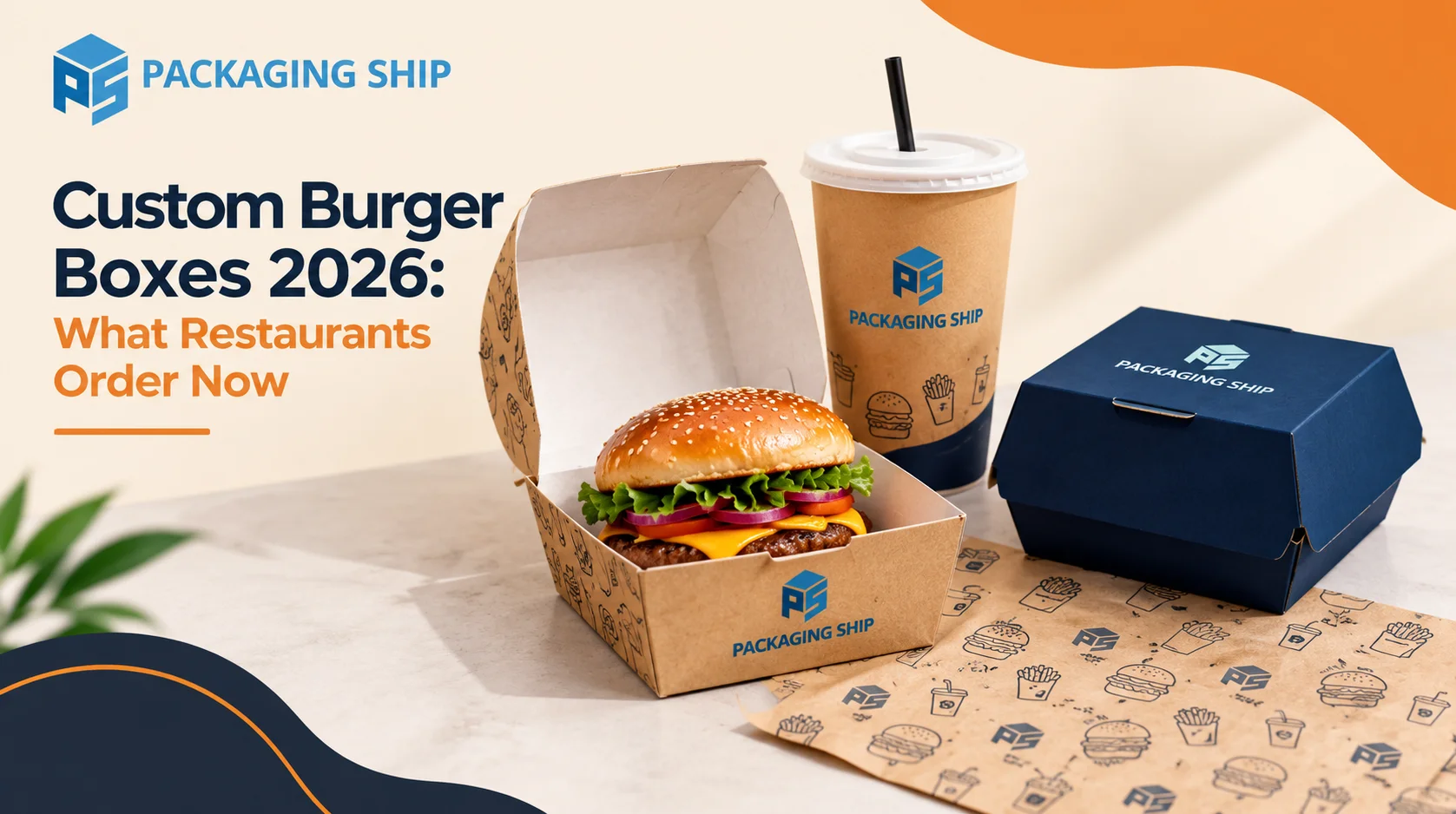
Custom burger boxes are food safe containers, usually clamshell or tray style, built to hold a burger during transport while resisting grease, steam, and pressure from stacking. A good one uses coated kraft or corrugated board sized to the burger, keeps the bun from sliding, and carries your logo so every pickup and delivery order works as free branding.
That last part matters more than it used to. According to the National Restaurant Association’s 2025 Off-Premises Restaurant Trends report, nearly 75 percent of all restaurant traffic now happens off premises, meaning three out of four orders leave the building before anyone eats them. Dr. Chad Moutray, the association’s chief economist, has noted that off-premises dining has become a key revenue driver for operators. If most of your orders travel, your box is doing marketing work whether you planned for it or not.
Grease soak is not random. It usually comes down to one of these:
For decades, many grease resistant boxes relied on PFAS coatings, often called forever chemicals, to keep oil from soaking through paper packaging. That changed recently, in a way most suppliers have not caught up to:
If a supplier still markets old style PFAS based grease resistance, treat that as a compliance red flag, not a selling point. Modern custom burger boxes get their grease resistance from PE coated or wax coated kraft paperboard instead, paired with the right paper weight for the box size.
These two issues get mixed up constantly, but the fix is different for each:
If your burgers arrive soggy on top but the bottom looks fine, you likely need airflow, not a thicker box.
Most fast-casual restaurants choose between three formats, and the right pick usually comes down to how the burger travels, not just how it looks on a counter.
| Format | Best For | Material | Price Tier |
| Clamshell | Delivery apps, stacking, dine-in trays | Coated kraft or corrugated | Mid |
| Straight Box | Loaded or double stack burgers | Double wall corrugated | Mid to high |
| Wrap Style | Fast counter service, single patty | Light kraft paper | Low |
For food truck burger packaging, weight and stacking matter more than they do in a fixed kitchen. Trucks operate in tighter space, so a flat pack clamshell that assembles in seconds saves real time during a rush.
A food truck and a 12 unit fast-casual chain do not buy packaging the same way. Trucks need boxes that store flat and assemble fast under pressure. Multi-location brands care more about consistent print quality across every order, since a slightly off logo color at one location looks careless at scale.
Burgers rarely stay the only handheld item on a fast-casual menu for long. As the menu grows, so does the packaging list:
Burger boxes are really one piece of a bigger decision most fast-casual operators eventually face, which is how the entire menu gets packaged, not just the flagship item. Custom food packaging boxes as a category cover everything from bakery cartons to fry sleeves to drink carriers, and the same variables that make a good burger box apply across nearly every item on the menu. Restaurants that treat packaging as one coordinated decision tend to get a more consistent unboxing experience as the menu grows. Packaging Ship’s custom food packaging line covers this full range under one factory.
If grease is soaking through your current boxes, or your delivery orders keep arriving squashed, the fix is usually a material and structure change, not a full rebrand. Send your logo and box dimensions, and a design proof comes back within 24 to 48 hours at no charge.
Grease soak, soggy bottoms, and boxes that fail mid delivery are not just bad luck. They are material and structure problems with clear fixes, and the regulatory ground under grease resistant packaging has genuinely shifted since the FDA’s PFAS phase out. As more of your orders travel out the door instead of staying in the dining room, the right custom burger boxes stop being a small line item and start acting as part of your delivery strategy. Start with a small test order, see how it performs during a real rush, and scale from there.
| Question | Answer |
| What are custom burger boxes made from? | Most use kraft paperboard or corrugated cardboard with a PE or wax coating for grease resistance. Rigid board is used for premium or gourmet concepts. |
| Does a vented burger box stop grease from leaking? | No. Vents release steam to reduce sogginess. Grease resistance comes from the board coating, not the vent holes. |
| Is there a minimum order for custom burger boxes? | Not with every supplier. Packaging Ship accepts orders starting at 50 units, so a single location can test a design before committing to a bulk run. |
| Are custom burger boxes recyclable? | Kraft and plain corrugated boxes are generally recyclable. Boxes with certain plastic laminates or foil finishes may not be, so ask your supplier directly. |
| How long does a custom order take? | Standard production runs 7 to 10 business days after you approve your design proof, with rush options available for tighter timelines. |