
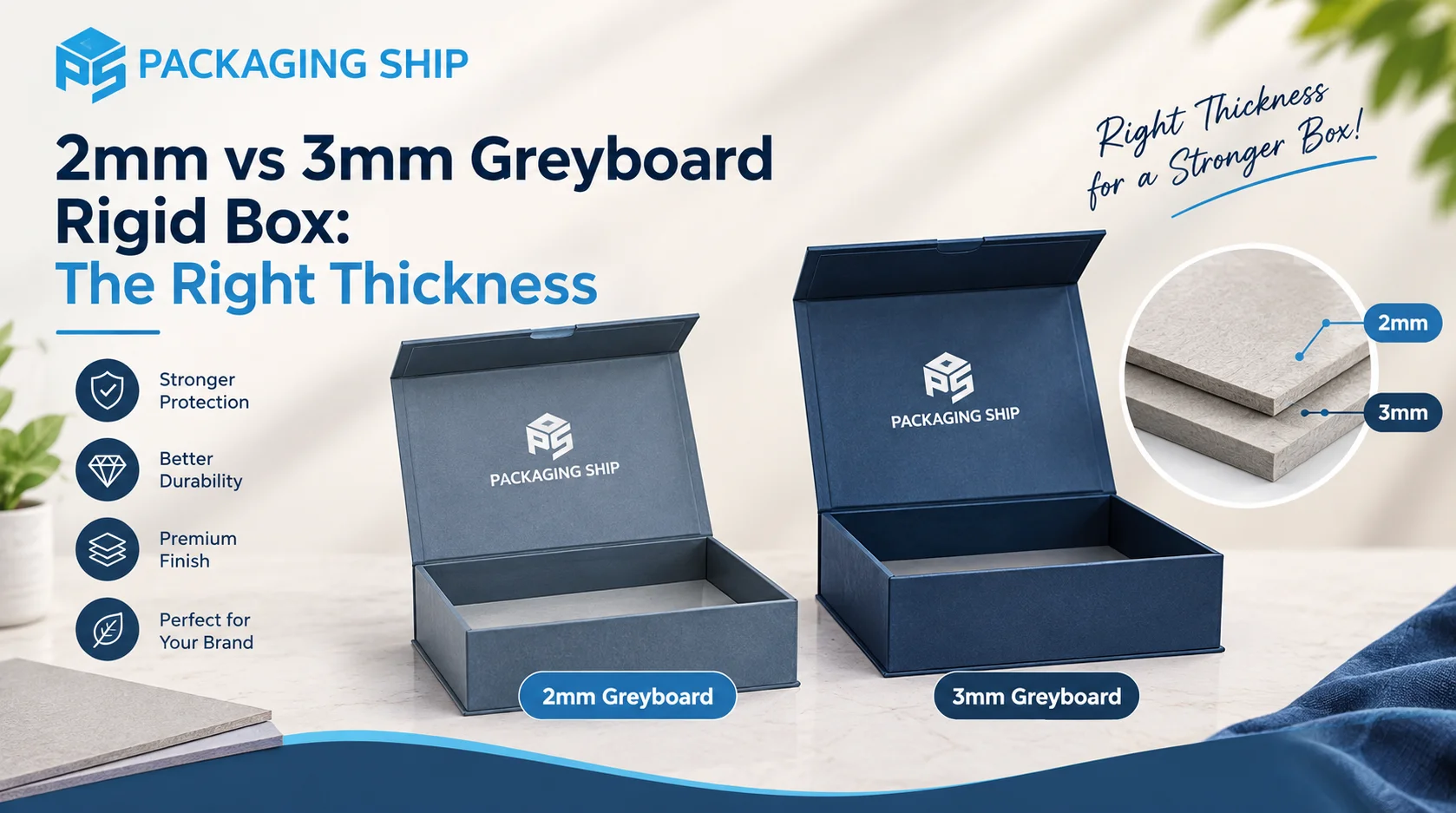
Weight is really what decides this, not looks. A 2mm greyboard rigid box handles lighter products fine, think jewelry, cards, small cosmetics, anything under roughly eight ounces. Once you’re dealing with glass, electronics, or anything that can crack under pressure, 3mm holds up a lot better in a truck full of other boxes.
TL;DR: Most brands default to 2mm because it’s cheaper and it’s plenty strong for light items. Go with 3mm if your product is heavy, breakable, or both. Don’t pick based on which one sounds more premium. Pick based on what’s actually going inside the box.
We get asked this almost every week at Packaging Ship, usually right after someone asks how fast we can turn an order around. A customer will send us dimensions and a product weight, then pause and ask, honestly, do I need 2mm or 3mm here? It’s a fair question, and most of the answers online don’t really settle it.
Greyboard is the dense paperboard core that gives a rigid box its shape. It’s not corrugated cardboard, and people mix those up a lot. Corrugated has that fluted layer in the middle for cushioning. Greyboard doesn’t. It’s solid straight through, so it holds its form instead of bending under a hand or a stack of other boxes.
You’ll see thickness listed in millimeters, sometimes in points, and sometimes in GSM (grams per square meter). Rough numbers, 2mm greyboard sits around 1250 GSM, and 3mm is closer to 1900 GSM. If you want the technical side, ISO 534 is the international standard that covers how paper and board thickness and density actually get measured. That same standard is part of why thickness by itself can be misleading. A dense 2mm board sometimes holds up better than a cheap, low-density 3mm one. It happens more than people expect. If you want to see what we actually build with this stuff, our custom rigid boxes page has the full lineup.
Honestly, 2mm is what we ship the most of, and it’s not close. It gives a box that solid, satisfying weight in your hand without tacking on cost for products that don’t need the extra protection.
Small, light items are the sweet spot. Credit card boxes are a good example, and so are wedding invitation boxes, we run a lot of both. Neither one carries much weight, so the box isn’t fighting gravity or getting crushed under other packages in a shipping bin. That’s really where 2mm greyboard rigid packaging earns its keep. Good rigid box durability, without paying for strength you’re not going to use.
Once a product gets heavy or fragile, or both, 2mm starts to feel thin. Glass jars are the classic case. So are ceramics, electronics, and those multi-piece gift sets where everything’s packed in tight. A thinner board flexes under that kind of pressure, and once one corner gives even a little, the rest of the box follows.
We see this a lot with rigid tube packaging, since bottles and cylindrical products tend to put all their weight in one narrow spot instead of spreading it out. That extra millimeter of greyboard weight rigid packaging isn’t just for show. It’s the difference between a box that survives a warehouse stack and one that doesn’t.
Neither wins outright, and I’ll be straight with you, anyone who tells you one is just better hasn’t thought about what’s going inside it. Here’s the quick version so you can match it up yourself.
| Feature | 2mm Greyboard | 3mm Greyboard |
| Approx. GSM | 1250 GSM | 1900 GSM |
| Best for | Under 8 oz, light items | Heavier, fragile items |
| Typical use | Cards, jewelry, cosmetics | Glass, electronics, gift sets |
| Feel | Solid, standard premium | Heavy, ultra premium |
| Cost per unit | Lower | Higher |
Start with the product, not the aesthetic. A heavier box doesn’t automatically protect better, it just costs more to ship, and a lot of brands learn that the hard way after their first big order.
If your product is under 8 ounces and nothing inside it is fragile, 2mm will do the job. Anything heavier, anything glass, anything with moving parts, bump it up to 3mm. And if you’re pairing a magnetic lid with a heavier item, take a look at our magnetic closure rigid boxes too, because the closure style changes how much stress hits the corners every time someone opens and shuts the lid.
Here’s something people forget more often than you’d think. Board thickness stops a box from crushing. It does nothing about a product sliding around loose inside that box. A 3mm rigid box with a glass jar bouncing around inside it can still crack on a rough delivery route, thickness or no thickness. That’s what a foam insert is actually for, a die cut tray that holds the product still and takes the shock instead of letting it transfer straight to the glass. You really need both pieces working together on anything fragile, not one instead of the other. The International Safe Transit Association runs standardized drop, vibration, and compression testing for exactly this reason, board choice and internal protection both get tested because both actually matter.
Still stuck between the two for your specific product? Get a free quote and we’ll walk through your dimensions and weight with you directly.
Print quality, barely at all. The printed layer sits on top of the greyboard core as its own separate piece, so your artwork and finish look identical whether the core underneath is 2mm or 3mm.
Cost is where the two actually diverge. 3mm uses more raw material, plain and simple, so you’re paying more per unit and adding a little shipping weight on top. On a small order that might mean a few cents a box, nothing dramatic. Multiply that across a 10,000 unit run and it stops being a rounding error. That’s really the argument against just defaulting to the thicker option because it feels safer.
| Question | Answer |
| Is 2mm greyboard strong enough for glass? | On its own, usually not. Pair it with a foam insert for lighter glass, or step up to 3mm for heavier bottles and jars. |
| Can I mix thicknesses on one box? | You can, and some brands do exactly that, 3mm on the base for strength, 2mm on the lid to save a little cost. |
| Does greyboard thickness change shipping cost? | A little. 3mm adds some weight per unit, which shows up more on large freight orders than small parcel ones. |
| What thickness do most cosmetic brands use? | Mostly 2mm for standard cosmetic packaging. They move up to 3mm mainly for glass bottles or higher end sets. |
If you’re still weighing 2mm against 3mm, don’t guess. Request a free estimate from Packaging Ship and we’ll recommend a thickness based on your actual product, weight, and order size, no minimum order, no die charges tacked on later.
[ Get My Free Custom Packaging Quote → ]
This whole 2mm vs 3mm greyboard rigid box question really comes down to matching the board to what you’re shipping, not to what looks fanciest in a photo. Light, sturdy products do fine in 2mm. Anything heavy or breakable is worth the extra millimeter in 3mm. Get that call right and the box does its job quietly, protects what’s inside, keeps your cost reasonable, and still looks like something worth unboxing.